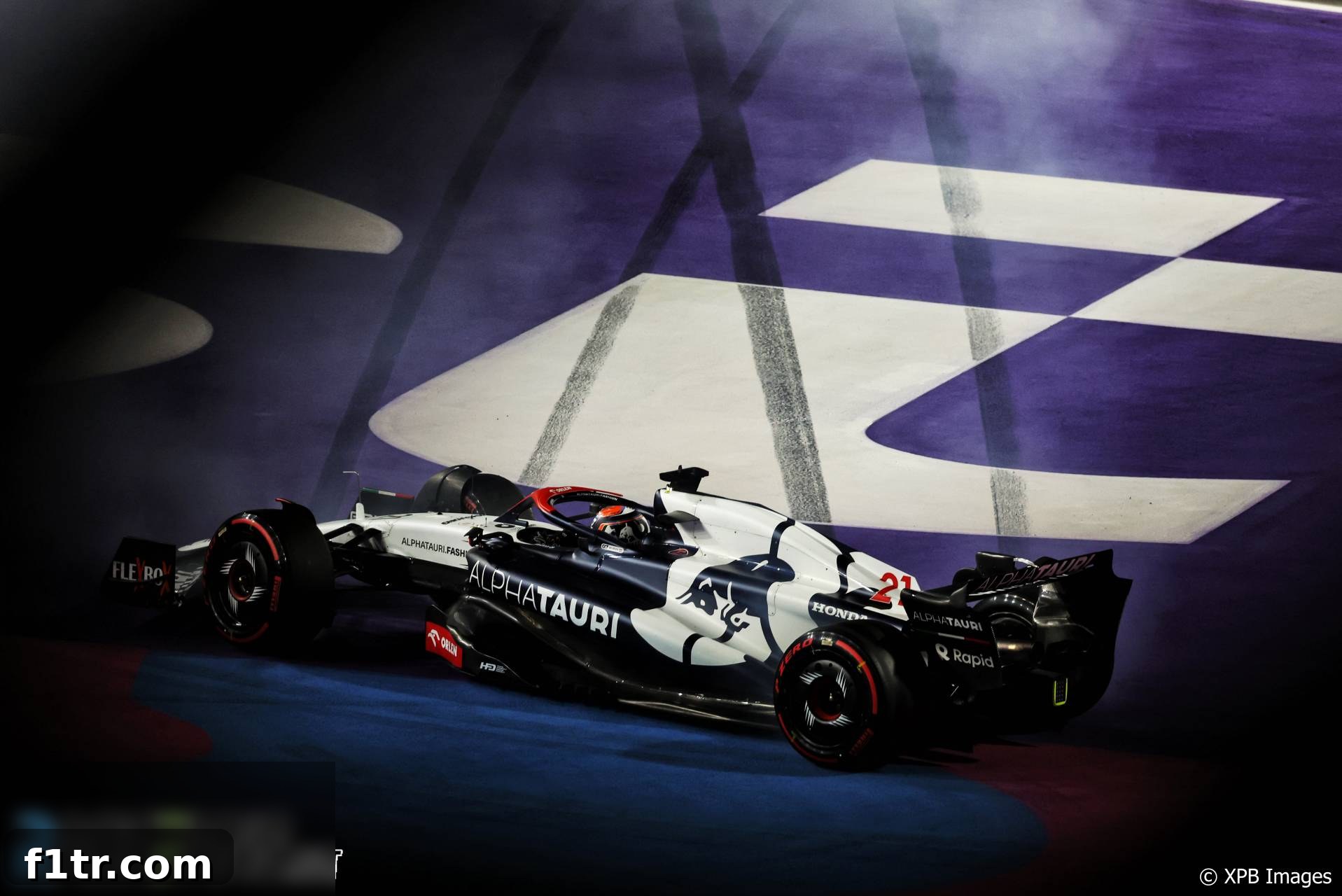
AlphaTauri’s rookie sensation, Nyck de Vries, has openly admitted to a challenging start to his inaugural full season in Formula 1, acknowledging that he has made “too many mistakes” across the opening five rounds of the 2023 championship. The highly anticipated debut of the accomplished Dutchman has been met with significant hurdles, placing him at the bottom of the driver standings and under considerable scrutiny as he navigates the demanding world of elite motorsport.
At 28 years old, De Vries arrived in Formula 1 with an impressive racing pedigree, including championships in Formula 2 and Formula E. However, the transition to the pinnacle of open-wheel racing has proven to be a steep learning curve. As of the recent races, De Vries is one of only two drivers, alongside Williams’ fellow rookie Logan Sargeant, yet to score any championship points this season, highlighting the difficulties he has faced in finding consistent form.
The contrast with his AlphaTauri teammate, Yuki Tsunoda, has been stark. Tsunoda has demonstrated solid performance, securing two top-ten finishes and consistently placing no lower than 11th in all five races completed so far. This consistent points-scoring run by Tsunoda has underscored the gap in performance within the team, with De Vries’ highest finish remaining a 14th place, achieved in the season’s opening rounds in Bahrain and Saudi Arabia.
A Season Marred by Incidents and Missed Opportunities
De Vries’ 2023 campaign has unfortunately been punctuated by a series of incidents and missed opportunities, preventing him from translating promising pace into tangible results. The Australian Grand Prix saw him sustain front wing damage early in the race before being ultimately forced into retirement after a collision with Logan Sargeant during a late safety car restart. While racing incidents can often be attributed to unfortunate circumstances, the subsequent rounds brought further challenges that De Vries himself has taken responsibility for.
The Baku street circuit, known for its high-speed sections and tight corners, proved particularly unforgiving for De Vries. He crashed out of both qualifying and the Grand Prix itself, a double setback that severely impacted his confidence and track time. Following this, the Miami Grand Prix presented another test, where De Vries was involved in an early-race incident, running into Lando Norris at the first corner. This contact compromised his car’s performance for the remainder of the race, relegating him to an 18th-place finish and further cementing a difficult streak.
“I definitely think that I personally made too many mistakes – I will admit that very openly,” De Vries candidly shared with media, including RaceFans, during an interview in Monaco. His transparency reflects a driver fully aware of the challenges and his role in them. Despite the setbacks, he remains optimistic, drawing confidence from moments where his pace has shown potential. “I also believe that the pace has been strong at several moments and that kind of encourages me and gives me confidence,” he added, emphasizing that the raw speed is there, even if the execution hasn’t always followed.
The core of his struggle, as De Vries articulated, lies in his inability to “execute at the end and haven’t been able to put it together.” This sentiment points to the subtle yet critical art of racecraft, consistency, and the pressure inherent in Formula 1, where every decision and every lap can make or break a result. “Equally, I made too many mistakes to turn that into a result, but that’s part of the learning process you go through. Sometimes it works out and sometimes it doesn’t. We are all human, we make mistakes and we move on,” he stated, highlighting the mental resilience required to compete at this level.
The Weight of Expectation: From Monza Heroics to Rookie Struggles
Nyck de Vries’ arrival in Formula 1 was heralded by a spectacular one-off performance at the 2022 Italian Grand Prix at Monza. Stepping into Alexander Albon’s Williams car at short notice due to Albon’s appendicitis, De Vries delivered an impressive drive, securing an eighth-place finish and immediately making a strong case for a full-time seat. This fairytale debut instantly elevated expectations, painting him as a potential dark horse and a seasoned talent ready to make his mark.
However, the transition from a single, high-stakes substitute appearance to a full-time role within a competitive, yet often struggling, team like AlphaTauri has presented a different set of challenges. When questioned by RaceFans if he found the step up to Formula 1 more difficult than anticipated, De Vries offered a pragmatic response: “you’re as good as your last race.” This insightful comment encapsulates the ever-present pressure and scrutiny faced by drivers in F1, where reputation can shift dramatically with performance.
“If you would have asked the same question after Monza, everyone would have had a very different perception,” he reflected, acknowledging how quickly narratives can change. His exceptional Monza result undoubtedly created a strong positive perception, almost masking the inherent difficulties of entering F1. “Now I have had a bit of a more difficult start of the season and it becomes more relevant. I don’t really go in that much depth, it’s just I made some mistakes and that’s it,” he concluded, preferring to focus on the immediate issues rather than delving into the broader psychological or transitional complexities.
Navigating the Rookie Learning Curve in Formula 1
The Formula 1 grid is arguably the most competitive sporting arena in the world, and for rookies, the learning curve is exceptionally steep. Unlike other racing series, F1 cars are incredibly complex machines, requiring a delicate balance of aggressive driving, precise technical feedback, and immense mental fortitude. Factors such as managing tire degradation, understanding intricate hybrid power unit settings, executing flawless pit stops, and maintaining composure under extreme pressure all contribute to the monumental task facing a debutant.
Furthermore, De Vries is not just a rookie, but a rookie in a team that itself has been fighting for consistency. AlphaTauri, as Red Bull’s sister team, often serves as a proving ground for young talent, but it also means the car might not always be at the forefront of the grid. This can make it even harder for a new driver to shine, as the margins for error are smaller and the car’s limitations can exacerbate a driver’s own struggles. While the AT04 has shown flashes of potential, it has generally lagged behind its midfield rivals, placing additional pressure on drivers to extract every ounce of performance.
Comparing De Vries’ situation to other rookies of recent years highlights the varied experiences. Some, like Oscar Piastri, have shown remarkable adaptability from the outset, consistently matching or even outperforming experienced teammates. Others, like Logan Sargeant, have also found the transition challenging, battling for consistency and points. The difference often lies in factors such as previous experience with similar car dynamics, the competitiveness of their machinery, and the unique pressures of their team environment.
Looking Ahead: The Path to Redemption for Nyck de Vries
Despite the difficult start, Nyck de Vries’ self-awareness and willingness to openly acknowledge his mistakes are crucial first steps toward improvement. Formula 1 is a sport where adaptation is key, and drivers often find their rhythm as the season progresses and they gain more experience with the car, the team, and the specific demands of each circuit. The upcoming races, particularly those on more traditional tracks where setup differences might be less pronounced than on street circuits like Baku and Monaco, could offer opportunities for De Vries to demonstrate his true potential.
The backing of Red Bull, through its AlphaTauri team, comes with high expectations but also significant resources. De Vries will undoubtedly be working closely with his engineers and performance analysts to dissect his performances, understand the root causes of his errors, and develop strategies to improve consistency and execution. His past championships in highly competitive series like Formula 2 and Formula E are undeniable proof of his talent and capability to perform under pressure. The challenge now is to translate that proven winning mentality and pace into sustained success in Formula 1.
For De Vries, the remainder of the 2023 season represents a critical period to demonstrate his learning and progression. By minimizing errors, consistently extracting performance from the AlphaTauri car, and closing the gap to his teammate Yuki Tsunoda, he can solidify his position and silence the critics. The journey of a Formula 1 driver is rarely linear, and many champions have faced significant hurdles in their early careers. Nyck de Vries’ path to redemption will be closely watched, as he strives to harness his undoubted talent and fulfill the promise that his impressive racing resume suggests.