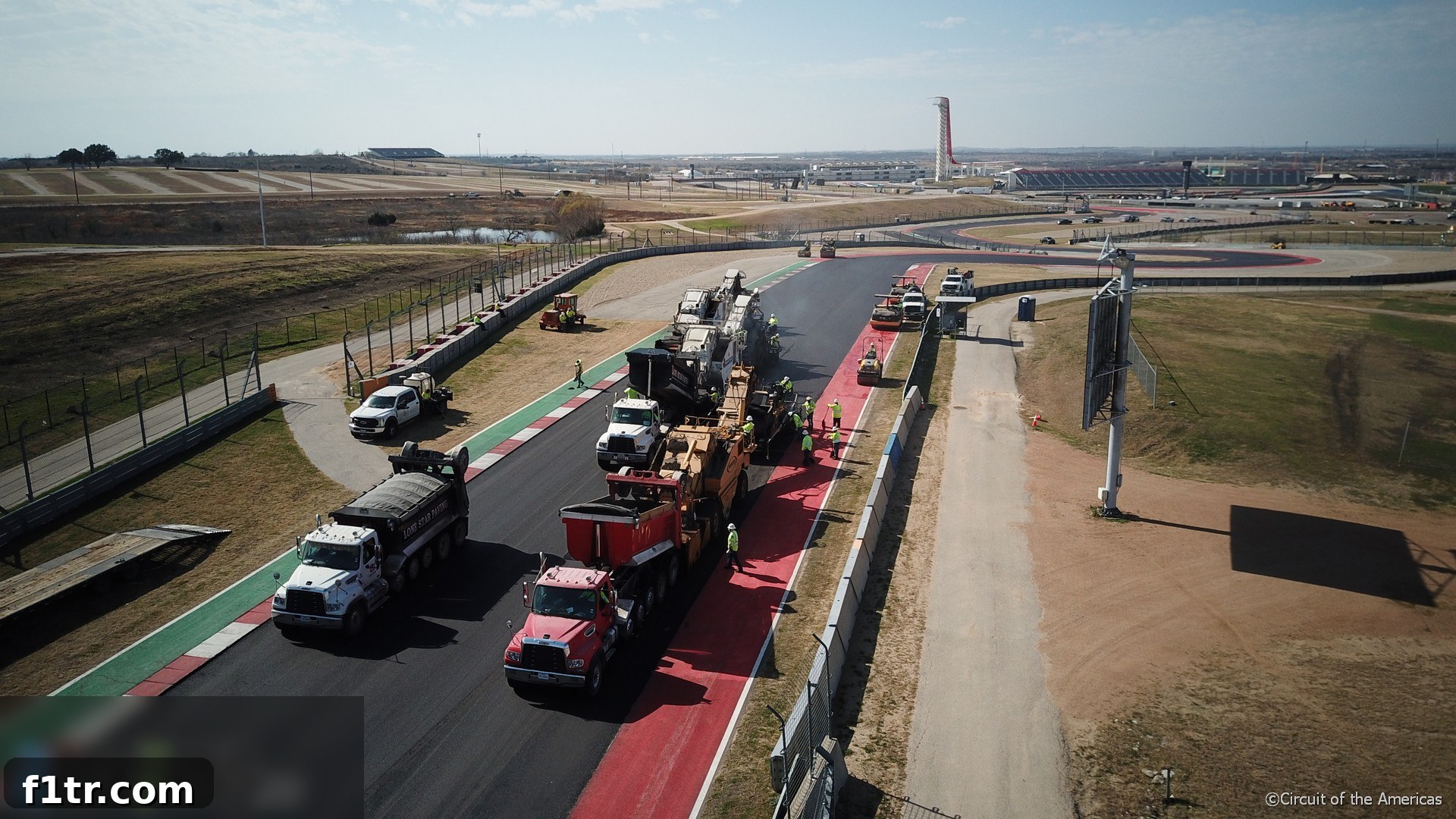
Circuit of the Americas Undergoes Extensive Resurfacing to Eradicate Notorious Bumps Ahead of US Grand Prix
The renowned Circuit of the Americas (COTA), nestled just outside Austin, Texas, is currently undergoing an ambitious and comprehensive resurfacing effort. This significant infrastructure upgrade is specifically designed to eliminate the track’s long-standing issue of notorious bumps, a recurring problem that has historically drawn strong criticism from competitors across both Formula 1 and MotoGP. As a premier venue hosting the prestigious United States Grand Prix, COTA’s commitment to delivering a world-class racing surface is paramount, ensuring both the safety of its elite athletes and the integrity of its high-profile events for the upcoming season and beyond.
The Persistent Challenge: COTA’s Bumpy History and Driver Discontent
COTA’s unique geological foundation, built on expansive clay soils, coupled with its demanding layout and the severe stresses imposed by modern motorsport machinery, has unfortunately led to persistent issues with track undulations. These conditions cause significant ground movement, resulting in the formation of bumps and an uneven racing surface that has been a source of contention for many years. From the cutting-edge technology of Formula 1 cars to the precision-demanding bikes of MotoGP, drivers and riders have consistently voiced concerns over the track’s condition, highlighting its impact on performance, vehicle reliability, and, critically, safety.
The severity of these issues has manifested in several high-profile incidents. During the 2015 United States Grand Prix, for instance, both Williams Racing drivers, Valtteri Bottas and Felipe Massa, were forced to retire prematurely from the race. Their team directly attributed these costly suspension failures to the severely uneven track surface. Such occurrences not only compromise competitive integrity but also lead to substantial financial burdens for teams, underscoring the necessity for a permanent solution.
The discontent reached a critical juncture more recently within the MotoGP community. Last year, the complaints from riders escalated dramatically, with the eventual world champion Fabio Quartararo famously likening COTA to a “motocross track” – a damning assessment for a purpose-built road racing circuit. These grievances were so severe that riders openly threatened not to participate in the 2022 event if their fundamental concerns regarding track safety and ride quality were not definitively addressed. This unified and stark warning from the world’s best two-wheel racers served as a powerful catalyst for COTA to undertake this extensive and much-needed intervention, recognizing that the circuit’s reputation and future on the global motorsport calendar were at stake.
A Precision-Engineered Approach: Advanced Technology for Track Renovation
In response to these persistent challenges, the Circuit of the Americas has embarked on its latest and most comprehensive effort to repave its entire 5.5-kilometer (3.4-mile) grand prix layout. This isn’t just a simple resurfacing; it’s a meticulously planned engineering project utilizing cutting-edge technology. COTA has enlisted expert consultants who are deploying advanced diagnostic tools, including ground-penetrating radar (GPR) and sophisticated laser mapping software. GPR allows engineers to see beneath the track’s asphalt, identifying hidden subsurface anomalies, voids, and areas of instability in the foundational layers that contribute to the formation of bumps. This provides crucial insights into the root causes of the surface irregularities, rather than just their visible symptoms.
Simultaneously, laser mapping technology creates an exceptionally precise three-dimensional scan of the track surface. This detailed topographical data enables engineers to pinpoint even the slightest deviations in elevation and gradient, ensuring that the resurfacing work is executed with unparalleled accuracy. This data-driven approach is critical for achieving a uniformly smooth and consistent racing surface that meets the exacting standards required for top-tier international motorsport. Beyond simple repaving, the project also includes strategic reinforcement of the asphalt in key areas. For example, concrete pads are being installed beneath the surface in particularly problematic sections. These robust concrete foundations provide a stable, unyielding base, effectively mitigating the future risk of ground movement and settlement that could lead to the reappearance of bumps, representing a long-term investment in the track’s durability and integrity.
Targeted Improvements: Key Sections Undergoing Transformation
The resurfacing efforts are highly focused on several critical sections of the circuit, areas that have historically proven most challenging for both drivers and engineers. Significant work is being carried out on the fast, downhill right-hander of Turn 2. This corner, immediately following the dramatic uphill sprint to Turn 1, demands absolute precision and a stable surface due to the high speeds and intense lateral forces involved. Any surface imperfection here can unsettle a car or bike, potentially leading to loss of control. Similarly, the challenging left-hand kink over the crest at Turn 10, situated at the circuit’s far end, is also being meticulously addressed. This blind, high-speed corner requires pinpoint accuracy, and a smooth, predictable surface is paramount for driver confidence. Both Turn 2 and Turn 10 will benefit directly from the installation of the aforementioned concrete pads, significantly enhancing their structural stability.
Perhaps the most extensive segment of the renovation is occurring within COTA’s iconic “stadium section.” This intricate sequence of corners, which begins with the left-hand Turn 12 at the end of the long back straight and flows through the complex, multi-apex Turns 16, 17, and 18, is being completely repaved. The stadium section is a fan favourite, offering incredible viewing opportunities as cars and bikes navigate its technical challenges. However, its demanding nature, combined with previous surface issues, has made it a particularly taxing part of the track for competitors. The comprehensive overhaul of this entire section underscores COTA’s dedication to providing an immaculate and safe racing canvas.
The imperative for these extensive repairs is further underscored by a severe incident during the 2021 United States Grand Prix weekend. W Series racer Abbie Eaton sustained fractured vertebrae after striking a particularly aggressive kerb at Turn 15. While kerb design is a distinct aspect of track infrastructure, incidents like Eaton’s injury highlight the critical importance of a uniformly smooth and predictable racing surface. A flawless track minimizes the chances of vehicles being unexpectedly unsettled, thereby allowing drivers to approach all circuit features, including kerbs, with greater confidence and control, ultimately contributing to a safer racing environment for everyone involved.
Securing COTA’s Legacy: Impact on Motorsport’s Future
The successful completion of this major resurfacing project holds profound implications for the Circuit of the Americas, securing its vital position within the global motorsport landscape. The United States Grand Prix is a cornerstone event in the Formula 1 calendar, instrumental in expanding the sport’s burgeoning popularity in North America. By proactively and definitively addressing the track surface issues, COTA is reinforcing its commitment to the motorsport community, its partners, and its vast fanbase. A consistently smooth, reliable, and safe racing surface is not merely an enhancement; it is an absolute prerequisite for attracting and retaining the world’s most prestigious racing series, including both F1 and MotoGP.
Drivers and teams across both disciplines demand circuits that are not only challenging but also inherently safe, allowing them to push the limits of their high-performance machinery without undue risk of mechanical failure or injury stemming from track imperfections. This substantial investment by COTA safeguards the future of the USGP in Austin, ensuring that fans can continue to anticipate thrilling, high-speed battles on a truly exemplary circuit. Moreover, this project mitigates potential financial penalties or the risk of losing coveted event slots that could arise from non-compliance with the stringent safety and quality standards mandated by governing bodies such as the FIA and FIM. For the millions of spectators who travel to Austin or tune in globally, a pristine track translates directly into better racing, closer competition, and a more enjoyable and safer spectating experience. The circuit is set to host this year’s United States Grand Prix on October 23rd, serving as a critical deadline and a testament to the urgency and importance of these vital renovation works.
A Wider Perspective: Circuit Maintenance in Modern Motorsport
The challenges faced by COTA with track degradation are not isolated incidents but reflect a broader reality for many high-performance circuits worldwide. Tracks built on geologically active terrains, or those subject to extreme climatic conditions, frequently contend with similar issues of asphalt wear, ground settlement, and surface irregularities. As a notable parallel, the venerable IndyCar venue Road America in Wisconsin has also announced plans for a comprehensive resurfacing of its entire six-and-a-half-kilometer length, scheduled to take place immediately following the 2022 season. This widespread need for significant and recurring infrastructure investment highlights the continuous commitment required to maintain top-tier racing facilities in an era of ever-advancing vehicle performance and safety standards.
Modern motorsport demands increasingly higher standards of track consistency and durability, placing continuous pressure on circuit owners to employ the latest civil engineering techniques and material science solutions. The proactive and technologically advanced approach adopted by COTA, integrating ground-penetrating radar and laser mapping with strategic structural reinforcement, serves as an exemplary model for how circuits can effectively tackle persistent issues. The successful implementation of these sophisticated techniques at Austin will undoubtedly set a new benchmark for comprehensive track maintenance and development within the global motorsport community, ensuring that circuits remain at the forefront of safety and performance for decades to come.
Conclusion: A New Era for the Circuit of the Americas
The extensive resurfacing and strategic reinforcement project currently underway at the Circuit of the Americas marks a pivotal moment for the iconic Texan circuit. By proactively confronting the long-standing issue of track bumps with advanced technological diagnostics and innovative engineering solutions, COTA is set to reaffirm its status as a premier motorsport venue. This unwavering commitment to driver safety, competitive integrity, and an unparalleled racing experience is fundamental for the continued success of the United States Grand Prix and MotoGP events held in Austin. The motorsport world eagerly anticipates the revitalized COTA, ready to host a new chapter of smoother, safer, and even more spectacular racing.
Related Articles: 2022 F1 Season News
- Mercedes told me “you’re wrong” about 2022 car’s problems – Hamilton
- FIA confirms all 10 F1 teams complied with 2022 cost cap
- Steiner “not ashamed” of panning “slow” Schumacher in Drive to Survive
- Albon believes year out of F1 improved him as a driver
- Hamilton sees diversity gains in F1 years on from his ‘traumatising’ experience of racism
Browse all 2022 F1 season articles