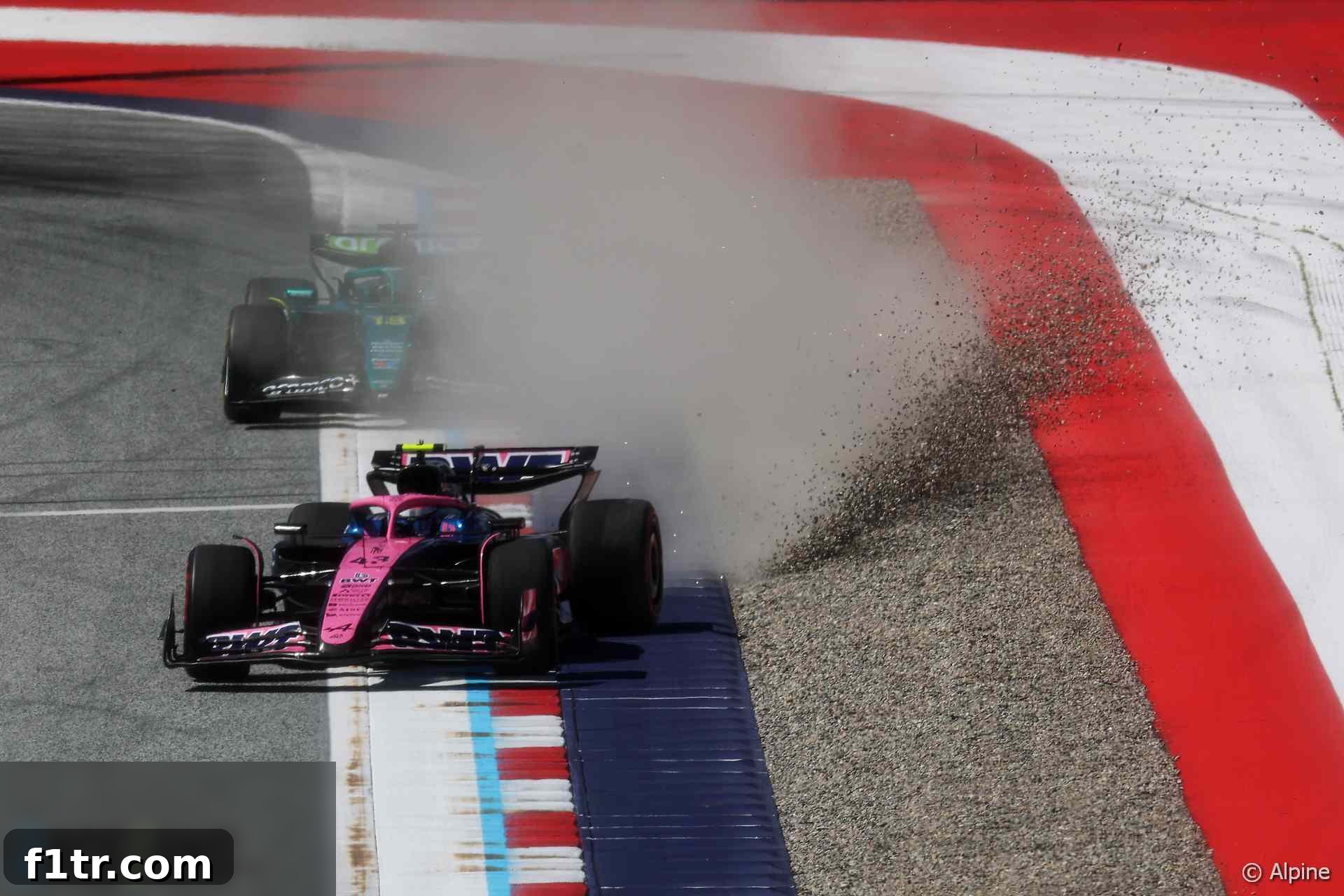
In a candid assessment that sent ripples through the Formula 1 paddock, Alpine’s executive consultant and acting team principal, Flavio Briatore, has publicly declared the team’s performance as “increasingly concerning.” His remarks come in the wake of another disheartening Grand Prix weekend where the Anglo-French outfit once again failed to add to its meager points tally, a stark reality that has seen them plummet to the very bottom of the Constructors’ Championship standings.
Advert | Become a Supporter & go ad-free
The team’s struggle for competitive pace and reliability has been a recurring theme throughout the current Formula 1 season. Having scored points in only one of the last five rounds, Alpine finds itself in a precarious position, facing an uphill battle to recover any meaningful standing in a fiercely competitive grid. Briatore, a figure synonymous with championship success during his previous stints with Benetton and Renault, did not mince words when addressing the team’s predicament, emphasizing the profound challenges facing the Enstone and Viry-Châtillon operations.
“We have lost ground to our direct rivals in the Championship after another race without scoring points and, frankly, this level of performance is increasingly concerning,” Briatore reiterated, underscoring the urgency with which Alpine must address its fundamental issues. His comments highlight not just a temporary dip in form but a systemic problem that requires immediate and effective solutions if the team is to avoid a complete write-off of the season and prevent further damage to its reputation and long-term ambitions within Formula 1.
The burden of point-scoring has fallen squarely on the shoulders of Pierre Gasly, who remains the sole driver to have brought home any points for Alpine this year. His efforts, though commendable given the car’s limitations, have not been enough to lift the team out of the championship cellar. The driver lineup itself has seen changes, with Briatore notably replacing Jack Doohan with Franco Colapinto after the sixth round of the season. This move was initially framed as a five-round evaluation for Colapinto, a clear indication of the pressure and scrutiny being applied to the driver pairing amidst the team’s ongoing struggles for F1 competitiveness.
Briatore’s keen eye for talent and performance extends to both drivers, and he expressed his conviction that both Gasly and Colapinto should have secured higher grid positions during qualifying in Austria. Pierre Gasly managed to reach Q3, a testament to his natural speed and ability, but ultimately qualified 10th after a crucial mistake on his final lap. Franco Colapinto, meanwhile, lined up 14th on the grid. However, the race proved to be a different story altogether for the Alpine F1 team, with both drivers finishing lower than their starting positions, underscoring a fundamental lack of race pace and consistency that plagues the A524 challenger.
“Yesterday the car was quick and [we] should have been well inside Q3 with two cars,” Briatore observed, highlighting the frustrating disparity between their qualifying potential and their race-day struggles. “Sundays are a very different story for us and it is important we understand why this is, especially if we want to turn this season around from this difficult position.” This statement points to a deep-seated issue within the team’s understanding of their car’s performance characteristics under race conditions, an area that demands immediate and thorough investigation by the technical departments at Enstone and Viry if Alpine hopes to salvage any pride from the current Formula 1 season.
Alpine’s Performance Dissected: The Austrian Grand Prix Perspective
The Austrian Grand Prix at the Red Bull Ring offered a microcosm of Alpine’s season-long challenges. Pierre Gasly, starting on the soft compound tyres, showcased a glimmer of hope early on, climbing as high as sixth position after a strong opening lap. This aggressive tyre strategy initially paid dividends, allowing Gasly to capitalize on early race chaos. However, this initial promise quickly faded as the race progressed. Gasly soon began to report a severe lack of overall grip, speculating that his car might have sustained some form of damage, which severely hampered his ability to maintain pace and defend his position. This incident highlights the fragility of their current package and the fine margins upon which their Formula 1 performance hinges, often leading to a rapid decline in competitive standing during a Grand Prix.
For Franco Colapinto, his Austrian Grand Prix was fraught with incidents, further complicating Alpine’s weekend. Early in the race, Colapinto was involved in a collision with Yuki Tsunoda, which resulted in a spin – a setback for any driver, especially a rookie. Later, while being lapped, he received a penalty for forcing Oscar Piastri off the track, an unfortunate sequence of events for the young driver attempting to make his mark in the high-pressure environment of Formula 1. He ultimately crossed the finish line in 15th position, two places behind his experienced teammate, Pierre Gasly. These incidents, while partly attributable to race circumstances and the unforgiving nature of F1, also reflect the intense pressure and the often steep learning curve for new entrants to the sport.
The Dire State of the Constructors’ Championship for Alpine F1
Alpine’s continuous struggle to score points has had significant ramifications for their standing in the Constructors’ Championship. The team now trails its closest championship rival, Sauber, by a significant margin of 15 points. This gap is particularly concerning given that Sauber, historically a team with its own set of challenges, has managed to score points in each of the last three races, showcasing a marked improvement in their competitive package and operational execution. The battle at the back of the grid, often overlooked by casual fans, is fiercely contested, with every point vital for budget allocation, team prestige, and future development within Formula 1.
The implications of finishing last in the Constructors’ Championship extend beyond mere bragging rights. It impacts prize money distribution, which is crucial for the team’s financial health and its ability to invest in crucial research, development, and infrastructure. A poor championship finish can create a vicious cycle, limiting resources and making it harder to attract top talent and further hindering performance. Flavio Briatore’s return was partly aimed at revitalizing the team’s competitive spirit and operational efficiency, and his current frustration underscores the magnitude of the task at hand for Alpine F1.
Flavio Briatore’s Challenge: Turning the Tide at Alpine F1 Team
Flavio Briatore’s re-engagement with Alpine F1 is not just a high-profile appointment; it signifies a desperate attempt to inject a winning mentality and strategic direction into a team that has clearly lost its way. Known for his ruthless efficiency and ability to forge championship-winning teams, Briatore faces perhaps one of his toughest challenges yet in the modern era of Formula 1. His immediate focus will undoubtedly be on understanding the underlying causes of the car’s poor race pace and developing a clear roadmap for improvement, both in the short term for the remainder of this season and for the crucial 2025 campaign.
The problem, as articulated by Briatore, is not necessarily a lack of speed in qualifying, but a profound inability to translate that raw pace into consistent race performance. This could stem from various complex factors: excessive tyre degradation, suboptimal car setup for race conditions, aerodynamic inefficiencies when running in traffic, or even strategic missteps during a Grand Prix. Addressing these multifaceted issues will require a cohesive and concerted effort from across the entire Enstone chassis facility and the Viry-Châtillon power unit division. The pressure is immense on the technical directorate to deliver upgrades that genuinely improve race performance and reliability, rather than just isolated qualifying flashes.
Furthermore, the ongoing evaluation of drivers like Franco Colapinto, coupled with Pierre Gasly’s ongoing battle to extract performance from a challenging car, points to a broader assessment of the team’s entire operational structure and personnel. Briatore’s history suggests he is not afraid to make bold and sometimes unpopular decisions regarding personnel if he believes it will ultimately benefit the team’s overall objective of climbing the Formula 1 ladder. The short-term goal for Alpine must be to halt the current slide, consistently challenge for points, and begin to close the significant gap to their midfield rivals, starting with Sauber, to prevent further loss of competitive ground.
The current state of affairs is particularly disappointing for a manufacturer team with the extensive resources and rich heritage of Renault, operating under the Alpine brand. The ambition to compete at the very front of Formula 1, once a cornerstone of their long-term vision, seems a distant dream given their current struggles. The rest of the season will be a critical period for Alpine, not just in terms of points scored, but in demonstrating a clear path towards recovery and renewed competitiveness. The F1 paddock will be watching closely to see if Briatore’s legendary touch can once again transform a struggling outfit into a formidable force in the highly competitive world of Formula 1, restoring the team’s pride and potential.
Advert | Become a RaceFans supporter andgo ad-free
Don’t Miss a Beat: Subscribe to RaceFans Updates
Stay informed with all the latest stories from RaceFans – delivered directly to your inbox every day. No marketing, no unsolicited ads, just pure F1 content. Sign up now:
More from the 2025 Austrian Grand Prix
- Antonelli Reflects on Verstappen Collision: “Not as Bad as Monza Debut Crash”
- Piastri Details “F*** Me Up” Radio Message After Third Alpine Run-in in Austria
- Bortoleto Confesses “Mistake” in Duel with “Very Smart” Alonso at Austrian GP
- Tsunoda’s Record Point-less Streak: Longest for a Red Bull Driver in 16 Years (Austrian GP Stats)
- Russell “Confused” by Leclerc’s Role at Start: “Help Me or Lewis?”
Explore all 2025 Austrian Grand Prix articles