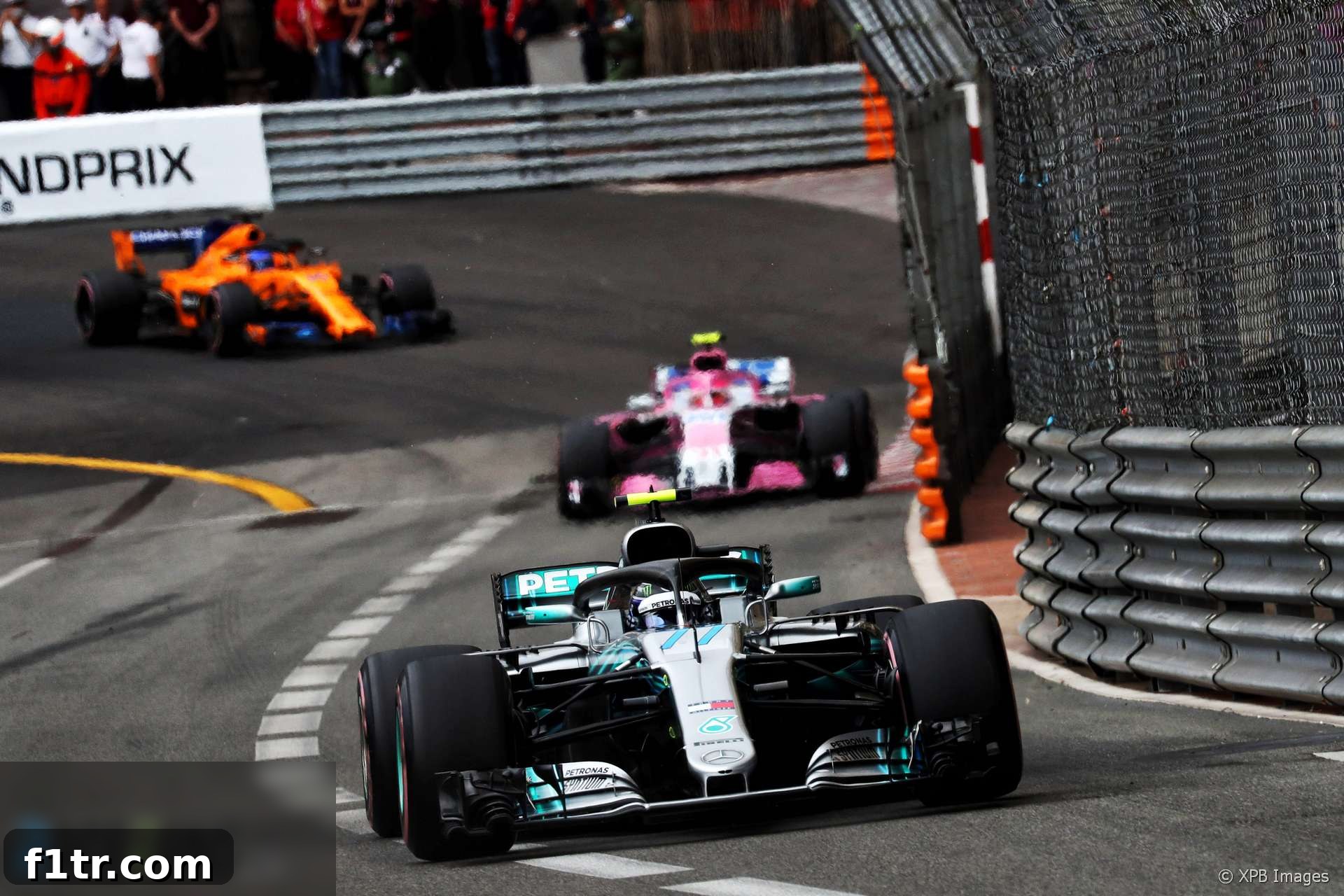
Valtteri Bottas endured a profoundly frustrating experience at the 2018 Monaco Grand Prix, a race that tested his patience and tactical acumen to its limits. Starting the iconic street circuit race from fifth position, the Mercedes driver found himself in an unenviable predicament: stuck directly behind the Ferrari of Kimi Raikkonen for the entire duration. This effectively sealed his fate on a track renowned for its near-impossible overtaking opportunities, leaving Bottas to rue what he perceived as untapped potential. His post-race reflections painted a clear picture of a driver grappling with the unique challenges of Monaco, where raw pace often takes a backseat to track position.
Monaco, with its tight corners, narrow straights, and unforgiving barriers, presents a singular challenge in Formula 1. For Bottas, the 2018 edition was a stark reminder of this reality. “It can be very frustrating when you feel you have the pace but there’s nothing you can do with it,” Bottas candidly admitted, articulating the sentiment of many drivers who have faced similar stalemates in the Principality. He elaborated on the futility of his efforts: “It is extremely difficult here to overtake and I was never close enough to Kimi that I could try to attack.” This isn’t just about driver skill; the very layout of the Circuit de Monaco fundamentally restricts traditional overtaking maneuvers. The minimal run-off areas and high-speed sections that are still remarkably narrow mean that a driver needs a significant speed advantage and a clear gap to even contemplate a pass, conditions that rarely materialize in a top-tier F1 race. The mental game of trying to force an overtake that isn’t there, lap after lap, adds another layer of difficulty to the already demanding physical and psychological task of racing at Monaco. The pressure to maintain focus and not make a mistake while pushing to the limit, yet knowing success is unlikely, is immense.
Advert | Become a Supporter & go ad-free
A significant factor contributing to Bottas’s frustration was Kimi Raikkonen’s impeccable defensive driving and astute tyre management. While Bottas felt he had an advantage in certain areas, Raikkonen proved impenetrable. “I think he struggled with his front tyres more than I, but his rears looked in very good condition and he could always get good traction out of the last corner and also into the tunnel,” Bottas observed. This insight highlights a crucial aspect of Monaco racing: rear tyre degradation and traction are paramount. Being able to get excellent drive out of the final corner (La Rascasse and Anthony Noghès) and maintain momentum into the tunnel section—one of the few high-speed areas—is vital for preventing any slipstream advantage for the car behind. Raikkonen’s ability to consistently generate superb traction meant Bottas could never close the gap sufficiently in the critical overtaking zones. Despite Bottas’s best efforts, driving right on the limit and searching for any slight error, Raikkonen’s disciplined performance left no opening. “So I never get close to him in the places where you can overtake here, unfortunately.” Bottas recounted only “a couple of times” when he fleetingly believed an attack might be possible, particularly on the main straight. “Coming into the main straight, when I was getting close and I was doing everything I could to get closer, get the slipstream and try to have a go but he always had such good traction coming out of the last corner so I could never be close enough to try and dive on the inside going into turn one.” The first corner, Sainte Dévote, while a braking zone, offers a narrow entry and is easily defended. “Actually here turn one is quite easy to cover, it’s not that wide an entry. There was no chance, he didn’t do any mistakes and I could never get close enough.” This demonstrated the Finn versus Finn battle, where experience and track position trumped raw pace in Bottas’s case.
Mercedes, recognizing the challenging circumstances, opted for a split strategy between their two drivers. Valtteri Bottas was pitted for a set of super-soft tyres for his second stint, while teammate Lewis Hamilton, who started ahead, was given a fresh set of ultra-softs to carry him to the chequered flag. This tactical divergence was an attempt to mitigate the rapid degradation observed in the softer compounds. Bottas explained the team’s rationale: “I think strategy-wise that was the best we could do. As we saw, the hyper-soft degraded very quickly for Lewis and me so we decided to split.” The hyper-soft, the softest compound available that weekend, proved to be far more fragile than anticipated, prompting Mercedes to re-evaluate their mid-race tyre choices.
Interestingly, the super-soft compound, which had shown less promise during Thursday practice sessions, emerged as a surprisingly effective tyre choice on race day for Bottas. “Even though we saw on Thursday that the super-soft wasn’t great for our car, today it worked and it was the best tyre to be on,” Bottas revealed. “It was much more robust than any other tyre and it felt like the pace was there.” This adaptability of the super-soft provided Bottas with the theoretical pace required to challenge, yet the inherent difficulties of Monaco meant this pace could not be leveraged into tangible gains on track. The team’s decision to provide Bottas with the more durable super-softs, despite initial reservations, underscored their efforts to provide him with the best possible chance to progress, even if ultimately fruitless due to track characteristics.
Despite the palpable frustration, Bottas displayed a pragmatic acceptance of the outcome, acknowledging the limitations imposed by the circuit and his starting position. “But we just couldn’t do anything with the pace. Strategy-wise I wouldn’t have done anything different,” he stated, reinforcing the idea that Mercedes had executed their plan optimally under the given constraints. The reality of racing in Monaco, he concluded, often boils down to a lottery if you’re not at the very front. “It’s just that when you start fifth in Monaco you kind of need to hope something is going to happen in the race because even with good pace you cannot move up the order.” This statement encapsulates the unique nature of the Monaco Grand Prix, where the qualifying session often dictates the race result more than any other event on the calendar. Accidents, safety cars, or unexpected mechanical failures are often the only catalysts for significant position changes outside of the top three or four. For a driver of Bottas’s caliber, starting fifth in a competitive field meant relying on external factors rather than pure driving skill or strategic brilliance to improve his standing.
Advert | Become a RaceFans supporter andgo ad-free
The 2018 Formula 1 season was a fiercely contested championship, primarily a battle between Mercedes and Ferrari. For Valtteri Bottas, it was a crucial year to establish himself as a consistent front-runner and a strong contender for victories, especially alongside his highly decorated teammate, Lewis Hamilton. Races like Monaco, while challenging for everyone, amplify the pressure on drivers aiming for championship contention. Every point matters, and missing out on potential gains due to track characteristics can be particularly disheartening. Bottas had shown flashes of brilliance throughout the season, but mechanical issues and unfortunate circumstances, combined with the impenetrable nature of circuits like Monaco, often conspired against him. His performance in Monaco, despite the final result, highlighted his underlying pace and determination, even when faced with insurmountable obstacles. The frustration he expressed was not merely about this single race but reflected the broader ambition to maximize every opportunity in a highly competitive F1 season, making every Sunday count.
2018 F1 season
- F1 feared “death knell” for Drive to Survive after Ferrari and Mercedes snub
- McLaren staff told us we were “totally crazy” to take Honda engines in 2018 – Tost
- ‘It doesn’t matter if we start last’: How Red Bull’s junior team aided Honda’s leap forward
- Honda’s jet division helped F1 engineers solve power unit problem
- McLaren Racing losses rise after Honda split
Browse all 2018 F1 season articles
In retrospect, the 2018 Monaco Grand Prix served as a microcosm of the challenges faced by drivers and teams in Formula 1 when confronted with the unique demands of certain circuits. Valtteri Bottas’s experience, trapped behind Kimi Raikkonen despite possessing what he felt was superior pace, underscored the age-old adage that track position is king in Monaco. His analysis of Raikkonen’s strong traction and Mercedes’ best-laid strategic plans, which ultimately yielded no advancement, paints a vivid picture of a race where opportunity was scarce. While frustrating, Bottas’s candid reflections offer valuable insight into the mindset of a top-tier athlete navigating the intricacies of a Grand Prix that prioritizes qualifying performance above all else. His acceptance of the outcome, coupled with a clear understanding of why he couldn’t progress, speaks volumes about the pragmatic realities of professional motor racing, especially on the legendary streets of Monaco. The race was a testament to the fact that even with optimal strategy and strong pace, some battles are simply unwinnable when the circuit itself becomes the most formidable competitor.