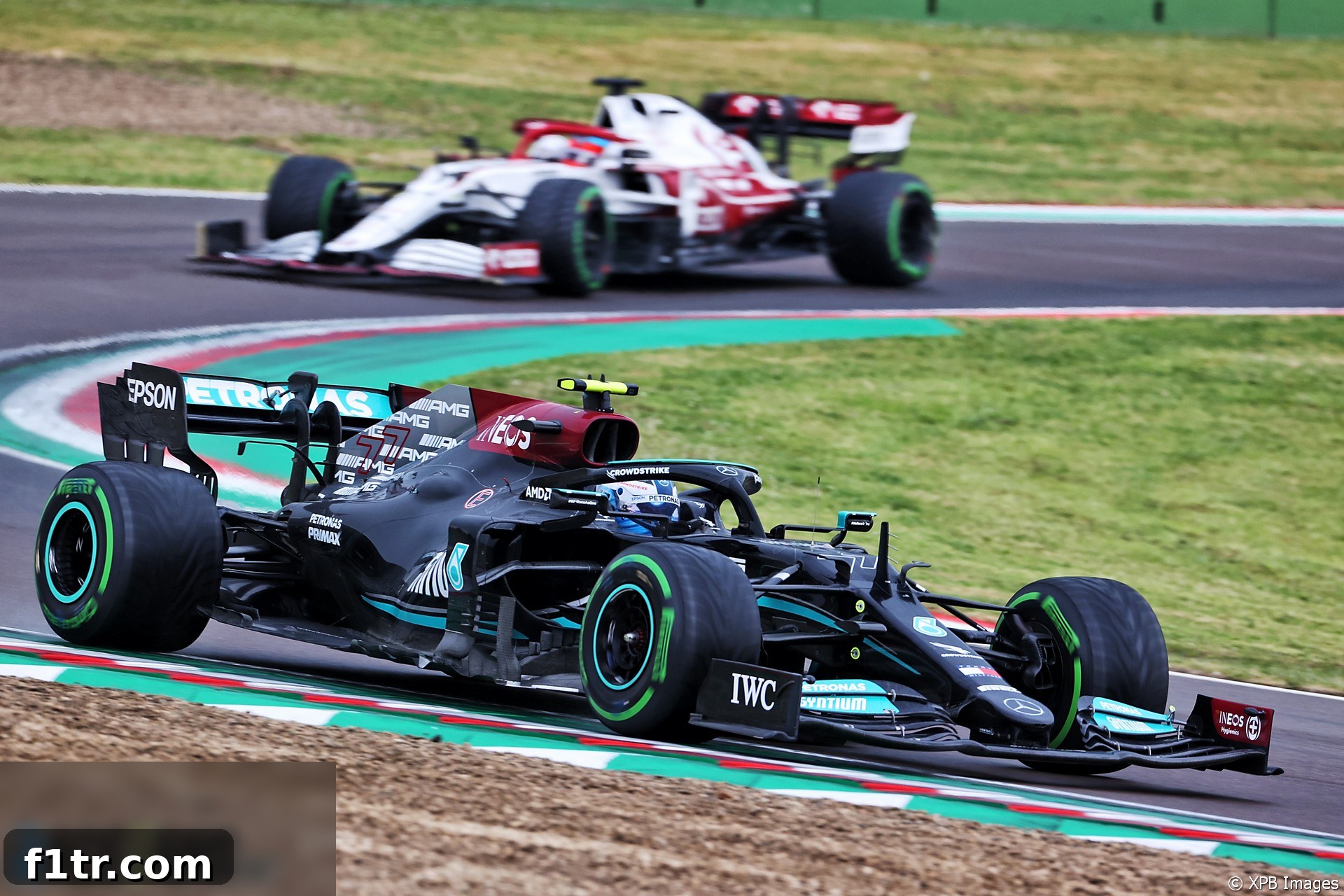
Valtteri Bottas’s Imola Pace Mystery Unraveled: The Critical Role of Tyre Temperature
The Emilia-Romagna Grand Prix presented a challenging weekend for Valtteri Bottas and the Mercedes-AMG Petronas F1 Team. What began with promising pace in practice sessions quickly devolved into a perplexing struggle, culminating in a dramatic collision with George Russell that prematurely ended his race. Following an in-depth analysis, Bottas and the team have pinpointed the root cause of his underwhelming performance: a critical issue with tyre temperature and management, particularly affecting the rear tyres.
Despite appearing to be among the quickest drivers during Friday’s practice sessions at Imola, Bottas found himself significantly off the pace when it mattered most. He qualified a disappointing eighth, trailing his teammate Lewis Hamilton by nearly half a second. The struggles continued into the race, where his performance failed to improve. Before the high-speed incident with Russell, Bottas was losing considerable ground, even facing the prospect of being lapped by Hamilton, highlighting a profound lack of grip and overall car performance.
Understanding Bottas’s Tyre Conundrum at Imola
In the aftermath of the race, Bottas openly discussed the team’s findings, attributing his difficulties “100% to tyres.” This candid admission underscores the immense complexity of modern Formula 1 machinery, where even the slightest deviation in tyre operating conditions can have monumental consequences on a driver’s lap times and overall performance. The Finn recounted the stark contrast in his qualifying performance, noting, “My Q1 time would have been enough for the second row. And in Q3, we ended up eighth. So it’s an area that we need to pay more attention to.” This observation points to a transient issue, suggesting that while the car and driver were capable of pace, they struggled to consistently hit the narrow operating window required for optimal tyre performance.
The essence of Formula 1 tyre performance lies in maintaining them within a very specific temperature range. Too cold, and they lack grip; too hot, and they degrade rapidly. The Pirelli tyres used in F1 have an incredibly sensitive operating window, often just a few degrees wide. When a driver struggles with tyre warm-up, it means they cannot generate or retain the necessary heat to bring the rubber into this optimal window. This results in reduced adhesion to the track, leading to understeer, oversteer, or a general lack of confidence for the driver, forcing them to push less and lose precious lap time.
For Bottas at Imola, the problem was exacerbated on the rear tyres. This is a crucial distinction because rear tyre temperature directly impacts traction and stability, especially under acceleration and through high-speed corners. A cold rear tyre means the car struggles to put power down effectively, making it prone to snap oversteer and significantly hindering corner exit speed. This can snowball into a larger problem, affecting braking stability and mid-corner balance, disrupting the entire rhythm of a lap.
The DAS System: A Red Herring?
A notable difference from the 2020 season, where Bottas demonstrated peerless one-lap pace at Imola, was the absence of Mercedes’ innovative Dual Axis Steering (DAS) system. DAS allowed drivers to adjust the toe angle of the front wheels by pushing or pulling the steering wheel, primarily aiding in tyre warm-up on the straight sections of the track. Given its previous effectiveness in tyre management, speculation arose that its prohibition for 2021 might have contributed to Bottas’s difficulties.
However, Bottas himself was quick to dismiss this notion, asserting that the loss of DAS was not a primary factor in his 2021 Imola struggles. “With the DAS for sure it was helpful on that [tyre warm-up] but to be honest in Imola the main issue for me was rear tyres,” he explained. “Getting them warm, instead of the fronts. The DAS system was only for the fronts. So I’m sure last year we had a benefit in some places for that, but not necessarily for Imola.”
This clarification is vital. While DAS certainly offered a strategic advantage for front tyre conditioning, its absence would logically have a minimal direct impact on rear tyre warm-up. This reinforces the specific nature of Bottas’s problem: a localized issue with the rear axle, distinct from the overall tyre heating strategies that DAS facilitated. The complexities of car setup, aerodynamic balance, and driver input all play a far greater role in how the rear tyres are brought up to temperature and maintained throughout a session.
The fact that Bottas was able to perform strongly on Friday, and then struggled, suggests a sensitivity in the car’s setup or operating window that became apparent as track conditions evolved over the weekend. Factors like ambient temperature, track temperature, wind direction, and even rubber laid down by other cars can subtly alter the balance and grip characteristics, pushing a finely tuned car out of its sweet spot. Identifying and rectifying this sensitivity is paramount for Mercedes to ensure consistent performance across diverse conditions.
Mercedes Engineering Corroboration: Andrew Shovlin’s Insight
Mercedes engineering director Andrew Shovlin provided further clarity and corroboration for Bottas’s assessment. Speaking after the Emilia-Romagna Grand Prix weekend, Shovlin unequivocally stated that tyre warm-up was indeed the fundamental problem plaguing Bottas at Imola. His detailed explanation painted a clearer picture of how a seemingly minor issue could cascade into significant performance losses.
“He did look very strong on Friday and was in a good position, very happy with the car,” Shovlin confirmed, echoing Bottas’s initial practice performance. “In qualifying he seemed to be struggling a little bit more for the tyre temperature than Lewis.” This differential highlights the often minuscule margins that separate peak performance from midfield struggles in Formula 1. It also suggests that Hamilton, for whatever reason – be it driving style, car setup nuances, or a combination – was better able to manage his tyre temperatures on the day.
Shovlin elaborated on the disproportionate impact of tyre temperature, stating, “The thing with tyre temperature though is often a very small difference has a very big impact on grip. Unfortunately for Valtteri, he was just the wrong side of a lot of cars and that gave him a very compromised start position.” This emphasizes the narrow window of opportunity for F1 tyres. Being just a few degrees outside the optimal range can reduce grip significantly, leading to slower lap times and a domino effect that impacts a driver’s entire race weekend.
The compromised starting position was a direct consequence of the qualifying struggles, and its effects were felt acutely in the race. “In the race, really, he was struggling following, and being able to overtake, just because he was losing front end in the tow but also the rear wasn’t strong. And again, it was that theme that warm-up was a problem for him,” Shovlin explained. When following another car closely, a Formula 1 car loses a significant amount of downforce, particularly at the front, due to the turbulent air (the “tow”). This makes the car understeer. If a driver is already struggling with rear tyre grip and temperature, this loss of front-end downforce can make the car incredibly difficult to handle, hindering both pace and overtakes. The cycle of poor grip, slow pace, being stuck in traffic, and further compounding the tyre issues becomes a relentless challenge.
Implications and Moving Forward
The identification of the tyre temperature issue at Imola is crucial for Valtteri Bottas and Mercedes. In the hyper-competitive world of Formula 1, understanding the precise technical reasons behind a performance deficit is the first step towards rectification. For Bottas, who is under constant scrutiny regarding his future with the team, such detailed technical feedback provides a clear objective for improvement and demonstrates the team’s commitment to supporting him.
The focus will now be on how Mercedes can adapt their car setup, tyre management strategies, and potentially even their understanding of Bottas’s driving style to mitigate these warm-up issues in future races. This might involve adjustments to suspension settings, aerodynamic balance, brake biasing, and even a review of out-lap procedures during qualifying. Every fraction of a second counts, and optimizing tyre performance across various circuits and conditions is paramount for championship success.
While the Emilia-Romagna Grand Prix ended prematurely and disappointingly for Bottas, the detailed investigation into his pace issues provides invaluable data. By isolating the problem to rear tyre warm-up, Mercedes can now develop targeted solutions, ensuring that such a fundamental challenge does not recur. For Bottas, armed with this knowledge, the path forward is clearer: to work closely with his engineers to refine the car’s setup and his approach to tyre management, turning a past weakness into a future strength.