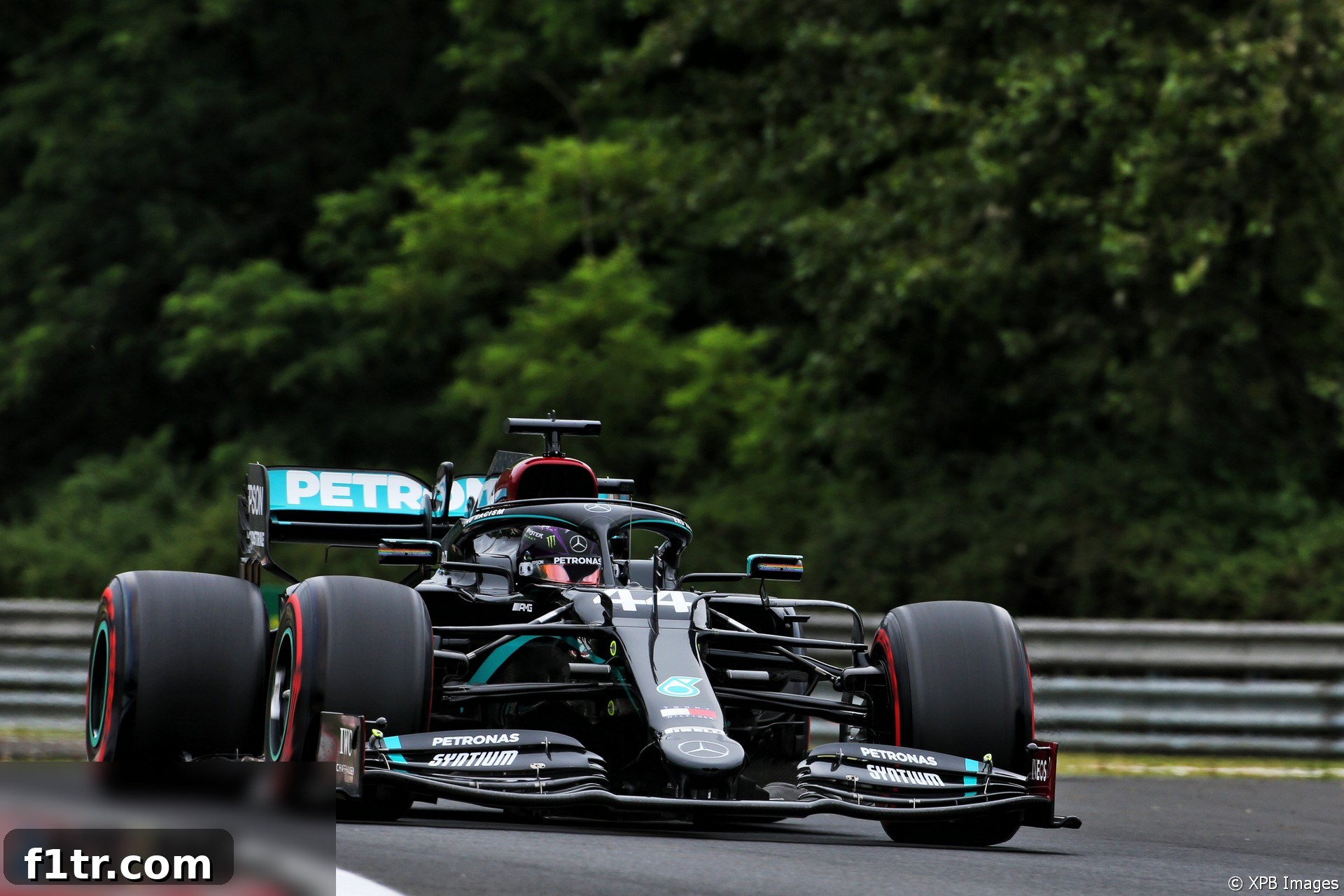
Lewis Hamilton spearheaded a dominant performance for Mercedes-AMG Petronas F1 Team in the opening practice session for the Hungarian Grand Prix, topping the timesheets ahead of his teammate Valtteri Bottas. The silver arrows showcased formidable pace around the tight and technical Hungaroring circuit, suggesting another strong weekend could be on the horizon for the championship leaders. Their close one-two finish in Friday’s first 90-minute run immediately established them as the team to beat at a track known for its challenging layout and strategic complexities.
Following closely behind the two Mercedes W11 machines were the cars that have generated significant debate and controversy in the paddock: the Racing Point-Mercedes RP20s. Often dubbed the “Pink Mercedes” due to its striking resemblance to last year’s championship-winning car, the team continued to display impressive speed. Sergio Perez delivered a stellar performance, securing the third-quickest time of the session. His lap was remarkably just half a second shy of Hamilton’s benchmark, underscoring the potential of the RP20. Team mate Lance Stroll was not far behind, placing fourth, approximately a second off the leading pace. This strong showing comes amidst an ongoing protest from rivals Renault, who have formally questioned the legality and origins of certain parts of the RP20, intensifying the scrutiny on the Silverstone-based outfit as the season progresses.
After a challenging start to the 2020 Formula 1 season with two difficult races at the Red Bull Ring in Austria, Ferrari appeared to find a slightly better rhythm at the Hungaroring. The twisty nature of the circuit, which places less emphasis on raw engine power and more on aerodynamic efficiency and driver skill, seemed to suit the SF1000 more effectively. Both Sebastian Vettel and Charles Leclerc managed to secure positions comfortably within the top ten, finishing sixth and seventh respectively. Their improved form offered a glimmer of hope for the Scuderia, indicating that they might be more competitive this weekend than in the previous rounds, though they were still outpaced by ‘s Renault, which impressively secured fifth place.
Expectations were high for Max Verstappen and Red Bull-Honda heading into the Hungarian Grand Prix, with many pundits tipping them as Mercedes’ closest challengers. However, the first practice session proved to be less straightforward for the Dutchman. Verstappen could only manage the eighth-fastest time, a result he found frustrating. During his final flying lap, he reported to his team that he had “completely destroyed the left-front” tyre, compromising his performance. Additionally, he voiced his frustration at being held up by Nicholas Latifi at a crucial point in the session, which further hindered his ability to set a more representative lap time. His teammate, Alexander Albon, also struggled to match the pace, placing the second Red Bull in thirteenth position. This initial outing suggests Red Bull has some work to do to unlock the full potential of their car and challenge the dominant Mercedes, a task they will undoubtedly be focused on for the remainder of the weekend.
In the fiercely contested midfield, Lando Norris demonstrated resilience and speed for McLaren-Renault. Despite nursing a sore chest that had been a concern since the previous weekend’s race, Norris piloted his car to the ninth-fastest time. His consistent performance highlights McLaren’s strong start to the season and their ongoing battle for third in the constructors’ championship. He finished ahead of ‘s Renault, who took tenth, and his own teammate Carlos Sainz Jnr, who secured eleventh. The close proximity of these drivers underscores the intensity of the midfield competition, where every tenth of a second can significantly alter grid positions. Teams like Renault and McLaren are locked in a relentless fight for crucial championship points, making every session vital for optimizing their packages.
One notable absence from the lap times was Pierre Gasly, who was unable to complete any laps during the session. AlphaTauri-Honda reported a problem with his power unit. Honda, their engine supplier, stated on social media that they had “seen an anomaly on the data of Pierre’s [power unit] and we need to carry out physical checks which will take some time.” This unfortunate setback meant Gasly lost valuable track time at a critical juncture, as teams strive to fine-tune their cars for the unique demands of the Hungaroring. Such technical issues can severely impact a driver’s preparation for qualifying and the race, forcing them to play catch-up in subsequent sessions.
Rounding out the field and setting the slowest time of the session was Robert Kubica. The Polish driver made his second practice appearance of the year for Alfa Romeo-Ferrari, stepping into Kimi Raikkonen’s car for the session. These practice outings are crucial for providing feedback to the team and helping with car development, though they often see the substitute drivers at the lower end of the timesheets as they adapt to the car and specific testing programmes.
The first free practice session at the Hungaroring provided an intriguing glimpse into the potential pecking order for the Hungarian Grand Prix weekend. While Mercedes’ dominance remained unchallenged at the top, the strong showing from Racing Point, the improved performance from Ferrari, and the unexpected struggles of Red Bull have all set the stage for an exciting weekend of Formula 1 action. Tyre management and understanding the nuances of the twisty Hungarian circuit will be key factors in determining success, as teams continue to gather data and refine their strategies ahead of qualifying and Sunday’s main event.
The Hungaroring, with its undulating terrain and constant sequence of corners, offers a stark contrast to the high-speed layouts of the Red Bull Ring. This particular track demands maximum downforce and exceptional mechanical grip, rewarding cars that are well-balanced and agile. The cooler temperatures forecasted for parts of the weekend could also play a significant role, affecting tyre performance and strategic decisions. For teams battling in the midfield, consistency and avoiding mistakes will be paramount, as the compact nature of the circuit offers few overtaking opportunities, making grid position exceptionally critical.
As teams head into FP2, the focus will shift towards longer runs and race simulations, giving a clearer picture of their race pace and tyre degradation. The data gathered from FP1, despite some compromised sessions for certain drivers, will be invaluable for engineers working tirelessly to extract every ounce of performance from their machines. The saga surrounding Racing Point’s car will undoubtedly continue to be a talking point, adding another layer of intrigue to what promises to be a captivating Hungarian Grand Prix.
Ultimately, the first practice session served as a clear indicator of Mercedes’ formidable strength, with Hamilton leading the charge. However, the unexpected challenges faced by Red Bull and the promising signs from Ferrari and Racing Point ensure that the Hungarian Grand Prix is far from a foregone conclusion. Fans can anticipate a thrilling weekend as the battle for supremacy and vital championship points unfolds at this iconic circuit.
| Pos. | No. | Driver | Car | Best lap | Gap | Laps |
|---|---|---|---|---|---|---|
| 1 | 44 | Lewis Hamilton | Mercedes | 1’16.003 | 36 | |
| 2 | 77 | Valtteri Bottas | Mercedes | 1’16.089 | 0.086 | 37 |
| 3 | 11 | Sergio Perez | Racing Point-Mercedes | 1’16.530 | 0.527 | 20 |
| 4 | 18 | Lance Stroll | Racing Point-Mercedes | 1’16.967 | 0.964 | 35 |
| 5 | 3 | Daniel Ricciardo | Renault | 1’17.200 | 1.197 | 28 |
| 6 | 5 | Sebastian Vettel | Ferrari | 1’17.238 | 1.235 | 26 |
| 7 | 16 | Charles Leclerc | Ferrari | 1’17.404 | 1.401 | 29 |
| 8 | 33 | Max Verstappen | Red Bull-Honda | 1’17.435 | 1.432 | 28 |
| 9 | 4 | Lando Norris | McLaren-Renault | 1’17.523 | 1.520 | 26 |
| 10 | 31 | Esteban Ocon | Renault | 1’17.615 | 1.612 | 34 |
| 11 | 55 | Carlos Sainz Jnr | McLaren-Renault | 1’17.675 | 1.672 | 32 |
| 12 | 20 | Kevin Magnussen | Haas-Ferrari | 1’17.713 | 1.710 | 34 |
| 13 | 23 | Alexander Albon | Red Bull-Honda | 1’17.727 | 1.724 | 27 |
| 14 | 8 | Romain Grosjean | Haas-Ferrari | 1’17.890 | 1.887 | 35 |
| 15 | 6 | Nicholas Latifi | Williams-Mercedes | 1’17.969 | 1.966 | 31 |
| 16 | 26 | Daniil Kvyat | AlphaTauri-Honda | 1’18.292 | 2.289 | 35 |
| 17 | 99 | Antonio Giovinazzi | Alfa Romeo-Ferrari | 1’18.425 | 2.422 | 30 |
| 18 | 63 | George Russell | Williams-Mercedes | 1’18.574 | 2.571 | 29 |
| 19 | 88 | Robert Kubica | Alfa Romeo-Ferrari | 1’19.150 | 3.147 | 26 |
| 20 | 10 | Pierre Gasly | AlphaTauri-Honda | 0 |
First practice visual gaps
Lewis Hamilton – 1’16.003
+0.086 Valtteri Bottas – 1’16.089
+0.527 Sergio Perez – 1’16.530
+0.964 Lance Stroll – 1’16.967
+1.197 Daniel Ricciardo – 1’17.200
+1.235 Sebastian Vettel – 1’17.238
+1.401 Charles Leclerc – 1’17.404
+1.432 Max Verstappen – 1’17.435
+1.520 Lando Norris – 1’17.523
+1.612 Esteban Ocon – 1’17.615
+1.672 Carlos Sainz Jnr – 1’17.675
+1.710 Kevin Magnussen – 1’17.713
+1.724 Alexander Albon – 1’17.727
+1.887 Romain Grosjean – 1’17.890
+1.966 Nicholas Latifi – 1’17.969
+2.289 Daniil Kvyat – 1’18.292
+2.422 Antonio Giovinazzi – 1’18.425
+2.571 George Russell – 1’18.574
+3.147 Robert Kubica – 1’19.150
Drivers more then ten seconds off the pace omitted.
2020 Hungarian Grand Prix Related Content
- ‘Driver aids’ rule Haas broke with Hungary pit calls to be reviewed
- Ferrari did not sacrifice Vettel to help Leclerc – Binotto
- Di Resta to serve as McLaren’s ‘standby driver’ for Silverstone
- Pirelli: 2020 tyres teams rejected would have coped better with high Silverstone loads
- Ferrari wade into Racing Point legality row with letter to F1 and FIA
Browse all 2020 Hungarian Grand Prix articles