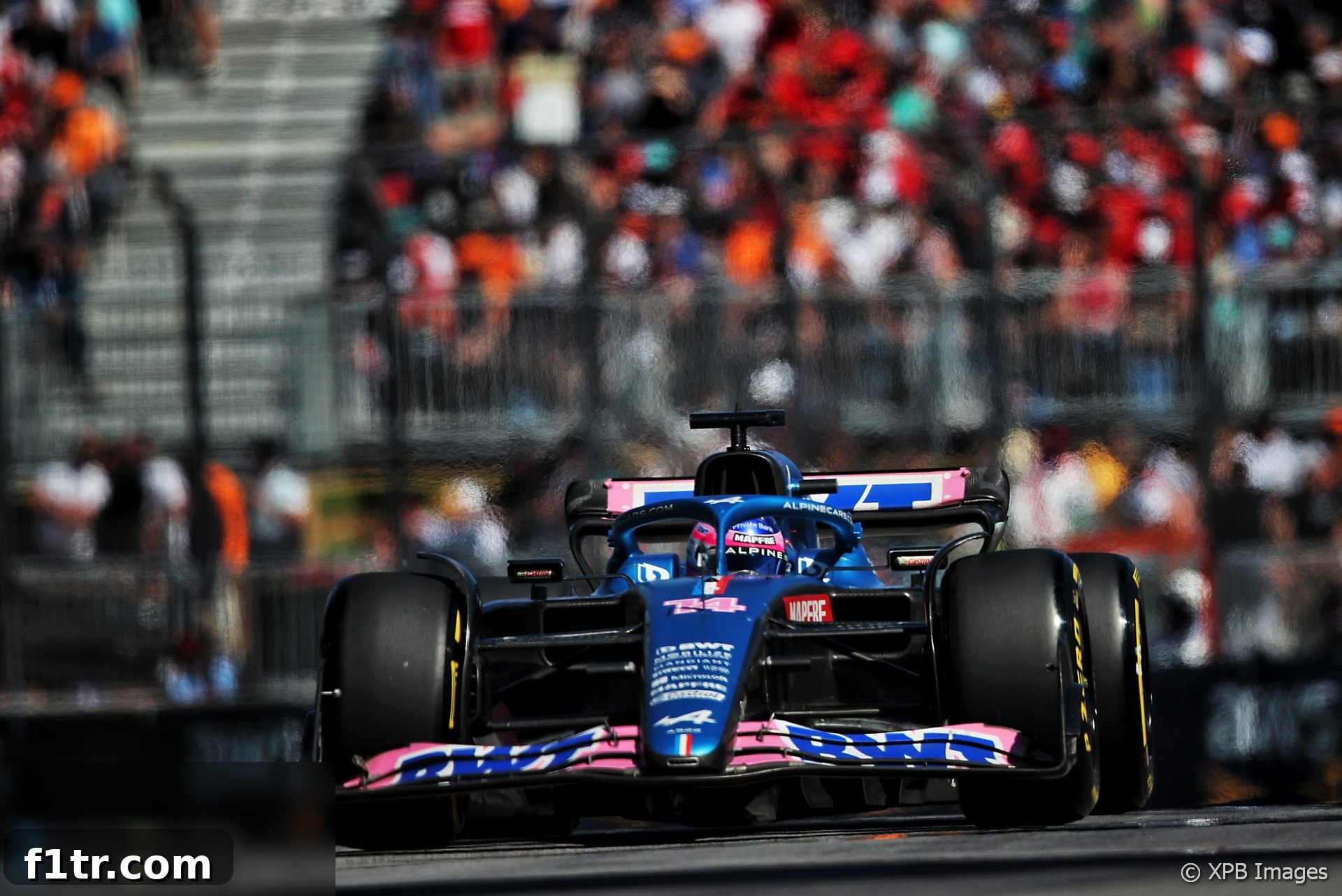
The aftermath of the Canadian Grand Prix saw Alpine team management staunchly defending their veteran driver, Fernando Alonso, following a contentious penalty for weaving during the thrilling final lap. This incident reignited debates within the Formula 1 paddock regarding defensive driving tactics and the consistent application of sporting regulations by race stewards, particularly as it mirrored a similar penalty issued earlier in the season.
Alonso, who had delivered a spirited performance throughout the race despite underlying technical challenges, found himself under scrutiny for the defensive maneuvers he executed to ward off the rapidly approaching Valtteri Bottas. The Finnish driver, piloting his Alfa Romeo, had closed the gap significantly to the Alpine on the final circuit of the Circuit Gilles Villeneuve, a crucial moment triggered by Alonso experiencing a snap of oversteer at the demanding exit of Turn Nine.
The Controversial Final Lap: A Battle for Position
As the two drivers hurtled towards the Turn 10 hairpin, Alonso masterfully defended the inside line, a standard and legitimate racing tactic. However, the critical sequence of events unfolded as Bottas emerged from the corner with superior momentum, positioning himself to exploit the DRS (Drag Reduction System) zone that followed. It was at this juncture that Alonso’s defensive actions transitioned into moves that the stewards ultimately deemed unacceptable and a direct violation of the rules.
The sequence described by the stewards detailed a series of rapid changes in direction by Alonso. First, he pulled off-line to the left. Immediately thereafter, he swerved back to the right as he activated his DRS, seemingly attempting to maximize his own straight-line speed while simultaneously trying to break Bottas’s tow. This was followed by another swerve to the left, then right once more, before finally returning to the established racing line. Throughout these rapid directional changes, Bottas, recognizing the erratic movement, cautiously backed off slightly, losing critical momentum. As they approached the final chicane, Alonso executed yet another change of line, once again positioning his car to cover the inside, leaving Bottas with limited options.
The stewards’ verdict was unequivocal: Alonso had violated Article 2.7.4 of the FIA International Sporting Code, which explicitly states, “More than one change of direction to defend a position is not permitted.” They concluded that Alonso’s driving constituted a “clear breach” of these regulations, leading to a five-second time penalty. This decision was met with immediate and vocal disagreement from Alpine team principal Otmar Szafnauer, who commented after the race, “Was it deserved? No,” expressing his frustration with the ruling.
Alpine’s Stance: Defending the Defender
Szafnauer’s robust defense of Alonso underscored a broader philosophical difference between the teams and the regulatory body regarding the interpretation of aggressive, yet often deemed necessary, defensive driving. Alpine argued that Alonso’s actions were a natural and instinctive response to protect a hard-earned position, especially given the circumstances of his car’s performance issues. They suggested that the spirit of the rule, intended to prevent dangerous or overly aggressive blocking, might have been applied too rigidly in a dynamic, high-pressure racing scenario.
This incident marked the second time in the 2022 season that Fernando Alonso had points stripped from him due to a post-race penalty. His five-second time penalty in Canada relegated him from a respectable seventh position to ninth, echoing a similar outcome in Miami where a penalty had cost him a points finish entirely. On that previous occasion, Alpine had voiced strong complaints about not being granted the opportunity to present their case to the stewards before the penalty was issued, raising concerns about procedural fairness. While Szafnauer stated he was “not frustrated” with the latest sanction, he emphasized the team’s desire to avoid such penalties to consistently finish higher, acknowledging the detrimental impact on championship points.
Alonso’s Race Struggles and Team Strategy
The penalty cast a shadow over what had initially promised to be a stellar weekend for Alonso. Having sensationally qualified on the front row in second place, his race unravelled somewhat due to a significant power unit problem that plagued his car throughout the Grand Prix. This technical setback severely hampered his performance, particularly affecting his straight-line speed, which is crucial on a circuit like Montreal with its long straights.
Szafnauer elaborated on the issue, stating, “We don’t know what it is yet, it looks like it was an air leak somewhere, but from where I don’t know. That manifested itself in some higher temperatures and then you had to manage, so we were limited down the straight.” This limitation meant Alonso was constantly managing engine temperatures and power delivery, making him an easier target for competitors like Bottas, even with his exceptional defensive skills.
Adding another layer to the team’s race management, Alpine declined Alonso’s request to be allowed ahead of his teammate Esteban Ocon during the final stint. Despite Alonso’s struggles, the team opted against a direct swap. Szafnauer articulated his reasoning: “We were [sixth and seventh], right, so what do you want to do, allow them to race or swap them to be [sixth and seventh] again? I’m all in favour of allowing them to race, but you’ve got to remember Fernando had a powertrain issue that, he had a leak that caused him to not have the straight-line speed. Esteban graciously waited for him, so he could have a DRS train, which was the right thing to protect him from Bottas.”
This strategic decision highlighted Alpine’s commitment to internal racing while also prioritizing team results. Ocon’s decision to back off sufficiently to allow Alonso to benefit from DRS was a critical moment, creating a “DRS train” that offered crucial aerodynamic assistance to Alonso, helping him mitigate the impact of his power unit deficit and keep Bottas at bay for as long as possible. This act of teamwork, even without a direct position swap, demonstrated a cohesive strategy to maximize points for the constructor.
The Broader Implications: Defensive Driving and Stewarding Consistency
The penalty levied against Fernando Alonso in Canada contributes to an ongoing dialogue within Formula 1 regarding the precise boundaries of defensive driving. While the FIA’s regulations are designed to prevent dangerous and unfair tactics, the interpretation of “more than one change of direction” can be subjective. Drivers often instinctively react to threats, and the speed at which these decisions are made leaves little room for meticulous adherence to a strict numerical count of directional changes.
The incident drew comparisons to a penalty given to Lance Stroll in Australia earlier in the season for similar defensive weaving. While consistency in stewarding is generally welcomed, each racing scenario presents unique variables. The core issue remains: how can stewards ensure fair and safe racing without stifling the competitive instinct and tactical brilliance that define top-tier drivers like Alonso?
For Alpine, the repeated loss of points due to post-race penalties is a concerning trend that impacts their constructors’ championship aspirations. Such incidents not only affect individual driver standings but also the team’s overall position and financial rewards. The team will undoubtedly continue to advocate for clearer guidelines or a more nuanced approach to stewarding decisions, particularly in the heat of a race’s final moments.
Fernando Alonso, known for his aggressive yet astute race craft, will likely remain a focal point in discussions about defensive driving. His ability to extract maximum performance and hold positions often pushes the limits of the regulations. As the season progresses, both Alpine and the FIA will face renewed scrutiny on how these rules are applied and interpreted, shaping the very nature of competition on track.
2022 Canadian Grand Prix: Related Articles
- Alfa Romeo see “great future in F1” for Zhou after best result so far
- Ocon has “big hopes” for Alpine’s Silverstone upgrade package
- Hamilton’s Canada podium especially satisfying after run of “bad luck” – Wolff
- Verstappen urges Red Bull to find more pace after close win in Canada
- More confident Sainz is now a contender for wins – Binotto
Browse all 2022 Canadian Grand Prix articles