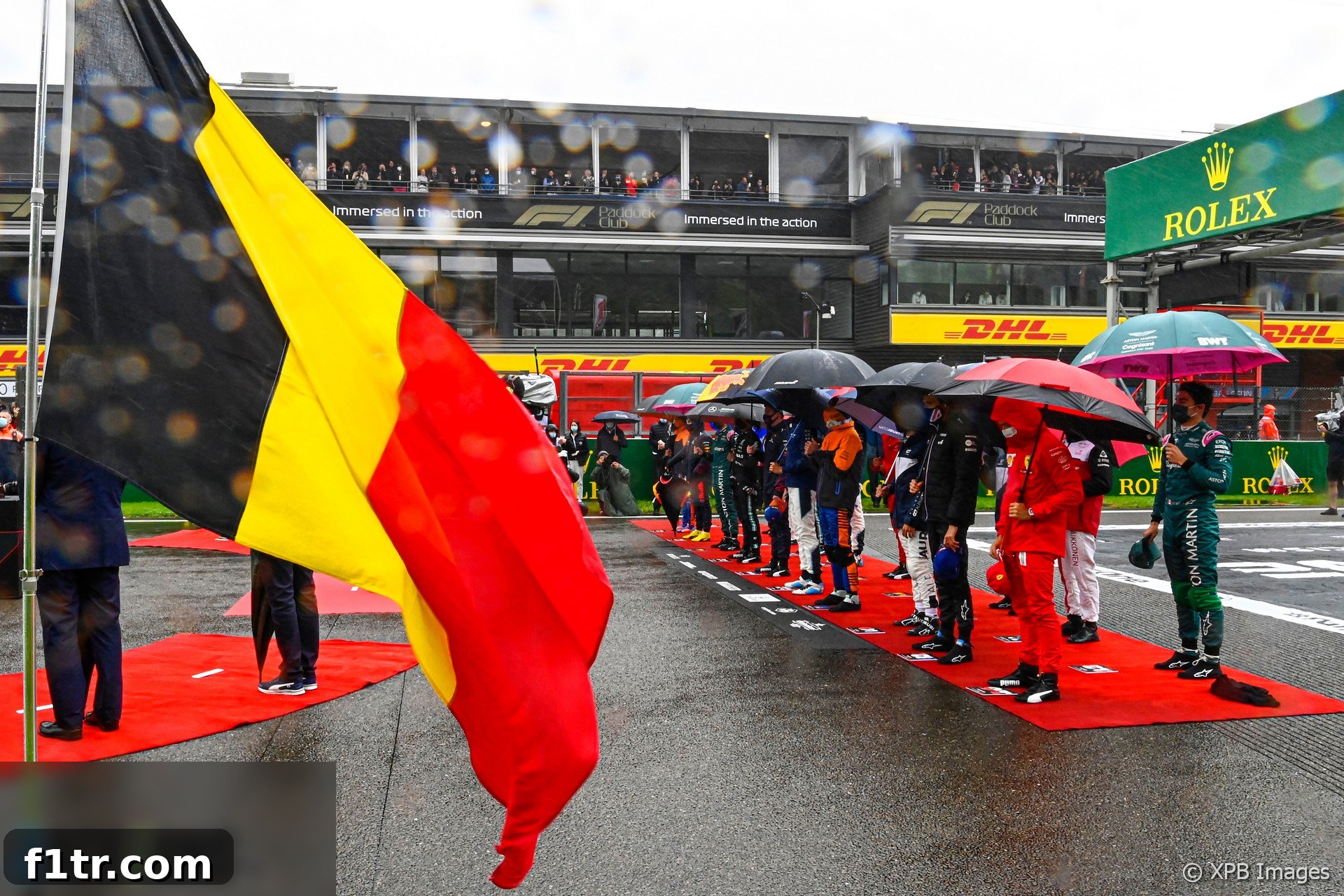
The 2021 Formula 1 Belgian Grand Prix at Spa-Francorchamps left a bitter taste for loyal fans, both trackside and watching from home. What promised to be a thrilling spectacle on one of motorsport’s most iconic circuits quickly devolved into a farcical display of poor decision-making and miscommunication. Television viewers were kept in suspense, often misled by speculative reports about a possible postponement to Monday, a notion that a paddock insider reveals was logistically impossible. This account from the heart of the paddock brings to light the frustrations, behind-the-scenes whispers, and the eventual shame of a weekend that Formula 1 would rather forget.
The Ill-Fated Belgian Grand Prix: A Paddock Insider’s Account
Saturday: Navigating the Storm, On and Off Track
My journey to Spa on Saturday morning, typically a routine commute, began with an unexpected struggle. Despite allocating an extra 30 minutes over Friday’s travel time, local police redirected me from the designated F1 personnel-only roads, claiming my pass – identical to the one accepted without question on Friday and later on Sunday – was “wrong.” This bureaucratic mix-up thrust me into heavy public traffic, turning what should have been an hour-long trip into a frustrating ordeal lasting well over two hours. It felt like a portent of the disorganization that would define the weekend.
This wasn’t an isolated incident. I overheard similar tales of woe from fellow media colleagues, highlighting a perplexing inconsistency in how local officials applied access rules. Clearly, there was a significant lack of training regarding the complex hierarchy of F1 car passes, which range from essential service supply permits and full team credentials to media, VIP, and specific spectator parking zone passes. Such basic operational inconsistencies foreshadowed the larger logistical failures to come.
Despite the chaotic start, a late Friday evening tip-off regarding the final leg of F1’s 2021 calendar kept me focused. After meticulously verifying the details from the car, I managed to reach the media centre just in time to break the news ahead of its official publication. For freelance journalists, timing is everything, especially when it comes to securing travel arrangements. Flight and hotel fees can quadruple once dates are officially confirmed, making immediate rebooking a high-stakes race against time that every cent counts in.
My plan to capture the breathtaking sight of cars tackling Eau Rouge during FP3 was thwarted. My request for a journalist tabard, essential for trackside access, was denied due to Covid-19 protocols; it would have required passing through public areas, breaching the stringent health codes. Trackside photographers operated under different rules, segregated in their own bubbles without paddock access. This was a significant disappointment, as I had eagerly anticipated witnessing the raw power of Max Verstappen and Lewis Hamilton navigating that legendary corner on full wet tyres. The incessant rain also severely hampered face-to-face interactions with team personnel, who naturally sought shelter indoors. With media forbidden from entering hospitality units due to Covid restrictions, direct sourcing became a challenge, though a few dedicated contacts braved the downpour for a chat.
Paddock Whispers: The Driver Market Heats Up
Amidst the rain-soaked paddock, a crucial piece of driver market news began to solidify. I learned that Alfa Romeo was preparing to announce Valtteri Bottas as Kimi Raikkonen’s replacement, a development I had first revealed in early July. The timing for this announcement was set for Monza, Alfa Romeo’s home race. This imminent move explained the delays in officially confirming George Russell at Mercedes. The information aligned perfectly with two recent statements from Toto Wolff: that Mercedes had made its final decision regarding Hamilton’s 2022 teammate and would confirm its line-up in September. Yet, I was somewhat surprised when Williams CEO Jost Capito later expressed to me that he had not yet been informed if a decision had indeed been made about his driver’s future. More revelations from him were clearly on the horizon.
Russell’s Masterclass: A Star is Born (Almost)
During qualifying, as the rain intensified, I found myself contemplating a bet on George Russell for a top-three grid slot. Not being a betting man, I refrained – a decision I would immediately regret. Russell delivered an absolutely sensational session, defying expectations to secure a stunning second place on the grid. At the subsequent press conference, I seized the opportunity to question Lewis Hamilton, who had previously shown lukewarm enthusiasm about Russell joining Mercedes, whether his opinion had shifted after the young Williams star outqualified both Mercedes drivers despite demonstrably inferior equipment.
Hamilton’s response was characteristically composed, yet revealing. “I don’t feel any different,” he stated. “I mean, George has been doing a great job all year. This just doesn’t really change anything. I’m sure he’s got pressure on him just as Valtteri does to do the job. And it’s great to see him delivering. I can’t fault him for it.” A British media colleague later observed the world champion’s stony expression, remarking, “That sure was said through gritted teeth.” We agreed that Russell’s stellar performance was probably the worst 32nd birthday present Valtteri Bottas could have wished for, further complicating his future.
The circuit departure at 7pm was unusually swift, with minimal traffic. Most fans had already abandoned the premises immediately after qualifying, seeking refuge from the relentless rain and heading back to their by-then muddy camping sites. Being an F1 fan at Spa often feels like a masochistic endeavor, and sadly, Sunday would bring no respite from the misery.
Sunday: The Race That Never Was, And Its Aftermath
Sunday dawned with an equally wet but less complicated commute to the circuit, allowing me to settle into the media centre by 9 am. My morning began with managing visa formalities for the upcoming Russian and US Grands Prix, a stark reminder of the global nature of F1, before shifting focus to the unfolding drama of the day.
Peculiar Paddock Shuttles and Brand Dilution
A curious detail caught my attention: the paddock shuttles, which transport media and other personnel, were no longer the familiar Mercedes V-Class minibuses. At Spa, Renault SUVs were in use, which was understandable given the brand’s presence in F1. However, high-rollers and VIPs, eager to keep their expensive designer shoes dry, were being ferried to and from the exclusive Paddock Club in Volvos and KIAs – brands conspicuously absent from Formula 1’s commercial landscape. This struck me as an extraordinary oversight, a symbolic “slap in the face” to F1’s official brand partners, and prompted further investigation.
It transpired that Mercedes had ceased supplying shuttles last year, a change largely unnoticed due to Covid-19 restrictions that had banned such services until this event (golf carts ferried media in Budapest). This year, Mercedes intensified its policy, no longer providing race control or VIP shuttle vehicles, save for the (now red) safety and medical cars at 50% of the events, with Aston Martin servicing the remaining races. Consequently, the Grand Prix promoter was left to source vehicles from various providers. This created the somewhat absurd scenario where a Mercedes VIP, accustomed to luxury and brand alignment, might be transported to their $5,000 hospitality suite in a Kia Niro, a stark symbol of diluted brand integrity within the sport.
Culinary Comforts Amidst the Chaos
Some readers have inquired about the scarcity of culinary details in recent paddock diaries. The simple truth is that due to Covid-19 protocols, the much-appreciated team hospitality, with its diverse offerings, is no longer accessible to the media. Our sustenance now comes exclusively from the media centre fare. This varies significantly across venues: from basic ham and/or cheese baguettes with slot machine coffee in Monaco to lavish three-course meals in Austria. At Spa, we were treated to a variety of local delicacies, including the ubiquitous and much-appreciated Belgian waffles, even without the customary frites.
The Unfolding Farce: False Hopes and Wasted Dreams
As the scheduled race start time approached, it became painfully clear that the event faced massive disruption. Yet, the official line from both the FIA and Formula 1 remained stubbornly vague: “we will have a race of sorts” – a phrase that, in hindsight, proved chillingly prophetic. This ambiguity only prolonged the agony for thousands of fans who had braved the elements, many having saved for a year to cover the considerable costs of attending a Grand Prix and dreaming for weeks of witnessing their heroes in action. To them, the handling of the event felt cynically dismissive, a profound betrayal by those who should have known better. In my 350 F1 races, I have been ashamed of my pass thrice: at the 2000 British Grand Prix, the 2005 United States Grand Prix, and yesterday at Spa. Each time, my heart cringed for the thousands of disillusioned fans. While this accounts for only 1% of my attendance, it’s a percent too many.
The Great Deception: Why a Monday Race Was Never an Option
Television viewers also deserved far better, particularly from certain commentators who spouted absolute nonsense to fill airtime, fueling anger and false hope. Any so-called experts who genuinely believed that the race could be staged on Monday desperately need to brush up on the intricate logistics of staging a Grand Prix before next weekend’s race at Zandvoort. The idea of a Monday race was, to put it mildly, preposterous. Staging an F1 event, even under normal circumstances, is an monumental undertaking. To unexpectedly extend it by a day with fans present would have required at least 2,000 support staff and officials – including marshals, medical personnel, and track safety crews – all of whom would need to be accommodated overnight at short notice. The vast majority of these individuals are volunteers or have other full-time jobs and family commitments; they dedicate their time, usually free of charge, to the sport they love. Expecting them to spontaneously commit to an additional day, often taking time off from their primary employment, is simply unrealistic. Medics, for instance, have hospital shifts and other responsibilities they cannot simply abandon.
Furthermore, from a fan perspective, a race staged without ticket holders would open an unprecedented legal can of worms, given the significant investment in tickets, travel, and accommodation. Forcing a postponement would also disrupt the tightly packed F1 calendar, with the Dutch Grand Prix at Zandvoort scheduled for the very next weekend. Rearranging freight, personnel, and equipment with such a tight turnaround would be a logistical nightmare, if not an impossibility. Beyond these insurmountable challenges, weather forecasts for Monday were even grimmer, predicting more rain. While events certainly conspired against F1 on Sunday, a significant number of contributory factors were well within the sport’s gift. Better planning, foresight, clearer communication, and perhaps a more flexible approach to race formats could have averted this widely condemned farce. The lack of decisive action and transparent messaging only compounded the frustration.
A Muddy Farewell: The Bitter End for Fans
I delayed my departure from the circuit until 11 pm, as every traffic map displayed massive congestion in all directions. Social media feeds painted a vivid picture of the chaos, showing tractors valiantly dragging cars out of sodden parking fields. Apparently, some enterprising farmer capitalized on the misery, charging €20 per vehicle for extraction, reportedly earning thousands of euros. This final indignity simply added insult to injury for the bedraggled, disappointed fans, whose unforgettable Grand Prix experience was memorable for all the wrong reasons.
Conclusion: Lessons Learned from Spa’s Storm
The 2021 Belgian Grand Prix will undoubtedly be remembered as a low point in recent Formula 1 history. It highlighted critical issues, from inconsistent local event management and the strains of pandemic protocols on media access to the profound impact of adverse weather and the urgent need for more robust contingency planning. Most importantly, it underscored the sport’s responsibility to its most vital asset: its passionate global fanbase. Moving forward, Formula 1 must learn from the Spa debacle, ensuring that such a farcical situation never again leaves spectators, drivers, and teams feeling so utterly let down.
Related Content
2021 Belgian Grand Prix
- Spa spectators who saw no racing offered prize draw for 2022 tickets
- ‘Wrong to award points for a couple of laps behind the Safety Car’ – Horner
- Hamilton offers “exclusive gift” to fans who attended Belgian GP wash-out
- Change rules to give points for qualifying if race can’t happen – Seidl
- “I apologised to the entire team for my mistake” – Perez
Browse all 2021 Belgian Grand Prix articles