F1 Stewards Uphold Fernando Alonso’s Penalty After Aston Martin’s Review Request Denied
Formula 1 stewards have dismissed Aston Martin’s official request to review the penalty handed to Fernando Alonso. The two-time world champion received a ten-second penalty and three penalty points for his collision with Carlos Sainz Jnr during the high-intensity sprint race at the Chinese Grand Prix two weeks prior. The decision was reached after a video conference held in Miami, just ahead of this weekend’s round.
Aston Martin had formally petitioned the FIA to reconsider the sanction, arguing that new evidence, specifically previously unavailable forward-facing onboard camera footage from Alonso’s car, would shed new light on the incident. This footage, they contended, presented a fresh perspective, suggesting the clash was a racing incident rather than an infraction warranting a penalty against their driver.
The core of the review process hinges on strict criteria outlined in the FIA International Sporting Code. For a review to proceed, the petitioner must present a “significant and relevant new element” that was “unavailable to the parties seeking the review at the time of the decision concerned.” While the stewards acknowledged that Aston Martin’s submitted footage met the “new” and “relevant” criteria, they ultimately concluded it was not “significant” enough to warrant a re-evaluation of their initial verdict. This distinction proved pivotal in their dismissal of the appeal.
The Shanghai Sprint Race Collision Unpacked
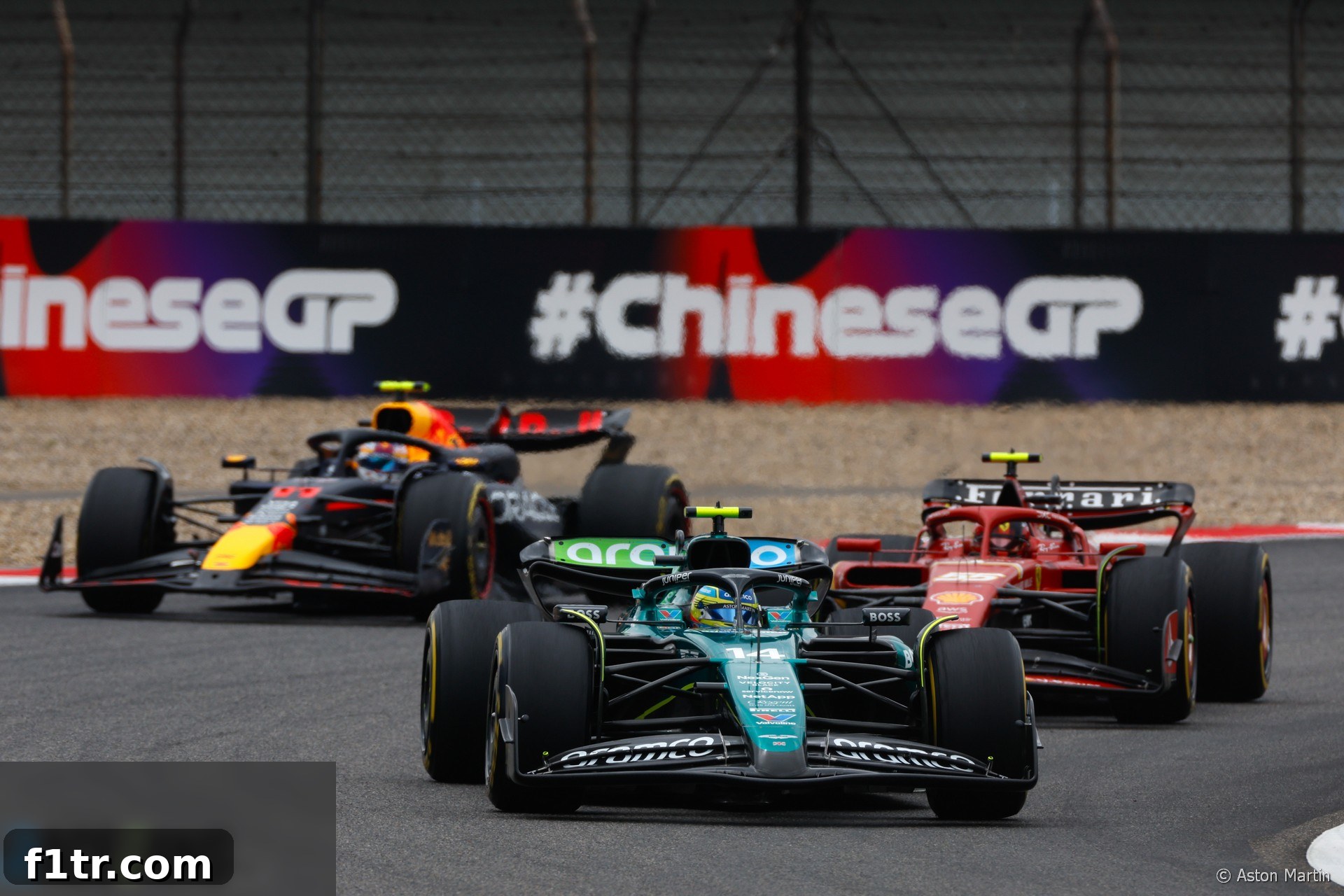
The incident in question occurred with just four laps remaining in the thrilling Chinese Grand Prix sprint race. Fernando Alonso, driving for Aston Martin, and Carlos Sainz Jnr of Ferrari, were locked in a fierce battle for a podium position, specifically third place. As the race approached its climax, the intensity between the two seasoned drivers escalated, leading to the controversial contact.
Sainz executed a decisive overtake on Alonso exiting Turn 6, successfully navigating through the sweeping Turns 7 and 8. Not one to yield easily, Alonso immediately attempted to reclaim his position. He launched a counter-attack, aiming to re-pass the Ferrari into the tight left-hander at Turn 9. However, in the heat of the moment, the two cars made contact. The collision pushed both drivers wide off the racing line, creating an opportune moment for Sergio Perez, who had been closely following the pair, to capitalize and overtake both rivals, securing third place for himself.
While the penalty handed to Alonso amounted to ten seconds, it did not alter his finishing position as he had already retired from the sprint race due to significant damage sustained from the contact. More impactful, perhaps, were the three penalty points added to his Super Licence, bringing his total to six. This accumulation of penalty points serves as a critical concern for drivers, as a tally of 12 points within a 12-month period results in an automatic race ban.
Stewards’ Review Process and Rationale
Aston Martin’s submission for a right of review prompted a formal video conference on Friday morning in Miami, bringing together representatives from both Aston Martin (Messrs. Mike Krack and Andy Stevenson) and Ferrari (Mr. Diego Loverno), alongside FIA officials (Messrs. Nikolas Tombazis and Tim Malyon).
The focus of this hearing was to rigorously assess whether the evidence presented by Aston Martin satisfied the stringent conditions set forth in Article 14 of the FIA International Sporting Code. This article dictates that stewards, at their sole discretion, must determine if a “significant and relevant new element is discovered which was unavailable to the parties seeking the review at the time of the decision concerned.”
Aston Martin argued that the new forward-facing camera angle from Alonso’s car was indeed “significant” because, according to their submission, it showed “more clearly than any other evidence considered by the stewards and/or the parties to date, that car 14 was in a position of the incident which entitled it to be given room whilst attempting to overtake on the inside of turn nine pursuant to the Guidelines.” They also contended it was “relevant” as it showed the entirety of the incident for the first time, and “new” because it wasn’t available during the initial hearing.
Despite these arguments, the stewards remained unconvinced about the ‘significance’ of the new footage. Their detailed explanation clarified that while the footage was undeniably “new” (having been downloaded post-session and unavailable initially) and “relevant” (directly pertaining to the incident), it lacked the crucial “significant” element. The stewards stated that the existing footage they had access to at the time of the original decision was sufficient for their initial judgment. They concluded that the new camera angle “would not have caused us to question our decision or otherwise give us a perspective that we did not already have of the incident” and “added nothing material to the visual perspective that we already had.”
Consequently, the stewards determined that the evidence submitted by Aston Martin did not meet the stringent criteria necessary to justify holding a full review of the initial decision. This upholds the high bar set for challenging stewards’ verdicts in Formula 1, underscoring the finality of their initial rulings unless truly groundbreaking and determinative new evidence emerges.
Precedent and Consistency in FIA Rulings
This decision aligns with previous rulings by the FIA stewards in similar circumstances, reinforcing a consistent approach to the “right of review” clause. A notable precedent occurred during the highly contentious 2021 season. Following a dramatic incident between Max Verstappen and Lewis Hamilton at the Brazilian Grand Prix, Mercedes sought a review, submitting previously unavailable forward-facing footage from Max Verstappen’s car.
In that instance, much like with Alonso’s case, the stewards also turned down Mercedes’ request. Their reasoning was remarkably similar: despite the footage being new and relevant, it did not provide a “significant” new element that would alter their original understanding or decision regarding the on-track clash. This consistent application of Article 14 underscores the FIA’s commitment to maintaining a robust and challenging threshold for reopening investigations into race incidents.
Such consistency is vital for maintaining the integrity and perceived fairness of the sport’s judicial process. It sends a clear message to teams that appeals based on marginally different perspectives, rather than genuinely game-changing evidence, are unlikely to succeed. The emphasis remains on the quality and impact of the new evidence, not merely its novelty.
Stewards’ Official Decision in Full
Petition for the Right of Review
1. On April 23, 2024, the stewards received a petition from Aston Martin Aramco F1 Team (“Aston Martin”) requesting a Right of Review in accordance with Article 14 of the FIA International Sporting Code (“the Code”).
2. The request related to the decisions of the stewards contained in documents number 40 (Infringement on car 14 for a breach of Appendix L, Chapter IV, Article 2d) of the FIA International Sporting Code) (“ALO Decision”) and number 41 (Final Sprint Classification) from the 2024 Chinese Grand Prix.
3. A hearing was convened at 0800hrs EST on 3rd May 2024 and the concerned parties were summoned (document numbers 78 to 79).
4. The stewards of the Chinese Grand Prix conducted the hearing.
5. Attending the hearing were:
On behalf of Aston Martin – Messrs. Mike Krack and Andy Stevenson
On behalf of Scuderia Ferrari (“Ferrari”) – Mr Diego Loverno
On behalf of the FIA – Messrs Nikolas Tombazis and Tim Malyon
6. This hearing was to determine, at the sole discretion of the stewards (as specified in Article 14.3 of the Code), if “a significant and relevant new element is discovered which was unavailable to the parties seeking the review at the time of the decision concerned”.
7. Therefore, the stewards were required to determine if any evidence presented to them was:
a. “significant”;
b. “relevant”;
c. “new”; and
d. “unavailable” to the party seeking the review at the time of the original decision.
8. Only if that criteria is met, would the stewards be required to convene a further hearing to reconsider their original decision.The Test under Article 14.1.1
9. Article 14.1.1 sets a very high bar for reviewing a decision of the Stewards. This has been the consistent position taken in previous requests to exercise the right of review.
Alleged New Element
10. The alleged new element presented was a forward-facing video footage of car 14 which was unavailable to Aston Martin and the stewards at the time of the original decision – it was downloaded post the sprint session by F1.
11. While the Stewards had various other footage of the incident from different camera angles, they did not have this footage.
12. In its written submission seeking the review, Aston Martin suggested that the new camera angle showed that the incident in question was a racing incident and not one for which their driver should be penalised.
13. They contended, among other things, that:
a. The new footage was “significant” because it showed “more clearly than any other evidence considered by the stewards and/or the parties to date, that car 14 was in a position of the incident which entitled it to be given room whilst attempting to overtake on the inside of turn nine pursuant to the Guidelines”;
b. The new footage was “relevant” as it showed for the first time the entirety of the incident; and
c. The new footage was “new” as it was not available during the hearing.
14. During the hearing, Aston Martin maintained the above points and sought to convince us that this satisfied the threshold in Article 14.Our Decision
15. While the footage was undoubtedly “new”, as it was unavailable to us during the hearing, there was sufficient footage from other camera angle to give us a clear basis to make the decisions in Documents 40 and 41.
16. The footage would also be “relevant” given that it related specifically to the incident in question.
17. However, even though we did not have this footage at the time we made our decision, we did not consider the footage to be a “significant” new element. The new footage would not have caused us to question our decision or otherwise give us a perspective that we did not already have of the incident.
18. While it showed the incident from a different angle, it added nothing material to the visual perspective that we already had.
19. We accordingly dismissed the petition for review, without the need for us to proceed to the second stage of the review.Competitors are reminded that, in accordance with Article 14.3 of the Code, this decision is not subject to appeal.
Decisions of the stewards are taken independently of the FIA and are based solely on the relevant regulations, guidelines and evidence presented.
Implications for Alonso and Aston Martin
The stewards’ decision to dismiss Aston Martin’s petition means that Fernando Alonso’s 10-second penalty and the three associated penalty points stand. While the time penalty itself had no practical effect on his sprint race result due to his retirement, the penalty points contribute to his overall tally on his Super Licence. With six points accumulated, Alonso is halfway to the threshold that would trigger a race ban, a scenario both he and Aston Martin will be keen to avoid throughout the remainder of the season.
For Aston Martin, the denial represents a missed opportunity to overturn a controversial decision and clear their star driver’s record. It highlights the rigorous nature of the FIA’s review process and the exceptionally high bar that must be met to challenge a stewards’ ruling. Moving forward, the team will need to accept the decision and focus their efforts on upcoming races, ensuring their drivers operate within the strict boundaries enforced by the sport’s governing body.
This ruling reinforces the F1 stewards’ commitment to their initial judgments, emphasizing that only genuinely groundbreaking, undeniable new evidence can alter a decision. It underscores the pressure on drivers to race cleanly and the responsibility teams bear in understanding and adhering to the FIA International Sporting Code.
Related Articles: 2024 Chinese Grand Prix
- Alonso and Sainz incidents prompt changes to Formula 1’s rules
- Aston Martin fail in bid to have Alonso’s Shanghai penalty reviewed
- Mercedes cleared over Hamilton pit stop infraction as ‘nearly all teams in breach’
- Aston Martin petitions FIA to review Alonso’s penalty for Sainz collision
- “You need to be more on it”: 12 unheard radio exchanges from the Chinese GP
Browse all 2024 Chinese Grand Prix articles