The Shifting Landscape: Do F2 and F3 Championships Still Pave the Way to Formula 1?
The exhilarating world of Formula 1’s primary feeder series, Formula 2 and Formula 3, consistently delivers thrilling on-track action and intense championship battles. Spectators are regularly treated to nail-biting finishes and remarkable talent showcases. Yet, beneath the surface of this excitement, persistent questions linger regarding the true value of these championships as a direct pathway to motorsport’s pinnacle: Formula 1.
The recently concluded racing weekend offered a perfect microcosm of this evolving dynamic. The Formula 3 title fight, for instance, reached a dramatic crescendo, seemingly decided by a final-corner lunge that exemplified raw racing talent and fierce determination. Meanwhile, the Formula 2 points battle saw unexpected twists, tightening the championship chase and promising more drama ahead. However, these very events simultaneously fueled a growing debate: are these prestigious junior titles still the definitive ticket to an F1 seat, or is the path becoming increasingly unconventional?
Advert | Become a Supporter & Go Ad-Free
The F3 title decider was a proper barnstormer, a testament to the high-stakes racing inherent in these series. Gabriele Mini and Leonardo Fornaroli pushed each other to the absolute limit, with the championship hanging in the balance until the very last corner. Fornaroli’s decisive move past Christian Mansell was a moment of pure sporting theatre, appearing to secure the crown in a spectacular fashion. While Mini’s subsequent post-race disqualification for a technical infringement may have technically altered the record books, it did not diminish the incredible effort and skill displayed by all contenders. Such on-track heroics are precisely what fans expect from Formula 3.
However, the sense of accomplishment for these F3 hopefuls might have been tinged with an unexpected reality check. The same weekend brought news that significantly challenged the traditional narrative of progression. Many in the F3 paddock, including the championship contenders themselves, could be forgiven for feeling a degree of deflation, realizing that their arduous journey through the feeder series might not be the only — or even the primary — route to Formula 1.
Andrea Kimi Antonelli: The New Blueprint for F1 Promotion?
Just a day before the F3 title was decided, Mercedes-AMG Petronas F1 Team made a groundbreaking announcement: their highly-touted junior driver, Andrea Kimi Antonelli, would be promoted to their Formula 1 team for the upcoming season. This news sent ripples through the motorsport community, not just because of Antonelli’s undeniable talent, but because of his unconventional and accelerated path.
Antonelli has had a remarkably short stint in F1’s officially designated feeder championships. He entirely skipped the FIA Formula 3 series, a traditional stepping stone, and is currently only two-thirds of the way through his maiden season in Formula 2. For those who view F2 and F3 as the natural, mandatory rungs on the ladder to F1, Antonelli’s rapid ascent begs the question: how can a driver earn such a coveted promotion after spending so little time proving himself in these competitive categories?
Antonelli’s trajectory stands in stark contrast to that of his predecessors in the Mercedes junior program, such as George Russell, who meticulously climbed the ladder, winning both the GP3 (now F3) and F2 titles in consecutive seasons before earning his F1 opportunity. Similarly, Ferrari academy graduate Charles Leclerc followed an identical path, as did McLaren’s Oscar Piastri. These drivers demonstrated consistent dominance across the junior categories, accumulating impressive championship accolades that seemingly validated their readiness for the premier class. Antonelli’s promotion, therefore, signals a significant shift in how F1 teams evaluate and select future talent, suggesting that traditional championship success in feeder series might no longer be the sole, or even primary, determinant.
Advert | Become a RaceFans Supporter andGo Ad-Free
Oliver Bearman and the Complexities of F1 Aspirations
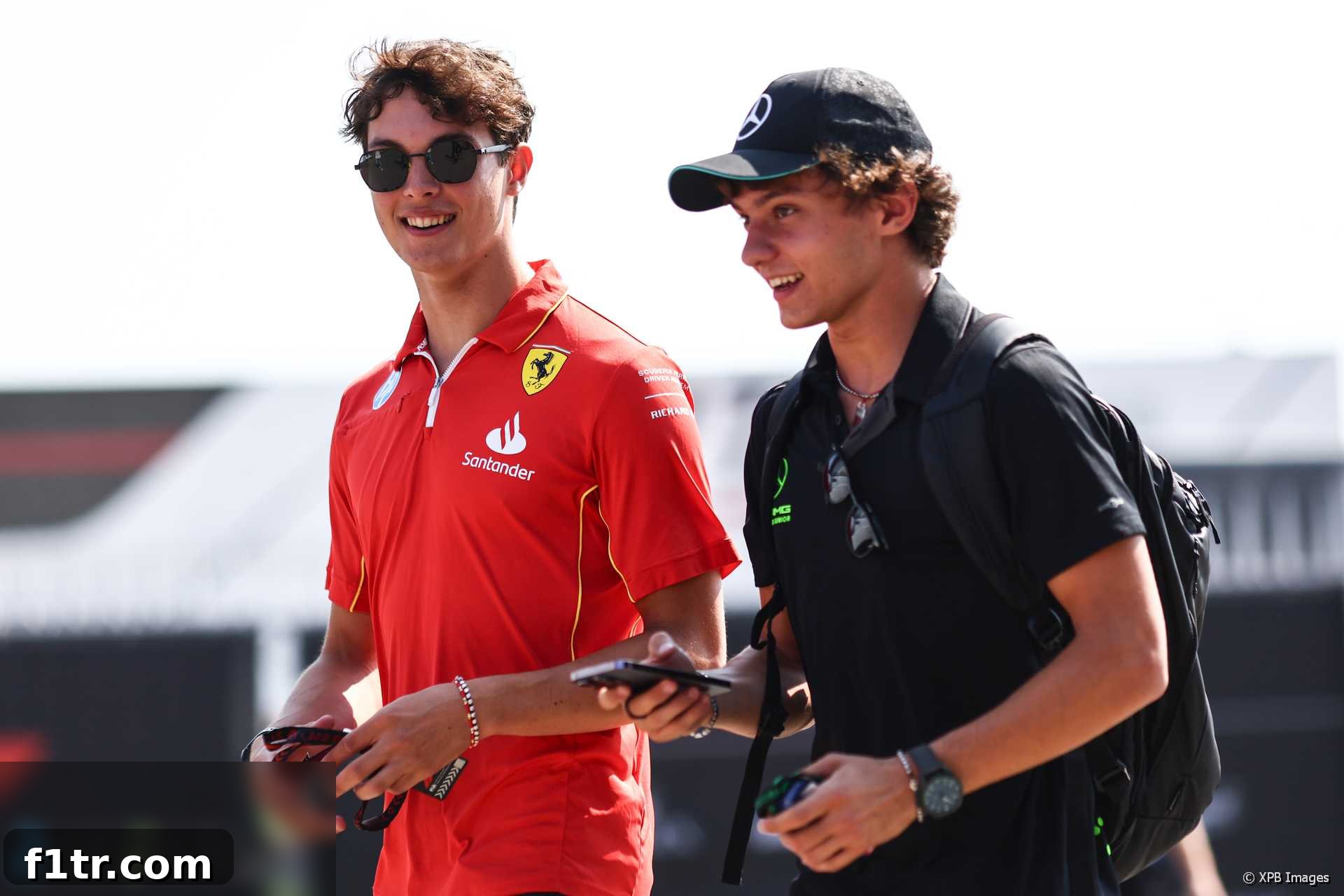
Antonelli is not an isolated case in this evolving narrative. Another prominent example is his Prema team mate, Oliver Bearman. Like Antonelli, Bearman announced his impending graduation to F1 at his home round of the championship just two months prior. Despite this F1 confirmation, Bearman’s position in the current F2 standings is a modest 14th. While his enforced absence from the Jeddah round, where he commendably substituted for Carlos Sainz Jnr at Ferrari, undoubtedly hampered his points tally and would likely have placed him comfortably within the top 10, his championship standing still doesn’t scream ‘F1-ready champion’.
These cases clearly illustrate that a lack of outright championship success at the F2 level does not necessarily prevent drivers from moving up to Formula 1. Conversely, the inverse is also true: winning the F2 title offers no guarantee of a grand prix seat. Just ask Theo Pourchaire, last year’s F2 champion, who has spent this year competing in IndyCar and Super Formula, struggling to find an F1 opening. His predecessor, Felipe Drugovich, is a prime example; a talented F2 champion now part of Aston Martin’s junior driver program, yet with F1 seats at that team filled until at least 2027.
This phenomenon isn’t entirely new. Even in its former guise, GP2, several champions – Fabio Leimer, Davide Valsecchi, and Giorgio Pantano (whose F1 debut predated his 2008 GP2 title) – never made it to the F1 grid or had very limited F1 careers despite their junior series triumphs. What has changed, however, is the increasing frequency and prominence of drivers like Antonelli and Bearman, whose F1 promotions seem to bypass the traditional metrics of feeder series success.
Beyond the Junior Categories: What F1 Teams Really Look For
Mercedes clearly views Andrea Kimi Antonelli as a special talent. Their confidence in him stems less from his F2 results and more from his performances in an actual Formula 1 car. Most of these evaluations have taken place away from the public eye, in private test sessions, offering F1 teams an unfiltered glimpse into a driver’s raw speed and adaptability. While his widely publicized six laps at Monza ended in a crash, it’s the consistent data from these extensive private tests that has truly impressed the team. Even his rivals in the feeder series acknowledge his innate ability to compete at the highest level.
“I think Kimi deserves to be in Formula 1, to be honest,” stated Gabriel Bortoleto, current F2 frontrunner, in an interview with RaceFans. “He’s a very young guy, just turned 18, with so much pressure on his shoulders. So many people making hype around him and everything, it’s not easy to perform in the circumstances.” Bortoleto’s insight highlights the immense scrutiny on young talents. He further explained, “But F1 teams have so much more ability to analyse data and analyse performances from their drivers than fans, because obviously fans don’t have our data.” This candid admission underscores a crucial point: F1 teams possess proprietary data and evaluation tools that go far beyond public perception or even championship standings in junior categories.
Advert | Become a RaceFans Supporter andGo Ad-Free
For those F2 champions who, despite their achievements, failed to secure an F1 seat, Bortoleto believes unfortunate timing played a significant role. “They were champions, they deserve a Formula 1 seat but the opportunity never came to them,” he elaborated. “Obviously Drugovich is in Aston Martin and a seat has never been open since he entered the academy. I’m quite sure that if there was a seat available, he would have been the one to get the seat.” This perspective highlights the bottleneck created by limited F1 grid slots and long-term driver contracts, which can often leave even highly deserving junior champions on the sidelines.
The Disconnect: F2/F3 as a Ladder vs. F1 Driver Evaluation
This complex situation points to a fundamental issue with viewing F1’s two premier junior series as an infallible ladder that inevitably leads to the championship. F1 teams are ultimately searching for drivers who can extract the absolute maximum performance from an F1 car, consistently and quickly. And while F2 and F3 are undoubtedly high-level competitive environments, they don’t always perfectly simulate or reveal that specific F1-calibre aptitude.
Consider the stark differences between an F2 car and an F1 machine. While both are single-seaters, F1 cars boast significantly more power, advanced hybrid systems, complex aerodynamic packages, and bespoke tire compounds that demand a distinct driving style and profound understanding. F2 cars, by design, are more standardized, with limited setup options. This means a driver’s ability to adapt to a specific F1 car’s nuances, work with engineers on advanced setups, and manage the incredibly complex power unit is often better demonstrated in private F1 testing rather than through F2 race results. Furthermore, the inherent reliability issues that sometimes plague F2 seasons can unfairly impact championship standings, distorting a true reflection of driver performance. The reverse grid races in F2, while providing exciting entertainment, also mean that single-lap qualifying pace, a crucial F1 metric, is not always rewarded as highly in the championship structure. These systemic differences highlight why championship points in F2 may not perfectly correlate with F1 readiness.
Oliver Bearman’s compelling performances for Haas in Formula 1 practice sessions last year undoubtedly strengthened his case in the eyes of both Haas and Ferrari, demonstrating his capability in an F1 environment. Mercedes, similarly, identified Antonelli’s exceptional potential much earlier, tracing back to his karting days and continuously nurturing his talent through various junior formulas and private F1 tests. For these teams, direct F1 car feedback and long-term development plans often supersede the results of a single F2 or F3 season.
The Enduring Importance of Superlicence Points
Despite these challenges to their perceived ultimate value, F2 and F3 remain critically important. Their most undeniable and functional role is providing drivers with the best opportunity to accumulate the necessary Superlicence points required by the FIA to compete in Formula 1. Without meeting these stringent requirements, no driver, regardless of talent or F1 team backing, can legally race in the championship. This makes F2 and F3 indispensable as a pathway to accrue these essential points, ensuring that drivers meet a fundamental eligibility criterion for F1 graduation. However, while the superlicence points tally is non-negotiable, the actual championship points standings within F2 and F3 appear to hold less weight for F1 teams than other, more direct, performance indicators.
If the FIA and Formula 1 management were to introduce changes to the F2 regulations – perhaps by allowing more technological freedom, introducing more complex hybrid systems, or re-evaluating race formats to prioritize pure pace and consistency – the correlation between top F2 drivers and those deemed ready for F1 might improve. However, it will likely always be the case that F2 produces more F1-capable drivers than there are places to fill on the grand prix grid. This issue is only exacerbated as long as Formula One Management continues its restrictive stance on new entrants like Andretti, limiting the overall number of available seats.
Advert | Become a RaceFans Supporter andGo Ad-Free
The Talent Bottleneck and Future of Feeder Series
“There are so many good drivers at the moment in F2 and there’s only 20 F1 seats, so it’s not possible for those teams to put everyone in that’s good,” observed Richard Verschoor, now in his fourth season of F2, highlighting the intense competition and limited opportunities. “So sometimes people have to wait, like Oscar [Piastri], like Jack [Doohan], who now gets a chance.” Verschoor’s comments resonate deeply within the paddock. The sheer depth of talent in F2 often means that deserving drivers, even champions, must bide their time, hoping for a rare opening. This underscores the brutal reality that while F2 and F3 are excellent proving grounds, they are also crucibles that produce far more ready-to-race F1 talent than the sport can currently accommodate.
“So I do think it’s a good that promoting more young drivers into F1 and I hope they make the best of it,” Verschoor concluded, expressing a sentiment shared by many that while the path may be changing, the influx of fresh talent into F1 remains a positive development. The evolving landscape of F1 promotion signifies a shift from a purely linear progression through junior championships to a more multi-faceted evaluation process, heavily influenced by F1 team academies, private testing, and an acute understanding of a driver’s potential within the unique demands of Formula 1 itself. While the feeder series will continue to provide spectacular racing and crucial superlicence points, their role as the *sole* determinant of an F1 career is increasingly being redefined.
Further Reading: Formula 2 Insights
- Formula 2 to debut in Miami and Montreal after Iran war cancellations
- Ex-McLaren junior Dunne’s move to Alpine finally confirmed
- Schumacher says his IndyCar feels like ‘an F2 car, just with better tyres’
- The Formula 2 team with an older driver line-up than almost half the F1 grid
- FIA to award more F1 superlicence points to IndyCar drivers from 2026
Browse all Formula 2 articles