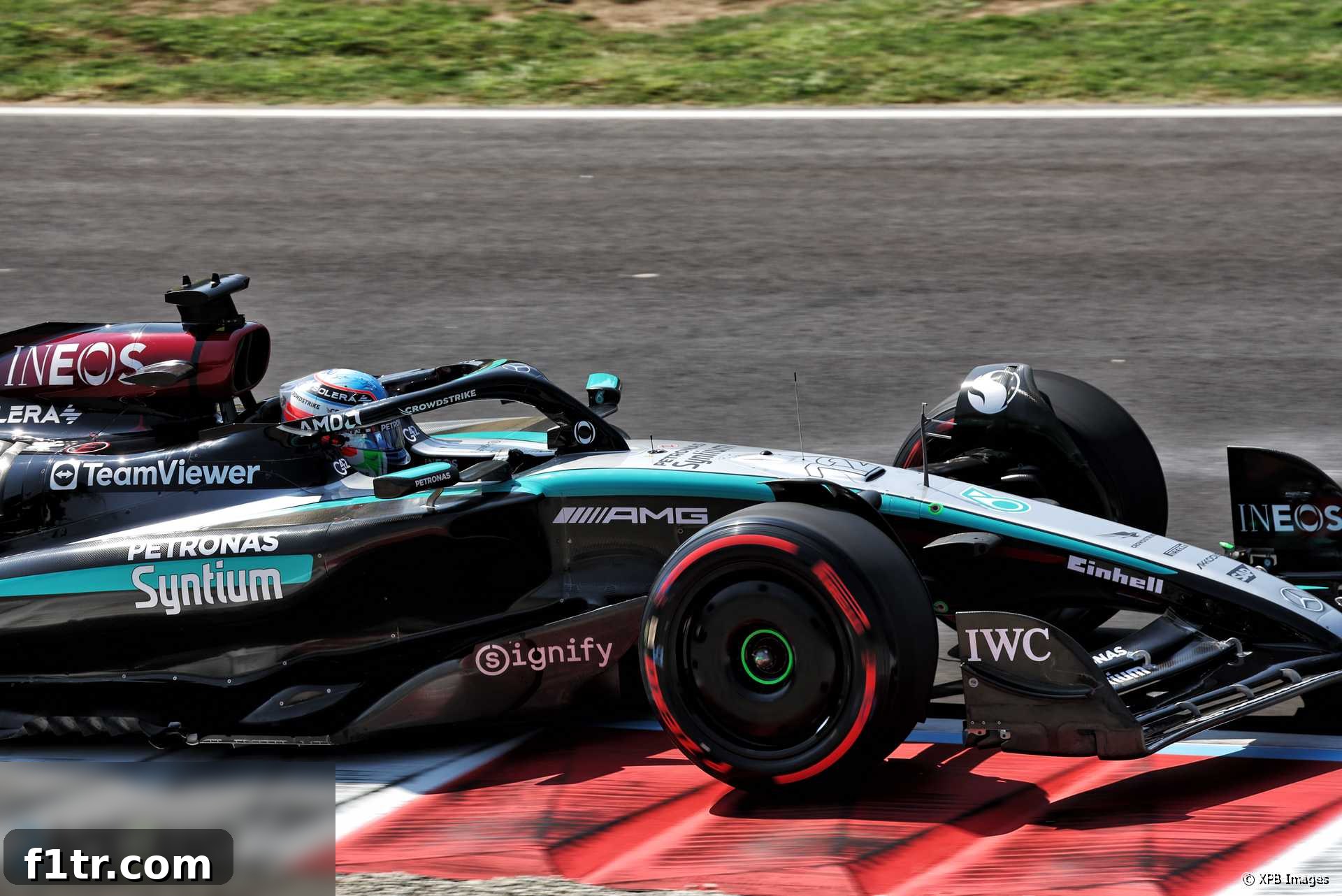
Andrea Kimi Antonelli Takes Responsibility for Monza FP1 Crash, Mercedes Remains Confident
In a highly anticipated Formula 1 debut that captivated fans and experts alike, Andrea Kimi Antonelli, Mercedes’ prodigiously talented junior driver, experienced a challenging start to his official F1 career. Making his first appearance in a Formula 1 free practice session at the iconic Monza circuit, Antonelli showed flashes of his widely acclaimed potential before a significant crash cut short his participation in the opening practice. The young Italian quickly accepted full responsibility for the incident, offering a sincere apology to the Mercedes-AMG Petronas F1 Team and his teammate, George Russell, for the damage incurred to the W15.
A Baptism of Fire: Antonelli’s F1 Debut at Monza
The Monza Grand Prix weekend was poised to be a momentous occasion for Antonelli, who has been widely tipped as a future star and a potential replacement for Lewis Hamilton at Mercedes in 2025. Stepping into George Russell’s car for the first free practice session, the 18-year-old Italian was under immense scrutiny, particularly given the home crowd atmosphere in Monza. From the outset, Antonelli demonstrated remarkable speed, briefly topping the timesheets in the early stages of the session – a testament to his raw talent and quick adaptation to Formula 1 machinery. This initial burst of pace only heightened expectations and offered a tantalizing glimpse of what he is capable of.
However, on his sixth lap, the dream debut took an abrupt turn. Pushing the limits in the challenging conditions of the final corner, Antonelli lost control of the Mercedes W15, spinning into the barrier. The impact was substantial, registering a G-force of approximately 52G. The accident not only brought an early end to his maiden F1 session but also necessitated extensive repairs to the car, which subsequently delayed George Russell’s start to the second practice session of the day.
Accountability and Lessons Learned: Antonelli’s Reflection
Following the incident, a visibly disappointed yet composed Antonelli addressed the media, directly confronting his mistake. “What a day,” he began, reflecting on the mixed emotions of his debut. “First FP1 done, unfortunately it ended quite quickly, because of the crash, it was quite a big one, around 52G.” His immediate thoughts turned to the team and his teammate, underscoring his sense of responsibility. “I’m really sorry to the team and George for making them work afterwards,” he stated, highlighting the extra burden his error placed on the dedicated Mercedes crew.
Antonelli’s self-assessment was candid and mature, acknowledging that his eagerness might have overridden caution. “It was just a mistake from my side, just pushing a bit too much for the conditions,” he explained. “I should have built the run up a bit more progressively. But definitely lesson learned for next time.” This reflective attitude, characteristic of promising young drivers, suggests a strong capacity for learning and improvement – qualities highly valued in the demanding world of Formula 1. The incident, while regrettable, served as a poignant reminder of the fine margins and unforgiving nature of top-tier motorsport, even for the most gifted talents.
Navigating a Double Challenge: F1 and F2 Commitments
The Monza weekend presented a unique challenge for Antonelli, as his F1 free practice session was sandwiched between his Formula 2 practice and qualifying sessions. This demanding schedule required him to quickly switch focus between two vastly different cars and competitive environments. Despite the emotional and physical toll of the F1 crash, Antonelli demonstrated resilience by returning to the F2 paddock and delivering a strong performance in qualifying, securing an impressive sixth position on the grid for Sunday’s feature race. This dual commitment highlighted the incredible mental fortitude and adaptability required from young drivers aiming for the pinnacle of motorsport.
Reflecting on the whirlwind day, Antonelli expressed gratitude despite his current feelings. “I’m really thankful to the team for making this possible and still great to see all the Tifosi out there and to get the first laps with all the drivers on-track,” he said, acknowledging the unique privilege of his debut. However, he admitted, “I’m not feeling super-well at the moment.” His immediate priority was clear: “I’m just going to go back and try to rest and try to focus for the rest of the weekend, because there’s still some races to go and we’re going to still try to get a good result.” This demonstrates his commitment to his F2 campaign, even amidst the drama of his F1 debut.
Toto Wolff’s Unwavering Confidence and Future Plans
Mercedes team principal Toto Wolff, a key figure in Antonelli’s career trajectory, quickly moved to reassure the young driver and the public that the FP1 crash would have “zero effect” on his highly anticipated decision regarding Lewis Hamilton’s replacement for the 2025 season. This unequivocal backing from Wolff sent a clear message about Mercedes’ long-term faith in Antonelli’s abilities, despite the setback.
“I think most important is to hire based on ability,” Wolff emphasized, articulating Mercedes’ core philosophy in driver selection. “And an FP1 that’s gone wrong is not the reason why you decide for or against the driver.” This statement powerfully reinforces the idea that true potential and talent are assessed over a longer period and through a broader lens than a single incident, particularly during a high-pressure debut. Wolff’s comments aim to shield Antonelli from undue pressure and maintain focus on his development path.
When questioned about potentially rescheduling Antonelli’s next confirmed FP1 appearance at the Mexican Grand Prix in two months’ time to offer an immediate confidence boost, Wolff remained firm in his developmental approach. “No, I think a strong driver needs to recover from these things and cope with the pressure,” he asserted. This highlights Mercedes’ belief in Antonelli’s mental resilience and their strategy of allowing him to navigate and learn from challenging experiences independently, rather than intervening with what might be perceived as special treatment. It underscores the rigorous demands placed on aspiring Formula 1 champions.
The Magnifying Glass of Monza: Pressure on a Young Prodigy
Wolff further elaborated on the unique circumstances surrounding Antonelli’s Monza debut, acknowledging the immense psychological burden on the young Italian. “You have all these shenanigans around you in Monza – an Italian kid that’s being hyped for the first time in a Mercedes. And that must be a heavy burden,” Wolff explained. Monza, with its fervent Tifosi and deep motorsport history, creates an unparalleled atmosphere, especially for a local hero making his debut for a top team. This level of attention and expectation, particularly for an 18-year-old who has bypassed Formula 3, adds a layer of complexity to an already challenging transition.
The Mercedes team principal’s insights shed light on the development curve of elite athletes. “If he wants to be a champion one day, he needs to cope with that, and I have no doubt that he can and he will,” Wolff stated with conviction. This perspective frames the crash not as a failure, but as an integral, albeit difficult, part of the learning process for a future F1 contender. It’s a trial by fire designed to forge character and resilience.
“In our industry, we perfectly understand who is capable and not,” Wolff reiterated, affirming Mercedes’ comprehensive evaluation process. He connected the crash to the broader narrative of Antonelli’s meteoric rise: “He’s jumped F3, he’s pretty much won everything beforehand then it’s clear you start to become a Mercedes driver, you test in FP1, and at the same time you’re under the magnifying glass because it all happens in Monza. And it has been a while that an Italian driver was in a top team.” These factors collectively created an extraordinary pressure cooker environment.
“So I’m sure that this can be a lot for an 18-year-old. But as I said before, he needs to swim. And these days that are so difficult, like it is for him at the moment, it feels certainly terrible and that’s part of the development curve,” Wolff concluded. His compassionate yet firm stance emphasizes that such challenges are essential for growth and for distinguishing true champions from the rest. The ability to overcome adversity, learn from mistakes, and maintain focus under intense scrutiny is paramount for success at the pinnacle of motorsport.
Underlying Performance and Future Potential
Despite the unfortunate ending to Antonelli’s FP1, Wolff was keen to highlight the underlying performance shown by the young driver. “I don’t want to be the one who picks out great moments and say ‘well, did you see that sector, did you see that lap time?’ Or ‘we could have been third or first’ or whatever,” Wolff remarked, cautioning against over-analyzing isolated moments. However, he quickly added, “But what we see is… there’s performance. And we’ve even seen that in the few laps that we’ve seen, but what he tried to do, the car can’t take.”
This statement is crucial. It suggests that Antonelli was pushing the limits of the car and track conditions, perhaps trying to extract more than was feasible at that precise moment. While it led to a mistake, it also speaks volumes about his ambition and natural speed. It indicates that the raw talent, which Mercedes values so highly, is undeniably present. The challenge now for Antonelli, with the continued support and guidance from Mercedes, is to refine this aggression, understand the limits of the machinery and conditions, and channel his immense potential into consistent, error-free performance.
Andrea Kimi Antonelli’s F1 debut at Monza was a stark reminder of the highs and lows inherent in motorsport. While the crash was a difficult moment, his immediate accountability, coupled with Toto Wolff’s unwavering confidence and insightful perspective, paints a picture of a young driver on a steep but promising learning curve. The incident, rather than derailing his future, appears to be an integral part of his development into a potential Formula 1 star, with Mercedes firmly committed to nurturing his talent on the path to the sport’s elite.