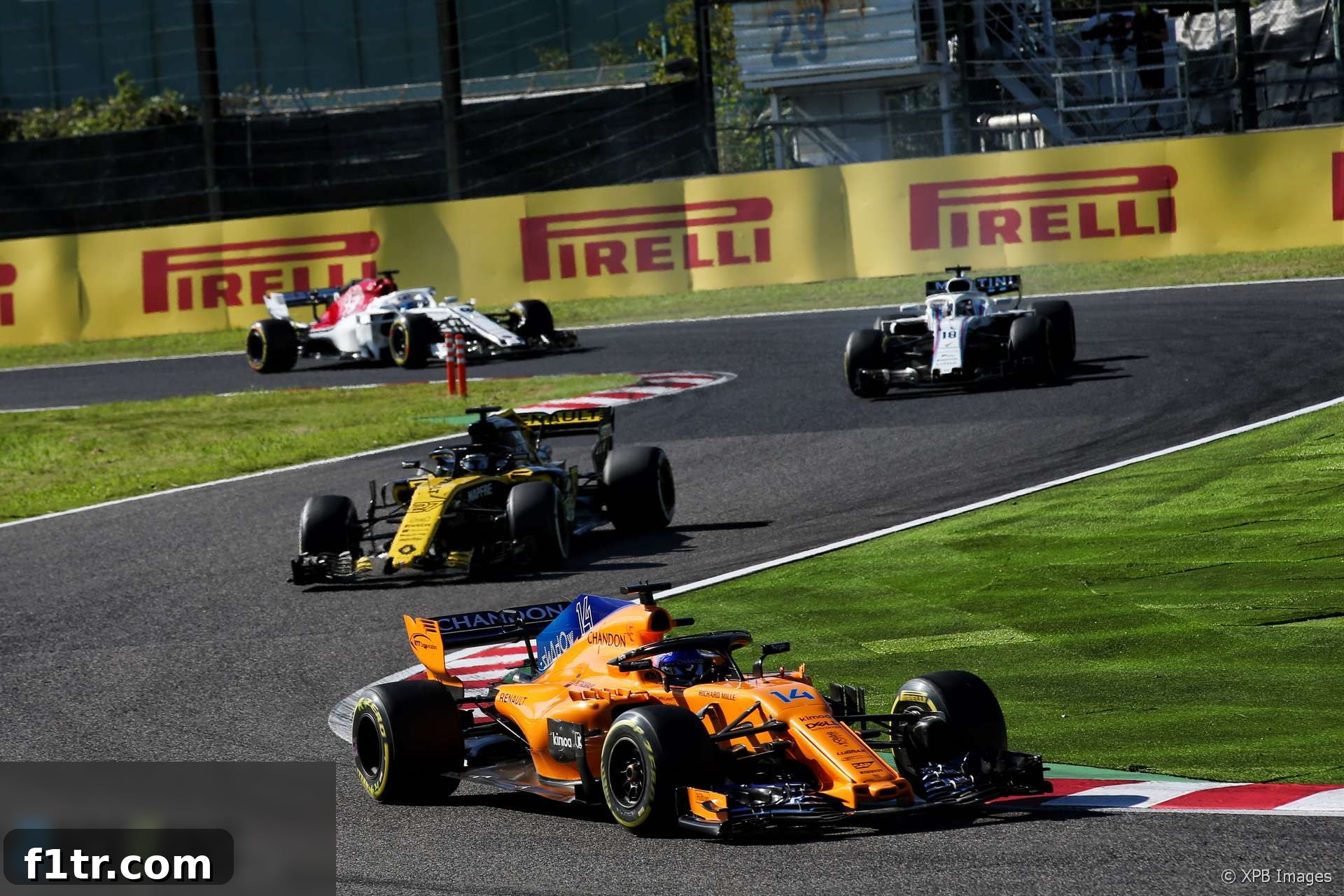
The 2018 Formula 1 season delivered its usual dose of drama and controversy, and the Japanese Grand Prix at Suzuka was no exception. Amidst thrilling on-track battles, two incidents involving chicane cutting drew significant attention and sparked debate within the paddock and among fans: one involving Fernando Alonso and Lance Stroll, and another featuring Valtteri Bottas and Max Verstappen. These events not only led to penalties but also prompted detailed explanations from then-FIA Race Director Charlie Whiting, shedding light on the intricate rules governing track limits and sporting conduct. The aftermath highlighted the fine line between an honest mistake and a tactical advantage, as well as the constant challenge of maintaining consistent stewarding decisions in the high-stakes world of Formula 1.
Alonso-Stroll Incident: A Controversial Chicane Cut and Dual Penalties
One of the most talked-about moments of the race involved McLaren’s Fernando Alonso and Williams driver Lance Stroll. The incident occurred early in the race when the two drivers made contact while battling for position. Stroll, in what was deemed an overly aggressive move, forced Alonso off the track. To avoid a significant collision and return to the racing line, Alonso cut the chicane, driving across the gravel trap. Upon rejoining, he found himself ahead of Stroll, creating an immediate quandary for race stewards.
Following a review, both drivers were handed five-second time penalties. Alonso received his penalty for “leaving the track and gaining a lasting advantage,” while Stroll was penalized for “causing a collision” or forcing another driver off the track. The McLaren driver, known for his outspoken nature, sharply criticised his five-second penalty for the incident, arguing that he had been forced off the circuit and had no choice but to cut the chicane. He saw his penalty as a symptom of a deeper malaise within Formula 1’s officiating, articulating his displeasure with the perceived inconsistency and severity of such decisions.
Charlie Whiting’s Clarification: The Intricacies of Gaining an Advantage
In the immediate aftermath, FIA Race Director Charlie Whiting provided a comprehensive explanation of the stewards’ rationale, aiming to clarify why Alonso’s actions warranted a penalty despite being forced off track. Whiting underscored that while Stroll was indeed deemed to have forced Alonso wide, Alonso’s subsequent action of cutting the chicane and rejoining the track ahead constituted an advantage.
Advert | Become a Supporter & go ad-free
Your advertising content here
“The stewards felt that it was perfectly clear what Fernando did,” Whiting stated. “He cut the chicane, drove quickly across the gravel, came on way in front. I think that was pretty clear that he had gained an advantage by leaving the track.” He further elaborated on the nuance: “The stewards, however, felt that Stroll had actually forced Fernando off, so you could say that because Fernando was forced off he was entitled to cut the chicane – he wasn’t. He shouldn’t have taken a place by doing it but equally Stroll shouldn’t have pushed him off the track. So they felt that each driver should get a five-second penalty for two separate offences.” This explanation highlighted the stewards’ view that two distinct infractions had occurred, each meriting a penalty, irrespective of their interconnectedness.
Whiting further clarified that Alonso could have entirely avoided his penalty for cutting the chicane had he immediately relinquished the position he gained back to Stroll. This act of “giving back the position” is a common protocol in motorsport, designed to negate any advantage gained through an illegal maneuver or track excursion. “If he’d given back the position I don’t think Fernando would have been penalised,” said Whiting. “That would have been straightforward.” He pointed out that Alonso had indeed returned a position later in the race after a similar incident with Brendon Hartley, which allowed him to escape a second penalty. This distinction underscored the importance of driver judgment and proactive self-correction on track. The fact that Alonso chose not to cede the position to Stroll immediately after the initial incident sealed his fate regarding the penalty.
Verstappen’s “Silly” Remarks and Bottas’s Defensive Chicane Cut
The Alonso-Stroll situation wasn’t the only instance of chicane cutting that day. Later in the race, Valtteri Bottas, under immense pressure from a charging Max Verstappen, also found himself cutting the chicane. Unlike Alonso, Bottas did not gain a significant advantage, and no penalty was issued to him for this particular incident.
This disparity in outcomes, however, deeply frustrated Max Verstappen. Having already received a five-second penalty earlier in the race for a collision with Kimi Raikkonen at the very same chicane, Verstappen was particularly irked by what he perceived as inconsistent stewarding. In a post-race interview, a clearly agitated Verstappen controversially declared that “next time I’ll just cut the chicane like Bottas,” implying that he felt penalized unfairly compared to others.
Whiting’s Rebuttal: Distinguishing Intent and Consequence
Charlie Whiting swiftly addressed Verstappen’s remarks, dismissing them as “quite a silly thing to say.” He provided a clear distinction between Bottas’s incident and situations where a driver deliberately cuts a corner to gain an advantage.
“It was quite clear that Valtteri locked up, made a mistake,” Whiting explained. “We looked at the mini-sector time and he lost half a second to Max. He wasn’t being threatened, it’s not as if he cut the corner and stayed in front by virtue of cutting the chicane, it was just a mistake.” This explanation emphasized that Bottas’s action was an involuntary error, and crucially, it did not result in a net gain of time or position. The telemetry data confirmed that Bottas actually lost time by going off track, thus negating any advantage that would warrant a penalty. This starkly contrasted with Alonso’s situation, where the stewards believed he had indeed gained an advantage over Stroll by his track excursion.
Broader Implications for Formula 1 Stewarding and Driver Conduct
The events at Suzuka, particularly the differing outcomes and explanations surrounding chicane cutting, reignited perennial debates about stewarding consistency and the interpretation of racing rules in Formula 1. Alonso’s passionate criticism – describing the stewards’ decision as “evidence of ‘just how bad F1 is'” – resonated with many who often question the application of penalties.
The FIA’s challenge lies in balancing the need for clear, enforceable rules with the dynamic and often chaotic nature of wheel-to-wheel racing. Every incident, though seemingly similar, has unique variables: the intent of the driver, the consequence of the action (gain or loss of time/position), and the specific circumstances of contact or track excursion. Whiting’s detailed explanations, while sometimes frustrating to drivers and fans, are crucial attempts to demystify these decisions and uphold the integrity of the sport.
Ultimately, these incidents serve as a vital reminder to drivers about track limits and the need for proactive self-correction. The “giving back the position” rule exists precisely to provide drivers with an immediate avenue to avoid penalties when an advantage is gained unintentionally. Conversely, it places the onus on drivers to make split-second ethical decisions under immense pressure. The Suzuka penalties of 2018 were more than just isolated incidents; they were a microcosm of the ongoing tension between aggressive racing, regulatory oversight, and the pursuit of sporting fairness in Formula 1. Alonso finished fourteenth in the race, while Bottas secured a podium finish ahead of Verstappen, contributing to Mercedes’ 44th 1-2 podium finish, adding another layer to the complex narrative of the event.
Advert | Become a RaceFans supporter andgo ad-free
Your advertising content here
2018 F1 Season Coverage
- F1 feared “death knell” for Drive to Survive after Ferrari and Mercedes snub
- McLaren staff told us we were “totally crazy” to take Honda engines in 2018 – Tost
- ‘It doesn’t matter if we start last’: How Red Bull’s junior team aided Honda’s leap forward
- Honda’s jet division helped F1 engineers solve power unit problem
- McLaren Racing losses rise after Honda split
Browse all 2018 F1 season articles