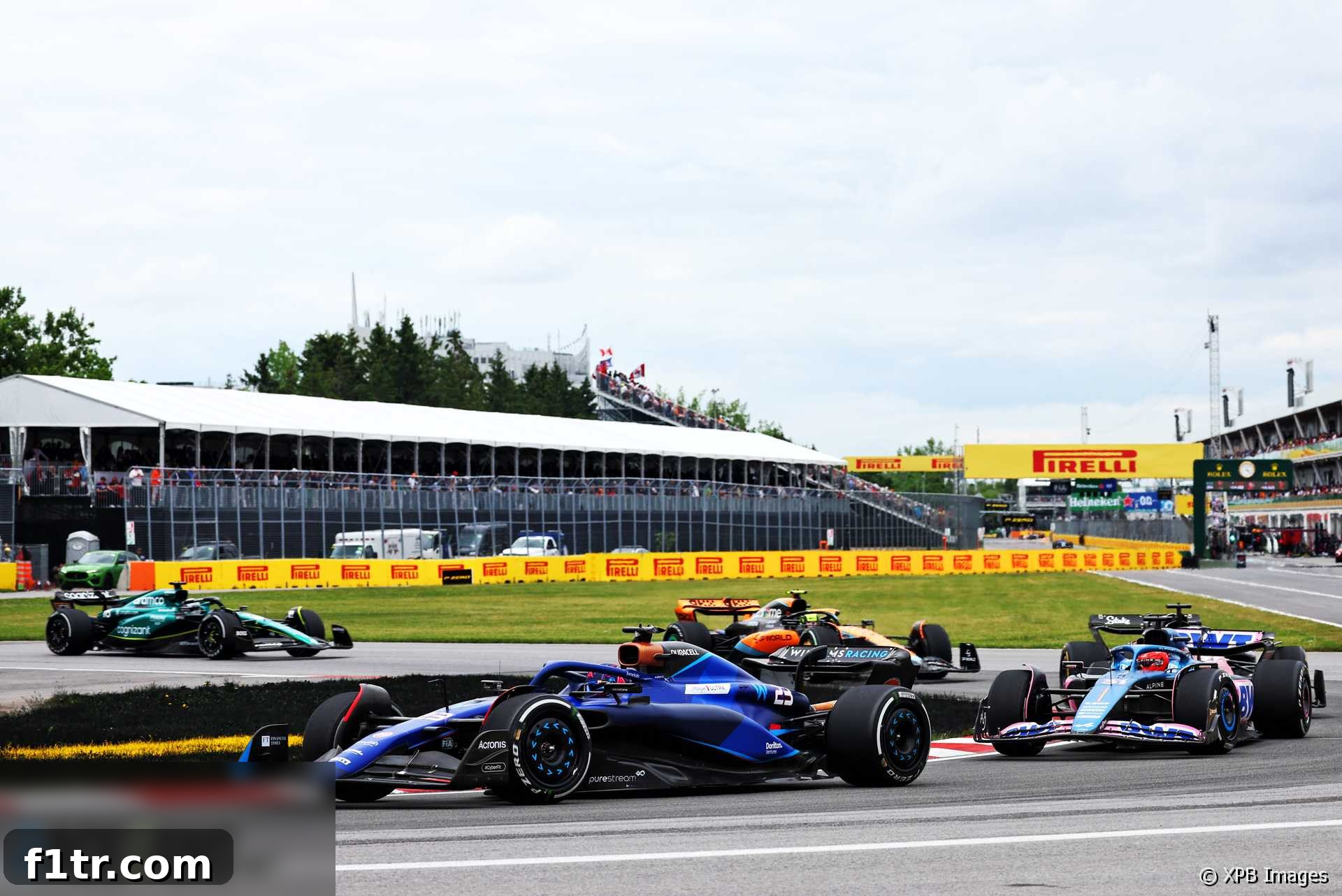
In a season defined by intense competition and strategic gambles, Alexander Albon delivered a remarkable performance at the Canadian Grand Prix, securing Williams Racing’s best result of the season so far. His masterful drive to seventh place not only earned crucial points for the team but also propelled them past AlphaTauri in the constructors’ championship, a significant leap from their previous last-place standing. This achievement was particularly noteworthy given the challenging conditions and the shrewd, albeit slightly deceptive, strategy employed by his team regarding the length of his final stint.
Albon, the sole Williams driver to utilize the team’s newly introduced upgrade package in Montreal, quickly demonstrated its efficacy. The enhancements brought the FW45 significantly closer to the fiercely competitive midfield, allowing Albon to battle drivers he previously couldn’t match. “To be honest, I do think we had similar pace to the McLarens the whole weekend,” Albon revealed, highlighting the tangible improvement. This newfound competitiveness was a testament to the hard work behind the scenes at Williams, transforming their prospects on track.
Advert | Become a Supporter & go ad-free
The Canadian Grand Prix circuit, with its long straights and heavy braking zones, often presents unique strategic opportunities. For Williams, renowned for its strong straight-line speed, it was a chance to capitalize. However, securing points in Formula 1 remains an arduous task, especially when up against the established front-runners. Albon acknowledged this reality: “I think realistically, where we were, we had to do something different to them, as they were in front, to get the points. We’ve had very good pace this weekend, it’s just to still get points is difficult. You’ve got the eight cars – the Astons, the Red Bulls, the Ferraris, the Mercedes – and the final two positions normally it feels like it’s the Alpines now.” This keen observation underscores the difficulty of breaking into the top ten in a grid dominated by several factory teams and well-funded rivals.
The pivotal moment of Albon’s race came early on during a Safety Car period. While many of his midfield competitors opted for a conventional two-stop strategy, Albon and Williams committed to an aggressive one-stop plan. This involved an early tyre change, switching to the durable hard compound, and then attempting to run an astonishing 58 laps to the checkered flag. This tactic is not new territory for Williams and Albon; they have successfully deployed similar single-stop strategies in the past, leveraging the FW45’s efficiency and Albon’s exceptional tyre management skills. However, the sheer length of this particular stint made it one of the most demanding of his career.
The team’s conviction in their strategy was so strong that they employed a psychological tactic to help Albon manage the immense pressure. They deliberately kept him in the dark about the true number of laps remaining. Albon candidly confessed: “We had to stick to the one-stop. When the guys told me I had – I don’t know what it was, 35 or 40 laps, they even told me ’20’ just to make me feel better – I looked at the TV screen and I was like, oh my god, I hope that’s not real.” This revelation highlights the extraordinary mental fortitude required of Formula 1 drivers, pushing them to the absolute edge of their capabilities while managing complex race scenarios.
The decision to commit to such a lengthy hard-tyre stint transformed the latter half of Albon’s race into a relentless defensive masterclass. With a train of faster cars, including Esteban Ocon’s Alpine, building up behind him, Albon had to deploy every trick in the book to maintain position. The Williams’ inherent straight-line speed proved invaluable, acting as a shield against overtakes on the circuit’s long straights. However, defending on badly worn tyres demands more than just raw speed; it requires acute awareness, precise car placement, and an intimate understanding of tyre degradation.
Advert | Become a RaceFans supporter andgo ad-free
Albon articulated the brutal reality of these defensive battles: “I’ve done these races a lot now and I can tell you they’re not that fun. We’re good at defending, we have a straight-line car. In these situations it’s all about you’re obviously in a big tyre deficit but at the same time saving the tyres to make the key corners count.” His strategy involved manipulating his position on track to force rivals into less advantageous lines, deliberately placing his car in their “dirty air” to make them work harder, degrade their own tyres, and hurt their traction out of corners. This chess match played out at speeds exceeding 200 mph, demanding split-second decisions and unflappable concentration. “So you’re driving a race that’s very much in your rear-view mirrors, even though obviously you’re trying not to make mistakes.”
The physical and mental toll of such a long stint on degrading tyres is immense. As the race wore on, the rubber wore down to its absolute limit. Albon described the sensation vividly: “The other thing is obviously when the tread comes down, the tyres start to cool down quite a lot and you have to start pushing. And by the end of the race the carcass is almost, like, you see white parts where you’re right down to the canvas. And you’ve got to push flat-out.” This imagery paints a stark picture of the knife-edge Albon was driving on, pushing a car with tyres literally showing their internal structure. “It feels like qualifying for the last 20 laps. At the same time, you can’t afford to make a mistake. There’s this real balance going on. But that’s what we’re paid for.” This statement underscores the incredible skill, bravery, and composure required to extract maximum performance from the car under such extreme conditions.
This stellar drive in Canada was not an isolated incident. Albon had previously scored Williams’ only other point of the season at the opening race in Bahrain, further cementing his reputation as a formidable driver capable of extracting every ounce of performance from his machinery. Despite these commendable efforts and the team’s visible progress, Albon believes Williams often goes “under the radar.” While their gains are substantial, they can be overshadowed by the more dramatic narratives surrounding front-running teams. “A lot of our good races get completely unseen by everyone because honestly, it’s a boring race for most people. It’s just how it is,” he reflected, acknowledging the nature of Formula 1 viewership.
However, the Canadian Grand Prix offered a rare moment in the spotlight for Williams. “We’ve got our TV time, I think, today. When I saw the screens, I was always there. It’s great and if anything it just shows the progress we’re making,” Albon proudly stated. This visibility is crucial for a team striving to rebuild its legacy and attract further investment and talent.
Advert | Become a RaceFans supporter andgo ad-free
The journey of Williams Racing has been one of perseverance and gradual improvement. While much of the F1 world focuses on the rapid ascent of teams like Aston Martin, Albon is keen to emphasize Williams’ own significant strides. “I know I’ve said it before, but everyone talks about the Aston, how much they made a step forwards. You could even argue, [if you] look at Barcelona, you see it as a disappointing weekend but we were still far more competitive than we were last year.” This perspective highlights the consistent, albeit less flamboyant, development curve at Williams. The team is not just reacting to rivals; they are systematically improving their car and operational efficiency.
Looking ahead, Albon remains incredibly optimistic about the team’s direction. The leadership of James Vowles, coupled with strategic investments and a renewed focus on engineering excellence, has instilled a strong sense of purpose within Grove. “So I’m really positive for the team. I think we’re on our way, we’re on our journey. I feel like we’ve still got a couple of years ahead of us. But it’s great to be able to do these kind of results.” This long-term vision is critical for a team like Williams, emphasizing that their current successes are stepping stones towards a more competitive future. The Canadian Grand Prix was not just a race; it was a powerful statement of intent from Alexander Albon and Williams Racing, signaling their return to relevance in the fiercely contested world of Formula 1.
Become a RaceFans Supporter
RaceFans is run thanks in part to the generous support of its readers. By contributing £1 per month or £12 per year (or the same in whichever currency you use) you can help cover the costs of creating, hosting and developing RaceFans today and in the future.
Become a RaceFans Supporter today and browse the site ad-free. Sign up or find out more via the links below:
- Become a RaceFans Supporter
- RaceFans Supporter FAQ
2023 Canadian Grand Prix
- Norris ‘even more’ sure Canada penalty was wrong after review request fails
- McLaren seeking more than just downforce gains from major upgrade
- Winning more races won’t necessarily lead to F1 seat – Palou
- Red Bull’s testing restriction will “massively affect” 2024 car development
- Schumacher’s set-up input gives Mercedes a “super advantage” – Wolff
Browse all 2023 Canadian Grand Prix articles