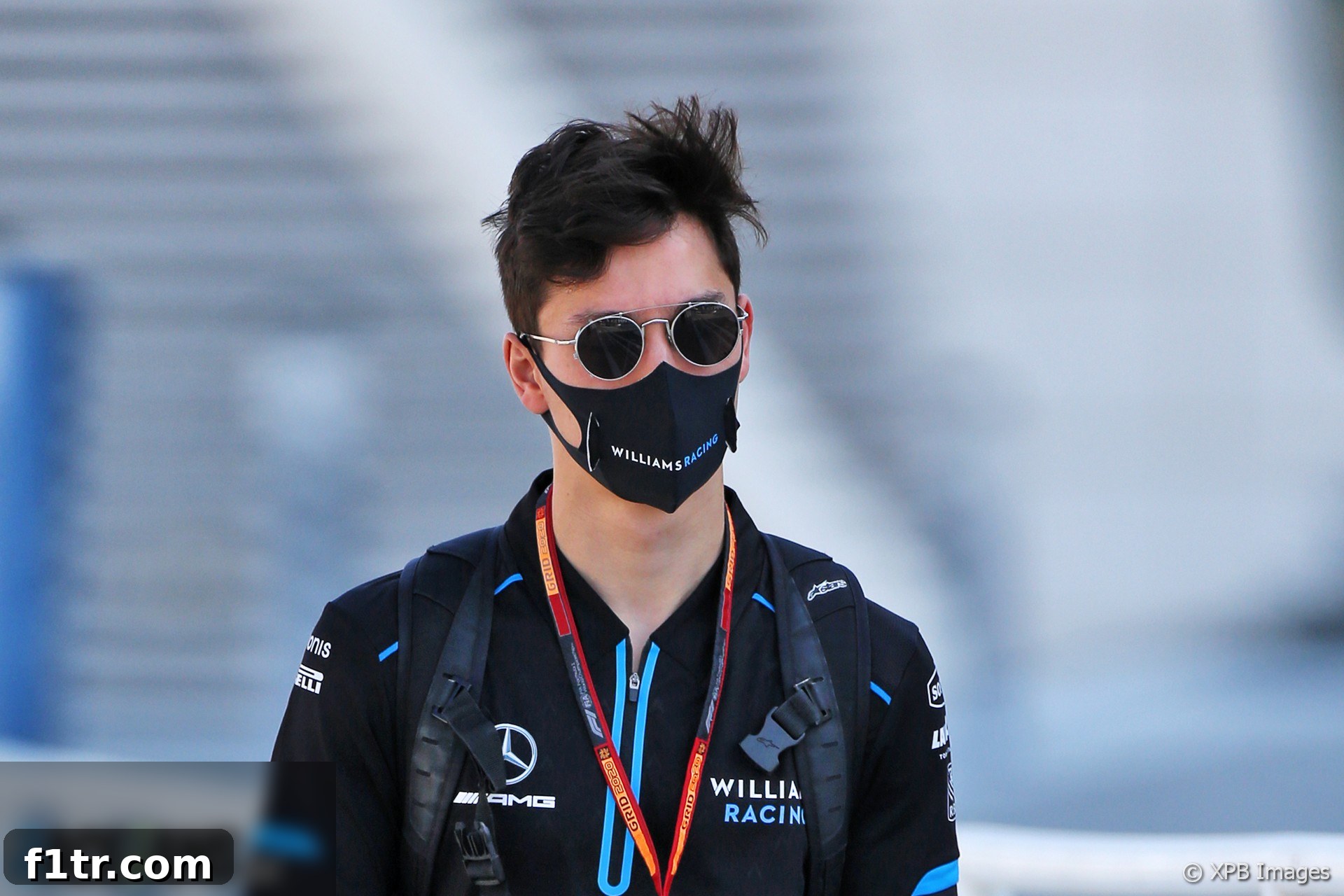
Jack Aitken Poised for Stronger Performance in Potential Abu Dhabi Grand Prix Return
Formula 1’s highly competitive grid often presents unique opportunities, and for Jack Aitken, the Abu Dhabi Grand Prix could be another pivotal moment. Having made his Formula 1 race debut under unexpected circumstances at the Sakhir Grand Prix, Aitken believes he can deliver an “even better” performance for Williams if granted the chance to race in the season finale.
The British-Korean driver stepped into the breach last week, substituting for regular Williams driver George Russell, who himself was called up by Mercedes to replace the recovering Lewis Hamilton. As the F1 paddock descends upon Yas Marina, the question of who will pilot the Williams FW43 remains a central talking point. With Russell still on standby for Mercedes should Hamilton not be fully cleared to race, Aitken’s own fate hangs in the balance, awaiting a crucial decision that could shape the trajectory of his burgeoning career.
The Unfolding Drama: Awaiting Confirmation for Yas Marina
The uncertainty surrounding Lewis Hamilton’s return from COVID-19 adds a layer of suspense to the Abu Dhabi Grand Prix weekend. While Hamilton is undoubtedly keen to conclude his championship-winning season on track, Mercedes’ ultimate decision will dictate whether George Russell once again deputizes for the seven-time world champion. This, in turn, directly impacts Aitken’s prospects of a second F1 outing.
Speaking at the FIA press conference, Aitken acknowledged the situation: “We don’t know yet, it’s up to Mercedes and obviously Lewis’s recovery. I’m just waiting for confirmation either way.” His professional demeanor belies a clear hunger for another opportunity. “Obviously I would love to be in the car because I’ve made some big steps and this weekend would be even stronger. But really I just have to wait and listen to see what the confirmation will be.” This patient, yet hopeful, stance highlights the intense anticipation for any reserve driver to secure valuable seat time in Formula 1, especially when it comes at such a high-stakes moment for all parties involved.
A second Grand Prix appearance for Aitken would not merely be another entry in his racing resume; it would be a critical chance to build upon the lessons learned from Sakhir, demonstrate consistency, and further cement his capabilities in the eyes of the F1 world. For Williams, having a driver with recent experience in the car, even if limited, could provide valuable feedback and continuity heading into the final race of a challenging season.
A Debut Under Pressure: Reflecting on the Sakhir Grand Prix
Jack Aitken’s F1 debut at the Sakhir Grand Prix was a whirlwind experience. Thrown into the deep end with minimal preparation and no prior testing in the Williams FW43, he faced the immense pressure of competing at the pinnacle of motorsport. While his race included a spin that momentarily derailed his progress, Aitken reflects positively on the overall weekend, emphasizing the steep learning curve and the valuable experience gained.
“Immediately after I got out of the car on Sunday, I was a little bit frustrated with myself because of the spin that I had,” he admitted. This initial frustration is a natural reaction for any competitive driver pushing the limits. However, with time for digestion and analysis, his perspective shifted. “But actually having had a bit of time to digest everything and move on, it was a pretty solid weekend.” This mature outlook speaks volumes about his character and ability to learn quickly.
The significant progress Aitken made throughout the Sakhir weekend underscores his adaptability. “The pace came on a really long way from Friday,” he noted. Given the unique challenge of stepping into an F1 car with no prior test sessions to familiarize himself with its intricacies, his improvement from free practice to qualifying and then the race itself was commendable. This rapid adaptation is a key attribute for any driver aspiring to a full-time F1 seat, proving their ability to maximize limited track time and extract performance from unfamiliar machinery.
Learning Curve: Overcoming a Race Day Spin
The incident Aitken refers to was a spin at the final corner during the Sakhir Grand Prix, which resulted in a damaged front wing and a subsequent pit stop. While undoubtedly a setback, such moments are often crucial learning experiences for rookies. It highlighted the razor-thin margins in F1 and the unforgiving nature of its high-performance cars.
For a driver making their debut, even minor mistakes can seem amplified. Yet, Aitken’s ability to recover from the spin, continue the race, and still maintain a positive outlook reflects resilience. Every lap completed in an F1 car is invaluable, particularly when pushing limits. The experience of managing the car after an incident, dealing with unforeseen damage, and maintaining focus throughout a full Grand Prix distance are all critical elements of an F1 education. These are lessons that cannot be replicated in a simulator or through observation; they must be lived. Aitken’s acknowledgment of this learning process bodes well for his future prospects.
Mastering the Beast: The Distinctive Demands of Formula 1 Machinery
Having spent most of 2020 competing in Formula 2, Jack Aitken possesses a strong foundation in single-seater racing. However, the transition to Formula 1 cars presents a unique set of challenges and requires a distinct driving style. Modern F1 cars are marvels of engineering, far more complex than their F2 counterparts, demanding a different approach from their drivers.
“Formula 1 cars nowadays are such complex machines,” Aitken explained. “On the whole, that means they’re easier to drive because there’s a lot of systems working in the background to make the car better.” This paradox is fascinating: while power steering, sophisticated traction control, and advanced hybrid systems (like the MGU-K and MGU-H) certainly assist the driver, they also introduce “quirks” that require specific understanding and adaptation. The sheer amount of downforce generated by F1 aerodynamics, combined with powerful hybrid engines and specialized Pirelli tires, creates a dynamic unlike any other racing category.
Aitken provided a specific example of these “quirks,” illustrating how traditional racing instincts can sometimes be counterproductive in F1. “So, for example, in qualifying I lost a decent amount of time on my best lap – you see, I’m becoming a proper F1 driver already, here are the excuses – because when you overshoot a corner my natural instinct is to shift down more to get more engine braking, to pull the car in. And that doesn’t apply to these cars necessarily all the time. Sometimes the better thing to do is actually to hold the higher gear and you’ll get more rotation that way.”
This insight highlights the profound differences. In many junior categories, downshifting provides significant engine braking to help rotate the car. In F1, however, the immense aerodynamic grip, the sophistication of the brake-by-wire system, and the powerful kinetic energy recovery system (KERS) often mean that relying solely on traditional engine braking is less effective. Furthermore, holding a higher gear can sometimes stabilize the car or allow the driver to exploit the torque delivery of the hybrid powertrain more efficiently, leading to better corner exit speed. These are the subtle nuances that separate F1 driving from other disciplines, requiring drivers to recalibrate their instincts and master new techniques.
Beyond this specific example, F1 cars demand exceptional physical conditioning to withstand extreme G-forces, immense mental capacity to manage complex steering wheel settings (including ERS deployment, differential settings, and brake bias), and an intricate understanding of tire degradation. These “little things” are what Aitken refers to as “quirks of Formula 1 cars that I haven’t encountered before. It’s just a case of banking that knowledge and next time I won’t make that mistake.” This continuous learning and adaptation are fundamental to success in Formula 1.
A Stepping Stone to the Future: What Another Race Means for Aitken
In the cutthroat world of Formula 1, every opportunity counts. For a reserve driver like Jack Aitken, a second Grand Prix appearance could be instrumental in solidifying his position and opening doors for future opportunities. With only 20 seats available on the grid, competition is fierce, and proving one’s mettle in a race scenario is invaluable.
A strong, clean performance in Abu Dhabi would allow Aitken to demonstrate consistency and further adapt to the Williams FW43. It would provide crucial data for both himself and the team, highlighting areas of strength and continued development. Building confidence through consecutive race weekends is vital, allowing a driver to settle into the rhythm of an F1 event without the initial shock of a debut. Such an experience would not only boost his chances within the Williams setup but also make him a more attractive prospect for other teams looking for reliable test or reserve drivers, or even future race seat candidates.
For Williams, continuity, even for a temporary driver, is beneficial. Aitken’s recent experience with the car from Sakhir means he would arrive in Abu Dhabi with a better understanding of its behavior and the team’s operational procedures. This allows the team to focus more on fine-tuning performance rather than basic familiarization, potentially aiding their competitive efforts in the season’s final race. A commendable showing from Aitken could also underscore Williams’ commitment to nurturing talent within their junior ranks, reinforcing their reputation as a team that provides opportunities.
Anticipation Builds for the Season Finale
As the Formula 1 circus prepares for its final act of the 2020 season in Abu Dhabi, the personal stakes for Jack Aitken are incredibly high. The uncertainty surrounding Lewis Hamilton’s health and George Russell’s potential role at Mercedes creates a dramatic backdrop for the season finale. Aitken’s readiness to step up again, armed with the invaluable experience of his Sakhir debut, speaks to his dedication and ambition.
His promise to be “even better” should he get the chance is not just bravado, but a reflection of a driver who has processed his first F1 experience, identified areas for improvement, and is eager to apply those lessons. Whether he gets the call or not, Aitken has already proven his capability and resilience. However, another run at the Yas Marina Circuit would be a significant milestone, a chance to further write his name into the F1 narrative and strengthen his claim for a permanent place among motorsport’s elite.