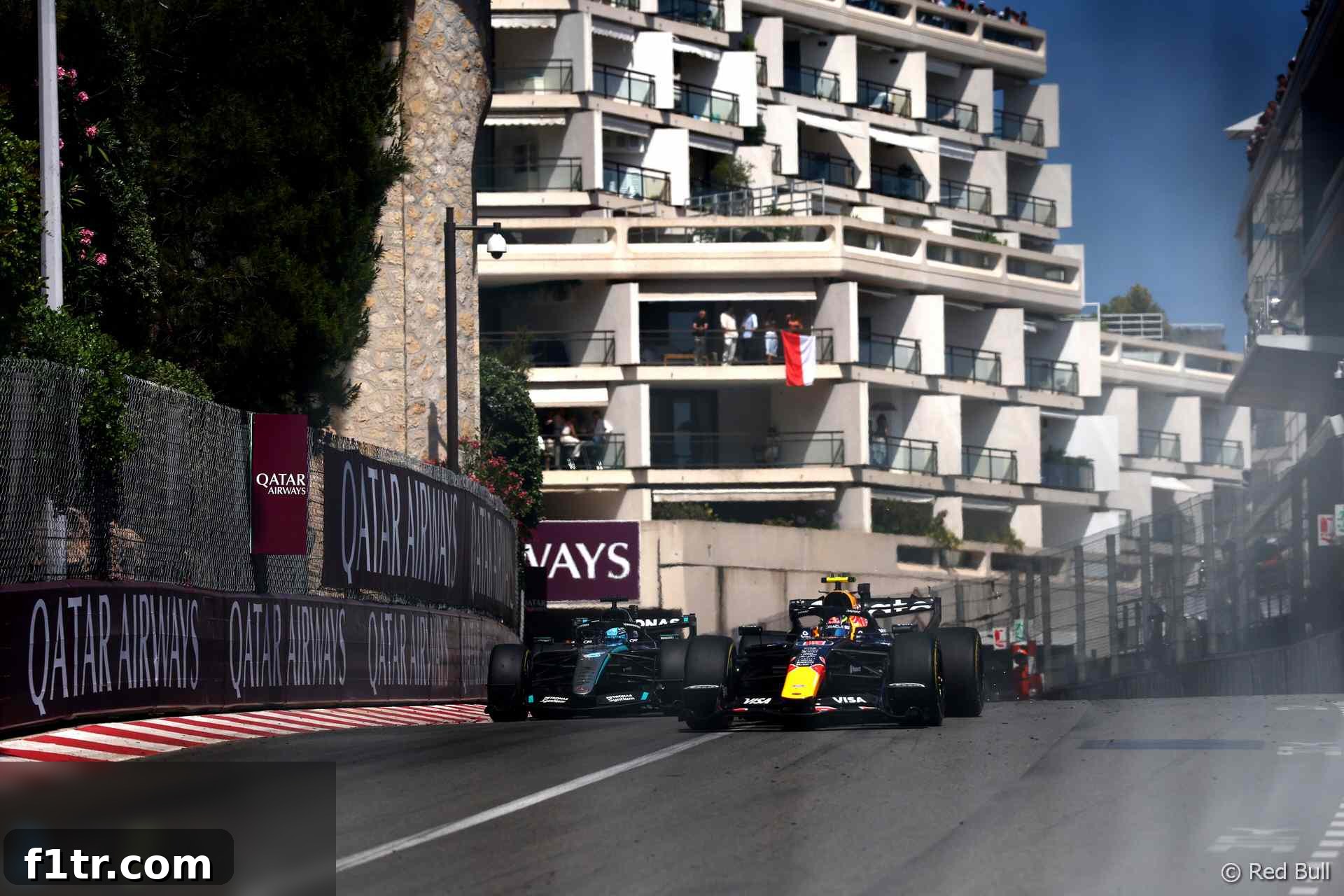
The Monaco Grand Prix has sparked a complex controversy in Formula 1 that has no straightforward answer.
Early in the race it became apparent that something was wrong when the stewards issued several penalties for pit lane speed-limit violations. After the chequered flag it emerged most of those breaches were by only about 0.1 km/h.
The stewards later disclosed that the pit lane length had been measured incorrectly. That error contributed to the problem, although some team principals pointed out that not every team was affected in the same way. All teams had opportunities during practice to assess pit lane speed and some adjusted their systems to avoid penalties.
When the penalties began to be applied, the situation grew more complicated. Some drivers served their penalties during the race, which normally means those penalties cannot be rescinded retrospectively.
George Russell, for example, made a pit stop at which he should have served an initial penalty but did not, and was subsequently given a harsher drive-through penalty that he did serve, eliminating his chance of scoring points.
Pierre Gasly received two five-second penalties yet did not serve either of them during the race. After those post-race penalties were applied, his team submitted a Right of Review request. The stewards’ review revealed the pit lane length measurement error and the stewards then rescinded Gasly’s penalties.
The resulting outcome feels plainly unfair. Five drivers were incorrectly issued penalties for pit lane speeding, but only one had their penalties overturned. Unsurprisingly, at least one team has announced an appeal against the stewards’ decision; another team initiated a Right of Review and later withdrew it.
Is there any genuinely fair way to resolve this? If the stewards could choose from all available options, several potential responses present themselves, each with different implications for race results, championship points and perceived fairness.
Revert to the original result
One option is to regard the penalties as having been issued in error and to restore the original, unpenalised finishing order. Since the affected penalties should not have been issued, rescinding all post-race sanctions would reinstate the positions as they crossed the line without any adjustments.
Under this approach, the drivers who were promoted by the incorrect penalties would lose those gains and the original race order would be restored.
Remove penalties imposed after the race
Another approach is to cancel only those penalties that were applied after the race finished. Several of the drivers who served penalties during the race stopped for reasons other than a mandatory visit to the pits, which means those teams might reasonably argue their drivers could have avoided the pit stops and therefore could have avoided serving the incorrect penalties.
With this option, penalties applied only after the race would be removed while penalties that were actually served during the race would remain, accepting the practical reality that race-time penalties have immediate effects that cannot be fully undone.
Deduct time from drivers who served incorrect penalties
A different solution would be to adjust race times to account for the incorrect penalties by deducting time from drivers who served them. Historically, the stewards have been reluctant to alter results by removing time after the fact if a driver has already served the penalty on track. Still, since the stewards do have authority to apply post-race penalties, a symmetrical application might be possible: removing the time cost of incorrectly served penalties by subtracting the equivalent seconds from those drivers’ final times.
For example, if a driver served a five-second penalty on track, removing that penalty would require subtracting five seconds from their final race time; a drive-through applied post-race is usually converted into a fixed time and could be removed in the same way. This would allow the final standings to be recalculated without invalidating the stewards’ ability to alter official times.
Add time to drivers who did not serve incorrect penalties
If removing time post-race is ruled out, the opposite logic could be applied: add the equivalent penalty time to every driver who did not serve the incorrect penalties. This would mean levying artificial time additions to equalise the field with regard to penalties that should not have been applied.
While this approach is complex and counterintuitive—it would be adding penalties where no infringement occurred—it could be justified as correcting the imbalance created by a set of penalties that were wrong in principle but partly served in practice. It would seek to restore consistent treatment across the field rather than erase penalties selectively.
Use the race result from the last lap before the first incorrect penalty was served
A more straightforward option is to revert to the standings as they stood immediately before the first incorrect penalty was actually served on-track. That snapshot would avoid the complications created by penalties applied during the race and by the later post-race adjustments.
Applying this method would produce a clear, time-stamped result based on the race order before the taint of incorrectly applied penalties. Depending on how many laps had been completed relative to the scheduled distance, it might also affect whether full or reduced points are awarded under the sporting regulations.
Award no championship points for the race
Given the scale of the procedural error and its effect on several teams and drivers, a final option is to void the points allocation for the round entirely. Declaring the event void for points would acknowledge the integrity of competition had been compromised and avoid arbitrarily rewarding or penalising drivers based on an inconsistent application of the rules.
Conclusion
All options have drawbacks. Reinstating the original unpenalised result recognises that the penalties should not have been issued, but it negates actions taken during the race in response to stewarding decisions. Canceling only post-race penalties treats retroactive action differently from race-time events and may feel partial. Adjusting times either way—subtracting from those who served penalties or adding to those who did not—attempts to equalise the field but risks creating further controversy and precedent issues. Using a snapshot of the order before the first penalty or withholding points are clearer but harsher choices that may also be contested.
Whatever decision is made, the incident highlights the importance of accurate measurements, consistent stewarding and clear procedures for correcting mistakes. The integrity of the championship depends on fair and transparent resolutions when technical or human error affects race outcomes.