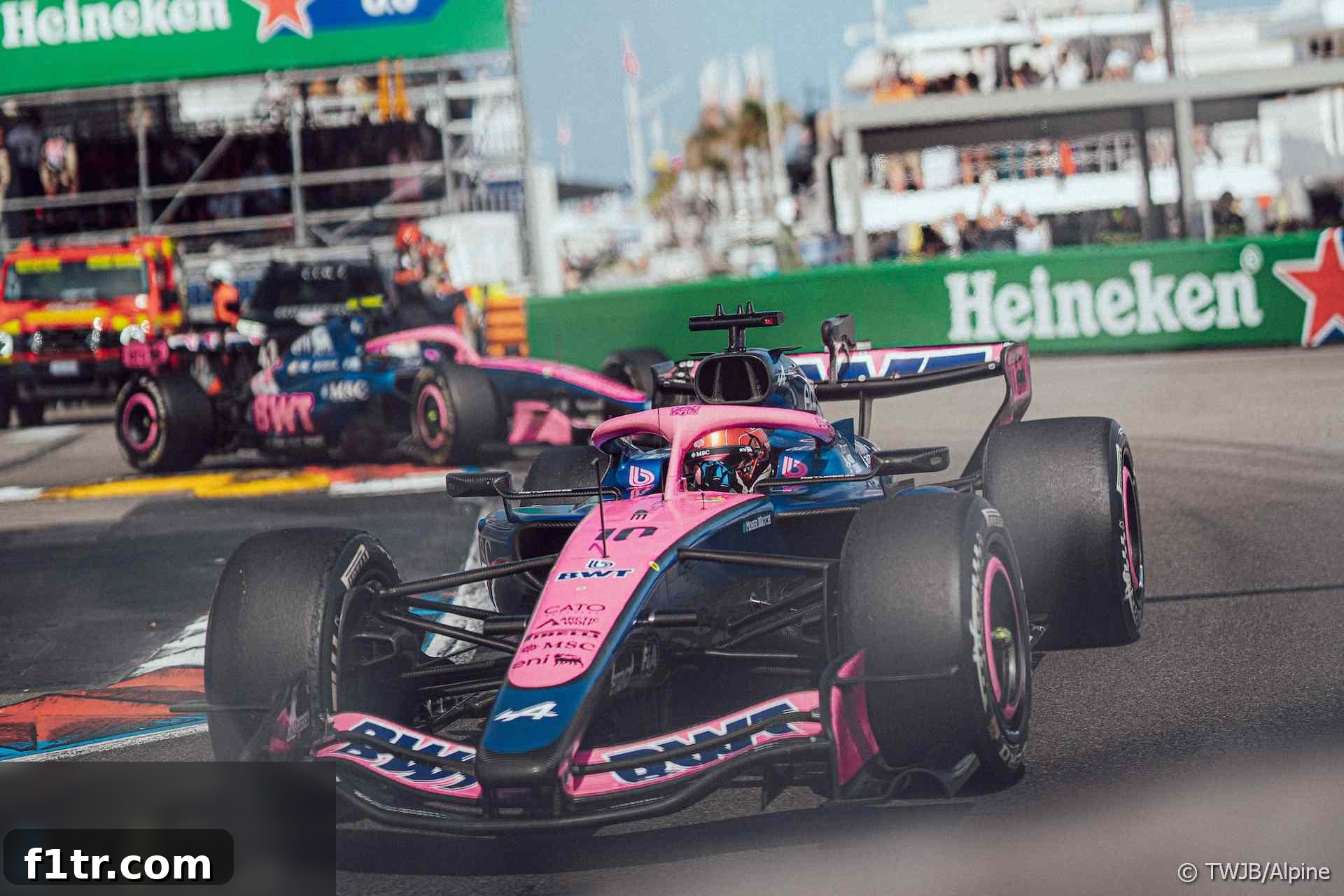
Alpine have successfully overturned the penalties that originally cost Pierre Gasly a podium finish at the Monaco Grand Prix.
Gasly was one of five drivers handed five-second time penalties for allegedly exceeding the pit lane speed limit during the race. Team mate Franco Colapinto was also cited for the same infringement, along with Lewis Hamilton, George Russell and Oscar Piastri.
Of the five drivers, only Gasly did not serve his penalty during the race, which allowed Alpine to lodge a Right of Review with the FIA after the event. The team challenged the legality of the timing measurements used to calculate pit lane speeds and the stewards accepted their appeal.
As a result the two five-second penalties applied to Gasly were rescinded and his classification was amended from seventh to third place. Isack Hadjar, who had been presented on the podium in third, was moved down to fourth. Oscar Piastri and the Racing Bulls drivers Liam Lawson and Arvid Lindblad each dropped one position in the official results.
The stewards concluded that the shortest distance between the timing loops used to calculate average pit lane speed had been recorded incorrectly. Formula One Management, acting as the official timekeeper, had initially provided a distance of 26.92 metres for the first timing zone, but later measurements showed the true shortest possible distance was 0.77 metres shorter.
That discrepancy affected the calculation of average speed as cars passed through the first timing zone after pit entry. Each of the five drivers exceeded the limit by only a fraction—around 0.1 km/h in the first instances—while Gasly’s second alleged breach measured 0.4 km/h over the limit. Alpine argued these margins and the measurement error justified overturning the penalties.
Several rival teams attended the hearing and argued the penalties should stand. McLaren stressed that discrepancies in pit lane speed calculations are a known risk and teams manage for that, while representatives from both Red Bull squads also opposed Alpine’s challenge.
Following the stewards’ ruling, Alpine issued a statement welcoming the decision. The team thanked the FIA and Formula One Management for their transparency and cooperation during the Right of Review process and confirmed that Gasly’s third place had been reinstated.
Update: McLaren and Red Bull have notified the FIA of their intention to appeal the stewards’ decision.
Stewards’ full decision
1. After receiving two petitions for a Right of Review and summoning representatives of BWT Alpine F1 Team, the FIA and Formula One Management (FOM) as the Official Timekeeping Supplier, the Stewards determined a significant and relevant new element was available that had not been considered at the time of the original decisions. The hearing reconvened on Thursday 11 June 2026 at 13:20 CEST.
2–4. All concerned parties attended and Alpine provided extensive written evidence in advance. Their submission included a formal admissibility brief, a chronology of events, a memo from the electronics meeting on 5 June, the Official Timekeeper’s presentation regarding discrepancies in the distance measurement between timing loops, Alpine’s telemetry review, telemetry from Mercedes and Ferrari, and a written statement from Pierre Gasly.
BACKGROUND
5–12. Article B1.6.3a of the FIA F1 Regulations sets a pit lane speed limit and details potential penalties. For Monaco the Race Director amended the limit to 60 km/h. Pit lane speed is measured as an average between consecutive timing loops: distance between loops divided by the measured time to pass between them. The distance is determined by GNSS and on-track survey, accurate to within 1 cm. Monaco’s pit lane comprises multiple short timing zones; the shortest distance between loop endpoints is used for the calculation. The Official Timekeeper later reported that all alleged breaches in the race occurred in the first timing zone and that barrier changes between 2025 and 2026 may have enabled a shorter trajectory through the zone in 2026.
FACTS
13–18. During the race the Official Timekeeper issued six pit lane speeding reports (driver/time/speed): HAM 15:39 – 60.1; RUS 15:43 – 60.1; COL 15:49 – 60.1; GAS 16:02 – 60.1; PIA 16:06 – 60.1; GAS 16:22 – 60.4. After the third report the stewards queried Race Control because it was unusual to see repeated identical readings. Race Control checked with the Official Timekeeper and was initially told the data was accurate. The Official Timekeeper’s setup used a distance of 2692 cm for the first timing zone, but subsequent LIDAR scans found a theoretical shortest distance of 2615 cm—77 cm less—though that figure did not account for car width.
HEARING PART 2 SUBMISSIONS
19–25. Alpine’s representatives referenced the Official Timekeeper’s report and on-track measurements taken immediately after the race. Alpine used a trundle wheel to measure the zone; the device’s resolution is 0.1 m. FOM explained it applied an established process used at previous events, selecting the shortest distance between loop endpoints for speed calculations. They acknowledged that, for Monaco’s pit lane geometry and the line drivers took, the standard process might not represent the true shortest distance and therefore could be unsuitable for this specific layout. Team sensor data (vCar and vSaS) was discussed but not accepted as definitive by the FIA due to calibration and methodological differences.
OTHER EVIDENCE
30–34. Alpine warned Gasly on radio to be cautious at pit entry after their team mate’s penalty. Radio transcripts show repeated instructions to undershoot pit entry speed. The Official Timekeeper’s post-event analysis indicated that if the theoretical shortest distance of 2615 cm were used, Gasly’s recorded times would equate to speeds of 58.7 km/h and 58.8 km/h. It was noted, however, that the theoretical route may not be physically achievable because of car width and the pit entry trajectory.
CONCLUSIONS
35–45. While Alpine’s trundle-wheel measurements and team sensor data carry tolerance concerns, they do not contradict the Official Timekeeper’s findings. The stewards concluded there was a significant difference between the distance used for the speed calculation and the distance that was likely driven by Gasly. Official Timekeeper timings for Gasly (1.604s and 1.602s) correspond to distances consistent with an average speed below 60 km/h when compared with plausible trajectories. The stewards found merit in Alpine’s assertion that the “measured minimum distance between loops” should reflect the shorter measurement identified. They also noted the revised pit entry barrier layout may have altered typical trajectories. Applying the legal standard of comfortable satisfaction, the stewards concluded Gasly did not exceed the 60 km/h limit in the relevant zone.
DECISIONS
46–49. The stewards rescinded both five-second penalties applied to Car 10, removed the added time from Gasly’s race result, and amended the classification accordingly. Drivers’ and Constructors’ Championship points will be recalculated. As the Right of Review succeeded, the deposits paid by Alpine for the petitions will be returned. The decisions are final subject to any appeal by the affected parties.
Competitors retain the right to appeal under the FIA’s sporting and judicial rules within the applicable time limits. The stewards emphasised their decisions are independent and based solely on the regulations, guidelines and evidence presented.
Miss nothing from RaceFans
2026 Monaco Grand Prix
- Official: McLaren and Red Bull to appeal stewards’ decision to restore Gasly’s podium finish
- Updated championship standings after Gasly regains Monaco podium finish
- Gasly promoted to third place in Monaco GP as stewards strike out penalties
- Alpine succeed in first stage of Right of Review request over Gasly’s penalties
- “Stroll the usual idiot”: Aston Martin driver frustrated leaders in Monaco GP