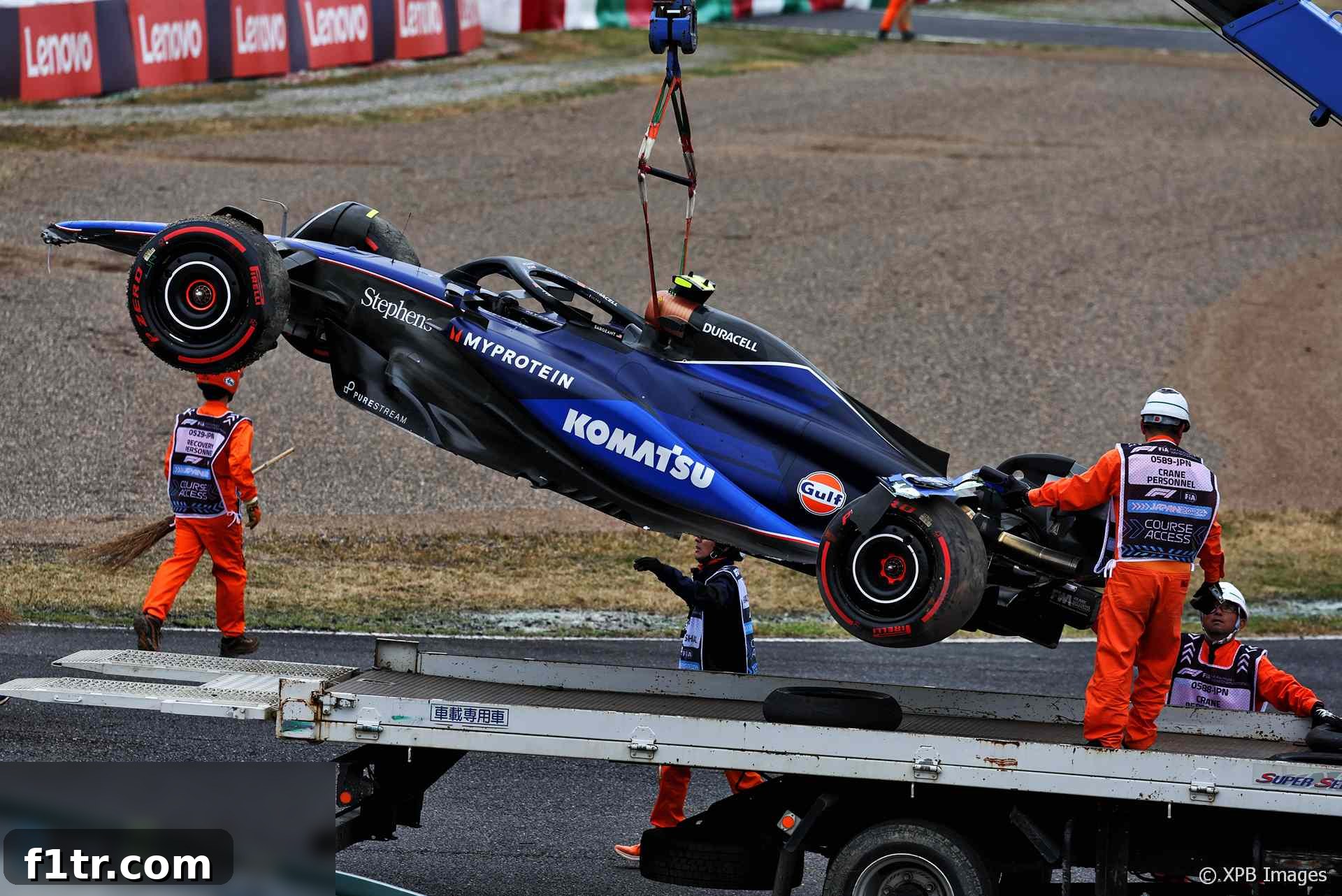
In the high-stakes world of Formula 1, every session, every lap, and every corner holds immense significance. For Williams Racing driver Logan Sargeant, the opening practice session of the Japanese Grand Prix at the iconic Suzuka Circuit took an unfortunate turn, culminating in a crash that left his car damaged and forced him to the sidelines. Sargeant, candidly reflecting on the incident, admitted that the costly mistake was simply a “silly” error, one that he shouldn’t have been making, especially during the crucial initial phase of a race weekend.
The incident unfolded midway through the first free practice session (FP1) as Sargeant navigated the challenging uphill left-hander known as the Dunlop Curve. A notoriously technical section of the Suzuka track, the Dunlop Curve demands precision and commitment. On this occasion, Sargeant ran wide, straying onto the grass before losing control and spinning into the protective barriers. The impact, while not resulting in catastrophic chassis damage, was sufficient to inflict significant harm to other crucial components of his Williams FW46, highlighting the delicate balance between pushing the limits and maintaining control in Formula 1.
The immediate consequence of the crash was Sargeant’s forced absence from the second free practice session (FP2). This loss of valuable track time could have been a major setback, particularly for a driver still acclimatizing to the demands of F1 and seeking to maximize every opportunity for development. However, fortune, in a somewhat ironic twist, favored Sargeant on this occasion. The second session was largely compromised by damp track conditions, preventing his rivals from completing any truly representative running. This meant that while Sargeant was indeed sidelined, he arguably didn’t suffer as great a disadvantage as he might have under normal, dry conditions, although any missed track time is far from ideal for a developing driver.
Delving deeper into the cause of the accident, Sargeant was quick to clarify that it wasn’t a result of him over-pushing or attempting to extract more performance than the car could offer. Instead, he attributed the mistake to a momentary lapse in judgment regarding his car’s exact positioning on the tarmac. “I just put the car in a place I didn’t realise I was at,” Sargeant explained to the official F1 channel, highlighting a fundamental error in spatial awareness that can prove costly at the speeds of Formula 1. “It’s a bit of a silly error, to be honest – one that I shouldn’t be making, especially in FP1.” This admission underscores the relentless precision required at the pinnacle of motorsport, where even a slight misjudgment can lead to significant consequences.
Sargeant was also keen to differentiate this incident from his previous crash at the same circuit during last year’s qualifying session. That particular error was widely perceived as a result of pushing the car beyond its limits in pursuit of a faster lap time – a common occupational hazard for racing drivers. This time, however, the nature of the mistake was different. “But fortunately, it wasn’t like the mistake last year. It wasn’t an over-pushing thing, but nevertheless still left the team with some damage. But fortunately got away better than it could have been.” This distinction is important, as it suggests a different kind of learning experience for the young American driver.
The incident, while personally frustrating for Sargeant, also presented another challenge for Williams Racing, a team already grappling with resource constraints. Team principal James Vowles provided a crucial update, confirming that the chassis of Sargeant’s car was not damaged in the accident. This was a significant relief, as a compromised chassis would have demanded extensive, time-consuming, and incredibly expensive repairs, potentially impacting the team’s ability to field two cars in upcoming events. However, the crash still necessitated a second major repair job for Williams in as many rounds, following the substantial damage sustained by Alexander Albon’s car during practice in Melbourne.
The Melbourne incident, which saw Albon crash heavily, led to the unprecedented and difficult decision by Williams to ask Sargeant to sit out the entire Grand Prix weekend, effectively sacrificing his race to provide Albon with his chassis. This decision sent shockwaves through the paddock and undoubtedly placed immense psychological pressure on Sargeant. Despite this, he remained resilient, insisting that his confidence “definitely wasn’t knocked at all” by the team’s call. He reiterated this stance following the Suzuka crash: “If anything, I came into this round after a week off feeling more fresh and ready to go than ever. So no, no confidence lost.” Sargeant acknowledged his disappointment with the Suzuka mistake, adding, “I wanted to kick myself a little bit after today, but, nothing to do with that. Just a visual error that I’ll move forward on from tomorrow.” This displays a commendable level of mental fortitude crucial for any aspiring F1 driver facing adversity.
James Vowles echoed the frustration felt within the team, characterizing Sargeant’s error as particularly vexing because it occurred when the driver was not pushing the car to its absolute limit. This distinction is vital for understanding the team’s perspective. “What you saw here wasn’t a driver making a mistake because I think they were pushing to the limit,” Vowles explained. “It’s a very different type of mistake, a frustrating one by all accounts, because it wasn’t on the limit of what the car could do.” He emphasized that the car had “far more turning potential in there,” indicating that the accident was not a result of the car’s inherent limitations or Sargeant exceeding its performance envelope. Instead, it was a pure driver error relating to awareness. “He just didn’t know where the car was on-track relative to where he expected it to be anyway. So I don’t think you’re seeing there the reaction of someone that wasn’t driving in Melbourne. I think you’re seeing more just a situation that could have appeared at any time.” This assessment from the team principal underscores the need for Sargeant to eliminate these kinds of fundamental errors as he strives to solidify his place in Formula 1.
The Suzuka Circuit itself is a legendary venue, revered by drivers and fans alike for its unique figure-eight layout and a series of challenging, high-speed corners. From the exhilarating Esses to the iconic 130R and the deceptive Spoon Curve, Suzuka demands absolute concentration, precision, and bravery. The Dunlop Curve, where Sargeant’s incident occurred, is no exception, requiring drivers to carry significant speed through a long, sweeping left-hander. It’s a track where even the smallest miscalculation can be severely punished, making every lap a test of skill and nerve. The fact that Sargeant’s error was one of spatial awareness rather than an overambitious push adds another layer to the challenge he faces in mastering such a demanding circuit.
For Williams Racing, a team with a storied history but currently navigating a rebuilding phase, these incidents are particularly taxing. Operating under Formula 1’s stringent budget cap, every component damaged, every hour spent on repairs, directly impacts their ability to develop and improve the car. While the chassis was fortunately unharmed, the financial and logistical burden of replacing suspension components, floor sections, and aerodynamic elements is substantial. It diverts valuable resources and engineering focus away from performance upgrades, placing additional pressure on a team striving to climb the Constructors’ Championship standings. Logan Sargeant’s performances and ability to deliver clean weekends are therefore critical, not just for his own career, but for the team’s broader ambitions.
As the Japanese Grand Prix weekend progressed, all eyes would be on Logan Sargeant to rebound from this setback. His ability to mentally reset, learn from the error, and perform consistently will be paramount. In the intensely competitive environment of Formula 1, every race is an opportunity to prove oneself, and every mistake is scrutinized. For Sargeant and Williams, the focus remained on moving forward, putting the FP1 incident behind them, and aiming for a clean and competitive remainder of the Suzuka weekend, demonstrating resilience and a commitment to continuous improvement in the face of adversity.
2024 Japanese Grand Prix
- “Am I in a race here or what?”: How Ferrari aced their Suzuka strategies
- Suzuka showed Mercedes “have a more stable platform” now
- Ferrari’s strategy gains in 2024 are “purely down to the car” – Sainz
- Tsunoda ‘at Verstappen and Alonso’s level’ with Suzuka performance – Marko
- Japan was first race where Red Bull’s winning margin was bigger than last year
Browse all 2024 Japanese Grand Prix articles