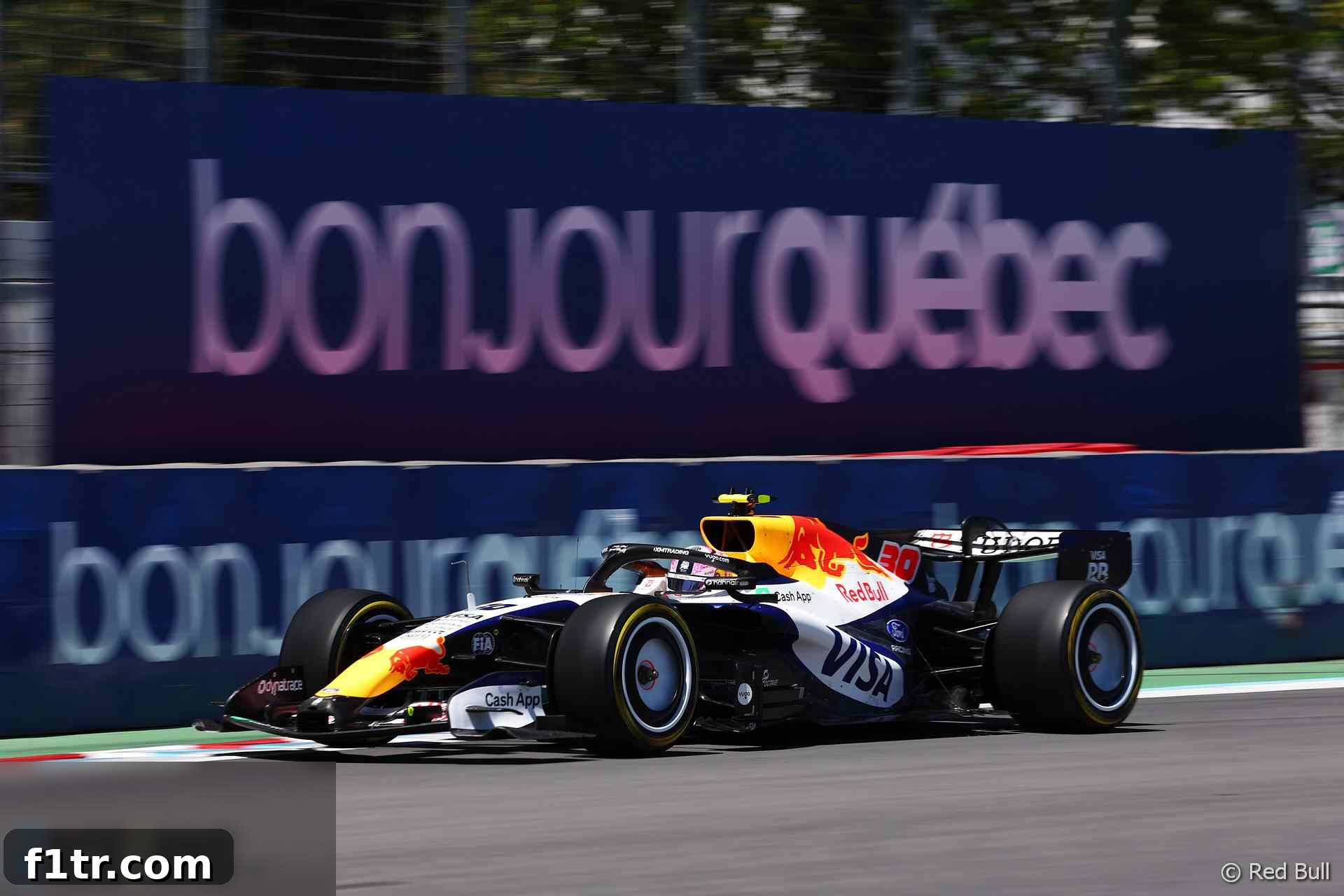
Racing Bulls have been fined €30,000 (£25,900), with two-thirds of the penalty suspended, after stewards found a fault on Liam Lawson’s car.
The stewards determined the Clutch Disengagement System (CDS) on Lawson’s car was not functioning after he stopped during the first practice session at the Canadian Grand Prix. The CDS is an external button marshals use to disengage the clutch so the wheels can turn, allowing the car to be recovered quickly.
According to the stewards’ report, the team’s engineer explained that the CDS on this car performs two roles: the primary function of releasing the clutch when the car is stopped and the engine is not running, and a secondary role linked to the anti-stall system. A ruptured joint caused a hydraulic leak that stopped the car and, when the marshal activated the CDS, it failed to release the clutch. As a result, the car could not be moved and the session was red-flagged.
“This is a serious matter,” the stewards wrote. “It resulted in the session being red-flagged. Had the system worked as intended by the regulations, the incident could have been dealt with swiftly via deployment of the Virtual Safety Car.”
The report also noted that the FIA Technical Delegate had previously raised concerns about the dual-purpose design of the CDS on Racing Bulls’ cars. The team was warned about their CDS design in 2025, the stewards said.
Lawson raised further issues with how the marshals handled the situation. He told stewards that, contrary to his instructions and usual practice, marshals attempted to push the stationary car, and that the marshal who tried to activate the CDS was pressing a button on the on-board camera rather than the CDS control.
The stewards commented that these observations indicate additional training for marshals is required, despite the FIA distributing detailed guidance in the “FIA Single Seater Recovery Specifications.” They suggested that the written guidance likely needs to be supplemented by practical, hands-on training provided by event organisers.
In light of the CDS failure and the session disruption, the stewards imposed a €30,000 fine on Racing Bulls, suspending two-thirds of the amount. The decision highlights the importance of reliable recovery systems and the need for clear equipment design and thorough marshal training to ensure incidents can be resolved safely and efficiently.
Advert | Become a RaceFans supporter andgo ad-free
The stewards’ findings underline the dual responsibility for safety: teams must ensure systems meet regulatory intent and remain reliable in failure modes, and organisers must ensure marshals are trained to operate recovery equipment correctly. Both elements are crucial to minimise disruption and preserve safety during sessions.
The incident at the Canadian Grand Prix serves as a reminder that technical design choices and operational practice are closely linked in on-track safety. Addressing both design concerns and practical training will be necessary to prevent similar issues in future events.
- Leclerc told Ferrari to complain about rivals’ “illegal” cool-down laps
- Russell narrowly beats Antonelli to sprint race pole position ahead of McLarens
- 2026 Canadian Grand Prix sprint race grid
- Racing Bulls handed suspended £25,900 fine for “serious” problem on Lawson’s car
- 2026 Canadian Grand Prix sprint race qualifying day in pictures
Browse all 2026 Canadian Grand Prix articles