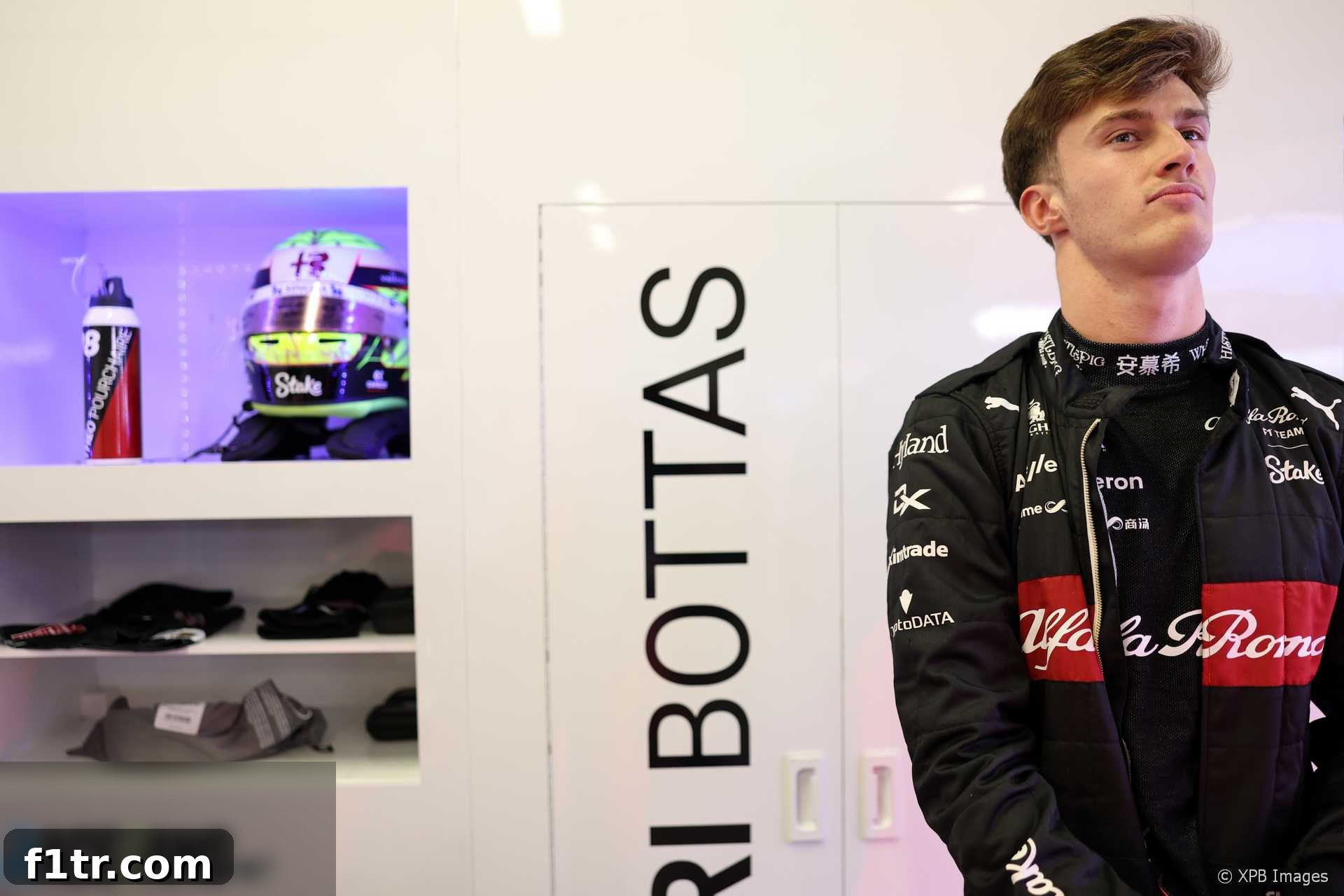
F2 Champion Theo Pourchaire Expresses Disappointment Over Lack of 2024 Formula 1 Opportunity
Newly crowned Formula 2 champion Theo Pourchaire has openly expressed his profound disappointment regarding his inability to secure a Formula 1 race seat for the upcoming 2024 season. The talented Sauber junior driver, who clinched the highly coveted F2 title at the dramatic final round in Abu Dhabi, beating Mercedes junior Frederik Vesti, finds himself in a familiar, yet frustrating, position for recent F2 winners.
Advert | Become a Supporter & go ad-free
The Unfortunate Trend: F2 Champions Await Their F1 Call
Pourchaire’s situation regrettably mirrors those of his immediate predecessors. He now becomes the third consecutive Formula 2 champion – following Oscar Piastri (2021) and Felipe Drugovich (2022) – to face the challenge of not immediately ascending to the pinnacle of motorsport, Formula 1, in the season directly following their championship triumph. This emerging pattern raises significant questions about the pathways for young talent in the fiercely competitive world of Grand Prix racing.
Pourchaire’s Candid Admission at the FIA Gala
Speaking with a mix of pride and regret at the prestigious FIA Prize Giving Gala in Baku, where he was presented with his hard-earned Formula 2 trophy, Pourchaire did not shy away from sharing his feelings. He admitted to being “disappointed” that a Formula 1 race seat for 2024 had not materialized, despite achieving the ultimate goal set for him by the Sauber Academy.
“I think I’m the third F2 champion in a row to not be promoted to F1,” Pourchaire reflected. “Which, it can happen. It’s not because you are an F2 champion that you will have a place in F1. But I’m disappointed, to be honest. Because I’m an F2 champion, I did some good results in the past. I did my best. The goal that the Sauber Academy told me was to win the championship – and I did it. So it’s like this.” His words encapsulate the harsh reality faced by many aspiring F1 drivers, where talent and achievement do not always guarantee an immediate progression.
A Championship Journey: Theo Pourchaire’s Road to F2 Glory
Theo Pourchaire’s journey to the 2023 Formula 2 championship was a testament to his resilience, raw speed, and strategic acumen. Having joined the Sauber Academy in 2019, Pourchaire quickly rose through the junior ranks. He impressed in Formula 3, securing multiple wins, before making his full-time F2 debut in 2021. Throughout his F2 career, he consistently showcased his potential, often battling against more experienced drivers. The 2023 season saw him engaged in a captivating title fight with Frederik Vesti, which went down to the wire at the Yas Marina Circuit. His ability to manage pressure, deliver crucial performances, and maintain consistency ultimately earned him the championship crown, solidifying his status as one of motorsport’s most promising young talents. His dominant performances and eventual title win were expected by many to be a direct springboard to an F1 seat, especially given his long-standing affiliation with Sauber, which will transition into Audi in the coming years.
The Post-Championship Conundrum: Paths of Past F2 Winners
A specific rule within Formula 2 prohibits champions from competing in the series the following season, forcing them to seek alternative avenues if an F1 seat isn’t immediately available. This rule, designed to ensure fresh talent rises through the ranks, inadvertently creates a holding pattern for successful graduates.
Oscar Piastri, the 2021 F2 champion, spent his 2022 season as a reserve driver for Alpine, dedicating his time to simulator work and private testing of the team’s pre-2022 cars. His patience and persistence paid off, as he was eventually poached by McLaren for a highly sought-after race seat in 2023, where he has already demonstrated immense potential. Felipe Drugovich, who triumphed in the 2022 F2 season, was signed as the inaugural member of the Aston Martin driver academy. He has actively participated in multiple Friday practice sessions for the team, gaining invaluable F1 experience and keeping himself firmly within the F1 paddock’s radar. Both examples highlight the necessity for F2 champions to remain engaged and visible, even if a full-time F1 drive isn’t immediately on the cards.
Advert | Become a RaceFans supporter andgo ad-free
Theo Pourchaire’s 2024 Outlook: Super Formula beckons?
Looking ahead to 2024, Pourchaire has articulated his strong desire to secure a race drive in a competitive championship, rather than settling for a purely reserve role. Among his considerations, the prestigious Japanese Super Formula championship stands out as a prime option. This series has become a viable proving ground for aspiring F1 drivers, notably demonstrated by Red Bull junior Liam Lawson, who competed in it this year and narrowly missed clinching the title.
“For me, I would like to do a championship next year,” Pourchaire stated, emphasizing his need for active competition. He further elaborated on the limitations of mere testing: “Driving in an F1 car for some testing days – it’s good, but it’s a lot of money and not every Formula 1 team can afford that. So unfortunately I think it will not be the case for me with the Sauber Academy. So I’ll try just to find a place in a good championship. So Super Formula is I think the best option for me.” His pragmatism reflects a clear understanding of the financial and logistical challenges in motorsport, particularly for drivers without direct F1 team funding for extensive testing programs.
Is it Bad Luck or a Systemic F1 Problem?
When pressed on whether his current predicament was simply a stroke of bad luck or indicative of a more systemic issue within Formula 1’s driver progression system, Pourchaire offered a balanced perspective. “I think it’s a bit of both,” he acknowledged, indicating a complex interplay of factors.
“It’s a bit of wrong timing, wrong place probably,” he continued. “Because there’s just no space next year in F1.” This sentiment highlights the brutal reality of a 20-car grid that offers extremely limited opportunities, especially when many current drivers hold multi-year contracts. The stability of the current F1 grid has inadvertently created a bottleneck for rising talents.
However, Pourchaire remains optimistic about future prospects. “Of course I think at the end of 2024 there’s a lot of drivers without a contract, but I will not be racing in F2. That’s why I want to keep racing and show myself to the Formula 1 paddock as well that I’m able to be really fast and that I deserve a place there.” His determination to stay active and visible underscores the competitive nature of the sport, where continued performance is key to future opportunities. He believes that while the system isn’t fundamentally broken, it presents unique challenges. “So I don’t think there’s a big issue in the system.”
The Undeniable Merit of an F2 Champion
Despite the current hurdles, Pourchaire firmly believes that a Formula 2 champion inherently deserves a place in F1. He points to the exemplary performance of Felipe Drugovich as evidence. “But for sure a Formula 2 champion normally deserves a place in F1, because even if it’s in the third season we saw that Felipe Drugovich I think in FP1 is always really quick. He’s ready to jump in an F1 car. So I think he also deserves a place in F1.” Drugovich’s consistently strong showings in free practice sessions validate the readiness of F2 champions for the top tier. Pourchaire concluded with a dose of realism: “But it’s like this. I mean we have to be realistic, and if we don’t have any places, it’s part of motorsport.” This pragmatic acceptance of motorsport’s harsh realities reflects a mature understanding of his challenging situation.
Advert | Become a RaceFans supporter andgo ad-free
Conclusion: A Champion’s Resolve in the Face of Adversity
Theo Pourchaire’s triumph in Formula 2 marks him as a talent of significant potential. His disappointment at not immediately progressing to Formula 1 is understandable, given the aspirations of any young driver reaching the pinnacle of the feeder series. His situation, alongside Piastri and Drugovich, highlights a broader discussion within motorsport about ensuring clear pathways for its most promising stars. While the immediate future may involve racing outside of F1, Pourchaire’s resolve to continue competing in a challenging series like Super Formula demonstrates his commitment to proving his worth and keeping his F1 dream alive. The motorsport world will undoubtedly be watching his next moves closely, anticipating his eventual, well-deserved arrival in Formula 1.
Formula 1
- GT driver killed in multi-car crash at Nurburgring Qualifiers
- Should F1 change tracks or racing guidelines to tackle dangers in 2026 rules?
- Controversies, Norris, Newey and more: Five new motorsport books reviewed
- One of F1’s greatest races happened 15 years ago today. Or did it?
- “Overtaking is overtaking”: Domenicali denies F1’s yo-yo racing is “artificial”
Browse all Formula 1 articles