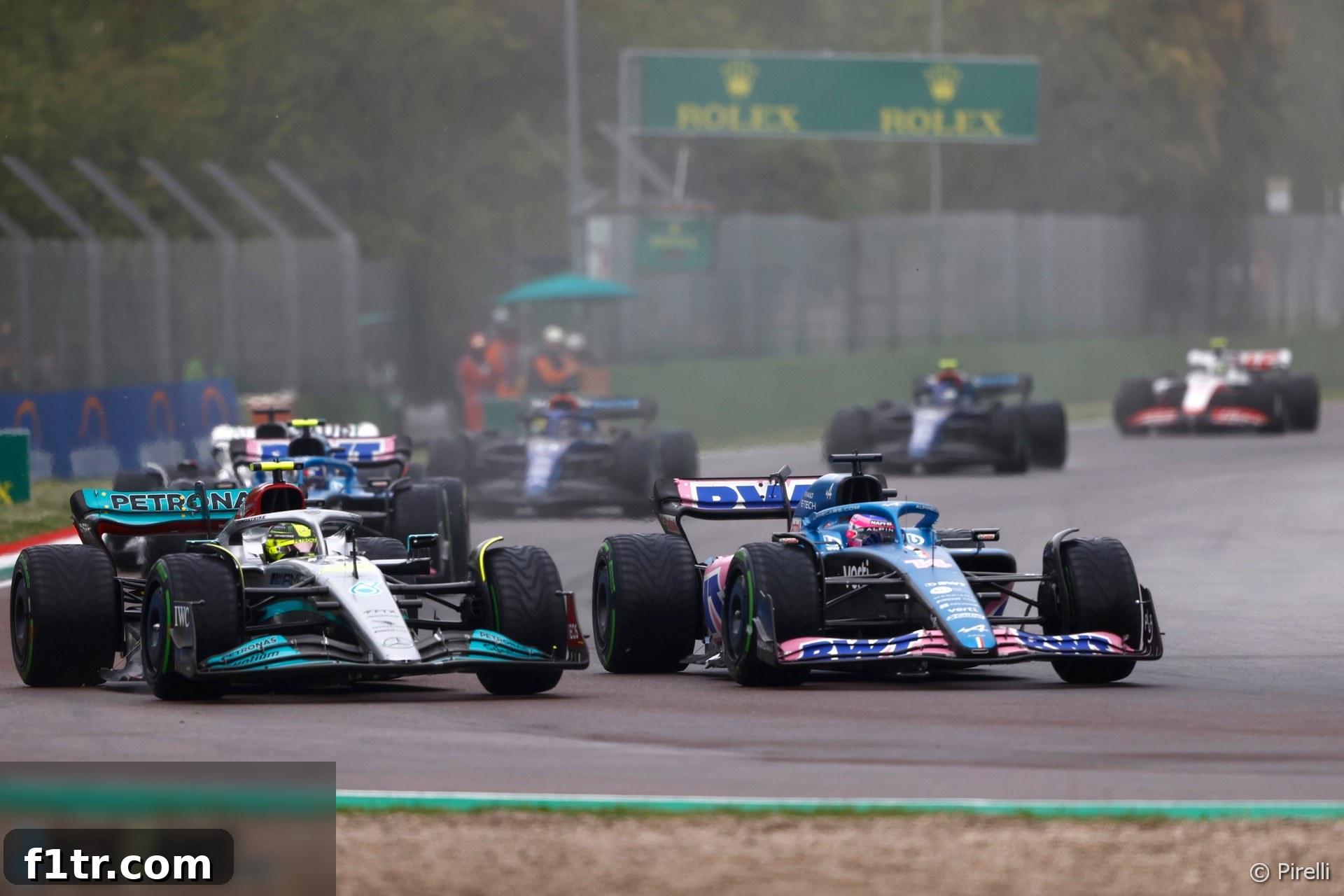
The 2022 Formula 1 season continued its challenging trajectory for two-time world champion Fernando Alonso, who was once again forced to retire early from a Grand Prix due to unforeseen circumstances. At the Emilia-Romagna Grand Prix, held at the iconic Imola circuit, Alonso’s race came to an abrupt end following a seemingly minor first-lap incident, adding another chapter to what has become a frustrating start to his campaign with the Alpine F1 Team.
Advert | Become a Supporter & go ad-free
The pivotal moment occurred on the opening lap when Alonso’s Alpine A522 made contact with the Haas of Mick Schumacher. While the touch appeared minimal from the cockpit and even to casual observers, the consequences for Alonso’s car were devastating. A large, gaping hole manifested in the right-hand sidepod of his car, leading to immediate and irreversible performance loss. This damage, far exceeding the visual severity of the contact, left Alonso visibly surprised and deeply perplexed.
Reflecting on the incident, Alonso recounted, “I didn’t feel much, obviously it was a very, very small touch with Mick. I only saw on the replay and obviously that was enough to destroy my car.” His words highlighted the stark contrast between the perceived impact and the critical damage sustained by his highly sophisticated F1 machine. Sidepods in modern Formula 1 cars are not merely aesthetic covers; they are intricate aerodynamic components designed to channel airflow to the rear of the car, cool vital engine components, and contribute significantly to overall downforce. A compromise to their integrity, especially such a large hole, effectively renders the car uncompetitive and can pose serious reliability risks, necessitating an immediate retirement.
This early exit marked a concerning pattern for the Spanish veteran. Having not scored a single point since the season-opening race, the Emilia-Romagna Grand Prix presented another missed opportunity to climb up the championship standings. Alonso openly expressed his growing frustration, attributing his recent string of misfortunes to factors largely beyond his control. “I think there are a lot of unlucky moments so far for me in the championship, out of my hands or my control, and this is another example,” he stated, his voice tinged with a blend of resignation and disbelief.
The two-time world champion acknowledged the psychological toll of these recurring setbacks, but also expressed a pragmatic perspective on the long season ahead. “I prefer to finish the season better than start it good and then finish it bad,” he remarked, indicating a preference for a strong finish over an auspicious but ultimately faltering beginning. “So if you want to choose one way, it’s the other way around and finish on a better performance.” Despite this hopeful outlook, the reality of his current championship standing weighed heavily on him. With only two points from the first four races, a stark contrast to the 25 or 30 points he believes he should have accumulated, Alonso confessed, “that’s painful.”
The incident at Imola also brought into sharp focus concerns about the Alpine A522’s durability. Alonso drew comparisons to his competitors, whose cars, he noted, seemed to withstand similar race-start skirmishes without issue. “Everyone will agree that we’ve been very unlucky. We have some reliability issues. We had this problem in Australia qualifying,” he explained, referencing another incident where a hydraulics issue led to a significant qualifying crash. “Today everyone is touching each other on the start and nothing happened. Their car seems unbreakable, but our car, it’s just a small kiss from Mick and is completely destroyed.” This observation raised critical questions for the Alpine engineering team regarding the robustness of their design, particularly in high-impact zones like the sidepods, which are often subjected to light contact in the close quarters of F1 racing.
Despite the accumulating frustrations, Alonso, a driver renowned for his tenacious spirit and ability to overcome adversity, maintained a long-term view. He drew parallels to the previous season, where a challenging start at Imola was ultimately followed by a strong performance curve throughout the year. “But let’s see, there’s still 19 races to go,” he affirmed. “I remember last year after Imola, I had only one point and the season was a bit rough at that point and then we ended it in a high, the championship and quite competitive. So let’s see if this year we can do the same.” This veteran perspective offers a glimmer of hope that the current string of bad luck might eventually give way to improved fortune and performance.
Beyond the immediate retirement, Alonso’s incident carried further implications for the Alpine F1 Team’s development efforts. Fernando Alonso was the sole Alpine driver running the team’s newly introduced floor upgrade at Imola. This crucial aerodynamic component, designed to extract more performance from the ground effect regulations, required extensive real-world testing and data collection. His early retirement meant a significant loss of invaluable race data, hindering the team’s understanding of the new floor’s performance characteristics and its potential for future development. “I don’t know even if this floor will be useful in Miami or not. So there are a lot of consequences out of our hands or not by our own mistakes, only because of someone else or something, that is quite painful,” Alonso lamented, highlighting the ripple effect of such incidents on the meticulous and data-driven world of Formula 1 research and development. The lost mileage and data could delay future upgrades or make it harder for Alpine to optimize the new package, potentially costing them precious tenths of a second on track.
Advert | Become a RaceFans supporter andgo ad-free
The string of unfortunate events for Fernando Alonso serves as a stark reminder of the fine margins and unpredictable nature of Formula 1. While his pace and determination remain undeniable, external factors and reliability woes have consistently denied him the opportunity to convert potential into points. As the championship heads to new and exciting venues, the Alpine F1 Team will be under pressure to address the durability concerns and ensure their star driver can finally enjoy a clean, uninterrupted race weekend. Alonso’s resilience, a hallmark of his illustrious career, will be thoroughly tested as he aims to turn the tide and deliver the strong performances he and the team undoubtedly capable of. The hope remains that the balance of fortune will eventually swing in his favor, allowing him to demonstrate the full potential of both himself and the Alpine A522.
2022 Emilia-Romagna Grand Prix
- Aston Martin’s first points reward “immense” effort by factory after Melbourne crashes
- Verstappen becomes 14th driver in F1 history to score more than one ‘grand slam’
- Transcript: “I need more power” – Hamilton and Russell’s contrasting fortunes at Imola
- Ferrari backs increase to six sprint races as F1 Commission meets in London
- Ocon blames pit equipment after penalty for near-miss with Hamilton in pits
Browse all 2022 Emilia-Romagna Grand Prix articles