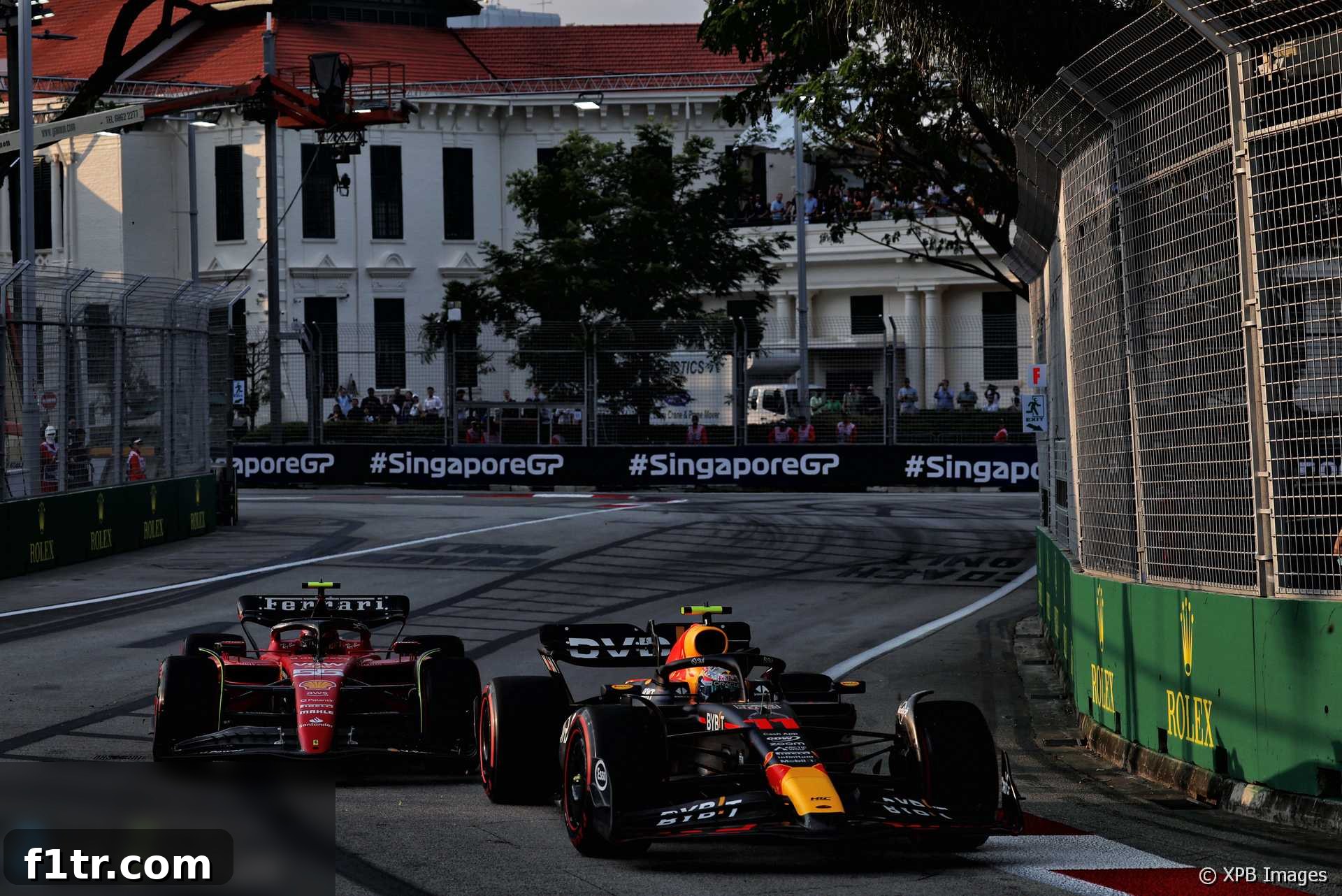
Singapore Grand Prix: Ferrari’s Unexpected Dominance and Red Bull’s Rare Struggles Reshape the Grid
Just two weeks after an unpredictable performance at Monza, where Carlos Sainz Jnr secured a thrilling pole position and a podium finish, the Formula 1 circus arrived at the challenging Marina Bay Street Circuit for the Singapore Grand Prix. Historically, the variances in Ferrari’s performance have made it difficult for Sainz to predict the team’s competitiveness week-to-week, especially in the shadow of the dominant Red Bull machinery. Yet, what unfolded on Friday in Singapore defied all expectations, setting the stage for one of the most intriguing qualifying sessions of the season.
Ferrari’s Stunning Turnaround: From Cautious Optimism to Front-Row Favourites
Heading into Marina Bay, a circuit demanding peak aerodynamic efficiency and driver precision, both Sainz and his teammate Charles Leclerc adopted a tone of cautious optimism. Mindful of preventing premature hype, they publicly downplayed Ferrari’s prospects, anticipating a track layout less favourable to their SF-23 than the high-speed Monza circuit. However, reality quickly painted a different picture. As the floodlights illuminated the Singapore night, the two Ferrari drivers demonstrated blistering pace, topping both free practice sessions, leaving their rivals trailing. Any hopes of entering qualifying without the heavy burden of heightened expectations quickly vanished, replaced by the undeniable reality of their formidable performance.
Interestingly, Ferrari arrived in Singapore with minimal upgrades – a minor tweak to their front wing flap – in stark contrast to rivals like Red Bull and McLaren, who introduced multiple new components. Despite this, both Leclerc and Sainz attributed their newfound speed to significant strides made in car setup during the initial day of running. Sainz, who edged out his teammate by a mere 0.018 seconds in FP2, commented on their progress: “For us, we haven’t really brought anything different. It’s just a small tweak to what we had.” He further elaborated on the team’s meticulous approach: “We tested a couple of things of set-up that I wanted to try around this kind of track and it looks like it worked and it’s going in the right direction. So let’s see if we can put another good lap tomorrow and be on the front row.” This meticulous optimization of their existing package hints at a deeper understanding of the car’s characteristics, a development that could be crucial for the remainder of the season.
The sudden surge in Ferrari’s competitiveness is particularly significant given the circuit’s demanding nature. Marina Bay, with its myriad of slow corners and unforgiving walls, requires a car that is both agile and stable under braking. The SF-23, often criticized for its inconsistency, appeared to have found a sweet spot in these conditions. This unexpected dominance elevates Ferrari from an outside contender to a genuine front-runner for pole position, potentially disrupting Red Bull’s season-long stranglehold on Saturday afternoons.
Red Bull’s Uncharacteristic Struggles: A Rare Off-Day for the Champions
Ferrari’s surprising pace was only one half of the Friday narrative. The other, equally seismic development, was the uncharacteristically subdued performance of the hitherto unstoppable Red Bulls. Reigning world champion Max Verstappen and his teammate Sergio Perez found themselves a staggering seven-tenths of a second off the pace, finishing seventh and eighth respectively in FP2. This significant deficit was all the more remarkable given the absence of rain, red flag interruptions, or any apparent mechanical issues plaguing their RB19s.
Verstappen, often unflappable, openly admitted his surprise and frustration: “Our performance today was unexpected. We tried quite a few different things in FP2 and some worked, and some didn’t. We never really got the car together today. I struggled with the balance especially, so there are quite a few things to work on with the team tonight.” His comments suggest a fundamental issue with their setup or perhaps the car’s inherent characteristics struggling with the unique demands of the Singapore circuit, particularly with the evolving track layout.
Perez echoed his teammate’s sentiments, describing a terrifying lack of stability in his RB19. Throughout the night session, he voiced concerns about the car’s rear end, expressing a feeling of being on the verge of a crash in every braking zone. While he managed to keep his car out of the unforgiving Marina Bay barriers, the challenge ahead for Red Bull is immense. Both drivers highlighted the urgent need for a comprehensive overhaul of their car’s setup overnight. “I think there are some interesting bits going on that we need to figure out overnight,” Perez said. “We seem to be struggling quite a bit with the rear end of the car, especially in FP2. We did expect the Ferrari to be good around here, but we are just too far away. All being well, we should be able to close the gap a bit more tomorrow, it will be quite a big challenge. The main thing is to improve the balance because right now we are too far off.” This rare display of vulnerability from Red Bull signals a genuine opportunity for their competitors, particularly Ferrari, to capitalize and potentially break their winning streak.
Mercedes’ Promising Showing: A Battle for the Second Row
With Red Bull unusually off the pace, George Russell’s Mercedes emerged as the closest challenger to the leading Ferraris by the end of Friday’s sessions. Mercedes often demonstrates a knack for improving their performance throughout a Grand Prix weekend, and their initial pace in Singapore bodes well. Russell couldn’t hide his satisfaction, declaring it “probably our best Friday of the year so far” around the Marina Bay circuit. He highlighted the car’s responsiveness to the conditions: “The car is feeling really good around the circuit. It definitely improved in the cooler temperatures of FP2 but equally, it still felt decent in the slightly unrepresentative conditions of FP1.”
Looking ahead to qualifying, Russell was realistic about Ferrari’s current advantage, even suggesting they might be holding back some performance. “Ferrari are looking favourites at the moment,” he acknowledged. “I don’t think they were maximum power unit as well. So they’ve probably got a couple more tenths in the pocket – so the fight’s on probably for the second row.” This assessment from a direct competitor underscores the impressive turn of speed displayed by the Scuderia, pushing Mercedes to focus on consolidating their position as the leading contender behind the front-running Prancing Horses. The battle for the second row, involving Mercedes and potentially McLaren and Aston Martin, promises to be fiercely contested, adding another layer of excitement to the qualifying session.
The Evolved Marina Bay Circuit: Faster, Yet Still a Unique Challenge
The 2023 Singapore Grand Prix marks a significant evolution for the Marina Bay Street Circuit, thanks to the removal of four corners in the final sector. The track now features a straight run from Turn 15 directly into what was previously Turn 20, transforming a complex chicane sequence into a high-speed braking zone. Drivers now hit the brakes at approximately 290 kph in seventh gear for the right-hander, a stark contrast to the previous 180 kph. This modification has dramatically increased lap speeds, with teams recording times over 10 seconds quicker than their best last year, and average lap speeds rising by around 15 kph. This is no minor adjustment; it demands recalibrated car setups and a revised driving approach.
Despite these speed increases, Singapore remains one of the slower circuits on the current F1 calendar, ranking even behind the Hungaroring in terms of average speed. The unique blend of relentless heat, oppressive humidity, and close-quarters street racing continues to make it one of the most physically and mentally demanding races for drivers. The absence of the slower chicanes may have added speed, but the technicality and unforgiving nature of the circuit endure, challenging both man and machine to their absolute limits.
Qualifying Dynamics and Traffic Concerns on a Tight Street Circuit
As with any street circuit, traffic management remains a paramount concern, particularly during the crucial qualifying sessions. The narrow confines of Marina Bay can quickly lead to congestion as drivers jostle for clear track space to set their flying laps. This was evident on Friday when Carlos Sainz had to abandon a quick lap after encountering an unaware Max Verstappen over the Anderson Bridge, just before Turn 13, forcing the Ferrari driver onto the brakes. While the controversial “maximum lap time” rule from Monza won’t be applied to all laps in Singapore qualifying, the inherent challenges of managing traffic persist.
Valtteri Bottas, reflecting on the potential for bottlenecks, suggested that Singapore’s intense heat and humidity might offer a slight reprieve: “Yes, there will be some bunching up in quali – especially Q1. But at least we’ve got some temperature, so I don’t think losing tyre temperature is going to be a massive issue.” However, his Alfa Romeo teammate, Zhou Guanyu, painted a more cautious picture, specifically highlighting the newly formed straight leading into Turn 16. Zhou predicted significant trouble: “I think mainly qualifying it’s going to be a massive pile-up going to the last chicane before you’re starting the lap. That’s probably the biggest issue at the moment.”
These traffic predictions underscore the pressure on teams, especially Ferrari, to execute a flawless qualifying strategy. Having been caught out by various incidents and strategic missteps earlier in the season, Ferrari cannot afford any errors that might attract the attention of the stewards. With both Sainz and Leclerc seemingly genuine contenders for pole position, the stakes are incredibly high. A clean, uninterrupted run will be essential for them to convert their raw pace into a front-row lockout.
The Battle for Pole: A New Dynamic Emerges
As the teams prepare for the intensity of qualifying, Ferrari’s strong start has undoubtedly altered the landscape. Charles Leclerc, ever focused on continuous improvement, summarized the team’s mindset: “It’s good to build a weekend starting on a Friday like this. But again, we still need to do a step forward for tomorrow so that’s where we are focusing everything at the moment and let’s see what we can do.” This commitment to incremental gains will be crucial in a session where every thousandth of a second counts.
The 2023 Singapore Grand Prix promises a captivating qualifying session. Ferrari, with its newfound confidence and optimized setup, looks poised to challenge for pole position for the first time this season on pure pace. Red Bull faces an unprecedented overnight challenge to rectify their car’s balance issues. Mercedes, meanwhile, aims to consolidate its position as a strong contender for the second row. The unique characteristics of the Marina Bay circuit, combined with the intense pressure of a night race, guarantee a dramatic and unpredictable battle under the lights.
Combined practice times
| Position | Number | Driver | Team | FP1 time | FP2 time | Gap | Laps |
|---|---|---|---|---|---|---|---|
| 1 | 55 | Carlos Sainz Jnr | Ferrari | 1’33.428 | 1’32.120 | 50 | |
| 2 | 16 | Charles Leclerc | Ferrari | 1’33.350 | 1’32.138 | 0.018 | 52 |
| 3 | 63 | George Russell | Mercedes | 1’33.695 | 1’32.355 | 0.235 | 50 |
| 4 | 14 | Fernando Alonso | Aston Martin-Mercedes | 1’33.974 | 1’32.478 | 0.358 | 53 |
| 5 | 44 | Lewis Hamilton | Mercedes | 1’33.540 | 1’32.585 | 0.465 | 44 |
| 6 | 4 | Lando Norris | McLaren-Mercedes | 1’33.522 | 1’32.711 | 0.591 | 47 |
| 7 | 11 | Sergio Perez | Red Bull-Honda RBPT | 1’33.725 | 1’32.812 | 0.692 | 45 |
| 8 | 1 | Max Verstappen | Red Bull-Honda RBPT | 1’33.476 | 1’32.852 | 0.732 | 45 |
| 9 | 20 | Kevin Magnussen | Haas-Ferrari | 1’34.887 | 1’33.017 | 0.897 | 48 |
| 10 | 77 | Valtteri Bottas | Alfa Romeo-Ferrari | 1’34.802 | 1’33.105 | 0.985 | 49 |
| 11 | 27 | Nico Hulkenberg | Haas-Ferrari | 1’34.985 | 1’33.139 | 1.019 | 44 |
| 12 | 40 | Liam Lawson | AlphaTauri-Honda RBPT | 1’34.894 | 1’33.285 | 1.165 | 54 |
| 13 | 31 | Esteban Ocon | Alpine-Renault | 1’34.066 | 1’33.361 | 1.241 | 49 |
| 14 | 18 | Lance Stroll | Aston Martin-Mercedes | 1’34.568 | 1’33.390 | 1.270 | 50 |
| 15 | 81 | Oscar Piastri | McLaren-Mercedes | 1’35.474 | 1’33.461 | 1.341 | 45 |
| 16 | 22 | Yuki Tsunoda | AlphaTauri-Honda RBPT | 1’34.042 | 1’33.477 | 1.357 | 52 |
| 17 | 24 | Zhou Guanyu | Alfa Romeo-Ferrari | 1’35.456 | 1’33.575 | 1.455 | 50 |
| 18 | 10 | Pierre Gasly | Alpine-Renault | 1’34.639 | 1’33.824 | 1.704 | 47 |
| 19 | 2 | Logan Sargeant | Williams-Mercedes | 1’35.778 | 1’34.327 | 2.207 | 52 |
| 20 | 23 | Alexander Albon | Williams-Mercedes | 1’34.657 | 1’35.558 | 2.537 | 24 |
2023 Singapore Grand Prix Related Articles
- Sainz’s Singapore win made Leclerc focus on improving his race pace – Clear
- Singapore and Austin retirements cost me top 10 championship place – Ocon
- How Ocon’s “extreme” height for an F1 driver is helping other tall racers
- Steward’s admission Verstappen should have had penalty frustrates his rivals
- Drivers back Singapore qualifying tweak as rule changes again for Japanese GP
Browse all 2023 Singapore Grand Prix articles