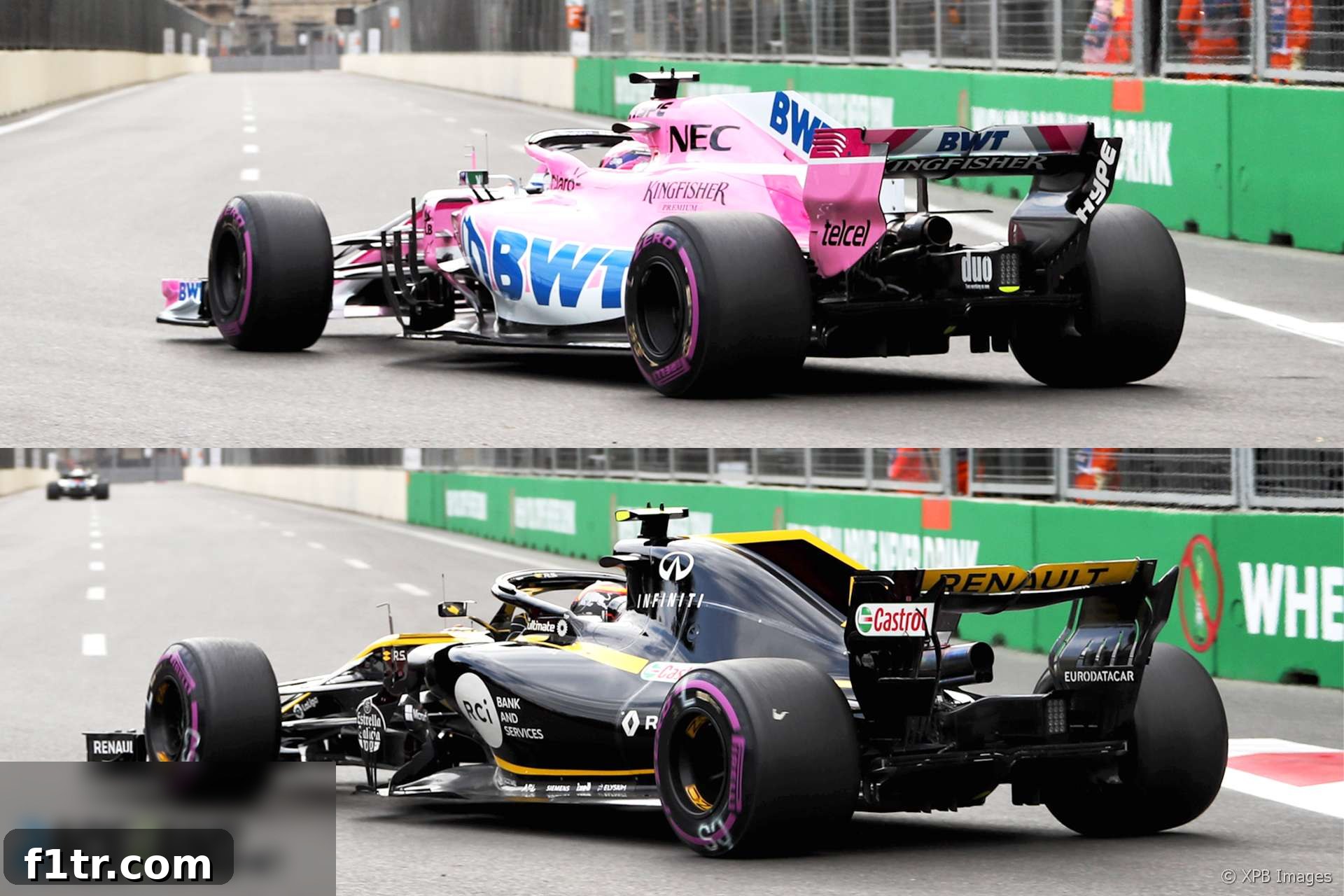
The Azerbaijan Grand Prix, held on the challenging Baku City Circuit, consistently highlights the critical balance between outright speed and aerodynamic downforce in Formula 1. Following the event, Carlos Sainz Jnr of Renault expressed his observations regarding the persistent straight-line speed advantage held by some of their key rivals. His remarks underscore a crucial area where Renault continues its intense development efforts to close the performance gap in the highly competitive world of F1.
The unique characteristics of the Baku track, with its incredibly long main straight and a mix of tight, technical sections, demand a very specific car setup. Renault, in a strategic move, introduced a specialized medium downforce aerodynamic package for the Azerbaijan Grand Prix. This approach was meticulously designed to optimize their performance on the track’s extensive straights, where top speed is paramount. Consequently, this entailed running with slimmer rear wing angles compared to many of their competitors, a decision that inherently meant sacrificing a degree of performance in the slower, more intricate cornering sections of the circuit.
Sainz elaborated on this engineering trade-off, highlighting the stark visual differences on track. “You see the Williams and the Force India with huge rear wings, and we, together with Red Bull, are running a very small rear wing,” he observed. This distinction reveals a fundamental disparity in power unit capabilities. Teams equipped with more potent engines, such as those supplied by Mercedes, possess the luxury of generating greater downforce through larger wing elements without being unduly penalized on the straights. Their superior engine performance effectively compensates for the increased aerodynamic drag, allowing them to maintain high top speeds while simultaneously benefiting from enhanced grip and stability in the corners.
The essence of Sainz’s concern lies in this underlying power difference. “It’s no secret that they are very strong in engine performance and it’s allowing them to carry more downforce in their cars,” he stated unequivocally. This ability to run higher downforce configurations without compromising straight-line speed is a significant competitive advantage, particularly on circuits like Baku where both attributes are vital. This explains why certain teams, despite perhaps not being front-runners on all track types, can demonstrate exceptional performance and “come back [to the front of the field] in this sort of track,” as Sainz pointed out. The sheer horsepower allows them to manage higher drag setups, leading to a more complete and versatile package for the Azerbaijan challenge.
Despite the current disparity, Sainz maintained an optimistic outlook regarding Renault’s capacity to diminish the performance deficit to their rivals. He acknowledged the ongoing nature of the challenge: “There’s still a gap, we’re still working on it, there’s development to come to close the gap. But it still exposes that there is a bit of work to do.” This candid assessment highlights Renault’s realistic understanding of the task ahead while reinforcing their commitment to continuous improvement across all facets of their F1 program, especially power unit development.
Sainz’s confidence stems from the significant progress Renault has already made over recent years. He drew a positive comparison to past seasons, noting, “I’m not worried at all because it’s something Renault is looking at, it’s something we are working at. The gap is smaller than what it was in 2015, 2014.” This historical perspective provides crucial context, illustrating a clear trajectory of improvement for the French manufacturer’s power unit. The tangible results of this progress were evident in Baku, where Renault was able to secure a place in Q3, a testament to their improved pace. Furthermore, the strong performance of Red Bull, also running Renault power units (re-badged as TAG Heuer), served as another indicator of the engine’s advancing capabilities, demonstrating that competitive results are achievable with the right car and setup.
Sainz’s team mate, Nico Hulkenberg, echoed the sentiment regarding the importance of the power unit, but also broadened the perspective. He pointed out that the dominance in engine development isn’t exclusively held by Mercedes. “The Mercedes power unit definitely helps here,” Hulkenberg conceded, acknowledging their clear advantage on high-speed tracks. However, he quickly added, “Obviously it’s not a Mercedes power unit on pole but we know Ferrari’s very good too.” This highlights Ferrari’s formidable engine capabilities, which, although not topping the speed charts in Baku’s qualifying, are undoubtedly among the best in Formula 1. Hulkenberg further emphasized the direct impact of the power unit by referencing other teams: “I think Williams also stronger than in previous events that shows power unit does have an effect here.” The significant performance boost seen in Mercedes-powered cars like Williams and Force India particularly underscored how vital engine horsepower is for the long straights of the Baku City Circuit.
Azerbaijan Grand Prix Qualifying Speed Trap: A Deeper Dive into Raw Power
The qualifying speed trap data from the Azerbaijan Grand Prix provides compelling evidence to support the observations made by both Sainz and Hulkenberg. This raw data offers a clear snapshot of where teams stand in terms of outright straight-line velocity, directly influenced by engine power and aerodynamic efficiency. Analyzing these figures reveals the true nature of the power unit hierarchy on a circuit that heavily favors top speed.
| Pos | Driver | Car | Engine | Speed (kph/mph) | Gap |
|---|---|---|---|---|---|
| 1 | Esteban Ocon | Force India | Mercedes | 329.0 (204.4) | |
| 2 | Sergey Sirotkin | Williams | Mercedes | 320.0 (198.8) | -9.0 |
| 3 | Kevin Magnussen | Haas | Ferrari | 319.8 (198.7) | -9.2 |
| 4 | Carlos Sainz Jnr | Renault | Renault | 319.2 (198.3) | -9.8 |
| 5 | Lance Stroll | Williams | Mercedes | 318.4 (197.8) | -10.6 |
| 6 | Lewis Hamilton | Mercedes | Mercedes | 318.0 (197.6) | -11.0 |
| 7 | Sergio Perez | Force India | Mercedes | 316.7 (196.8) | -12.3 |
| 8 | Daniel Ricciardo | Red Bull | TAG Heuer | 316.6 (196.7) | -12.4 |
| 9 | Valtteri Bottas | Mercedes | Mercedes | 315.7 (196.2) | -13.3 |
| 10 | Max Verstappen | Red Bull | TAG Heuer | 315.4 (196.0) | -13.6 |
| 11 | Charles Leclerc | Sauber | Ferrari | 313.9 (195.0) | -15.1 |
| 12 | Stoffel Vandoorne | McLaren | Renault | 312.5 (194.2) | -16.5 |
| 13 | Nico Hulkenberg | Renault | Renault | 312.1 (193.9) | -16.9 |
| 14 | Fernando Alonso | McLaren | Renault | 309.9 (192.6) | -19.1 |
| 15 | Sebastian Vettel | Ferrari | Ferrari | 309.4 (192.3) | -19.6 |
| 16 | Kimi Raikkonen | Ferrari | Ferrari | 309.3 (192.2) | -19.7 |
| 17 | Marcus Ericsson | Sauber | Ferrari | 307.6 (191.1) | -21.4 |
| 18 | Pierre Gasly | Toro Rosso | Honda | 304.3 (189.1) | -24.7 |
| 19 | Brendon Hartley”>Brendon Hartley | Toro Rosso | Honda | 300.0 (186.4) | -29.0 |
| 20 | Romain Grosjean | Haas | Ferrari | 299.0 (185.8) | -30.0 |
At the top of the speed trap standings, Esteban Ocon, driving for Force India with a Mercedes power unit, recorded an impressive 329.0 kph (204.4 mph). He was closely followed by Sergey Sirotkin of Williams, also Mercedes-powered, at 320.0 kph (198.8 mph). This immediately highlights the potent straight-line speed capability of the Mercedes engine, especially when paired with aerodynamic setups that prioritize low drag, as was often the case for Force India and Williams in 2018. Other Mercedes-powered cars, including Lewis Hamilton and Valtteri Bottas in the factory Mercedes team, also featured prominently, though often with slightly lower speeds, indicating they might have opted for more downforce for overall race balance rather than prioritizing peak speed in qualifying.
Carlos Sainz Jnr, in his Renault-powered car, achieved a commendable 4th position on the speed trap, reaching 319.2 kph (198.3 mph). This indicates that Renault’s specific medium-downforce package for Baku was relatively effective in achieving good straight-line speed, placing them ahead of many Ferrari-powered and even some Mercedes-powered cars. However, the performance gap to the fastest Mercedes-engined car (Ocon) was still considerable. Other Renault-powered cars, such as Stoffel Vandoorne and Nico Hulkenberg, were further down the list, suggesting varying team strategies or car characteristics influencing their top-end speed.
Interestingly, the Red Bull Racing cars, powered by what are essentially re-badged Renault engines (TAG Heuer), sat in 8th and 10th positions with Daniel Ricciardo and Max Verstappen, respectively. Their speeds were slightly lower than Sainz’s, which might point to Red Bull opting for a higher downforce setup to maximize their car’s renowned cornering prowess, accepting a minor penalty on the straights. This trade-off is often a strategic choice, especially for teams confident in their chassis’s ability to recover time in the technical sections.
Ferrari-powered cars, including Kevin Magnussen of Haas (3rd fastest), showed strong straight-line performance. However, the factory Ferrari drivers, Sebastian Vettel and Kimi Räikkönen, were notably further down the speed trap list (15th and 16th). This can be interpreted as Ferrari’s strategic choice to run a higher downforce setup, prioritizing overall lap time through cornering grip and tire management over pure straight-line speed, especially given their engine’s strong overall performance. This reflects the delicate balancing act F1 teams face on a circuit like Baku.
Towards the bottom of the speed trap rankings, the Honda-powered Toro Rosso cars consistently struggled for top speed. Pierre Gasly and Brendon Hartley recorded significantly lower speeds, highlighting the ongoing development challenges faced by Honda at that point in the 2018 season. Their speeds were substantially off the pace of the front-runners, emphasizing the critical role of the power unit in achieving competitive straight-line performance on fast circuits.
In essence, the Azerbaijan Grand Prix speed trap data powerfully illustrates the intricate relationship between engine power, aerodynamic configuration, and strategic choices. While Renault showed promise with Sainz’s speed, the consistent presence of Mercedes-powered cars at the very top of the speed charts affirmed their formidable engine advantage in conditions that heavily favored raw horsepower and efficient low-drag aerodynamics. This data not only confirms the observations from the drivers but also maps out the development path for teams like Renault looking to challenge for consistent top-tier performance.
Looking ahead, Renault’s ambitions as a factory team in Formula 1 are substantial. The feedback and performance data from races like the Azerbaijan Grand Prix are invaluable, providing clear direction for their ongoing development efforts. The focus on improving straight-line speed and overall power unit performance is not just about competing on specific circuits, but about creating a championship-contending package that can perform optimally across diverse track layouts. Bridging the gap to the established top teams, which often boast superior power units, remains a colossal challenge in the relentless pursuit of F1 excellence. Renault’s commitment to reducing this deficit is a cornerstone of their long-term project, demanding continuous innovation in engine design and aerodynamic efficiency. Their progress in closing the gap since earlier seasons offers a positive indication of their trajectory, but the journey to the pinnacle of Formula 1 is a continuous, hard-fought battle of engineering prowess.
2018 F1 season
- F1 feared “death knell” for Drive to Survive after Ferrari and Mercedes snub
- McLaren staff told us we were “totally crazy” to take Honda engines in 2018 – Tost
- ‘It doesn’t matter if we start last’: How Red Bull’s junior team aided Honda’s leap forward
- Honda’s jet division helped F1 engineers solve power unit problem
- McLaren Racing losses rise after Honda split
Browse all 2018 F1 season articles