Red Bull Addresses Brazilian GP Team Orders Controversy and Condemns Online Abuse
Following a highly contentious moment at the recent Brazilian Grand Prix, Red Bull Racing has issued a comprehensive statement, confirming they have accepted Max Verstappen’s explanation for his refusal to obey a late-race team order. The incident, which saw Verstappen decline to yield position to his teammate Sergio Perez, ignited a fierce debate within the Formula 1 community. Alongside addressing the internal team matter, Red Bull also forcefully condemned the alarming wave of online abuse, including death threats, directed at its team members and their families in the aftermath of the race.
The Brazilian Grand Prix: A Race of Unintended Consequences
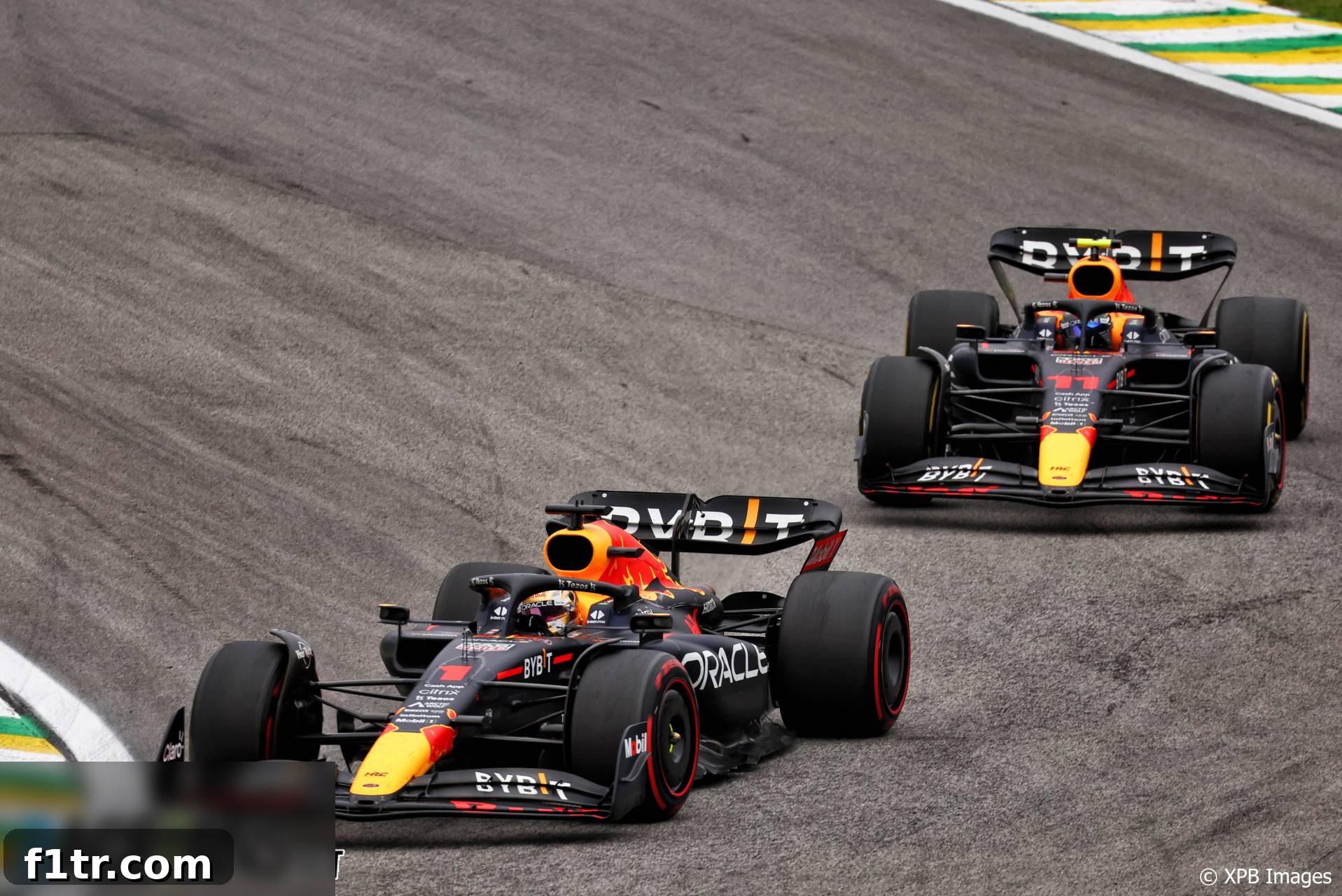
The controversy unfolded in the closing stages of the Brazilian Grand Prix at Interlagos. With just six laps remaining, Sergio Perez, who was battling for second place in the Drivers’ Championship with Ferrari’s Charles Leclerc, was instructed by his race engineer to not fight his teammate Max Verstappen. Verstappen, already crowned 2022 World Champion, was looking to make progress up the field, attempting to overtake Fernando Alonso and Charles Leclerc ahead. Perez, understanding the team’s broader strategy and receiving a promise that positions would be swapped back on the final lap if they were still together, dutifully complied, allowing Verstappen to pass.
However, a critical miscommunication within the Red Bull garage laid the groundwork for the ensuing drama. While Perez was assured of the swap, Verstappen was not privy to this specific arrangement at the time. His race engineer, Gianpiero Lambiase, simply told him, “Okay Max go and take some points off Alonso and Leclerc please.” Verstappen’s focus remained solely on his pursuit of the cars ahead, unaware of any obligation to repay the favor to his teammate.
Verstappen’s Refusal: A Matter of Information and Principle
As the final lap approached, and with Verstappen unable to pass the cars ahead, the team issued a second, more direct order: for him to let Perez re-take the position. This instruction came as they neared the Ferradura corner, the sixth turn of the 15-corner circuit. Verstappen’s response over the radio was immediate and firm: “I told you already last time you guys, don’t ask that again to me. Okay? Are we clear about that?” This pointed remark hinted at a deeper, perhaps unresolved, issue or a prior agreement within the team that was not publicly known.
Red Bull’s subsequent statement clarified their understanding of the situation, acknowledging significant internal errors. “As a team we made some mistakes in Brazil,” they admitted. The team explained that they “had not envisaged the situation that unfolded on the last lap and we had not agreed a strategy for such a scenario before the race.” Crucially, they highlighted that “regretfully, Max was only informed at the final corner of the request to give up position without all the necessary information being relayed.”
This lack of timely and comprehensive information, according to Red Bull, placed Verstappen, whom they described as “always been an open and fair team player,” in a “compromising situation with little time to react which was not our intention.” The team accepted Verstappen’s reasoning, indicating that an internal dialogue had taken place. They confirmed that Max spoke “openly and honestly” after the race, allowing both drivers to “resolve any outstanding issues or concerns.” The team concluded that “the conversation was a personal matter which will remain private between the team and no further comment will be made,” aiming to draw a line under the sporting aspect of the controversy.
Implications for Team Dynamics and the Championship Battle
The incident had immediate implications for Sergio Perez’s championship aspirations. Every point was crucial for him in his battle against Charles Leclerc for P2 in the Drivers’ Championship. Verstappen’s refusal potentially cost Perez valuable points, making his path to securing second place more challenging. While the team officially stated the matter was resolved internally, such events can often cast a long shadow over driver relationships and team morale, testing the unity of even the most successful outfits.
This episode also reopened discussions about the philosophy of team orders in Formula 1. While a common strategy, particularly in situations where one driver’s championship hopes are paramount, their implementation often sparks debate. The balance between individual ambition and team objectives is a delicate one, and Red Bull’s handling of this specific scenario underlined the complexities of managing two highly competitive drivers. The miscommunication serves as a potent reminder of how crucial clear, pre-defined strategies are, especially when high stakes are involved, to avoid such public disagreements and internal friction.
A Strong Stance Against Online Harassment
Beyond the sporting ramifications, Red Bull Racing used their statement to address a more sinister consequence of the incident: the horrific online abuse directed at team members. The team unequivocally condemned the “completely unacceptable” behavior witnessed across social media platforms. They highlighted that “the abusive online behaviour towards Max, Checo, the team and their respective families is shocking and saddening and unfortunately is something that we as a sport are having to address with depressing regularity.”
The specific types of abuse mentioned were particularly alarming: “Death threats, hate mail, vitriol towards extended family members is deplorable.” Red Bull passionately stated that “there is no place for it in racing or society as a whole and we need to do and be better.” The statement concluded with a powerful call for a more respectful environment, emphasizing, “We value inclusion and want a safe space for everyone to work in and enjoy our sport. The abuse needs to stop.” This robust condemnation serves as a vital reminder that while the passion for Formula 1 is immense, it must never descend into threats and harassment, reinforcing the importance of respect and sportsmanship both on and off the track.
Conclusion
Red Bull Racing’s statement aimed to provide clarity and closure on a multi-faceted controversy. By accepting Max Verstappen’s explanation and committing to keeping internal discussions private, the team sought to mitigate any lasting damage to team cohesion. Simultaneously, their unequivocal denouncement of online abuse sent a critical message to the wider F1 community, highlighting a pervasive problem that transcends the sport itself. The Brazilian Grand Prix incident, therefore, not only served as a dramatic moment in the 2022 season but also sparked important conversations about communication, team ethics, and the responsibility of fan conduct in the digital age.
Further Reading: 2022 Brazilian Grand Prix
- Ferrari’s season of missed chances led to “difficult” criticism for Binotto
- How many victory chances did Hamilton have in his first winless F1 season?
- Red Bull “never envisaged” Brazil team orders situation – Horner
- Red Bull “accept Max’s reasoning” over radio row and condemn online abuse
- Russell’s first grand prix victory means F1 has a dozen winners – for one race only
Browse all 2022 Brazilian Grand Prix articles