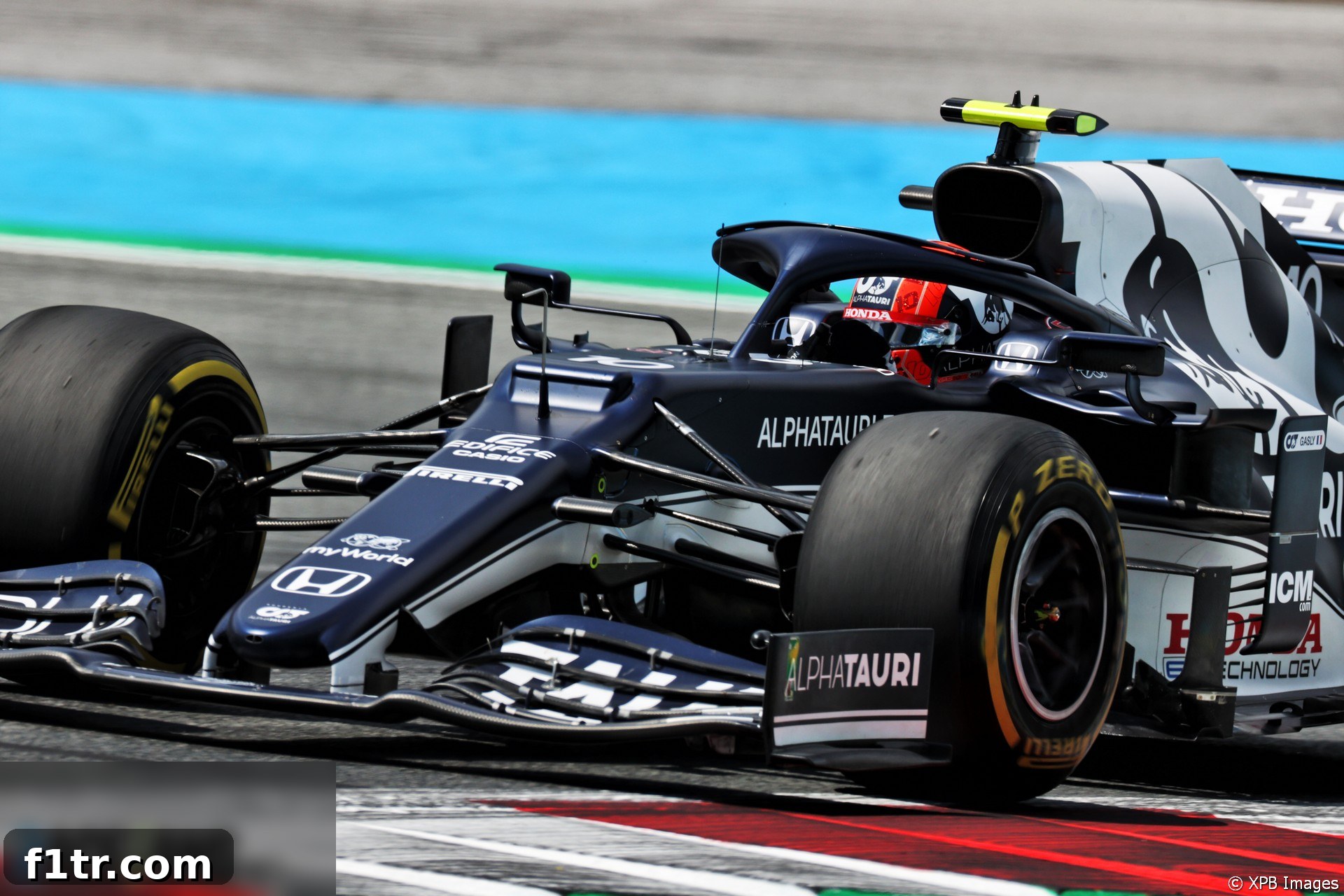
In a significant development for the Formula 1 season, Pierre Gasly has become the first driver to reach his maximum allocation of MGU-Ks for the current championship campaign. This early milestone raises pertinent questions about power unit reliability, strategic component management, and the potential implications for the AlphaTauri driver’s performance throughout the remainder of the year.
The situation came to light during the Styrian Grand Prix weekend. Honda, the power unit supplier for AlphaTauri, fitted the third new MGU-K to Gasly’s car after a concerning issue prevented him from participating in the second practice session. Following a strong performance where he was second fastest in the morning session, Gasly’s afternoon running was curtailed due to anomalies detected in the power unit data.
Honda confirmed the component change, stating, “After a thorough examination of Gasly’s [power unit] following the data anomaly spotted yesterday, we have fitted a new MGU-K. This is the third of these components used and therefore it is a penalty-free change. The MGU-K previously fitted is being sent back to Japan for further analysis.” This proactive measure by Honda ensures that Gasly avoids an immediate grid penalty, a crucial consideration given the tight competitive margins in Formula 1.
The MGU-K, or Motor Generator Unit – Kinetic, is a vital component of the modern F1 hybrid power unit. It recovers kinetic energy during braking, converting it into electrical energy stored in the Energy Store (ES). This stored energy can then be deployed to provide an additional power boost to the rear wheels, enhancing acceleration and overtaking opportunities. Its reliable operation is paramount for both performance and efficiency, making Gasly’s early exhaustion of his MGU-K allowance a point of concern.
Understanding Formula 1 Power Unit Regulations and Their Impact
Formula 1 regulations impose strict limits on the number of power unit components each driver can use within a single season. The primary aim of these rules is to control costs, promote reliability, and challenge engineers to design durable, efficient engines. Teams are permitted a maximum of three examples of each of the major power unit components: the Internal Combustion Engine (ICE), Turbocharger (TC), Motor Generator Unit – Heat (MGU-H), Motor Generator Unit – Kinetic (MGU-K), Energy Store (ES), and Control Electronics (CE).
Exceeding these limits automatically triggers an automatic grid penalty. For the first component beyond the allocation, a driver receives a 10-place grid penalty. For any subsequent components of the same type, a 5-place grid penalty is applied. If a driver takes multiple new components in one go that exceed the limit, the penalties can accumulate significantly, often leading to a back-of-the-grid start. This system forces teams and manufacturers to carefully manage the lifespan of their components, making strategic decisions about when to introduce new units and absorb potential penalties.
At this stage of the season, most other drivers have only fitted their second example of these major power unit components. This puts Pierre Gasly in a unique and potentially precarious position, as he now has no MGU-K units remaining for penalty-free changes. Should he require a fourth MGU-K at any point in the season, he will incur a grid penalty, which could severely impact his qualifying and race results. This scenario demands meticulous monitoring by Honda and AlphaTauri to mitigate future reliability risks.
The Complexity of the F1 Hybrid Power Unit
The contemporary Formula 1 power unit is a marvel of engineering, combining traditional combustion engine technology with advanced hybrid systems. It’s not just about raw power; it’s about efficient energy recovery and deployment. Here’s a closer look at its main components:
- Internal Combustion Engine (ICE): The primary power source, a 1.6-litre turbocharged V6 engine. It provides the bulk of the car’s horsepower.
- Turbocharger (TC): A device that uses exhaust gases to spin a turbine, which in turn drives a compressor to force more air into the engine, significantly increasing power output.
- Motor Generator Unit – Heat (MGU-H): Connected to the turbocharger, the MGU-H recovers energy from the exhaust gases. It can also control the speed of the turbo, reducing turbo lag and providing electrical energy.
- Motor Generator Unit – Kinetic (MGU-K): As mentioned, this unit recovers kinetic energy during braking, converting it into electricity to be stored or deployed for extra power.
- Energy Store (ES): This is the battery pack that stores the electrical energy recovered by the MGU-H and MGU-K, ready to be deployed as additional power.
- Control Electronics (CE): The “brain” of the power unit, managing the flow of energy and the operation of all other components to optimize performance and efficiency.
The synergy between these components is critical. A failure in one can cascade and affect the performance or reliability of others. The constant push for performance within stringent regulatory limits means that manufacturers are always walking a fine line between maximizing power and ensuring the longevity of each component.
Pierre Gasly’s Season Outlook and Honda’s Challenge
Pierre Gasly has been a consistent performer for AlphaTauri, often punching above the team’s weight. His early use of the maximum MGU-K allocation presents a significant hurdle. While the immediate change was penalty-free, the concern now shifts to the remaining races of the season. Will the “problem” MGU-K sent back to Japan for analysis reveal a systemic issue, or was it an isolated incident? The findings from Honda’s investigation will be crucial, not just for Gasly’s remaining MGU-K units, but potentially for all Honda-powered cars, including those of Red Bull Racing.
AlphaTauri, a customer team, relies heavily on its power unit supplier, Honda. The Japanese manufacturer is set to leave Formula 1 at the end of the 2021 season, transferring its IP to Red Bull Powertrains. This adds an extra layer of pressure to ensure reliability and performance in their final year. Any recurring issues with a critical component like the MGU-K would be a major setback for their championship ambitions, both with AlphaTauri and with the senior Red Bull team.
The table below provides a comprehensive overview of the power unit components used by each driver up to this point in the season, highlighting Gasly’s unique position:
Power unit components used by each driver so far
| No. | Car | Engine | Driver | ICE | TC | MGU-H | MGU-K | ES | CE | EX |
|---|---|---|---|---|---|---|---|---|---|---|
| 14 | Alpine | Renault | Fernando Alonso | 2 | 2 | 2 | 2 | 1 | 1 | 5 |
| 31 | Alpine | Renault | Esteban Ocon | 2 | 2 | 2 | 2 | 2 | 2 | 4 |
| 22 | AlphaTauri | Honda | Yuki Tsunoda | 2 | 2 | 2 | 2 | 3 | 3 | 3 |
| 10 | AlphaTauri | Honda | Pierre Gasly | 2 | 2 | 2 | 3 | 2 | 2 | 3 |
| 11 | Red Bull | Honda | Sergio Perez | 2 | 2 | 2 | 2 | 2 | 2 | 3 |
| 55 | Ferrari | Ferrari | Carlos Sainz Jnr | 2 | 2 | 2 | 2 | 1 | 2 | 3 |
| 16 | Ferrari | Ferrari | Charles Leclerc | 2 | 2 | 2 | 2 | 1 | 2 | 3 |
| 9 | Haas | Ferrari | Nikita Mazepin | 2 | 2 | 2 | 2 | 1 | 2 | 3 |
| 7 | Alfa Romeo | Ferrari | Kimi Raikkonen | 2 | 2 | 2 | 2 | 2 | 1 | 3 |
| 99 | Alfa Romeo | Ferrari | Antonio Giovinazzi | 2 | 2 | 2 | 2 | 2 | 1 | 3 |
| 47 | Haas | Ferrari | Mick Schumacher | 2 | 2 | 2 | 2 | 1 | 1 | 3 |
| 33 | Red Bull | Honda | Max Verstappen | 2 | 2 | 2 | 2 | 1 | 1 | 3 |
| 77 | Mercedes | Mercedes | Valtteri Bottas | 2 | 2 | 2 | 2 | 2 | 2 | 2 |
| 63 | Williams | Mercedes | George Russell | 2 | 2 | 2 | 2 | 1 | 1 | 2 |
| 4 | McLaren | Mercedes | Lando Norris | 2 | 2 | 2 | 2 | 1 | 1 | 2 |
| 3 | McLaren | Mercedes | Daniel Ricciardo | 2 | 2 | 2 | 2 | 1 | 1 | 2 |
| 31 | Williams | Mercedes | Nicholas Latifi | 2 | 2 | 2 | 2 | 1 | 1 | 2 |
| 44 | Mercedes | Mercedes | Lewis Hamilton | 2 | 2 | 2 | 2 | 1 | 1 | 2 |
| 5 | Aston Martin | Mercedes | Sebastian Vettel | 2 | 2 | 2 | 2 | 1 | 1 | 2 |
| 18 | Aston Martin | Mercedes | Lance Stroll | 2 | 2 | 2 | 2 | 1 | 1 | 2 |
Component Acronyms Explained:
ICE: Internal Combustion Engine
TC: Turbocharger
MGU-H: Motor Generator Unit – Heat
MGU-K: Motor Generator Unit – Kinetic
ES: Energy Store
CE: Control Electronics
EX: Exhaust Systems (Note: Exhaust systems are also limited, but often a separate count from the main power unit elements).
Consequences and Strategic Management
The early use of MGU-Ks by Gasly emphasizes the importance of strategic planning and component management throughout a lengthy Formula 1 season. With over half of the races still to come, the risk of needing a fourth MGU-K is considerable. This could force AlphaTauri into difficult decisions, potentially taking a grid penalty at a circuit where overtaking is easier to minimize the impact, or hoping that the initial issue was an isolated incident and the subsequent MGU-K units prove more robust.
The implications extend beyond just Pierre Gasly’s individual performance. For AlphaTauri, every point is crucial in the Constructors’ Championship battle. A grid penalty for their lead driver could cost them valuable points, impacting their standing against rivals. Moreover, the detailed analysis of Gasly’s faulty MGU-K will be critical for Honda, providing insights that could benefit Red Bull Racing, who share the same power units. Ensuring the reliability of all components is paramount for both teams as they chase their respective championship goals.
Advert | Become a RaceFans supporter andgo ad-free
Conclusion: A Test of Reliability and Strategy
Pierre Gasly’s situation serves as a stark reminder of the immense technical challenges and strategic complexities inherent in modern Formula 1. While the immediate MGU-K change came without penalty, it places the AlphaTauri driver on a tightrope for the remainder of the season. His early exhaustion of the MGU-K allowance highlights the critical balance between extracting maximum performance and maintaining unyielding reliability from these sophisticated hybrid power units. The coming races will undoubtedly test Honda’s engineering prowess and AlphaTauri’s strategic acumen in navigating this precarious situation, with Gasly’s championship aspirations hanging in the balance.
2021 Styrian Grand Prix
Browse all 2021 Styrian Grand Prix articles