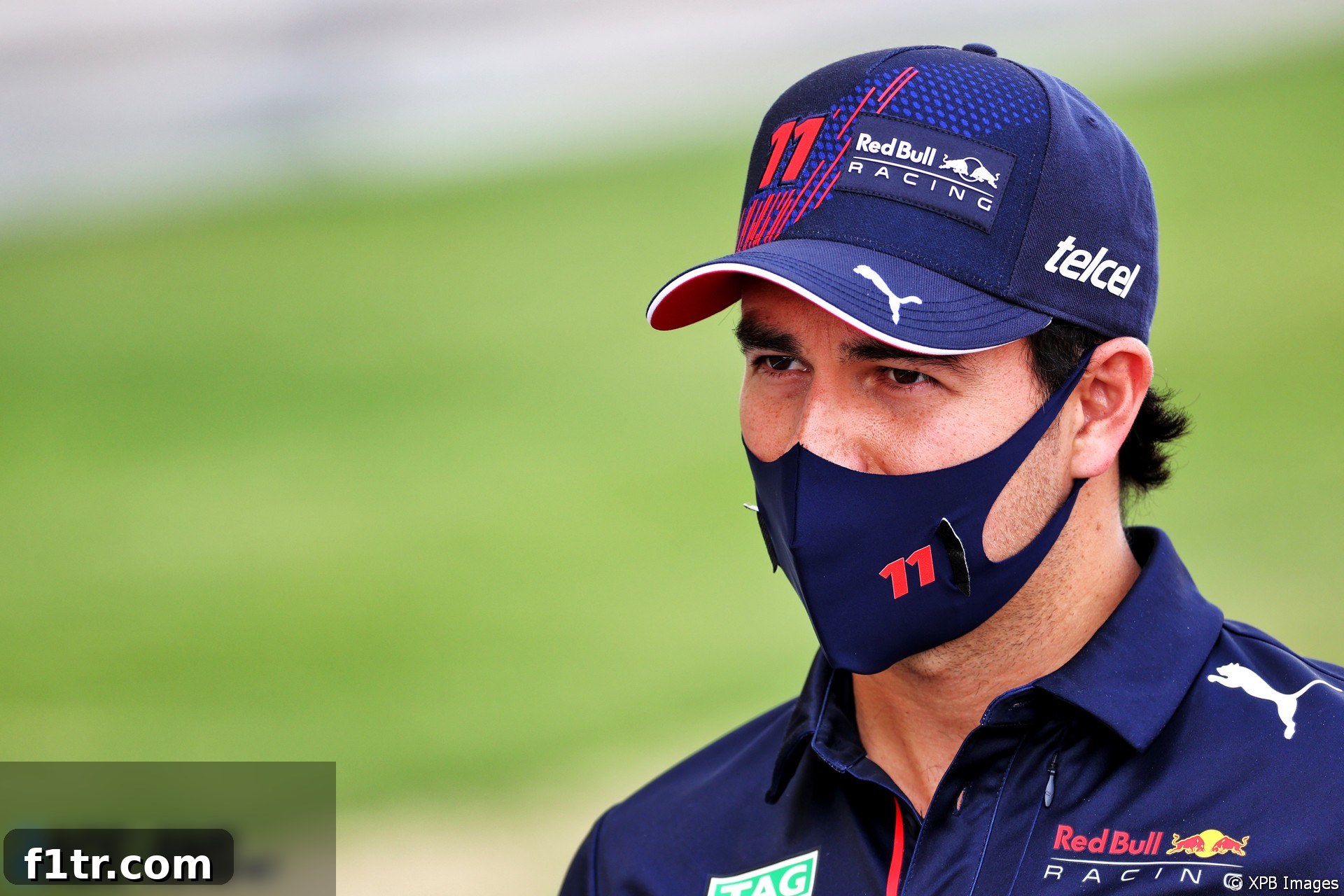
Sergio Perez Defends Red Bull’s Bahrain Qualifying Strategy Amidst Brake Woes and Adaptation Challenges
Sergio Perez, Red Bull Racing’s newest recruit, has offered a staunch defense of his team’s strategic decision to attempt qualifying on the medium compound tyres at the season-opening Bahrain Grand Prix. Despite failing to advance into the crucial top 10 shootout (Q3), a result that raised eyebrows among Formula 1 pundits and fans alike, Perez firmly stated that the approach was “definitely the right thing to do,” emphasizing the underlying strategy and unforeseen technical difficulties.
The Mexican driver’s inaugural qualifying session with Red Bull was fraught with challenges. After having his initial flying lap on the medium rubber deleted due to a track limits infringement – a tight margin that cost him valuable track time and confidence – Perez found himself under immense pressure. He ultimately missed a Q3 slot by a mere three-hundredths of a second, an agonizingly close gap that underscored the fine margins of elite motorsport. This outcome, however, was not, in his view, a direct consequence of the tyre choice.
Perez subsequently revealed a critical detail that shifted the narrative: a problem with his brakes. This issue, discovered only after the qualifying session, significantly hampered his performance, especially during the critical second run in Q2. “We had a little issue in the brakes that we only found out later, and now we understand what went wrong,” Perez explained. “I think without that issue, we definitely should have been through.” This technical glitch, rather than a misjudgment of tyre strategy, was the true antagonist in his quest for a top 10 grid position.
The Strategic Gamble: Medium Tyres in Bahrain
Red Bull’s decision to attempt Q2 on medium tyres was a calculated gamble. Typically, teams aim to start the race on the softest possible compound to maximize grip and lap time in qualifying. However, starting the Grand Prix on the medium tyre offers a significant strategic advantage in the race itself, allowing for a longer first stint and greater flexibility with pit stop timings. This strategy is often pursued by teams confident in their car’s inherent pace, believing they can comfortably advance to Q3 even on a harder compound, thus sacrificing a bit of outright qualifying speed for a stronger race foundation.
Perez articulated this strategic perspective, reinforcing his and the team’s belief in the plan. “Qualifying on the medium tyres was the right thing to do,” he asserted. “If you have the car to exploit the maximum result, you have to be on the best possible strategy. If that means taking some risks, we have to take them. Considering that we thought we had the pace, it was definitely the right thing to do.” This highlights Red Bull’s confidence in their RB16B chassis and powertrain, a confidence that, under normal circumstances, would have seen Perez comfortably through to the final qualifying segment.
The allure of starting on the mediums is clear. It provides durability and consistency over a race distance, potentially allowing a driver to avoid an early pit stop or extend their first stint, thereby opening up different strategic windows. For a team like Red Bull, battling Mercedes at the sharp end of the grid, every strategic advantage counts. The disappointment of Bahrain Q2 was not due to a flawed strategy, but rather an unfortunate confluence of track limit penalties and an underlying technical fault that proved insurmountable in the moment.
Overcoming Technical Hurdles and Fine Margins
The revelation of a brake issue sheds light on the immense complexity and precision required in Formula 1. Even a minor problem with such a fundamental component can have catastrophic effects on a driver’s ability to extract performance from the car. Brake balance, temperature, and responsiveness are crucial for confidence and consistency, especially when pushing the limits on a qualifying lap. A three-hundredths-of-a-second deficit, while minuscule, often comes down to such minute details – a fraction of a meter gained or lost under braking, or the confidence to carry slightly more speed through a corner.
Perez’s initial track limits infraction, costing him three-tenths of a second, compounded the problem. He himself admitted: “I lost three-tenths just in one corner by doing a mistake, so I was pretty confident that I was going to be able to get the lap time.” This indicates that even with the early error, his confidence in his pace on the mediums was high, further supporting the team’s strategic choice. The subsequent discovery of the brake issue provides a complete picture, underscoring how easily an unforeseen mechanical problem can derail even the most meticulously planned strategies in the high-stakes world of Formula 1 qualifying.
Adapting to the Red Bull Environment: Learning from the Best
Beyond the immediate aftermath of Bahrain, Perez has focused intensely on adapting to his new machinery and team dynamics. Joining a top-tier team like Red Bull Racing brings immense pressure, not only to perform but also to quickly integrate into a complex engineering environment and understand the unique characteristics of a championship-contending car. Perez acknowledges the significant progress he has made since the Bahrain test and race weekend.
“I made huge steps in Bahrain in understanding the car,” Perez stated, highlighting the steep learning curve. “It would be very easy to get lost and start chasing one direction that doesn’t make the car go faster.” This insight speaks to the delicate balance a driver must strike between providing feedback for development and not deviating too far from the car’s optimal setup window. Finding that sweet spot is crucial for maximizing performance, and it often takes time, experience, and careful analysis.
A key aspect of his adaptation strategy involves closely monitoring and learning from his highly successful teammate, Max Verstappen. Verstappen has become synonymous with the Red Bull car, developing a unique driving style that extracts maximum performance from its often pointy, rear-end-happy chassis. For Perez, Verstappen serves as an invaluable benchmark and a guide for understanding the car’s nuances.
“We have a pretty good reference in Max, the way he is driving the car, and which issues he’s chasing as well,” Perez explained. “So I think that’s a key area, to try not to go too far apart. He has a pretty good baseline in terms of how to extract the maximum out of the car, so I think we need to be in that operating area as much as possible.” This collaborative approach, where data and feedback are shared, is vital in modern Formula 1. By aligning his setup and understanding with Verstappen’s, Perez aims to shorten his learning curve and unlock the full potential of the RB16B, ensuring both cars are consistently operating within the optimal performance window.
Looking Ahead: Imola and the Road to Consistency
The lessons learned in Bahrain, particularly regarding the strategic calls and the impact of minor technical issues, will be crucial as the season progresses. The second race weekend, the Emilia-Romagna Grand Prix at Imola, presented a new set of challenges and opportunities for Sergio Perez to demonstrate his growing synergy with the Red Bull car and team. Imola, with its historic circuit layout and often unpredictable conditions, demanded a different approach to setup and strategy, yet the fundamental principles of adaptation and clear communication remained paramount.
Perez’s ability to quickly integrate and perform at a high level is not just important for his individual success, but also for Red Bull’s championship aspirations. Having two cars consistently at the front allows for greater strategic flexibility, puts more pressure on rivals, and significantly increases the team’s points haul. The initial Bahrain qualifying setback, viewed through the lens of unforeseen technical issues and strategic intent, served as a valuable, albeit frustrating, learning experience. As Perez continues to refine his approach and harmonize with the Red Bull engineering philosophy, his consistency and performance are expected to rise, making him a formidable asset in the team’s challenge for the Constructors’ and Drivers’ Championships.
The journey of adaptation in Formula 1 is rarely straightforward, but Perez’s methodical approach, combined with the clear benchmark provided by Max Verstappen and the unwavering support of the Red Bull team, positions him well for future successes. His defense of the Bahrain strategy, rooted in a deeper understanding of the technicalities and strategic objectives, highlights his thoughtful and committed approach to his new role. The focus now shifts from explaining past decisions to executing future ones with precision and pace.
Related Coverage: 2021 Emilia-Romagna Grand Prix
- Poor Imola pace was “100% tyres”, says Bottas
- Bottas says Imola crash is “history” after reading Russell’s apology
- ‘Lewis and Valtteri are team mates to me as Nicholas is’ says Russell after ‘private’ Wolff talks
- ‘Hamilton didn’t break the rules by reversing’ shouldn’t be a story
- 2021 Emilia-Romagna Grand Prix Star Performers
Browse all 2021 Emilia-Romagna Grand Prix articles