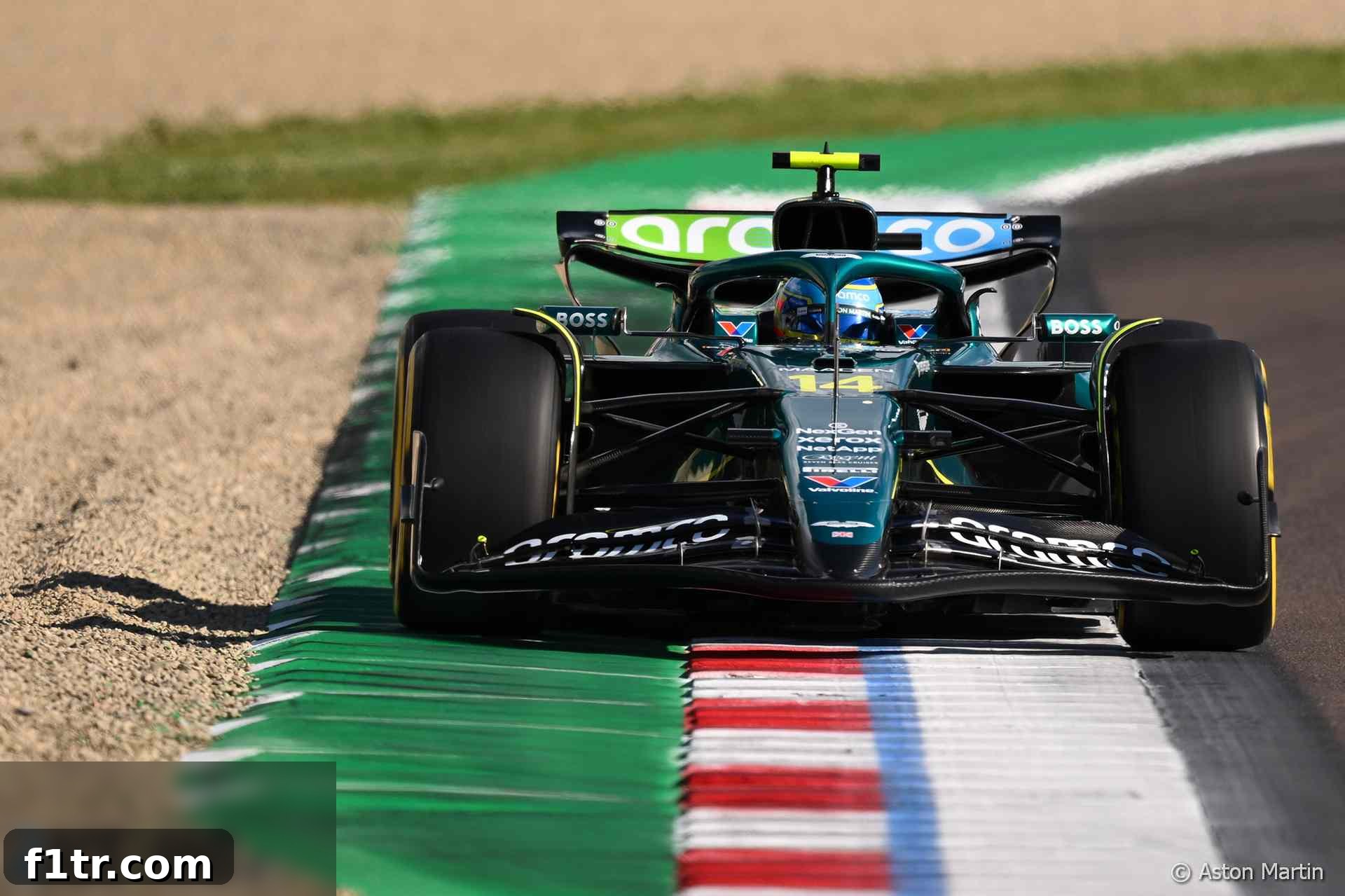
Fernando Alonso Sees “Step Forward” for Aston Martin Despite Imola Pointless Finish
Despite a frustratingly pointless finish at the Emilia Romagna Grand Prix in Imola, two-time Formula 1 World Champion Fernando Alonso remains confident that his Aston Martin team has made significant progress with their car. The Spanish driver, who started fifth on the grid, saw a strong performance undermined by unfortunate circumstances, particularly a crucial Virtual Safety Car (VSC) period that reshuffled the strategic landscape.
The Imola weekend had initially promised a potential turning point for Aston Martin. After a challenging start to the 2025 F1 season, the team arrived at the iconic Autodromo Internazionale Enzo e Dino Ferrari with a renewed sense of purpose and a series of upgrades designed to unlock more performance from the AMR25. Alonso’s impressive qualifying performance, securing a P5 start, immediately signaled a tangible improvement, setting the stage for what many hoped would be the team’s first significant points haul of the year.
Early Race Promise: Keeping Pace with Rivals
From the moment the lights went out, Alonso demonstrated the newfound potential of his Aston Martin. Both Aston Martin drivers initially found themselves well inside the top ten, with Alonso brilliantly holding his position and even matching the pace of top contenders like McLaren and Mercedes’ George Russell. This was a crucial indicator, as the team had often struggled to maintain such proximity to the front-runners in previous races. Alonso’s ability to run shoulder-to-shoulder with cars widely considered superior in pure performance terms underscored the positive strides made back at the factory.
Reflecting on this early phase of the race, Alonso expressed genuine surprise and satisfaction with the car’s competitiveness. “The car was super today,” he stated after the race. “We followed the McLarens and Russell at the beginning of the race, which was definitely a good surprise for us to be that competitive in the front part of the field. I think we were okay to secure P6 and P7 with both cars.” This sentiment highlighted not just his own car’s pace but also the collective strength of the team’s package, suggesting that a double points finish was well within reach before external factors intervened.
The Crucial VSC: A Strategic Blow
The turning point in Aston Martin’s promising race came with the deployment of a Virtual Safety Car. During a VSC period, cars must reduce their speed and maintain a delta time, effectively neutralizing the track and allowing drivers to pit with minimal time loss. For teams whose strategies align with such an event, it presents a golden opportunity; for others, it can be a devastating setback. Unfortunately for Aston Martin and Alonso, it was the latter.
Several competitors, finding themselves slightly out of sync with Aston Martin’s strategy, capitalized on the VSC to make their mandatory pit stops. By doing so, they emerged ahead of Alonso and his teammate, effectively gaining track position without having to overtake on track. This sudden strategic advantage for their rivals completely upended Aston Martin’s meticulously planned race. Alonso articulated his frustration, “Then the Virtual Safety Car gave the opportunity to everyone to stop and exit in front of us and our race was over. I think it’s extremely unlucky.” The timing of the VSC was particularly cruel, as it occurred precisely when Alonso felt his car was performing at its peak, instilling confidence in securing a strong points finish.
Resilience and a Late-Race Charge
Despite the significant setback, Alonso’s veteran grit and the car’s improved performance shone through in the latter stages of the race. Following the VSC incident, and later during a full Safety Car period, Alonso made another strategic pit stop. This allowed him to bolt on fresh tires and embark on a determined recovery drive. From a disadvantaged position, he showcased the car’s genuine step forward by methodically working his way back through the midfield.
“The car was competitive and I could fight,” Alonso affirmed, emphasizing the newfound agility and pace of the AMR25. “Even at the end, I overtook three or four cars of the midfield in nine laps. So it’s something that we were not used to this year, so definitely a step forward.” This ability to make decisive overtakes, especially in a circuit known for its challenging passing opportunities like Imola, was a clear demonstration of the car’s enhanced capabilities. While he ultimately finished 11th, just outside the points, the manner of his recovery drive undoubtedly boosted morale within the team and provided tangible evidence of their progress.
Analyzing the “Step Forward”: Beyond the Result Sheet
The Imola Grand Prix delivered a bittersweet cocktail for Fernando Alonso and Aston Martin. While the official result sheet showed a continuation of their point-less streak through the first seven rounds of the 2025 season, the underlying performance metrics and Alonso’s feedback painted a much more optimistic picture. The car felt stronger, more responsive, and crucially, faster than in previous outings. This perceived “step forward” is not merely wishful thinking; it’s a critical psychological boost and a validation of the hard work put in by the engineers and designers.
The ability to run with McLarens and Mercedes, even for a limited period, suggests that Aston Martin is closer to understanding and maximizing the potential of their current package. Improvements in aerodynamics, chassis balance, or power unit integration could all contribute to this perceived gain. What’s important is that Alonso, a driver renowned for his acute understanding of car dynamics, felt a distinct difference. This positive feedback from such an experienced and demanding driver is invaluable for guiding future development.
Alonso’s Philosophical View on Luck and Future Opportunities
Despite the clear disappointment of leaving Imola empty-handed, Fernando Alonso maintained a characteristically philosophical outlook on the role of luck in motorsport. He acknowledged the extreme misfortune of the VSC timing but also recognized that the capricious nature of racing often balances itself out over a season.
“The final result is just pure bad luck,” he mused. “Extreme bad luck, I think, today. But there’s going to be other races that we will have very good luck and we will take some points that maybe we don’t deserve. So let’s wait for another opportunity.” This pragmatic perspective is a hallmark of a seasoned competitor who understands the ebb and flow of a long championship. It’s a message not just to the media but also to his team, encouraging them to maintain focus and confidence, knowing that opportunities will arise where fortune might favor them.
Broader Implications for Aston Martin’s Championship Aspirations
The Imola performance, while not yielding points, has significant implications for Aston Martin’s 2025 championship aspirations. The team desperately needs to convert potential into tangible results to climb the constructors’ standings. This race provided compelling evidence that the car has the pace to compete for points, and potentially even strong finishes, when strategic events align or when pure race craft can be fully unleashed.
The challenge now lies in consistently extracting this newfound performance and ensuring that strategic calls are executed flawlessly. The fine margins in Formula 1 mean that even a fraction of a second or a missed opportunity can have monumental consequences. However, the confidence derived from a genuinely quick car, capable of holding its own against formidable rivals, is an invaluable asset for the remainder of the season. Aston Martin will be looking to build on this momentum, translating their evident “step forward” into concrete points in the upcoming races, starting with the next Grand Prix, where they hope fortune will finally smile upon them.