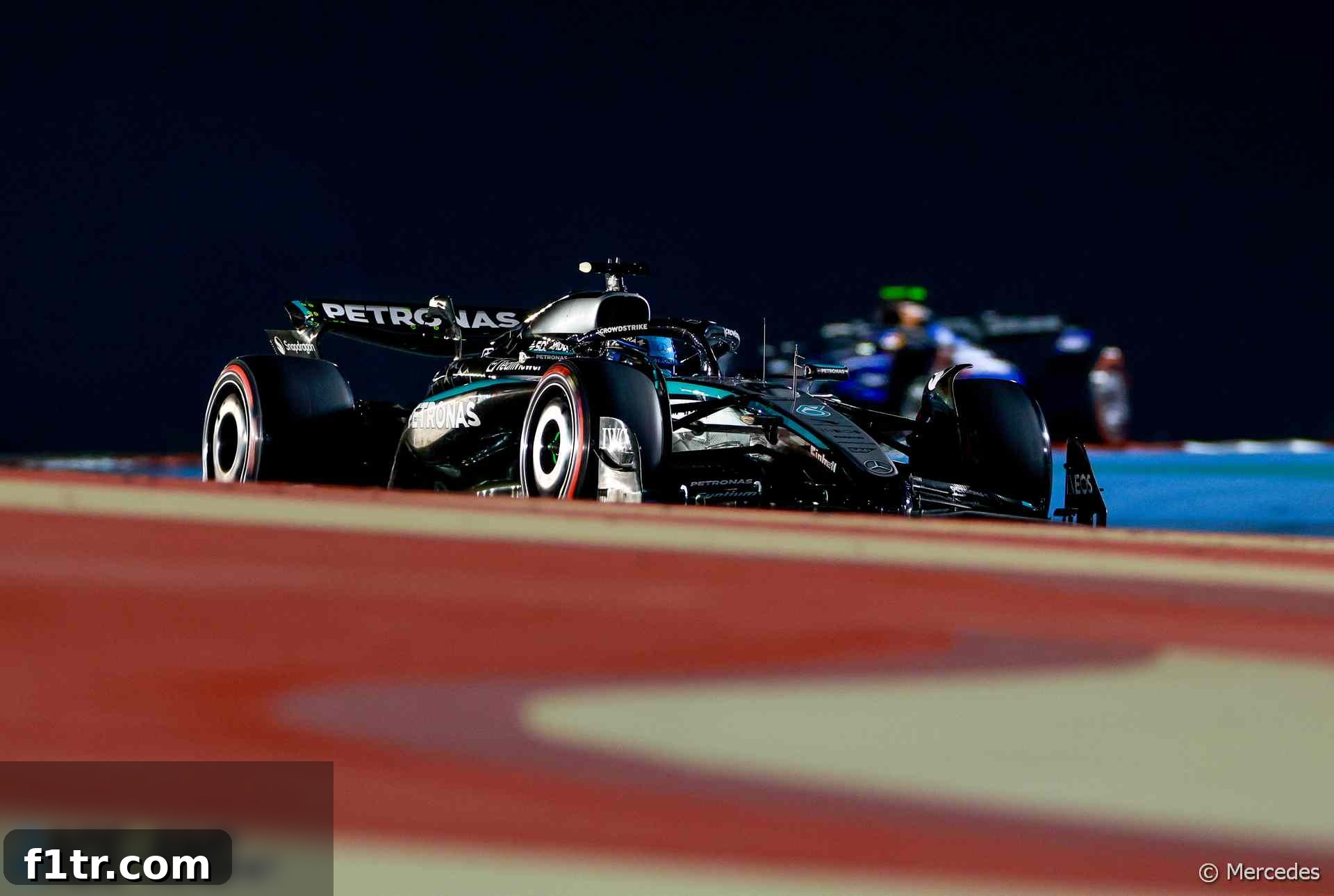
The exhilarating conclusion of the Bahrain Grand Prix was swiftly followed by a cloud of controversy surrounding George Russell. Finishing an impressive second, the Mercedes driver found himself under intense scrutiny and facing a stewards’ investigation for the alleged misuse of the Drag Reduction System (DRS). This incident ignited discussions across the Formula 1 paddock and among fans about technical malfunctions, the nuances of racing regulations, and the critical role of fair play in competitive motorsport.
Following the checkered flag, Russell and a representative from the Mercedes-AMG Petronas F1 Team were summoned to meet with the stewards at 8:45 PM local time. The core of the investigation revolved around his “alleged usage of the DRS system outside the pre-defined activation zones,” a breach of one of Formula 1’s most fundamental technical regulations designed to ensure equitable racing conditions. Such an inquiry, especially post-race and impacting a podium finish, always carries significant weight and potential ramifications.
Understanding the DRS system is crucial to grasping the gravity of the situation. The Drag Reduction System is a movable element on the rear wing of a Formula 1 car, designed to increase straight-line speed by reducing aerodynamic drag. Its activation is strictly regulated during a race: drivers are only permitted to deploy DRS when they are within one second of the car directly ahead at specific, pre-defined detection points on the circuit. Once detected, activation zones typically follow, allowing the driver to open the flap and gain a speed advantage for overtaking. Crucially, this system is almost entirely automated. The car’s onboard systems, linked to the track’s timing loops, detect the one-second gap and notify the driver, often allowing for a button press to engage DRS. This automation minimizes human error and ensures fair application of the rule across the field.
However, the Bahrain Grand Prix presented a unique and complex challenge for George Russell. A significant technical malfunction plagued his car’s timing system throughout the race. This critical issue was immediately apparent to viewers, as Russell’s name periodically vanished or dropped unexpectedly on Formula 1’s official live timing screens. The intermittent failure of this system meant that the automated DRS activation mechanism on his Mercedes was compromised, leaving him without the standard, reliable feedback and control usually afforded to drivers.
In response to this unprecedented technical glitch, Russell’s team had to resort to an unconventional and highly stressful strategy. They instructed him that he would need to rely entirely on their real-time guidance for when and where he was permitted to use DRS. This placed an immense burden on both the driver and the pit wall, as communication needed to be precise and immediate in the heat of battle. Throughout much of the second half of the race, Russell found himself running well over a second behind the race leader, Oscar Piastri, a gap that ordinarily would prevent DRS activation. This context became central to the subsequent investigation.
Upon being questioned about the incident, George Russell expressed his clear belief that he had not deliberately activated DRS inappropriately. “I wasn’t using DRS, I was ahead,” he stated to Sky Sports, emphasizing the fact that his position on track, often not within the one-second window, would naturally negate the possibility or necessity of using DRS for overtaking. His defense highlighted the confusion created by the faulty system and his reliance on team instructions rather than an intentional act of gaining an unfair advantage.
The technical issue on Russell’s car also had ripple effects on other competitors striving to battle him on track. Lando Norris, for instance, found himself catching the Mercedes in the closing stages of the race. His race engineer, Will Joseph, had to issue specific instructions to Norris, advising extreme caution regarding his own DRS usage when in proximity to Russell’s compromised car. “We can only use DRS when we’re 100% sure we’re within it,” Joseph stressed. This demonstrates how a single technical anomaly can complicate racing for multiple drivers and underscores the importance of fully functional and reliable systems for fair competition across the grid.
Instances of DRS misuse, particularly those leading to formal investigations, are rare in modern Formula 1 due to the system’s automated nature. The technology is designed to be foolproof, preventing drivers from engaging DRS when the rules prohibit it. However, history does offer a few notable exceptions that serve as important precedents for such inquiries.
One prominent case occurred during the 2013 Hungarian Grand Prix, involving Fernando Alonso. On three separate occasions, Alonso activated his DRS when it should have been disabled. This was not attributed to a technical fault on the car but rather to a misjudgment or error in the manual override. Consequently, his Ferrari team faced a substantial fine of €15,000 (£12,945) for the infringement. The penalty was directed at the team, acknowledging their ultimate responsibility for the car’s adherence to regulations, even if driven by a driver’s momentary lapse.
Another case emerged in 2018 at the Azerbaijan Grand Prix, where Sergio Perez activated his DRS outside the permitted zones. Unlike Alonso’s case, Perez ultimately avoided a penalty for the DRS infringement. The stewards concluded that while an infraction occurred, the circumstances, potentially including the specific track conditions or the very brief nature of the misuse, did not warrant a punitive action. These varied outcomes illustrate that while the rules are strict, the stewards’ decisions often take into account the nuances and specific context of each incident, evaluating intent, duration, and whether a significant sporting advantage was gained.
Update: Russell Keeps Second Place After Rare “No Penalty” Decision for DRS Infringement
Following a thorough review of telemetry data, radio communications, and statements from George Russell and the Mercedes team, the stewards delivered their verdict. In a rare and significant decision, they opted not to impose a penalty on Russell, thus allowing him to retain his well-deserved second-place finish. The stewards acknowledged the unprecedented nature of the technical failure on Russell’s timing transponder, which was later described as ‘frazzled and charred’, effectively disabling the automated DRS system. They found no evidence of malicious intent or a deliberate attempt by Russell to gain an unfair advantage. Instead, they recognized the extraordinary situation where the team had to manually guide the driver through DRS activation, a process fraught with potential for momentary human misjudgment given the high-speed, high-pressure environment of Formula 1 racing. This “no penalty” ruling reinforced the principle that while regulations are paramount, technical malfunctions beyond a driver’s control, coupled with no clear sporting advantage gained, can lead to leniency.
The resolution of Russell’s DRS investigation in Bahrain underscores the intricate balance between technological reliability, strict sporting regulations, and the human element in Formula 1. It serves as a stark reminder that even with the most advanced machinery, unforeseen technical glitches can introduce unexpected complexities into race management and regulatory enforcement. While the rules governing DRS are designed for simplicity and fairness, the unique circumstances of Russell’s malfunctioning system highlighted the necessity for adaptable and context-aware adjudication by the sport’s governing body. Ultimately, the decision to issue no penalty cemented Russell’s strong performance and acknowledged the extraordinary challenge he and his team faced, adding another intriguing chapter to the ever-evolving narrative of Formula 1 racing.
Miss nothing from RaceFans
Get a daily email with all our latest stories – and nothing else. No marketing, no ads. Sign up here:
2025 Bahrain Grand Prix
- Hamilton making “drastic shift” in driving style to master Ferrari’s car
- Leclerc revealed Ferrari strategy details to Gasly before Bahrain Grand Prix
- Lawson made “very significant step forward” in Bahrain – Mekies
- Russell’s transponder was ‘frazzled and charred’ after Bahrain Grand Prix DRS drama
- “Don’t give me too much now”: Hamilton’s search for speed at Ferrari continues
Browse all 2025 Bahrain Grand Prix articles