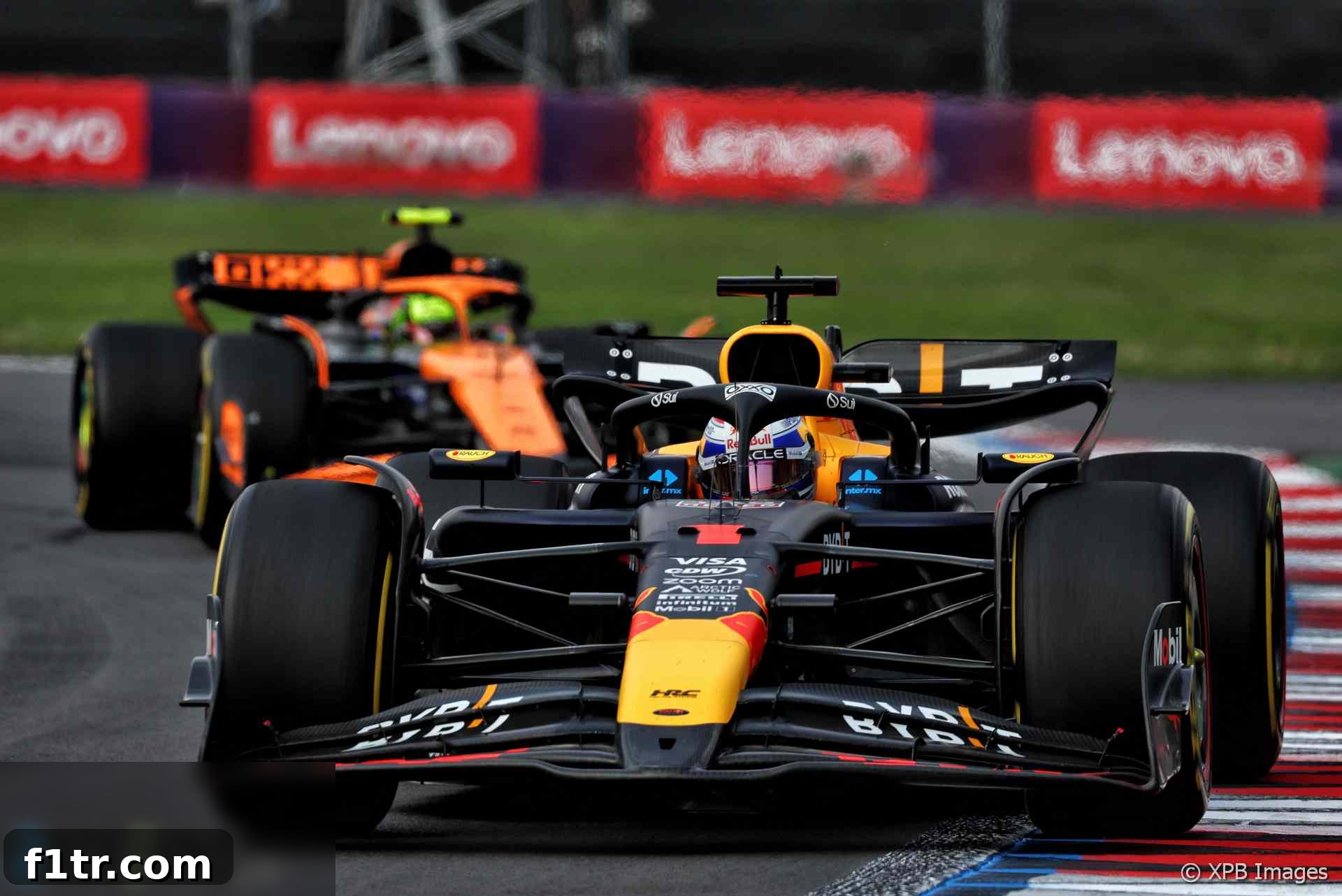
In the aftermath of a fiercely contested Mexican Grand Prix, Lando Norris has voiced his strong belief that championship rival Max Verstappen intentionally pushed the boundaries of fair racing, exceeding acceptable limits with his defensive maneuvers. The McLaren driver’s pointed comments follow two separate incidents during lap 10 of yesterday’s race, for which Verstappen received two 10-second time penalties. Norris contends that Verstappen’s aggressive tactics were not aimed at winning but purely at obstructing his progress, a strategy he found both unsporting and dangerous.
Verstappen’s Controversial Defensive Tactics Under Scrutiny
The tension between the two front-runners reached a boiling point at the Autódromo Hermanos Rodríguez. Norris, who successfully narrowed Verstappen’s championship lead to 47 points, elaborated on his rival’s approach. “I go into every race expecting a tough battle with Max,” Norris stated, reflecting on the intense competition. “It’s clear that it doesn’t matter if he wins or finishes second, his primary objective is to beat me in the race, and he’ll sacrifice himself to achieve that, much like we witnessed today.” This perception paints a picture of a championship battle where one driver is willing to compromise his own race outcome to impede a key contender.
The incidents that sparked this debate were particularly egregious in Norris’s view, going far beyond the realm of hard but fair racing. He unequivocally supported the stewards’ decision to impose two 10-second time penalties on Verstappen. “I want to have good battles with him,” Norris asserted, emphasizing his desire for genuine wheel-to-wheel competition. “I crave those tough battles, the kind I’ve seen him engage in numerous times before. But they must be fair ones.”
Norris acknowledged the inherent challenges of racing against a driver of Verstappen’s caliber, especially at a critical juncture in the season. “It’s always going to be on the line. It’s always going to be tough with Max. He’s never going to make anyone’s life easy, especially mine at this point of the year,” he conceded. However, he drew a distinct line at the conduct displayed in Mexico. “But I think today was just… It was not fair, clean racing. And therefore, I think he got what he had coming to him.” This sentiment underscores a growing concern among drivers about the fine line between aggressive defense and unacceptable infringement.
Analyzing the Key Incidents: Turn Four and Turn Seven
The controversial moments unfolded rapidly on lap 10. The first flashpoint occurred when Norris attempted to overtake Verstappen around the outside of Turn Four. In response, Verstappen forced his rival off the track, leaving Norris with no option but to take evasive action to avoid a collision. Just moments later, at Turn Seven, Verstappen executed an aggressive lunge up the inside of the McLaren. This maneuver pushed both cars off the track at a high-speed, 155kph corner with minimal run-off, creating a perilous situation for both competitors. The immediate consequence of these clashes was that both drivers lost a position to Charles Leclerc. While Norris eventually managed to recover his lost position by the end of the race, the damage to his race rhythm and strategy was undeniable.
Norris expressed his frustration with being repeatedly put in a position where collision avoidance became his priority. “Today I felt like I just had to avoid collisions and that’s not what you feel like you want to do in a race,” he explained. This reactive stance, he argued, prevented him from racing freely and competitively, ultimately compromising his performance in a crucial championship battle.
The McLaren driver further elaborated on Verstappen’s strategic advantage and perceived recklessness. “He’s in a very powerful position in the championship. He’s a long way ahead. He has nothing to lose. People can say it’s the other way around, like he’s got everything to lose and it’s all for me. But it’s not the case.” Norris believes that Verstappen’s substantial lead affords him the luxury of taking greater risks, including those that might result in penalties, because the championship impact on him is less severe than on his pursuing rivals.

The ‘Max Knows’ Argument and a Pattern of Behavior
Norris is convinced that Verstappen was fully aware his actions contravened the established rules of engagement but chose to proceed anyway, leveraging his championship lead. “He knows how to drive,” Norris stated emphatically. “And I’m sure he knows that today was probably a bit over the limit.” This implies a deliberate choice rather than an accidental misjudgment, adding another layer of controversy to the incidents. It suggests a calculated risk-taking approach from the reigning champion, willing to test the limits of what is permissible on track.
This wasn’t the first time the pair had clashed controversially in recent weeks. Just one race prior, at the United States Grand Prix in Austin, Norris received a five-second time penalty for overtaking Verstappen off the track. In that instance, Verstappen himself left the circuit while attempting to keep Norris behind. However, Norris views the Mexican Grand Prix clashes as a significant escalation. He described the intensity of the fight in Mexico as “another level in both of those cases,” highlighting the increased aggression and the heightened risk involved.
Comparing the two situations, Norris stressed a crucial difference. “I was ahead of Max in the braking zone, past the apex. I am avoiding crashing today. This is the difference.” His emphasis on active collision avoidance in Mexico suggests that Verstappen’s actions were far more forceful and direct, leaving Norris with less room to maneuver safely. “I can’t speak for him, and maybe he’ll say something different,” Norris acknowledged, “But I think today was a step too far from both of those, and it was clear that the stewards agreed with that.” The consistent theme of Norris’s statements is a call for a recognition of boundaries in competitive racing.
“So I don’t see it as a win or anything like this,” Norris clarified, downplaying any personal vindication from the penalties. “But it’s more that I hope Max acknowledges that he took it a step too far.” This reveals a desire not just for penalties, but for a fundamental shift in Verstappen’s approach to defensive driving, fostering a healthier and safer competitive environment.
Contrasting Philosophies: Rules of Engagement
Verstappen had previously responded to criticism of his defensive driving in Austin by insisting that he always adheres to the rules. However, Norris quickly pointed out a clear contradiction in Mexico, particularly regarding Verstappen’s re-pass at Turn Seven following the initial incident at Turn Four. “I didn’t need to let Max through,” Norris argued. “I was ahead at the apex of four; I had to avoid him crashing into me.” This establishes Norris’s legitimate position on track, making Verstappen’s subsequent actions even more questionable.
Norris continued, detailing the repeated nature of the transgression: “Then [Turn] seven was the same thing again. The thing is, what I didn’t understand, like what didn’t come earlier, was he overtook off the track.” This specific point directly challenges Verstappen’s assertion of driving by the book. “It was also overly aggressive and those types of things, but he overtook off the track. I don’t know what the wording of the penalties are and those types of things, but he says he drives to the rules. That was his main thing he said after last weekend, and today he overtook by going forwards off the track.” Norris’s analysis directly pits Verstappen’s words against his actions, creating a significant point of contention regarding the interpretation and application of racing regulations.
Looking Ahead: The Enduring Rivalry
The Mexican Grand Prix has undoubtedly intensified an already thrilling championship battle. With several races remaining, the rivalry between Lando Norris and Max Verstappen promises to deliver more high-stakes drama. The aggressive exchanges and the resulting penalties have added a layer of scrutiny to both drivers’ racing styles, particularly Verstappen’s. The sport now looks forward to the next round, with Norris fully anticipating a continuation of the fierce competition. “We’ll see. Max will be back next weekend and I expect just more tough battles,” he concluded, setting the stage for what promises to be a gripping conclusion to the season.
The incidents in Mexico serve as a powerful reminder of the fine margins in Formula 1, where aggressive driving, tactical maneuvering, and the strict enforcement of rules intersect to shape not only race outcomes but also championship narratives. As the season progresses, all eyes will be on how this rivalry evolves and whether the lessons from Mexico lead to a change in approach, or simply fuel an even more intense on-track spectacle.
2024 Mexican Grand Prix Coverage Highlights
- McLaren have no regrets over pitting Norris shortly before red flag came out
- Leclerc fined, avoids same penalty as Verstappen after apologising for swearing
- Leclerc not in the clear over swearing as Verstappen claims he went unpunished
- Majority of drivers wanted racing rules to change “straight away” – Russell
- Verstappen was “over the limit” with Norris but others would do same – Leclerc
Browse all 2024 Mexican Grand Prix articles