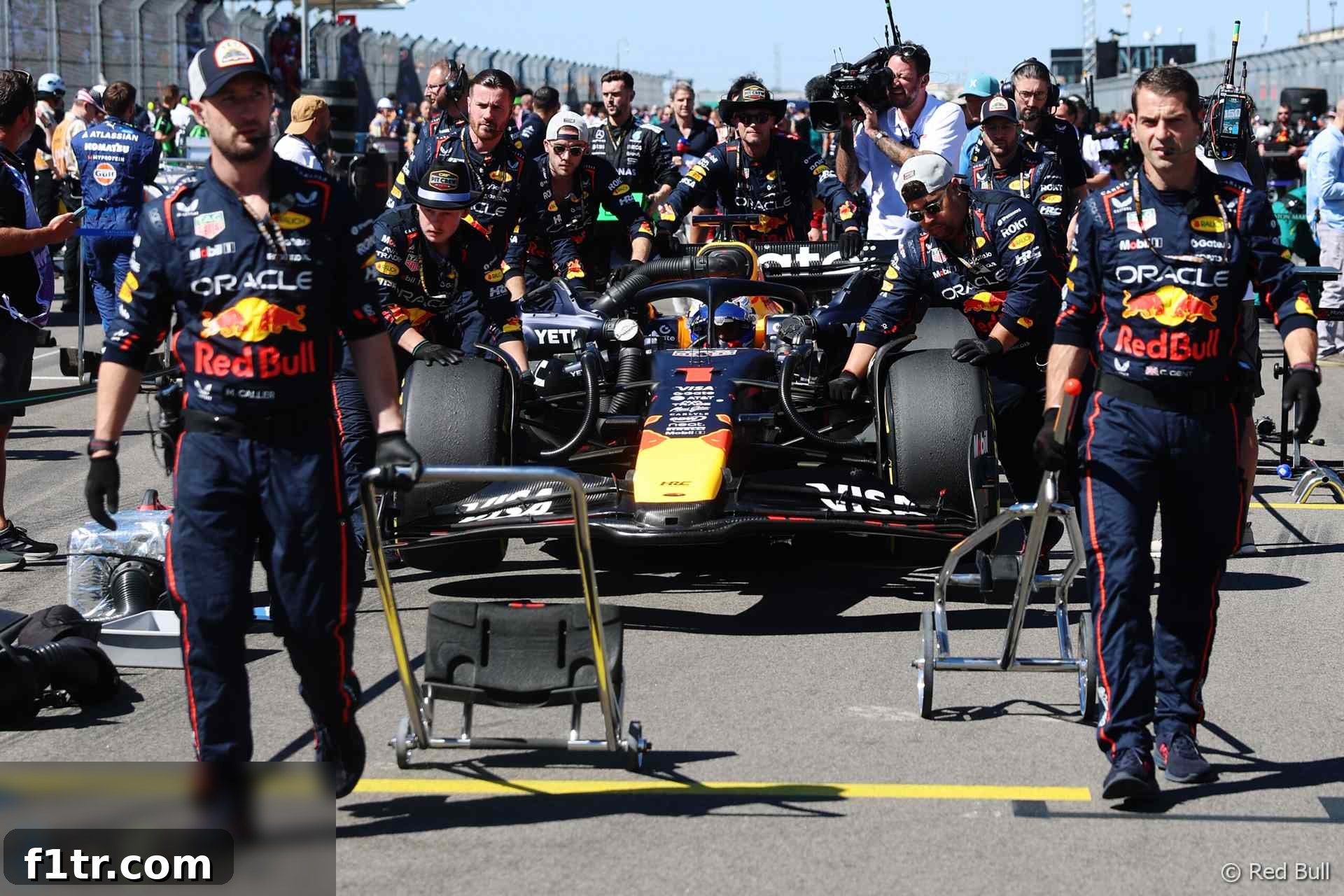
Red Bull Fined €50,000 for Formation Lap Safety Breach at US Grand Prix
In a significant development at the United States Grand Prix, Red Bull Racing was issued a substantial €50,000 fine by the event stewards following a critical safety breach. The penalty was imposed after a team member was found to have entered a prohibited area on the track during the crucial formation lap. This incident serves as a potent reminder of Formula 1’s stringent safety protocols and the absolute necessity for all personnel to adhere strictly to these regulations, designed to protect everyone involved in the high-stakes environment of motorsport.
The infraction occurred at the Circuit of the Americas (COTA) when a Red Bull team member gained unauthorized access to the gate well area situated next to Gate One. This specific zone, nestled between the pit wall and the racing track, is explicitly designated as a clear area once the formation lap commences. At the time of the breach, race marshals were actively engaged in their duties, working diligently to close and secure the gate, thereby ensuring the track was completely clear for the impending race start. This transitional phase, where static grid positions give way to dynamic racing, is one of the most critical for safety, demanding unwavering compliance from all trackside personnel.
The Incident Under Scrutiny: Unpacking the Safety Breach
The stewards’ thorough investigation revealed that the team member re-entered the restricted Gate One area, specifically in close proximity to the second grid position, after the formation lap had already begun. The timing of this unauthorized entry is paramount, as it coincided with the precise moment when all non-essential personnel are mandated to have cleared the track and its immediate surroundings. According to reports from the pit marshals present at the scene, the Red Bull team member reportedly did not appear to react to their explicit efforts and instructions aimed at preventing his entry into this potentially hazardous zone.
During the subsequent hearing, a representative from Red Bull Racing met with the stewards to address the incident. The team representative conveyed that the individual involved claimed to have been unaware of the marshals’ attempts to stop him. However, the stewards unequivocally dismissed this claim as a valid mitigating factor. Their ruling firmly underscored a fundamental principle of Formula 1 safety: any individual affiliated with a team or other stakeholders bears a primary responsibility to be fully aware of and strictly respect the absolute prohibition against entering the track or obstructing safety measures once the grid has been cleared for racing. This principle establishes a strict liability standard, emphasizing that ignorance of safety protocols is not an acceptable excuse within such a high-risk environment.
The official report from the stewards meticulously detailed the severity of the situation. It explicitly stated: “According to the report from the pit marshals the team member did not appear to react to their efforts to prevent him from entering the gate well area.” Furthermore, the stewards elaborated on their decisive stance, declaring, “Thus, irrespective of whether or not the instructions of the relevant officials have been realised by the person concerned, hindering or delaying the process of closing the gates before the race start must be considered as an unsafe act and therefore a significant penalty to the team is warranted.” This clear and unambiguous statement leaves no room for doubt regarding personal accountability when track safety is compromised, highlighting the non-negotiable nature of these regulations.
The €50,000 Penalty: A Stern Message on Non-Negotiable Safety
The imposition of a €50,000 (approximately £43,000) financial penalty is a clear reflection of the extreme seriousness with which the FIA and its appointed stewards view any infringement of established safety protocols. To amplify the message and to serve as a robust deterrent against any future recurrences, a critical portion of this fine—specifically, half of the total amount—has been conditionally suspended until the end of the current Formula 1 season. This suspended portion is entirely contingent upon Red Bull Racing ensuring that no similar breaches of these vital safety rules occur before the championship concludes. This particular punitive mechanism is strategically designed to provide a continuous incentive for teams to meticulously review, reinforce, and stringently implement their internal safety procedures and personnel training programs.
Penalties of this magnitude in Formula 1 are far more than mere punitive measures; they function as indispensable instructional tools within the intensely competitive and inherently safety-conscious realm of global motorsport. The resolute decision by the stewards at COTA broadcasts a powerful and unambiguous message throughout the entire Formula 1 paddock: track safety is an absolute priority and is entirely non-negotiable. Every team, irrespective of its current competitive standing or historical achievements, is unequivocally expected to uphold the most stringent standards of safety compliance. This commitment is crucial not only for safeguarding their own dedicated personnel but also for protecting the invaluable marshals, officials, and, most importantly, the drivers themselves, who operate at the very limits of human and mechanical endurance.
Why Track Safety is Paramount in Formula 1
Formula 1 represents the absolute pinnacle of motorsport, an environment where vehicles operate at breathtaking speeds, and the margins for error are infinitesimally small. The entire ecosystem surrounding an F1 track is, by its very nature, fraught with inherent dangers. Consequently, the implementation of exceptionally stringent safety regulations and their unwavering enforcement becomes not just important, but absolutely essential for the viability and integrity of the sport. The formation lap, while not a competitive race lap, is a profoundly critical phase of any Grand Prix. During this period, all 20 high-performance racing cars are in motion, drivers are meticulously preparing their tyres and brakes for optimal performance, and marshals conduct a final, thorough sweep of the track to ensure it is completely clear of any debris or unauthorized personnel.
In this high-stakes and rapidly evolving phase, marshals fulfill an indispensable role. They are the primary guardians of safety on the ground, working tirelessly and often under immense pressure to clear the grid, meticulously close all access gates, and provide definitive signals to Race Control confirming that the track is unequivocally safe for the start of the race. Their authority and instructions, born of extensive training and experience, must be respected without question or hesitation. Any disruption to their vital duties, or any unauthorized presence within a designated clear area, introduces an unacceptable level of risk. Such an oversight could potentially lead to severe accidents, endangering personnel, officials, and the multi-million-dollar vehicles and their drivers.
The “gate well area,” specifically referenced in the stewards’ report, vividly illustrates a zone that undergoes an instantaneous transformation from a relatively benign access point into a critically high-risk area within mere seconds. As the Formula 1 cars conclude their formation lap and meticulously align themselves on the grid for the start, every segment of the track’s perimeter must be completely secured. The presence of a team member in such an area, even for the briefest of moments, can create a profoundly hazardous situation. Such an unauthorized presence not only poses a direct and immediate threat to the individual’s own life but also risks distracting drivers or marshals at a crucial moment, thereby jeopardizing the safety of everyone on the circuit.
Broader Implications for Teams, Regulations, and Future Prevention
While specific in its details, this incident is not an isolated occurrence in the long and complex history of Formula 1 safety. Instead, it serves as a timely and potent reminder of the perpetual vigilance required. The sport has dedicated decades to continuously evolving and enhancing its safety protocols, frequently drawing lessons from unfortunate past incidents to improve future preventative measures. The comprehensive FIA International Sporting Code, alongside the highly specific Formula 1 Sporting Regulations, meticulously delineates rules governing track access, operations within the pit lane, and the precise conduct expected of all personnel. These regulations are not arbitrary; they are meticulously designed to preempt potential dangers and to rigorously maintain an orderly, secure, and predictable racing environment for all participants.
For Red Bull Racing, an organization boasting an exemplary safety record and numerous championship titles, this fine undoubtedly represents a source of considerable embarrassment. More significantly, however, it acts as a powerful catalyst for an immediate and thorough internal review of their existing safety procedures. Such an incident prompts all teams within the paddock to re-educate their entire staff on the critical importance of not only understanding but also meticulously complying with every single safety directive, particularly those pertaining to track access during live sessions. It powerfully reinforces the concept of collective responsibility, where even a momentary lapse in judgment or awareness by a single individual can trigger far-reaching and potentially severe repercussions for the entire team, extending beyond just financial penalties to reputational damage and potential safety crises.
The resolute decision by the stewards further underscores the vital and proactive role played by race officials in upholding the integrity of the sport’s safety framework. By imposing a substantial penalty, even for an incident that, thankfully, did not escalate into a direct injury or a significant disruption to the race itself, they are sending an unequivocal message centered on prevention. The overriding objective is to rigorously prevent any future reoccurrence of such breaches, not solely for Red Bull Racing but for every single team operating within the highly demanding and safety-critical parameters of Formula 1. This proactive stance ensures that safety remains at the forefront of all operational considerations, fostering a culture of unwavering adherence.
Conclusion: Prioritizing Safety in the Fast Lane
The substantial €50,000 fine levied against Red Bull Racing at the United States Grand Prix stands as a powerful and enduring testament to Formula 1’s non-negotiable stance on safety. The unauthorized entry of a team member into a strictly prohibited track area during the formation lap, despite fortunately not resulting in a direct accident or injury, was unequivocally deemed an “unsafe act” that warranted significant and immediate repercussions. This decisive ruling emphatically reinforces that absolute awareness, unwavering adherence to all established rules, and profound respect for the instructions issued by marshals are paramount for every single individual operating within the high-stakes, adrenaline-fueled environment of motorsport.
As Formula 1 persistently continues its quest to push the very boundaries of technological innovation and athletic performance, the foundational principle of safety must remain absolutely inviolable. This incident serves as a crucial reminder of the continuous, collective vigilance required from all teams, their personnel, and race officials alike, in order to uphold the most stringent safety standards. By maintaining this relentless commitment, the enthralling spectacle of Grand Prix racing can continue to be not only thrilling and competitive but also fundamentally secure and safe for every participant and spectator involved.