The Controversial 1997 Japanese Grand Prix: Schumacher’s Resurgence and Villeneuve’s Fight for Survival
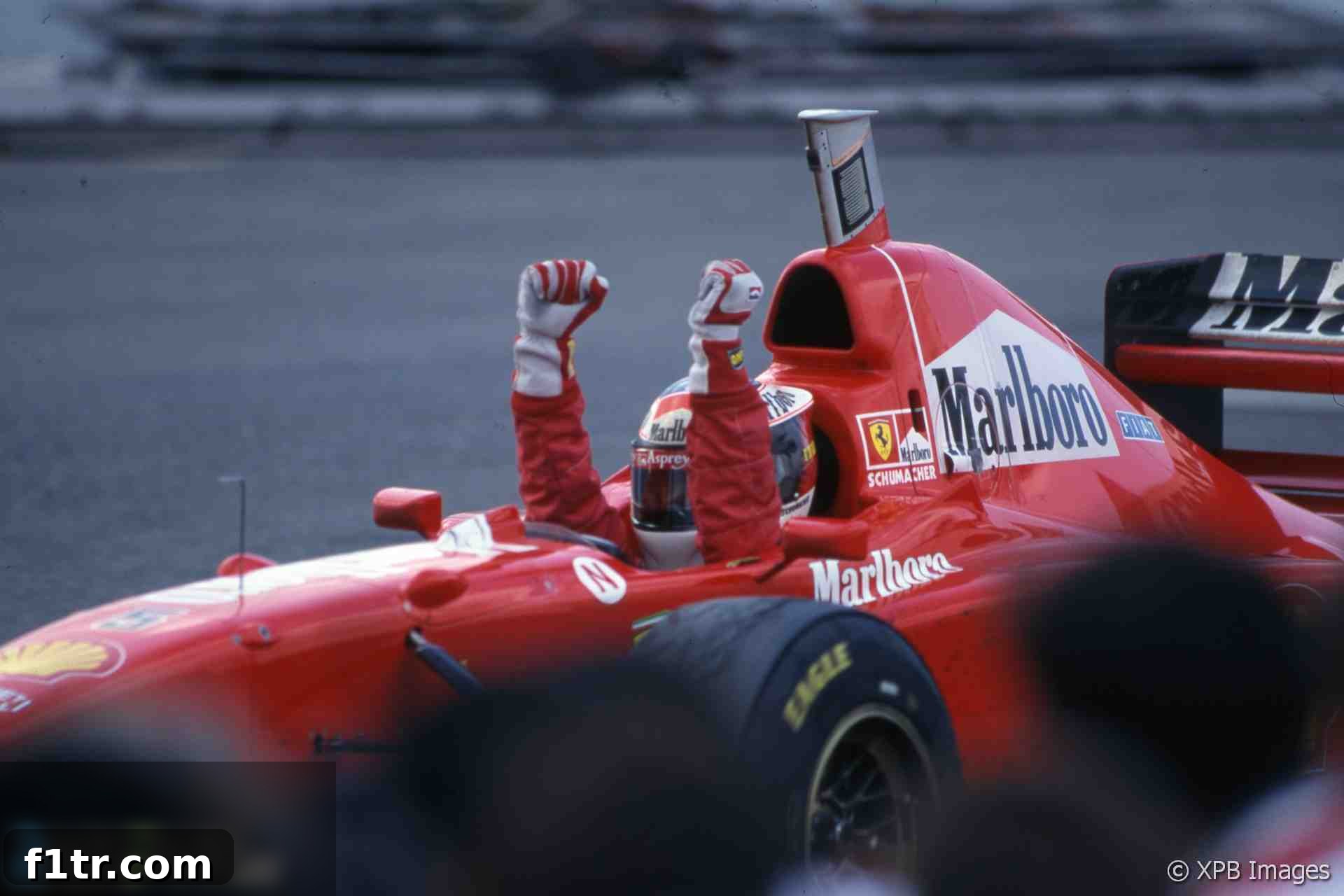
The 1997 Formula 1 season was a thrilling spectacle, culminating in an intense championship battle between two titans: Michael Schumacher of Ferrari and Jacques Villeneuve of Williams. As the penultimate round approached at Japan’s iconic Suzuka circuit, the stakes couldn’t have been higher. Schumacher’s dramatic victory at the 1997 Japanese Grand Prix didn’t just clinch vital points; it ignited a firestorm of controversy and set the stage for an unforgettable championship decider. This race was far from straightforward, a strategic masterpiece for Ferrari and a monumental challenge for Villeneuve, both on and off the track.
Villeneuve’s Championship Predicament: A Point Away, Yet Under Immense Pressure
Jacques Villeneuve arrived in Japan with a nine-point advantage over Michael Schumacher, needing only a single point from the Suzuka race to secure his maiden Formula 1 World Championship title. This seemingly comfortable lead, however, masked a dramatic shift in momentum. In the preceding two races, Villeneuve had scored a maximum 20 points, while Schumacher managed a mere single point. Yet, the Ferrari camp, led by Schumacher, projected an aura of quiet confidence, downplaying their title aspirations publicly. “We have already succeeded in our expectations this year,” Schumacher declared before the weekend, adding, “Even if we don’t win the championship, we will have fulfilled our expectations, or even more.” This statement, perhaps a psychological ploy, hinted at the fierce resolve brewing within the Maranello squad.
Villeneuve’s initial prospects looked promising. He expertly navigated the demanding Suzuka circuit to snatch pole position in a closely contested qualifying session, edging out Schumacher. The championship seemed within his grasp, a mere race away from concluding.
The Yellow Flag Controversy: A Ban Under Appeal
However, the paddock was soon rocked by news that threatened to derail Villeneuve’s championship bid: a potential race ban. During the Saturday morning practice session, Villeneuve was observed accelerating out of Spoon curve while passing Jos Verstappen’s stranded Tyrrell, which was being recovered under waved yellow flags. This seemingly innocuous incident triggered a fierce response from the FIA, which had recently introduced stringent penalties for drivers failing to respect yellow flags in an effort to enhance safety.
Villeneuve was not alone in his transgression. Five other drivers, including Johnny Herbert, Rubens Barrichello, Ukyo Katayama, and even Schumacher himself, also failed to sufficiently slow down. These drivers received one-race bans, which were suspended until the end of the season. Heinz-Harald Frentzen, having previously committed the same offense, was handed a five-race suspended ban. However, Villeneuve’s case was different and far more critical. He had already been penalized for similar yellow flag infringements on three previous occasions during the season. Consequently, the FIA issued an immediate ban, prohibiting him from competing in the Japanese Grand Prix.
This decision sent shockwaves through the Formula 1 community. The implications for the championship were immense: if Villeneuve was disqualified, Schumacher would have the opportunity to transform his nine-point deficit into a slender one-point lead heading into the season finale at Jerez.
Villeneuve later admitted his error and the risks he consciously took. “Then I thought ‘oh, it’s a straight’,” he recounted, reflecting on the moment he saw the yellow flags. “And I ended up doing it, and I shot myself in the foot.” He further elaborated on his fleeting thought process: “I did spend about a second thinking about it. Even after I passed the car I thought about hitting the brakes so it wouldn’t appear on the timing screens, which is what they look out for. But then I thought ‘no, I don’t want to play silly games like that’. So I didn’t. But I will in the future.” His candid admission highlighted the high-pressure environment and split-second decisions drivers face.
Predictably, Williams immediately lodged an appeal against Villeneuve’s ban. With insufficient time to convene a formal hearing before the race, Villeneuve was controversially allowed to start from pole position, albeit with the full knowledge that any points he scored might ultimately be rescinded. Many observers questioned the wisdom of Williams’s appeal, recalling the precedent from three years prior when Jordan’s similar protest for Eddie Irvine resulted in the FIA increasing his ban from one race to three. This looming uncertainty added an extraordinary layer of psychological pressure on Villeneuve.
Prior to the weekend’s events, Villeneuve had already underscored the importance of clinching the 1997 championship. He highlighted upcoming rule changes for 1998, which he believed would drastically alter the nature of the cars, potentially making 1997 “the last real season of Formula 1.” Having come close in his rookie year, he felt a deeper responsibility in 1997. “Last year I was a rookie, I was behind all of the season and got close towards the end. So for a first season that felt good. It wasn’t a question of losing it, it was more a question of not winning it, which was acceptable, there was always this year,” he explained. “But this year if we don’t win it it’s more that we lost it in a way because we had the most competitive car at the start of the season.” The pressure was palpable even before the yellow flag incident.
Qualifying at Suzuka: Ferrari’s Resurgent Form
Amidst the off-track drama, the on-track performance in qualifying showcased a rejuvenated Ferrari. The F310B, equipped with a new front wing that visibly flexed under the extreme aerodynamic loadings of Suzuka’s super-fast corners, delivered the team’s best combined qualifying result of the season. Michael Schumacher lined up alongside his championship rival, just six-hundredths of a second slower, setting the stage for a dramatic race. Eddie Irvine, Schumacher’s loyal teammate, secured an impressive third position, strategically placed to support Ferrari’s title challenge.
McLaren’s rapidly starting cars, a consistent threat in recent races, positioned Mika Hakkinen in fourth, ready to inject himself into the championship fight. However, his teammate David Coulthard was further down the grid, limiting McLaren’s dual threat. While Schumacher could count on significant support from Irvine, Villeneuve’s teammate Heinz-Harald Frentzen could only manage sixth, outpaced by an on-form Gerhard Berger in the Benetton. Jean Alesi in the second Benetton completed the fourth row.
At their home race, Bridgestone struggled to replicate the giant-killing form they had shown in Spain and Hungary. Olivier Panis, in his Prost, was the highest Bridgestone-shod qualifier in tenth place, despite benefiting from a new S-specification Mugen-Honda engine. Reigning Formula Nippon champion Ralf Schumacher, making his F1 debut season, used his extensive circuit knowledge to good effect in practice but couldn’t quite translate it into a higher qualifying position, placing his Jordan 13th, four places behind teammate Giancarlo Fisichella. The qualifying session was briefly red-flagged after Gianni Morbidelli crashed heavily at Dunlop. The Sauber driver, who had already missed part of the season due to an arm injury, was unfortunately unable to start the race.
1997 Japanese Grand Prix Starting Grid
| Row 1 | 1. Jacques Villeneuve 1’36.071 Williams-Renault |
|
| 2. Michael Schumacher 1’36.133 Ferrari |
||
| Row 2 | 3. Eddie Irvine 1’36.466 Ferrari |
|
| 4. Mika Hakkinen 1’36.469 McLaren-Mercedes |
||
| Row 3 | 5. Gerhard Berger 1’36.561 Benetton-Renault |
|
| 6. Heinz-Harald Frentzen 1’36.628 Williams-Renault |
||
| Row 4 | 7. Jean Alesi 1’36.682 Benetton-Renault |
|
| 8. Johnny Herbert 1’36.906 Sauber-Petronas |
||
| Row 5 | 9. Giancarlo Fisichella 1’36.917 Jordan-Peugeot |
|
| 10. Olivier Panis 1’37.073 Prost-Mugen-Honda |
||
| Row 6 | 11. David Coulthard 1’37.095 McLaren-Mercedes |
|
| 12. Rubens Barrichello 1’37.343 Stewart-Ford |
||
| Row 7 | 13. Ralf Schumacher 1’37.443 Jordan-Peugeot |
|
| 14. Jan Magnussen 1’37.480 Stewart-Ford |
||
| Row 8 | 15. Shinji Nakano 1’37.588 Prost-Mugen-Honda |
|
| 16. Pedro Diniz 1’37.853 Arrows-Yamaha |
||
| Row 9 | 17. Damon Hill 1’38.022 Arrows-Yamaha |
|
| 18. Ukyo Katayama 1’38.983 Minardi-Hart |
||
| Row 10 | 19. Tarso Marques 1’39.678 Minardi-Hart |
|
| 20. Jos Verstappen 1’40.259 Tyrrell-Ford |
||
| Row 11 | 21. Mika Salo 1’40.529 Tyrrell-Ford |
The 1997 Japanese Grand Prix: A Strategic Battle Unfolds
Villeneuve’s precarious situation, racing under appeal, created the circumstances for one of the most unusual and tactically charged races in Formula 1 history. Knowing that any points he scored might be nullified, his primary objective shifted from winning the race to strategically limiting Schumacher’s potential points haul. This scenario echoed Lewis Hamilton’s approach in the 2016 championship decider, where he deliberately slowed the field to allow rivals to pass Nico Rosberg. However, Villeneuve’s unique position, not needing to protect a teammate, allowed him to take even greater risks.
Michael Schumacher, on the other hand, had consistently benefited from the unwavering support of his teammate throughout the season. At Suzuka, Eddie Irvine’s role would prove more critical than ever, becoming a central figure in Ferrari’s elaborate race strategy. Irvine himself was clear about his responsibility: “We have been speaking about [team orders] all year,” he stated. “I know the situation. I have to help Michael as best I can.” This explicit acknowledgment of team orders set the tone for the highly anticipated race.
Race Start and Ferrari’s Masterclass
The race commenced with immediate drama as Villeneuve swerved aggressively across Schumacher’s bows off the line, determined to hold back the charging Ferrari. His intentions became clear within the first half-lap; he began to deliberately slow the field, hoping that a rival car, ideally Mika Hakkinen, would attempt to overtake Schumacher and deny him crucial championship points. Villeneuve’s strategy seemed to gain traction initially when Hakkinen, utilizing McLaren’s renowned rapid start, deftly split the two Ferraris. As Villeneuve cautiously led the field around at the end of a slow first lap, the top six cars were incredibly tightly packed, covered by just two seconds.
However, Ferrari had meticulously anticipated such tactics. As Villeneuve continued to back up the pack exiting the Esses, Schumacher briefly lifted, creating a gap that Irvine ruthlessly exploited. Darting around both Schumacher and Hakkinen, Irvine positioned himself directly on Villeneuve’s tail. With no interest in battling his potential points spoiler, Villeneuve allowed the Ferrari to pass without resistance.
At this juncture, the race veered into the theatrical. While Villeneuve continued his tactics, backing up the chasing pack in hopes that Hakkinen or another driver would challenge Schumacher, Irvine capitalized fully. He rapidly pulled five seconds clear of the lead group within a single lap. By lap six, Irvine had established a commanding 12-second lead, highlighting the effectiveness of Ferrari’s counter-strategy. The sight of Irvine disappearing into the distance while Villeneuve created a bottleneck for the rest of the field was a bizarre spectacle, with even last-placed Ukyo Katayama finding himself 12 seconds behind Villeneuve.
The Pit Stop Battle and Schumacher’s Ascent
Eventually, Villeneuve altered his approach, likely recognizing that his slowing tactics weren’t yielding the desired results against Irvine’s burgeoning lead, or perhaps fearing that Irvine might gain enough of a buffer to pit and re-emerge ahead of him. The race dynamics decisively swung in Ferrari’s favor as McLaren and Benetton made their first pit stops between laps 13 and 14. This allowed Ferrari the strategic flexibility to pit Irvine on lap 16, bringing him out with minimal traffic ahead.
Williams’s options were rapidly dwindling. Their last viable strategy was to keep Villeneuve ahead of Schumacher through the pit sequence. However, even this proved challenging. When Schumacher pitted on lap 18, Villeneuve was left out for an additional lap. During this crucial period, Schumacher set a blistering new fastest lap of the race. Villeneuve’s subsequent pit stop was fractionally too late; as he rejoined, Schumacher, having completed his out-lap, lunged down the inside at Turn One, seizing the advantage as Villeneuve drifted towards the racing line.
Schumacher later expressed his displeasure at Villeneuve’s aggressive rejoining maneuver. “I am not sure whether it was the correct thing to do, to come across the road and try to push someone,” he remarked. “I was able to correct my own situation and took him on the inside, but it could have been very dangerous.”
With Schumacher now ahead, Irvine, who was 14 seconds up the road, patiently awaited instructions. “I was just waiting for the phone call,” he explained. The call quickly came: Ferrari ordered Irvine to slow his pace, allowing Schumacher to pass and maximize his championship points. Irvine dutifully complied, cutting his pace by a remarkable six seconds a lap, and the two teammates executed a clean swap of positions at Turn Six. Irvine then assumed the critical role of holding up Villeneuve, meticulously managing his pace to keep the Williams bottled up behind him. This tactic, however, came at a cost to Irvine himself, as it allowed Heinz-Harald Frentzen to close the gap and eventually pass him for second place. Frentzen’s excellent drive to second, combined with his teammate’s efforts, ultimately secured the Constructors’ Championship for Williams.
The final blow for Villeneuve came during his second pit stop. In a desperate attempt to break free from Irvine’s strategic hold, he pitted early. However, a problem with the refueling hose meant a prolonged stop, dropping him to fifth position behind Mika Hakkinen.
In the closing stages, Frentzen mounted a spirited challenge, rapidly closing the gap to Schumacher. This impressive late-race charge likely prompted Williams’s pit wall to ponder the strategic time lost earlier in the race while Frentzen was held up behind his teammate. Further drama unfolded as Schumacher prepared to lap Damon Hill. Hill, the driver Frentzen had replaced at Williams, did not make it easy, battling a gearbox fault and a broken headrest, and later stating he was waiting for a safe place to allow Schumacher through.
Villeneuve eventually crossed the finish line in fifth, just ahead of the three-stopping Jean Alesi, with Johnny Herbert close behind. Giancarlo Fisichella, Gerhard Berger, and Ralf Schumacher also finished on the lead lap, while David Coulthard retired on the final tour at the challenging 130R corner due to an engine issue.
Schumacher’s hard-fought victory was a triumph of strategy and teamwork. It meant a championship that had seemed to be slipping away was now firmly back within his grasp. He publicly acknowledged his profound gratitude to Eddie Irvine. “I have said many times that Eddie is a great driver and a fine team mate,” Schumacher asserted. “I really have to thank him for this victory. And if any question marks have been raised about his future, I think they should be forgotten now.”
1997 Japanese Grand Prix Official Result
| Pos. | No. | Driver | Team | Laps | Time / gap / reason |
|---|---|---|---|---|---|
| 1 | 5 | Michael Schumacher | Ferrari | 53 | 1:29’48.446 |
| 2 | 4 | Heinz-Harald Frentzen | Williams-Renault | 53 | 1.378 |
| 3 | 6 | Eddie Irvine | Ferrari | 53 | 26.384 |
| 4 | 9 | Mika Hakkinen | McLaren-Mercedes | 53 | 27.129 |
| 5 | 7 | Jean Alesi | Benetton-Renault | 53 | 40.403 |
| 6 | 16 | Johnny Herbert | Sauber-Petronas | 53 | 41.630 |
| 7 | 12 | Giancarlo Fisichella | Jordan-Peugeot | 53 | 56.825 |
| 8 | 8 | Gerhard Berger | Benetton-Renault | 53 | 1’00.429 |
| 9 | 11 | Ralf Schumacher | Jordan-Peugeot | 53 | 1’22.036 |
| 10 | 10 | David Coulthard | McLaren-Mercedes | 52 | Engine |
| 11 | 1 | Damon Hill | Arrows-Yamaha | 52 | 1 lap |
| 12 | 2 | Pedro Diniz | Arrows-Yamaha | 52 | 1 lap |
| 13 | 18 | Jos Verstappen | Tyrrell-Ford | 52 | 1 lap |
| 3 | Jacques Villeneuve | Williams-Renault | 53 | Disqualified | |
| 21 | Tarso Marques | Minardi-Hart | 46 | Gearbox | |
| 19 | Mika Salo | Tyrrell-Ford | 46 | Engine | |
| 14 | Olivier Panis | Prost-Mugen-Honda | 36 | Engine | |
| 15 | Shinji Nakano | Prost-Mugen-Honda | 22 | Wheel bearing | |
| 20 | Ukyo Katayama | Minardi-Hart | 8 | Engine | |
| 22 | Rubens Barrichello | Stewart-Ford | 6 | Spun off | |
| 23 | Jan Magnussen | Stewart-Ford | 3 | Spun off | |
| 17 | Gianni Morbidelli | Sauber-Petronas | Did not start |
Championship Standings: A Pivotal Shift Before Jerez
Nine days after the race, as widely anticipated, the FIA officially rejected the appeal lodged by Villeneuve and Williams. This ruling confirmed Villeneuve’s disqualification from the Japanese Grand Prix, meaning he lost the two points he would have scored for his fifth-place finish. The consequence was a dramatic swing in the championship narrative: instead of arriving at the season-ending European Grand Prix in Jerez with a narrow one-point lead, Jacques Villeneuve now found himself trailing Michael Schumacher by a single point. This controversial turn of events transformed the final race into an even more intense, winner-takes-all showdown, forever etching the 1997 Japanese Grand Prix into the annals of Formula 1 history as a truly pivotal and contentious moment.
Further Reading on F1 History
Grand Prix Flashbacks
- 40 years ago today: How a tyre war prompted Senna’s unfinished Monaco masterpiece
- Schumacher seals record-breaking 10th constructors championship for Ferrari
- Strategic superiority clinches Schumacher’s first Ferrari title
- Disaster for Hakkinen brings title within Schumacher’s grasp
- Schumacher turns the tide against McLaren on tragic day at Monza
Browse all Grand Prix flashbacks
F1 History Articles
- When did F1 last have a mid-season break longer than five weeks? 1990
- Did Norris actually win Formula 1’s closest championship fight of all time?
- Hamilton is Ferrari’s first new driver in 44 years to complete season without a podium
- Ferrari are on course to lose an F1 record they’ve held since 2004
- Red Bull in 2010 or Ferrari in 1979? Past title fights illustrate McLaren’s current dilemma
Browse all history articles