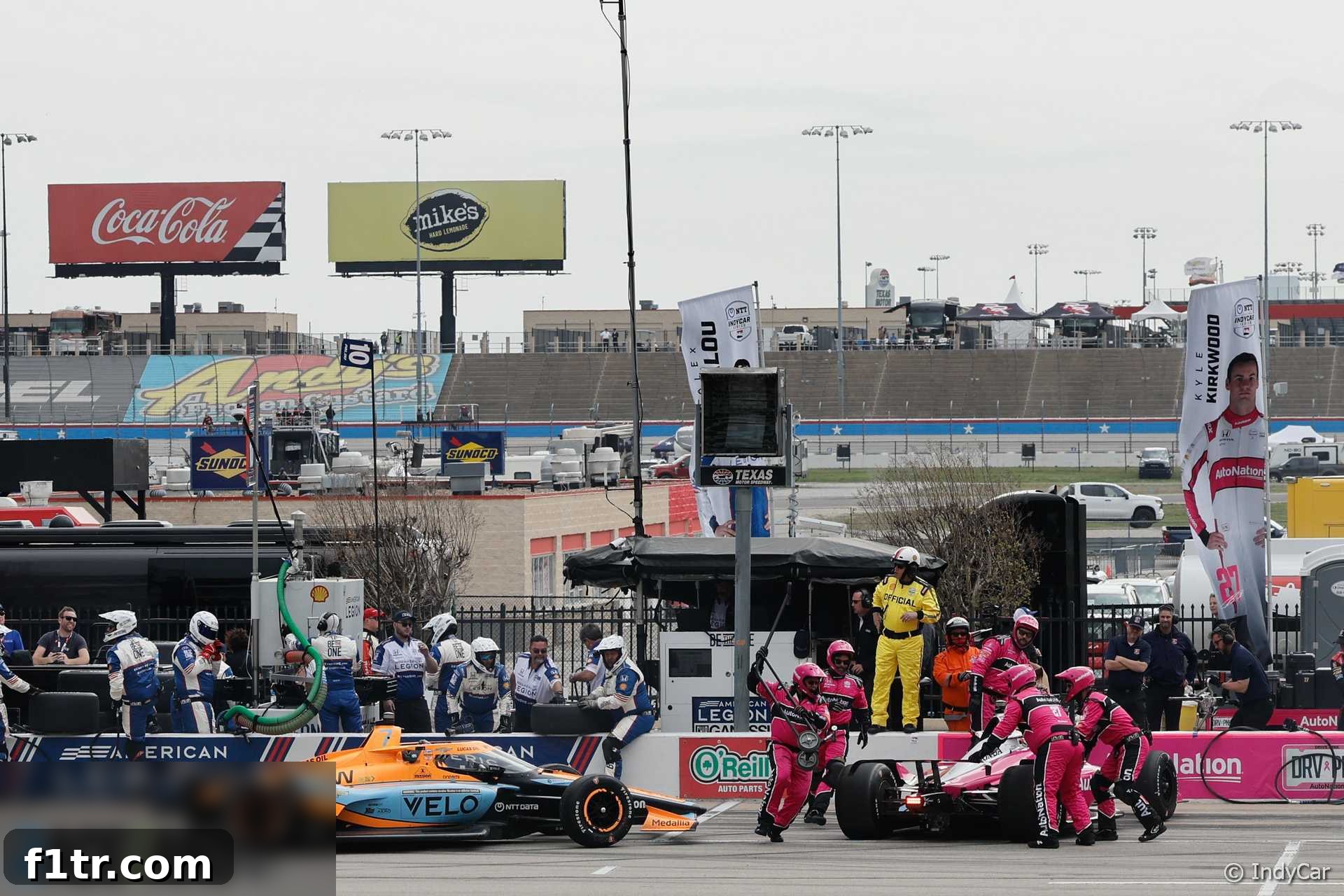
Alexander Rossi, a prominent figure in the NTT IndyCar Series, remains resolute in his conviction that fellow competitor Kyle Kirkwood was solely responsible for the controversial pit lane collision that marred their race at Texas Motor Speedway. This incident, which unfolded during a crucial caution period, ignited a debate among drivers, officials, and fans, underscoring the high-stakes precision required in top-tier motorsport.
Advert | Become a Supporter & go ad-free
The contentious encounter occurred when a caution flag was deployed following a crash involving Chip Ganassi Racing’s veteran driver, Takuma Sato. This common occurrence in IndyCar racing immediately triggered a mass exodus to the pit lane, as the majority of the field seized the opportunity for tire changes and refueling under yellow flag conditions. Both Rossi, driving for McLaren, and Kirkwood, representing Andretti Autosport, were among those heading to their respective stalls, setting the stage for the dramatic contact that would later impact their races significantly.
As the field streamed into the narrow confines of the pit lane, Rossi was in a strong fifth position, enjoying a substantial eight-place advantage over Kirkwood. This superior track position meant Rossi had the potential to complete his pit stop – a meticulously choreographed dance involving rapid tire changes and a full tank of fuel – and be released back onto the fast lane of pit road, ideally well ahead of Kirkwood. The timing and coordination of these operations are critical, as even a fraction of a second can alter a driver’s race trajectory.
However, the intricate ballet of pit stops quickly veered off script. Kirkwood’s approach to his designated pit stall was unexpectedly hampered by the presence of Josef Newgarden, whose car, spinning its wheels, briefly delayed Kirkwood’s entry into the fast lane. This momentary delay proved pivotal. By the time Kirkwood’s car drew level with Rossi’s pit stall, the McLaren crew was in the final stages of their stop. Rossi’s fuel hose was being disconnected, signaling his imminent release into the traffic stream. Instead of being clearly ahead, Kirkwood’s rear was precisely level with the front of Rossi’s McLaren, creating a highly ambiguous and dangerous overlap in the congested pit lane.
The inevitable outcome saw Rossi accelerate vigorously from his stall, as per standard procedure, immediately attempting to swing his car to the left. He applied full steering lock to merge safely onto the fast lane. Simultaneously, the now slowing Kirkwood was steering towards his own pit stall, inadvertently closing the gap. In a split second, Rossi’s front-right wheel made decisive contact with Kirkwood’s rear-left. The impact spun Kirkwood’s car sideways, forcing him into his pit area, while Rossi brought his McLaren to an abrupt halt, his race strategy in tatters.
Remarkably, and fortunately, both drivers and their respective pit crews emerged from the chaotic incident without injury. The immediate reaction from the NBC commentary team, witnessing the incident live, was to assign blame squarely to Kirkwood. However, the official stewards of the race reached a different conclusion. After reviewing the evidence, they deemed Rossi and his crew to be at fault, citing an “unsafe release” from the pit stall. This ruling resulted in Rossi being handed a drive-through penalty for “contact with another car,” placing the entirety of the responsibility for the incident squarely on the McLaren driver.
Even before the penalty was officially issued, Rossi’s race was already irrevocably damaged. The collision necessitated a lengthy repair, during which a new nose cone was fitted to his car, costing him a significant five laps. The stewards’ decision, therefore, served as a final, crushing blow to any hopes of salvaging a respectable finish. In the aftermath, both drivers took to social media, each presenting their perspective and asserting that they had meticulously adhered to the complex rules governing pit lane procedures, highlighting the differing interpretations of the incident.
Advert | Become a RaceFans supporter andgo ad-free
Kyle Kirkwood, expressing his dismay at the public reaction, stated, “Pretty disappointing how much hate mail I’ve received for the pit lane incident yesterday.” He then sought to clarify his position, adding, “I’d like to clarify that I was fully 100% within pit lane protocol and the IndyCar NBC broadcast team has kindly apologised for making me out to be the bad guy.” This public apology from the broadcasters underscored the ambiguity of the situation and the initial misjudgment in assigning blame solely to Kirkwood.
Despite the official ruling and Kirkwood’s public defense, Alexander Rossi conveyed to media outlets, including RaceFans, this week that his stance on the blame for the pit lane entanglement remains unchanged. His unwavering conviction suggests a deep-seated belief in his own actions and an alternative interpretation of the circumstances leading to the collision, further perpetuating the debate around the incident.
Rossi articulated a broader hope for the series, emphasizing the need for collective improvement. “Hopefully we can as a series learn about communication and continuity and just take lessons from it,” he remarked. “It’s a shame to have situations exist and not really learn anything from it. So it’s something that we all talked about at length.” This call for introspection highlights the potential for such incidents to serve as valuable learning opportunities, fostering a more unified understanding of regulations and procedures among all stakeholders in IndyCar racing.
He acknowledged the past, stating, “At the end of the day it’s history now and we just got to make sure that going forward, everyone’s on the same page.” This forward-looking perspective, while maintaining his personal view, suggests a desire to move beyond the controversy and focus on improving safety and clarity for future races. The incident at Texas serves as a stark reminder of the complexities and subjective interpretations that can arise even under clear rules in the high-pressure environment of IndyCar competition.
The lessons from Texas, particularly concerning pit lane dynamics, were immediately relevant for the subsequent event: the prestigious Long Beach Grand Prix. Rossi highlighted how crucial drivers’ positions in the pit lane would be for this iconic street circuit. The qualifying results from Texas dictated the order in which drivers could select their pit stalls for Long Beach. Rossi, having qualified third, enjoyed the distinct advantage of being among the first to choose, a strategic benefit he deeply appreciated.
He elaborated on the importance of this choice, particularly for street courses. “For Long Beach, it’s important to be in the front in terms of pit selection, just so that when you’re leaving to go to practice, qualifying, qualifying sims or whatever, you have as much clear track front of you as possible,” he explained. On a tight street circuit like Long Beach, having an unobstructed exit from the pit lane can significantly impact a driver’s ability to get up to speed quickly, crucial for setting fast laps in practice and qualifying, and maintaining track position during the race.
The strategic value of pit lane selection extends beyond street courses to oval races as well. Rossi further explained, “For the ovals, it’s a pretty big advantage to have an open ‘in’, just because of the way that cross weight is set up. You can carry more speed into the box for some of these tracks we go to where we have a lot of cars in a small pit lane.” An “open ‘in'” refers to a pit stall that allows a less acute entry angle, enabling drivers to brake later and carry more momentum into their box. This seemingly small advantage can translate into vital tenths of a second gained over an entire race, underscoring the granular level of strategy involved in IndyCar racing, where every detail matters. The Texas incident, therefore, served as a potent, albeit painful, reminder of the intricate dance and razor-thin margins that define pit lane operations in the NTT IndyCar Series.
Advert | Become a RaceFans supporter andgo ad-free
IndyCar Insights and Related Stories
- IndyCar driver McLaughlin cleared of injury after crashing through barrier at Barber
- Schumacher says his IndyCar feels like ‘an F2 car, just with better tyres’
- IndyCar “way faster than Formula 1” in some corners, says Grosjean
- FIA to award more F1 superlicence points to IndyCar drivers from 2026
- Schumacher to race full-time in IndyCar with RLL in 2026
Browse all IndyCar articles