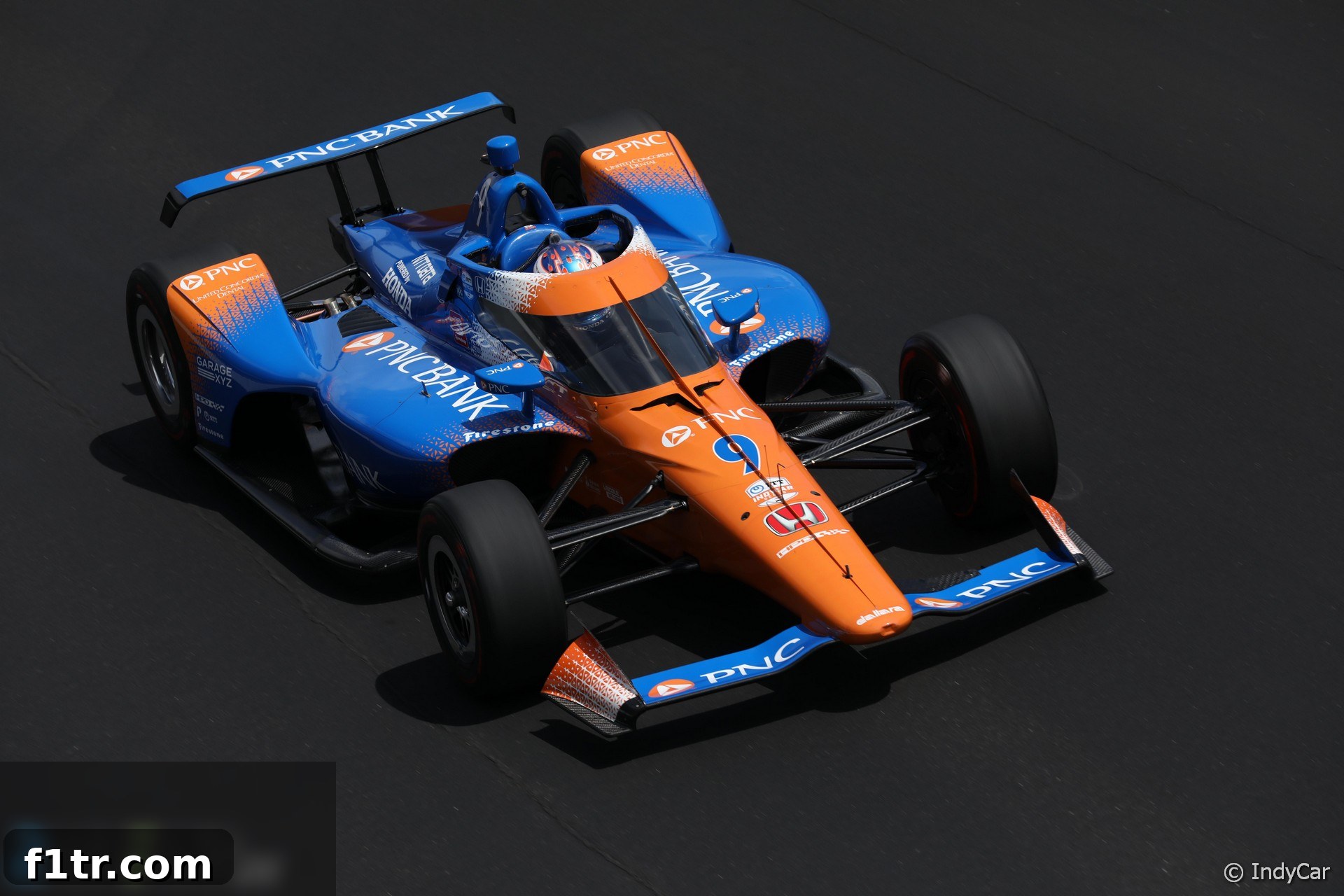
The legendary Scott Dixon, a six-time IndyCar champion and the illustrious 2008 Indianapolis 500 winner, etched his name further into the annals of motorsport history by claiming pole position for the 106th running of IndyCar’s most revered event. His remarkable qualifying performance wasn’t just fast; it was historically significant, setting the fastest pole-winning qualifying run ever recorded in the rich tradition of the “Greatest Spectacle in Racing.”
From the outset of the high-stakes Top 12 qualifying session, Dixon, nicknamed “The Iceman” for his composed demeanor, laid down a formidable benchmark that left competitors scrambling. His four-lap average speed of 233.510 mph (375.798 kph) was a testament to his precision, skill, and the potent combination of his Chip Ganassi Racing machine. This initial display of dominance foreshadowed a remarkable day for Chip Ganassi Racing, as Dixon was one of an impressive four drivers from the powerhouse team to advance to the decisive Fast Six qualifying stage. He was joined by formidable teammates Marcus Ericsson, the experienced veteran Tony Kanaan, and the reigning IndyCar Series champion, Alex Palou.
However, the Top 12 session wasn’t without its dramatic moments. Seven-time NASCAR champion and “super rookie” Jimmie Johnson narrowly averted a catastrophic incident, losing grip as he entered turn one on his very first lap. A slight brush with the wall was enough to unsettle his run, and although he continued bravely, his four-lap average wasn’t sufficient to propel him into the final Fast Six shootout. Johnson, a newcomer to the demanding Indianapolis Motor Speedway oval at these speeds, will start from the 12th position, a learning experience that highlighted the unforgiving nature of Indy 500 qualifying.
Beyond the Ganassi quartet, two strong contenders from Ed Carpenter Racing also secured their places in the Fast Six. Rinus VeeKay, a young and exceptionally talented driver, impressed with a four-lap average of 233.429 mph. His team owner, Ed Carpenter, a seasoned Indy 500 veteran and a three-time pole sitter himself, also demonstrated his prowess by progressing to the ultimate pole shootout, ensuring a diverse and highly competitive front group.
The intense pressure of the Top 12 session saw McLaren SP drivers Pato O’Ward and Felix Rosenqvist narrowly miss the cut for the Fast Six. Despite strong efforts, they were bumped from contention in the closing moments and will start from seventh and eighth positions respectively. Andretti Autosport’s Romain Grosjean delivered an impressive performance, qualifying ninth. The former Formula 1 racer showcased his adaptability and speed, securing the title of the fastest rookie on his Indianapolis 500 debut, a significant achievement for his first competitive outing at the iconic track.
Sharing the fourth row of the grid with Jimmie Johnson will be two-time Indy 500 winner Takuma Sato, driving for Coyne/RWR, who qualified 10th, and Team Penske’s formidable Will Power, who will start 11th. The grid was already shaping up to be a thrilling mix of veterans, rising stars, and celebrated champions, setting the stage for an unforgettable race.
The Battle for Pole: Fast Six Showdown
Following the initial Top 12 runs, a brief intermission provided a moment of respite and strategy. During this period, the six leading drivers engaged in symbolic 100 mph parade laps, allowing their engines to cool and providing a critical five-minute window for teams to make final adjustments to their finely tuned machines. The tension was palpable as the Fast Six qualifying then commenced, each driver knowing that just four laps could define their starting position in the most important race of the year.
Tony Kanaan, embarking on what could potentially be his 21st and final Indianapolis 500 start, was the first to take to the track. The beloved Brazilian veteran, a past winner of the event, delivered a solid performance that initially placed him sixth on the grid, demonstrating his enduring skill and passion for the race.
Next out was Ed Carpenter, navigating the challenging conditions, including a noticeable gust of wind on his crucial final lap. Despite the elements, the 19-year Indy 500 veteran and three-time pole sitter expertly guided his car to secure a commendable fourth-place starting position. He will line up next to Marcus Ericsson, who put together a stellar run to achieve his best-ever Indy 500 starting position in fifth, a significant milestone for the Swede.
The excitement intensified when Alex Palou, the defending IndyCar Series champion, unleashed a blistering and remarkably consistent run. With an average speed of 233.499 mph, Palou temporarily seized the provisional pole position, showcasing why he is a reigning champion and a fierce competitor. His precision and unwavering pace suggested that he might be unbeatable.
However, Rinus VeeKay, whose jaw-dropping speed and aggressive style had already captured everyone’s attention during Saturday’s qualifying runs, was determined to challenge for the top spot. VeeKay also delivered a highly consistent performance, but his average speed of 233.385 mph, while incredibly fast, wasn’t quite enough to displace Palou from the provisional pole. Nevertheless, VeeKay’s exceptional run secured his second consecutive front-row start at the Indy 500, a remarkable achievement for the young driver and a clear indicator of his immense talent.
Scott Dixon’s Historic Pole: A New Chapter in Indy History
The stage was set for the final competitor, Scott Dixon, the last man on track in the Fast Six session. With the pressure mounting and history within reach, Dixon delivered a performance that will be remembered for generations. His first two laps were nothing short of breathtaking, both exceeding 234 mph, a staggering display of raw speed. What followed was an exhibition of incredible consistency across all four laps, a hallmark of his distinguished career.
Dixon masterfully drove his way into another page of the Indianapolis 500 record books, culminating in an astonishing four-lap average speed of 234.046 mph (376.661 kph). This monumental achievement secured his fifth Indy 500 pole position, making it his second in a row, and solidified his place as one of the greatest qualifiers in the event’s history. Beyond the prestige, this pole also awarded him twelve valuable points in the fiercely contested IndyCar Series standings, bolstering his championship campaign.
Dixon’s record-breaking run officially stands as the fastest pole-winning qualifying speed in the long and storied history of the Indianapolis 500. It majestically eclipsed the previous record of 233.718 mph, a benchmark set by the late Scott Brayton in 1996. Brayton’s tragic practice accident just days after his record run adds a poignant layer to the history of speed at Indy, reminding all of the inherent dangers and ultimate sacrifices made in pursuit of glory.
It’s crucial to distinguish Dixon’s pole-winning record from the all-time qualifying record. The absolute fastest qualifying speed ever recorded at the Indianapolis Motor Speedway belongs to Arie Luyendyk, who achieved an incredible 236.986 mph (381.392 kph) in the same year, 1996. However, Luyendyk’s run occurred during the second day of qualifying, under different rules that meant it did not count for pole position. Dixon’s achievement, therefore, is a specific and highly celebrated record for securing the coveted pole position, a testament to his performance when it mattered most.
With his fifth Indianapolis 500 pole position now firmly secured, Scott Dixon will undoubtedly set his sights on the ultimate prize: finally taking his second victory in the legendary race next Sunday. The stage is set for a thrilling spectacle, with Dixon leading a field of elite drivers, all vying for their place in Indy 500 lore.
Indianapolis 500 Qualifiers
Top 12 (times set on Sunday)
| Position | Car | Driver | Team | Engine |
|---|---|---|---|---|
| 1 | 9 | Scott Dixon | Ganassi | Honda |
| 2 | 10 | Alex Palou | Ganassi | Honda |
| 3 | 21 | Rinus VeeKay | Carpenter | Chevrolet |
| 4 | 33 | Ed Carpenter | Carpenter | Chevrolet |
| 5 | 8 | Marcus Ericsson | Ganassi | Honda |
| 6 | 1 | Tony Kanaan | Ganassi | Honda |
| 7 | 5 | Pato O’Ward | McLaren SP | Chevrolet |
| 8 | 7 | Felix Rosenqvist | McLaren SP | Chevrolet |
| 9 | 28 | Romain Grosjean | Andretti | Honda |
| 10 | 51 | Takuma Sato | Coyne/RWR | Honda |
| 11 | 12 | Will Power | Penske | Chevrolet |
| 12 | 48 | Jimmie Johnson | Ganassi | Honda |
Remaining qualifiers (times set on Saturday)
| Position | Car | Driver | Team | Engine |
|---|---|---|---|---|
| 13 | 18 | David Malukas | Coyne/HMD | Honda |
| 14 | 2 | Josef Newgarden | Penske | Chevrolet |
| 15 | 23 | Santino Ferrucci | DRR | Chevrolet |
| 16 | 60 | Simon Pagenaud | Meyer Shank | Honda |
| 17 | 11 | JR Hildebrand | Foyt | Chevrolet |
| 18 | 20 | Conor Daly | Carpenter | Chevrolet |
| 19 | 77 | Callum Ilott | Juncos Hollinger | Chevrolet |
| 20 | 27 | Alexander Rossi | Andretti | Honda |
| 21 | 15 | Graham Rahal | RLL | Honda |
| 22 | 24 | Sage Karam | DRR | Chevrolet |
| 23 | 98 | Marco Andretti | Andretti | Chevrolet |
| 24 | 29 | Devlin DeFrancesco | Andretti Steinbrenner | Honda |
| 25 | 26 | Colton Herta | Andretti | Honda |
| 26 | 3 | Scott McLaughlin | Penske | Chevrolet |
| 27 | 06 | Helio Castroneves | Meyer Shank | Honda |
| 28 | 14 | Kyle Kirkwood | Foyt | Chevrolet |
| 29 | 4 | Dalton Kellett | Foyt | Chevrolet |
| 30 | 6 | Juan Pablo Montoya | McLaren SP | Chevrolet |
| 31 | 30 | Christian Lundgaard | RLL | Honda |
| 32 | 45 | Jack Harvey | RLL | Honda |
| 33 | 25 | Stefan Wilson | DragonSpeed/Cusick | Chevrolet |
Explore More IndyCar Content
- IndyCar driver McLaughlin cleared of injury after crashing through barrier at Barber
- Schumacher says his IndyCar feels like ‘an F2 car, just with better tyres’
- IndyCar “way faster than Formula 1” in some corners, says Grosjean
- FIA to award more F1 superlicence points to IndyCar drivers from 2026
- Schumacher to race full-time in IndyCar with RLL in 2026
Browse all IndyCar articles