Aston Martin Valkyrie AMR Pro: Red Bull Eyes Nürburgring Record After Porsche’s Dominance
Red Bull Racing’s Team Principal, Christian Horner, has expressed his belief that a Formula 1 car is unlikely to surpass the formidable Nürburgring Nordschleife lap record recently set by Porsche. However, in an exclusive interview with RaceFans, Horner revealed his high hopes for a different contender: the track-focused version of the Aston Martin Valkyrie hypercar, developed in a groundbreaking collaboration with Aston Martin, which he considers a “contender” for the ultimate outright record.
The Green Hell’s New Monarch: Porsche’s Record-Shattering Feat
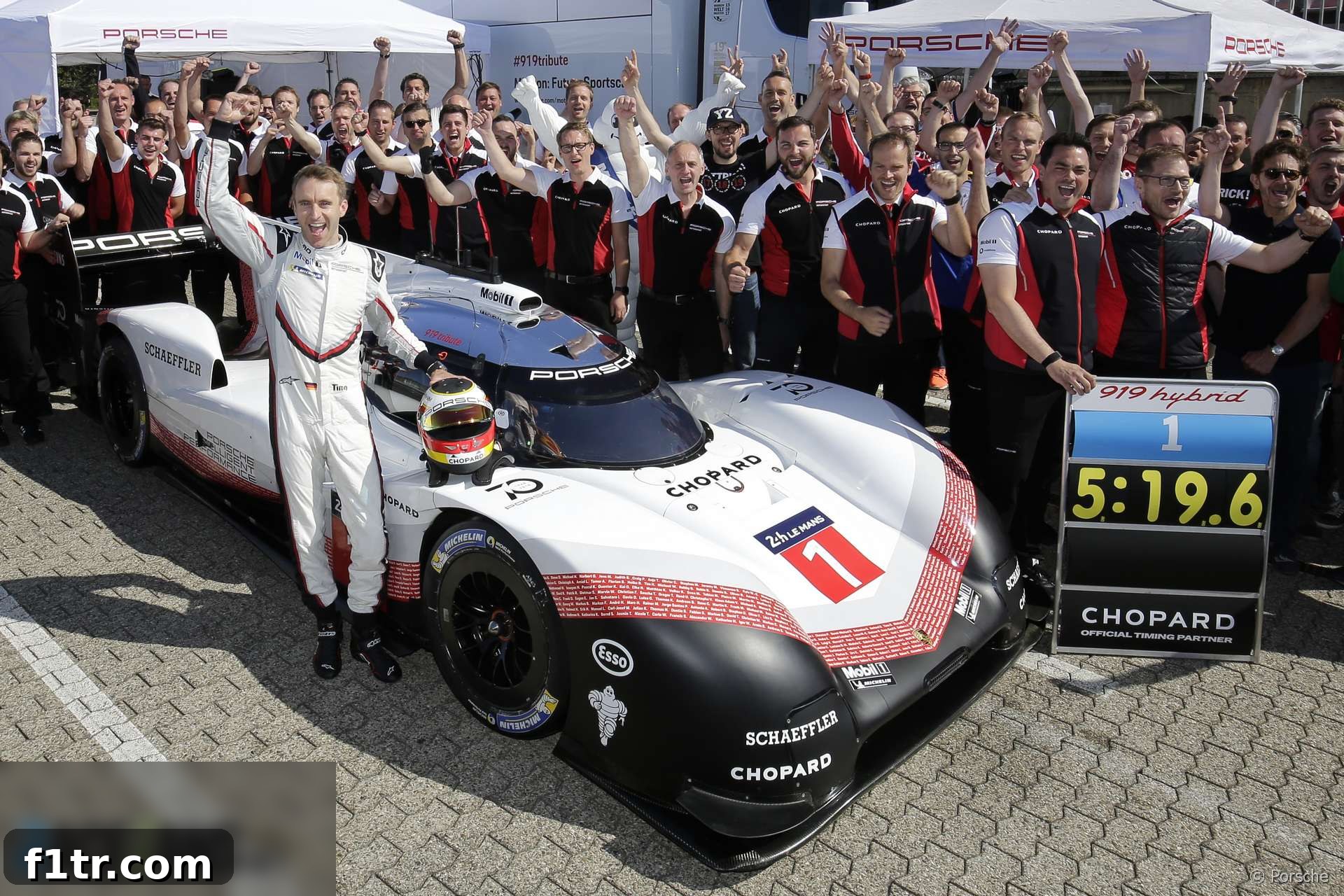
The legendary Nürburgring Nordschleife, often dubbed “The Green Hell,” bore witness to a historic moment when Porsche, utilizing a heavily modified development of its LMP1 919 Hybrid, obliterated the 35-year-old course record. This monumental achievement on Friday sent shockwaves through the motorsport world, reaffirming the unparalleled engineering prowess of the German manufacturer.
The record-breaking run was executed by the Porsche 919 Hybrid Evo, a car freed from the stringent regulations of the World Endurance Championship (WEC) LMP1 class. Without the constraints on fuel flow, aerodynamics, and weight, Porsche engineers unleashed the full potential of their innovative hybrid powertrain and advanced aerodynamic package. The result was a staggering lap time of 5 minutes, 19.546 seconds over the grueling 20.8-kilometer (12.9-mile) circuit. This incredible feat not only shattered the previous record of 6 minutes, 11.13 seconds – set by Stefan Bellof in a Porsche 956 in 1983 – but also established a new benchmark that many believed to be untouchable. The 919 Evo’s dominant performance underscored the extreme capabilities of purpose-built, unrestrained prototypes, showcasing what is possible when engineering boundaries are pushed to their absolute limit.
Following this unprecedented display, even Formula 1 champions Mercedes have publicly ruled out any attempt to challenge the time with their F1 machinery. This collective acknowledgment from the pinnacle of motorsport highlights the unique nature and sheer performance envelope of the 919 Hybrid Evo.
F1 Cars vs. The Nordschleife: An Unlikely Match
When questioned about whether Red Bull would attempt to challenge Porsche’s Nürburgring record with an F1 car, Christian Horner offered a pragmatic perspective. He promptly pointed out that the Porsche 919 Tribute, even in its non-WEC compliant form, has already demonstrated performance levels that exceed those of current F1 machinery in certain contexts.
“The problem is their LMP1 car broke the record in Spa which was beating a Formula 1 car time,” Horner explained in an exclusive interview with RaceFans. This prior achievement at Spa-Francorchamps, another high-speed, demanding circuit, serves as compelling evidence of the 919 Evo’s raw speed. “I’m not sure a Formula 1 car could actually do it [beat the Nürburgring record],” he concluded, casting doubt on the suitability of contemporary F1 cars for such a specialized record attempt.
The reasons behind Horner’s skepticism are multi-faceted. Modern Formula 1 cars are meticulously engineered for specific racing conditions: smooth, purpose-built Grand Prix circuits with predictable surfaces and ample run-off areas. Their aerodynamic packages generate immense downforce, but this is optimized for high-speed corners found on F1 tracks, not the diverse, undulating, and often bumpy terrain of the Nordschleife. The long, sweeping corners and lack of ultra-high-speed straights on the Nürburgring might not allow F1 cars to fully utilize their incredible top-end speed and aerodynamic efficiency in the same way. Furthermore, the extreme forces and vibrations encountered on the Nordschleife would put immense strain on F1 components, particularly the delicate suspensions and tires, which are designed for much shorter, more intense bursts of performance rather than a sustained, gruelling 20-kilometer sprint.
Safety is also a significant concern. The Nordschleife, with its close proximity to armco barriers, unforgiving gradients, and blind corners, presents a level of risk far beyond what F1 teams are typically willing to undertake for a record attempt outside of official competitive events. The financial and reputational risks associated with potentially damaging a multi-million-dollar F1 car or, worse, injuring a driver, outweigh the allure of a non-championship lap record.
Enter the Aston Martin Valkyrie AMR Pro: A Hypercar with F1 DNA
While an F1 car might not be the answer, Christian Horner sees immense potential in a different machine born from the very same engineering minds: the Aston Martin Valkyrie AMR Pro. “But I think that the Valkyrie, certainly the track version of the Valkyrie, could be a contender,” he stated with conviction.
The Aston Martin Valkyrie road car is a product of an extraordinary collaboration between British luxury sports car manufacturer Aston Martin and Red Bull Advanced Technologies, the engineering arm of the Red Bull Racing Formula 1 team. At its heart, the project bears the indelible mark of legendary F1 designer Adrian Newey, who conceptualized the car with an unwavering focus on aerodynamic efficiency and radical performance. The brief for creating the track-only version of the car, the Valkyrie AMR Pro, was even more ambitious: to rival the performance levels of top-tier LMP1 prototypes and even Formula One cars themselves.
The Valkyrie AMR Pro is not merely a stripped-down version of the road car; it is a beast unleashed. Divorced from road legality constraints, it features an even more aggressive aerodynamic package, significant weight reduction, and enhanced powertrain capabilities. Its design incorporates F1-derived principles, with ground effect aerodynamics, advanced cooling solutions, and a chassis built for extreme track demands. Every aspect of its construction is geared towards maximizing speed, grip, and downforce, mirroring the relentless pursuit of performance seen in Formula 1.
Under the bonnet, the Valkyrie AMR Pro is expected to house a naturally aspirated 6.5-litre V12 engine developed by Cosworth, generating an awe-inspiring 1,100 horsepower. This colossal power output is mated to an incredibly lightweight chassis, targeting a curb weight of approximately 1,000kg. The combination promises an insane power-to-weight ratio, exceeding that of many racing prototypes. Furthermore, the car is designed to produce a staggering amount of downforce, potentially matching its own weight, ensuring it remains glued to the track even at dizzying speeds through high-G corners. This level of engineering, combining raw power with sophisticated aerodynamics, is precisely what would be required to tackle the Nordschleife with the aim of setting a new benchmark.
The exclusivity of the Valkyrie AMR Pro is another testament to its extraordinary nature. All 25 examples planned for production have already been sold, highlighting the immense demand for such a high-performance, limited-edition vehicle. While the vision is clear, Horner cautions that the project is still in its developmental phases. “It’s a few years off because the car’s still on the drawing board,” he stated, indicating that considerable engineering work remains before the car can hit the track for such a demanding record attempt. However, his confidence remains unshaken: “but I’d be surprised if that car didn’t have the potential to do that.” This suggests that the internal targets for the Valkyrie AMR Pro are indeed set to rival, if not exceed, the Porsche’s breathtaking Nürburgring lap time of 5 minutes, 19.546 seconds.
The Future of Ultimate Automotive Performance
The pursuit of outright lap records on iconic circuits like the Nürburgring Nordschleife continues to captivate enthusiasts and push the boundaries of automotive engineering. Porsche’s achievement with the 919 Hybrid Evo established a new gold standard, demonstrating what an unrestricted, race-bred prototype can accomplish. While Formula 1 cars, with their highly specific design parameters and regulatory constraints, may not be the ideal tool for conquering the “Green Hell,” the emergence of hypercars like the Aston Martin Valkyrie AMR Pro offers a tantalizing prospect.
These ultra-exclusive, track-focused machines, born from collaborations between cutting-edge racing technology and luxury automotive manufacturing, represent a new frontier in performance. They leverage the knowledge and expertise gained from top-tier motorsport, free from the stringent rules that govern F1 or LMP1 racing, to create vehicles of unparalleled speed and dynamic capability. Christian Horner’s vision for the Valkyrie AMR Pro is a testament to this trend, suggesting that the quest for ultimate lap times may increasingly shift from regulated racing categories to these bespoke, engineering-intensive hypercars.
The potential Nürburgring Nordschleife record attempt by the Aston Martin Valkyrie AMR Pro, whenever it materializes, will not just be a battle against the clock; it will be a spectacle of engineering prowess, a demonstration of what is possible when the very best minds in motorsport and automotive design unite to create a machine without compromise. The “Green Hell” awaits its next challenger, and with the Valkyrie AMR Pro, the automotive world holds its breath for another chapter in the storied history of lap records.
2018 F1 season
- F1 feared “death knell” for Drive to Survive after Ferrari and Mercedes snub
- McLaren staff told us we were “totally crazy” to take Honda engines in 2018 – Tost
- ‘It doesn’t matter if we start last’: How Red Bull’s junior team aided Honda’s leap forward
- Honda’s jet division helped F1 engineers solve power unit problem
- McLaren Racing losses rise after Honda split
Browse all 2018 F1 season articles