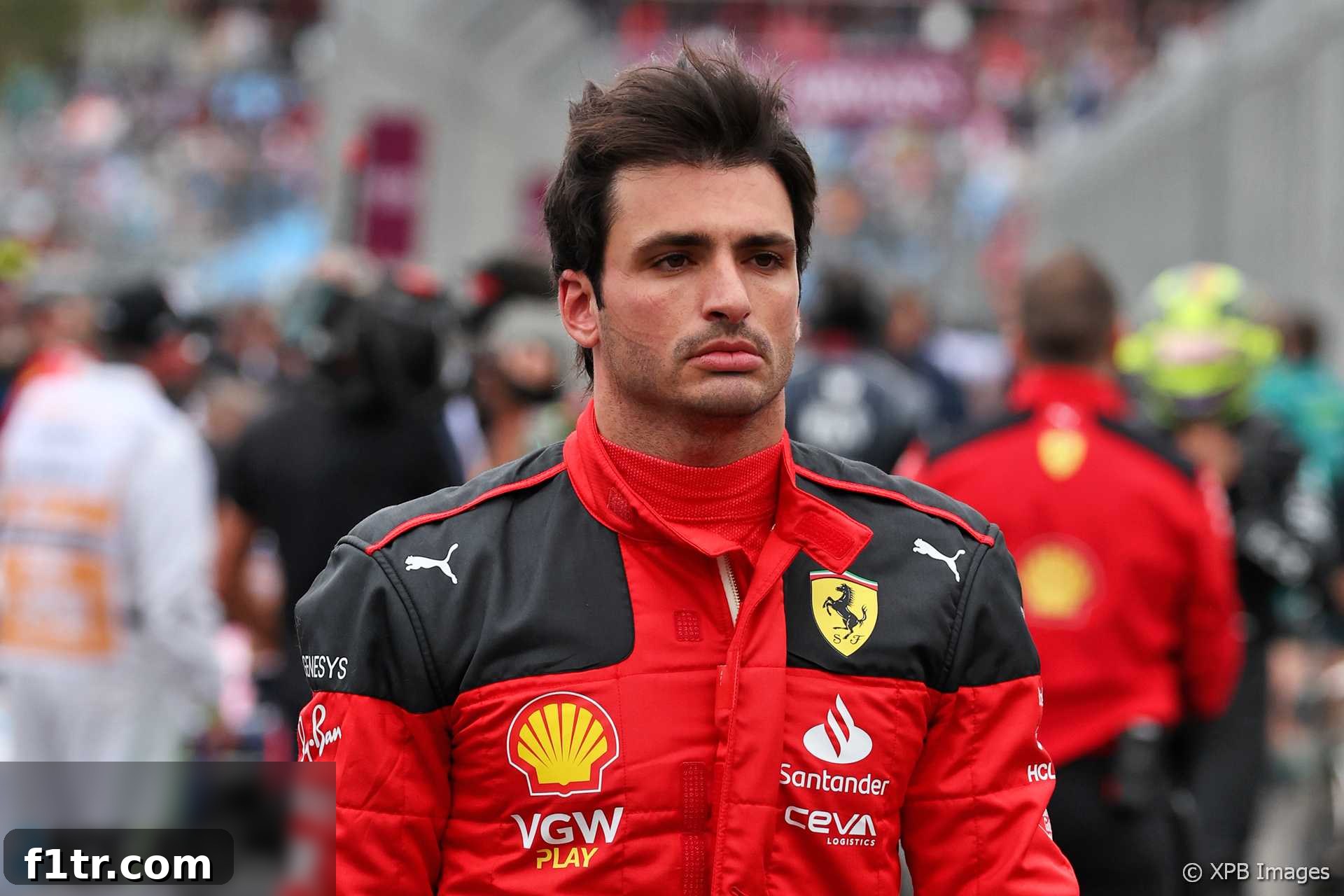
Ferrari’s Bold Move: FIA to Review Carlos Sainz Australian GP Penalty After Appeal
The Federation Internationale de l’Automobile (FIA) has officially confirmed that it will convene a crucial virtual hearing to address Scuderia Ferrari’s formal petition. This petition requests a comprehensive review of the controversial penalty handed to Carlos Sainz Jnr following his performance at the Australian Grand Prix. The highly anticipated hearing is scheduled for Tuesday, April 18th, marking a significant step in Ferrari’s bid to overturn a decision that cost their driver valuable championship points.
Carlos Sainz’s Australian Grand Prix ended in considerable frustration after he was demoted from a strong fourth-place finish to a lowly 12th in the final classification. This dramatic shift came as a direct result of a post-race time penalty, imposed by the race stewards. The sanction was issued after Sainz was deemed responsible for causing a collision with Aston Martin’s seasoned campaigner, Fernando Alonso, during a frantic restart towards the end of the race.
The Heart of the Controversy: The Australian Grand Prix Incident
The 2023 Australian Grand Prix was arguably one of the most chaotic races of the season, characterized by multiple red flag stoppages and thrilling restarts. It was during the penultimate restart, following a Safety Car period, that the incident involving Sainz and Alonso unfolded. With the field tightly packed and drivers pushing for every possible advantage, Sainz made contact with Alonso’s AMR23. While Alonso briefly went off track, he managed to recover and continue, but the stewards were quick to note the incident.
Following a review, the stewards concluded that Sainz was predominantly to blame for the collision, citing Article 33.4 of the Sporting Regulations which states that “a driver must not intentionally hinder another driver.” Although the contact was not severe enough to cause significant damage or retirement for Alonso, the stewards issued a five-second time penalty. This particular penalty, while often seen as one of the more lenient sanctions, had a disproportionately severe impact due to the unique circumstances of the race’s conclusion. The Australian Grand Prix finished under Safety Car conditions after another series of crashes, meaning the field was effectively neutralized. This allowed drivers behind Sainz to maintain a tight gap, enabling them to benefit directly from his penalty by moving up the classification without needing to overtake him on track. Consequently, Sainz plummeted out of the points-paying positions, a bitter pill for both the driver and his team.
Outcry and Disagreement: “The Most Unfair Penalty”
The stewards’ decision ignited an immediate firestorm of criticism. Carlos Sainz, visibly emotional and distraught after the race, powerfully articulated his dismay, stating it was “the most unfair penalty I’ve seen in my life.” His strong reaction underscored the depth of his conviction that the ruling was unjust. In a rare display of solidarity from a competitor, Fernando Alonso, the driver involved in the incident, echoed Sainz’s sentiments, expressing his belief that the penalty was “too harsh.”
This unusual agreement between the two drivers involved further amplified the debate surrounding the consistency and fairness of Formula 1 stewarding. Many within the paddock and the wider F1 community questioned the severity of the penalty given the context of a chaotic race restart and the amplified effect of a Safety Car finish. The feeling was that while Sainz might have been partially at fault, the outcome — dropping him from fourth to twelfth — was an overly punitive consequence for the nature of the infringement. This particular penalty became a focal point for long-standing discussions about how racing incidents are judged and whether driver intent or outcome should weigh more heavily in the stewards’ considerations.
Ferrari’s Strategy: Petitioning Under Article 14 of the International Sporting Code
Ferrari’s formal appeal strategy hinges on Article 14 of the FIA International Sporting Code. This critical article provides the framework under which a team can request a review of a stewards’ decision. However, the bar for such a review is deliberately set high: Ferrari must demonstrate the existence of “a significant and relevant new element” that was not available to the stewards at the time they made their original decision. This stipulation is crucial; it prevents teams from simply re-arguing their case based on existing evidence or expressing disagreement with the initial judgment.
What constitutes a “significant and relevant new element”? This could encompass a variety of previously unexamined evidence. Examples might include fresh telemetry data offering a more granular understanding of driver inputs, previously unseen onboard camera footage from another car that provides a new perspective, audio recordings, or even expert testimony that sheds new light on the dynamics of the collision or the prevailing track conditions. Ferrari’s task in the upcoming hearing is to convince the FIA that whatever new material they possess genuinely fits this description and has the potential to alter the interpretation of the incident fundamentally. If they fail to meet this stringent standard, the review process will not proceed to a re-evaluation of the penalty’s merits.
The Virtual Hearing: Process and Participants
The virtual hearing, scheduled for 8 am CET on April 18th, will be a pivotal preliminary step. During this session, representatives from Scuderia Ferrari will present their case, specifically focusing on the “new element” they believe warrants a reconsideration of Sainz’s penalty. They will need to meticulously outline why this new evidence is both substantial enough to potentially change the outcome and directly relevant to the specific incident and the stewards’ original ruling.
This initial hearing is not about re-judging the incident itself; rather, it’s about determining if the procedural requirements for a review have been met. The panel, likely comprising a different group of stewards or FIA officials than those who made the original decision, will meticulously assess Ferrari’s submission. They will evaluate whether the newly presented information truly qualifies as a “significant and relevant new element” under Article 14. Should Ferrari successfully cross this initial hurdle, a full review of the penalty, taking into account all available evidence, including the new elements, would then be scheduled.
The Stakes are High: Potential Outcomes and Their Implications
The outcome of this hearing carries profound implications for Carlos Sainz, Scuderia Ferrari, and the broader narrative of F1 stewarding consistency.
Scenario 1: Review Denied
If Ferrari is unsuccessful in demonstrating a “significant and relevant new element” to the FIA, Sainz’s penalty will stand. This outcome would mean that his 12th place finish in the Australian Grand Prix, and the consequent loss of crucial championship points, will remain definitive. For Ferrari, this would represent the end of their appeal process, cementing a frustrating setback in their Constructors’ Championship campaign. It would also underscore the difficulty of overturning stewards’ decisions under the FIA’s stringent review procedures.
Scenario 2: Review Granted
Conversely, if Ferrari successfully convinces the FIA panel that they possess a “significant and relevant new element,” the process will advance to a full review of the original penalty. This subsequent phase would involve a comprehensive re-examination of the incident, with all previous evidence considered alongside the newly presented information. Should the stewards, upon this full review, conclude that the initial penalty was unwarranted or excessively harsh given the complete picture, they could potentially overturn or modify the sanction. This would result in the reinstatement of Sainz’s points from the Australian Grand Prix, offering a vital boost to his individual championship standings and providing a much-needed morale and points injection for Ferrari in the Constructors’ Championship battle. A successful appeal would also send a powerful message about the robustness of the appeal process and could influence future stewarding decisions.
Ferrari’s Specific Grievances: A Question of Due Process
A significant part of Ferrari’s argument, as openly voiced by Team Principal Frederic Vasseur and Carlos Sainz, revolves around the procedural aspects of the original penalty. Both individuals expressed strong dissatisfaction, claiming that the team was not given an adequate opportunity to discuss the incident with the stewards before the penalty was officially issued. This alleged lack of consultation stands in stark contrast to how other incidents during the same Grand Prix were handled, notably those involving the Alpine drivers, who were reportedly allowed to present their perspective to the stewards before a final ruling was made.
This claim of being denied a fair hearing forms a crucial pillar of Ferrari’s appeal. If they can convincingly demonstrate that standard protocols for driver consultation were not followed in Sainz’s case, it could be interpreted as a procedural flaw or, indeed, a “new element” related to due process. The right for a driver or team to be heard before a penalty is applied is a fundamental principle in sports justice. Should Ferrari successfully highlight this perceived inequity, it could significantly bolster their argument for a full review of the penalty’s merits.
The Broader Landscape of F1 Stewarding: A Quest for Consistency
The controversy surrounding Carlos Sainz’s penalty is not an isolated incident; rather, it is part of a larger, ongoing dialogue within Formula 1 concerning the consistency and perceived fairness of stewarding decisions. Teams, drivers, and fans frequently voice concerns over what they consider to be inconsistent application of rules, particularly regarding on-track racing incidents. Stewards face an incredibly challenging task: they must make swift, high-stakes judgments in dynamic racing environments, often with limited immediate information, and apply a complex rulebook to ensure fair competition.
The Australian Grand Prix, with its multiple safety car periods and dramatic restarts, served as a microcosm of these challenges. The varying outcomes for different collisions throughout the race – some penalized, others not – intensified the feeling of inconsistency. Ferrari’s appeal, therefore, transcends mere points; it also represents a broader pursuit of greater clarity, transparency, and predictability in how racing incidents are judged. This sentiment is widely shared across the paddock, with many stakeholders advocating for a more streamlined and consistently applied stewarding framework.
Impact on the 2023 F1 Season and Beyond
For Ferrari, every single point is invaluable in the fiercely competitive 2023 Formula 1 Constructors’ Championship. The potential loss of 12 points from Sainz’s fourth-place finish in Australia could have a tangible impact on their season-long battle against strong rivals. For Sainz personally, reinstating these points would significantly boost his individual standing in the Drivers’ Championship, potentially moving him up several crucial places. Beyond the tangible points, a successful appeal would provide a significant psychological lift to the entire team, reinforcing their belief in the fairness of the sport and their tenacious spirit in fighting for every possible advantage.
Irrespective of the final decision, the outcome of this hearing is destined to remain a key talking point in the upcoming weeks and potentially months. It vividly highlights the immense stakes in Formula 1, where every decision, every penalty, and every championship point has the power to shift momentum and redefine the trajectory of a season. The world of Formula 1 awaits with keen interest to see if Ferrari’s bold appeal will lead to a historic reversal of fortunes.
Related F1 Season Articles
- FIA president cleared of alleged interference in two 2023 races
- First week viewing figures for new Drive to Survive season fall again
- Max who? Drive to Survive season six prefers its favourite faces
- RaceFans’ complete 2023 season review
- The F1 drivers who pulled off the 10 biggest charges through the field in 2023
Browse all 2023 F1 season articles