F1 Drivers Demand End to On-Track Recovery in Wet Conditions After Suzuka Scare: A Call for Uncompromising Safety
The harrowing scenes at the Japanese Grand Prix, where a recovery vehicle was deployed on track in heavily wet conditions, have reignited a passionate and urgent debate within Formula 1. The incident, which saw a tractor-crane on the circuit during a Safety Car period with severely limited visibility, prompted widespread condemnation from drivers, teams, and fans alike. At the forefront of this safety plea is Alfa Romeo driver Zhou Guanyu, who unequivocally states that Formula 1 must cease the practice of deploying recovery vehicles on track in such dangerous circumstances, even under Safety Car conditions. His stance, echoed by many of his peers, underscores a critical imperative: prioritizing driver safety above all else, especially when the memory of past tragedies still casts a long shadow over the sport.
The Suzuka Incident: A Dangerous Precedent Revisited
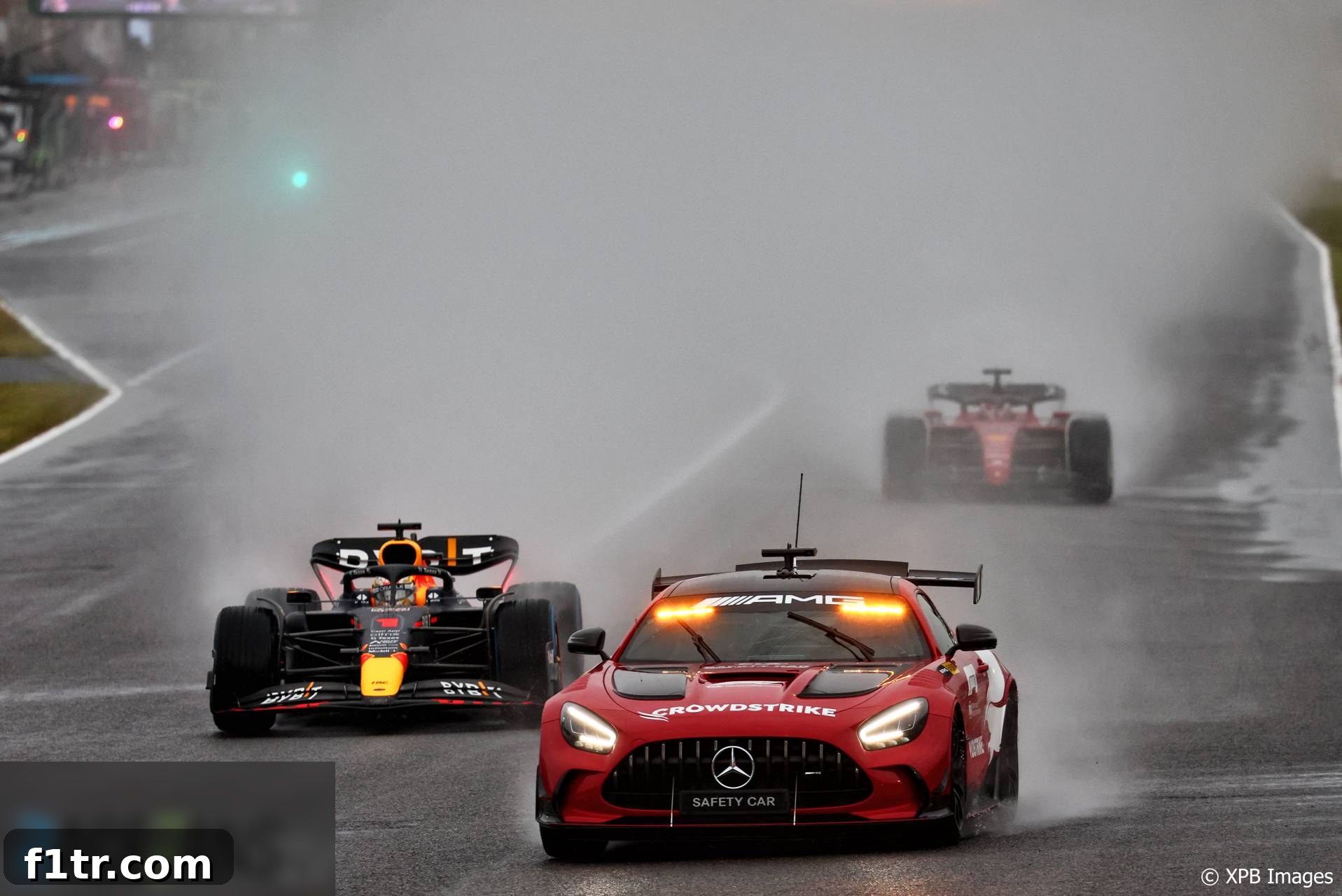
The opening lap of the 2022 Japanese Grand Prix quickly descended into chaos as torrential rain battered the iconic Suzuka International Racing Course. Visibility plummeted to near-zero, creating an incredibly treacherous environment for the world’s fastest racing machines. Carlos Sainz Jnr, driving for Ferrari, became an early casualty, aquaplaning off the track at Turn 12 and colliding with the barriers. While such incidents are unfortunately common in extreme wet races, what followed sent a chilling wave of alarm through the paddock: the deployment of a recovery vehicle, a large crane, onto the active circuit during a Safety Car period. This decision, made despite the atrocious conditions and the continued presence of F1 cars on track, drew immediate and fierce criticism.
The gravity of the situation was brought home most starkly by Pierre Gasly. Having pitted for repairs and then attempting to catch the Safety Car queue, the AlphaTauri driver encountered the stationary crane on the outside of the track at high speed, completely unsighted until the very last moment. His furious reaction, captured vividly over team radio, encapsulated the terror felt by many. “What is this tractor on track?” he exclaimed, the horror in his voice palpable as he recounted passing the vehicle at approximately 200 km/h. The lack of prior warning for drivers regarding the crane’s presence intensified the outrage, highlighting a severe breakdown in communication and safety protocols.
Team principals quickly joined the chorus of concern. Red Bull Racing’s Christian Horner called for an immediate and thorough investigation, emphasizing the unacceptable nature of the risk. McLaren team principal Andreas Seidl was equally emphatic, stating unequivocally that “something like this simply must not happen.” The consensus was clear: the incident at Suzuka represented a monumental failure in judgment that put drivers’ lives at unnecessary and unacceptable risk.
Jules Bianchi: A Haunting Reminder
For many within Formula 1, the sight of a recovery vehicle on track at Suzuka in wet conditions invoked grim and immediate parallels to the most tragic accident in recent F1 history. In 2014, at this very circuit, under similar torrential rain, Marussia driver Jules Bianchi suffered catastrophic head injuries after his car aquaplaned off track and struck a recovery crane that was attending to Adrian Sutil’s crashed Sauber. Bianchi succumbed to his injuries nine months later, leaving an indelible mark on the sport. His death prompted a series of significant safety overhauls, including the introduction of the Virtual Safety Car (VSC) and stricter protocols regarding track-side recovery operations. The very idea that such a scenario could be repeated, almost eight years to the day, at the same venue, was unfathomable and deeply disturbing.
The memory of Bianchi’s accident is not just a historical footnote; it is a permanent scar on the psyche of the F1 community, particularly for the drivers who race every weekend. For them, the 2014 tragedy serves as a constant, stark reminder of the ultimate price that can be paid when safety is compromised. Therefore, the reappearance of a crane in precarious conditions was not merely a procedural error; it was perceived as a profound disrespect to Bianchi’s legacy and a glaring disregard for the lessons so painfully learned.
Drivers Speak Out: A United Call for Change
Ahead of the United States Grand Prix, the collective voice of the drivers became a powerful instrument for change. Zhou Guanyu, whose observations were central to the discussion, articulated the drivers’ shared perspective with clarity and conviction. He highlighted the unique position of Formula 1 drivers: “Every driver has an important voice in the sport. There’s only 20 of us – it’s not like the NBA where you have 1,000 players. So the FIA and Formula 1 are really taking [notice of] what we say.” This sense of collective responsibility and influence underscored the weight of their concerns.
Zhou elaborated on the extreme conditions encountered at Suzuka: “For us the visibility was so low, it was like the lowest ever driving a racing car.” He recounted his own alarming experience: “Even when the vehicle was out, when I passed it through the Safety Car scenario, I didn’t see it until I was like two metres away. So for us it’s pretty dangerous. I was happy that no one crashed into Sainz when he was stopped in the aquaplaning area.” This firsthand account from a driver on track serves as a stark warning about the inherent dangers of limited perception in such conditions.
The Alfa Romeo driver went further, asserting a fundamental principle: “In general it’s never safe to have this tractor vehicle on track even while we are under Safety Car.” He stressed the unpredictable nature of F1 cars in heavy rain: “Obviously especially in the wet conditions, you can never judge if you get aquaplaning with our car, it’s so sensitive.” He also pointed out the specific challenges of tracks like Japan with its high-speed corners: “Especially with the water, everything can be happening, especially tracks like Japan, there’s a lot of corners where you are almost flat [out] but then with steering lock which creates an unbalanced car.” His ultimate conclusion was unambiguous: “So in general we don’t want to see any vehicle out there. Especially if the race was anyway going [to a] red flag it’s better to wait.”
Sergio Perez and Lando Norris were among the other prominent voices to speak out over the handling of the situation at Suzuka, reinforcing the widespread concern. Ferrari’s Charles Leclerc echoed Zhou’s sentiments, emphasizing the clear message delivered to the governing body. “I think we all made that point clear with the FIA, we don’t want to see that,” Leclerc stated. He explicitly referenced the past tragedy: “In 2014, we’ve obviously lost Jules for a similar crash and we’ve been very clear with the FIA that we don’t want that and I think they understood.” The unanimity among the drivers leaves no room for ambiguity: the protocol for on-track recovery in extreme wet conditions must be fundamentally revised.
The FIA’s Mandate: Investigating and Implementing Change
In the wake of the uproar, the Fédération Internationale de l’Automobile (FIA), Formula 1’s governing body, swiftly launched an investigation into the incident. The focus of this inquiry is on “procedural issues,” which are expected to cover the decision-making process for deploying recovery vehicles, communication protocols with teams and drivers, and the assessment of track conditions. The FIA has committed to making its findings public in the coming days, a crucial step towards transparency and accountability. Drivers, including Leclerc, expressed confidence that the FIA had grasped the gravity of their concerns, indicating a willingness within the governing body to address the issues comprehensively.
The outcome of this investigation is paramount. It is not enough for the FIA merely to acknowledge the problem; concrete policy changes must be implemented to prevent any recurrence. This could involve stricter guidelines for red-flagging races immediately when recovery is needed in severe weather, or the development of advanced warning systems that integrate real-time track condition data with precise vehicle location. The pressure is immense to ensure that the hard-learned lessons from the past are not forgotten and that the sport continues to evolve its safety standards proactively rather than reactively.
Ensuring Future Safety: A Continuous Evolution
Formula 1 has a long and often tragic history, but it is also a sport that has made monumental strides in safety over the decades. From the introduction of mandatory head and neck support (HANS) devices to the robust halo cockpit protection system, every significant accident has led to a re-evaluation and improvement of safety standards. The Suzuka incident of 2022 serves as a stark reminder that this evolution must be continuous and vigilant. While technology plays a crucial role, human decision-making, especially in high-pressure, rapidly changing weather conditions, remains a critical factor.
The balance between putting on a spectacle and ensuring the absolute safety of its participants is a delicate one. However, when it comes to the basic premise of clearing a track, especially in conditions that severely impede visibility, the safety of human lives must always take precedence. The drivers’ collective stand sends a powerful message that they will not tolerate unnecessary risks, particularly those that echo past tragedies. This incident is not just about a single crane deployment; it’s about reinforcing the culture of uncompromising safety that F1 has painstakingly built.
Conclusion
The uproar following the deployment of a recovery vehicle at the 2022 Japanese Grand Prix, eloquently articulated by drivers like Zhou Guanyu and Charles Leclerc, marks a pivotal moment for Formula 1 safety. The vivid and painful memory of Jules Bianchi’s fatal accident in 2014, under eerily similar circumstances at the same circuit, adds an undeniable weight to the current concerns. Drivers are united in their demand: no recovery vehicles on track in wet conditions, even during Safety Car periods, when visibility is compromised. The FIA’s ongoing investigation into these ‘procedural issues’ must culminate in definitive and stringent policy changes. Formula 1’s commitment to safety has always been its guiding principle, and this latest incident serves as a crucial reminder that vigilance and a proactive approach are essential to ensure that such dangerous scenarios are consigned to the history books, never to be repeated.
2022 United States Grand Prix
- Steiner annoyed by lack of apology from race director over COTA protest error
- How many victory chances did Hamilton have in his first winless F1 season?
- Income from new title sponsor will bring Haas up to cost cap level – Steiner
- Mexico’s first home win or Verstappen’s record 14th? Six Mexican GP talking points
- Mercedes doubt tyre strategy cost Hamilton chance to beat Verstappen to win
Browse all 2022 United States Grand Prix articles