The exhilarating world of Formula 1 is a relentless arena of innovation, where teams constantly push the boundaries of engineering to gain even the slightest edge. As the sport arrived at the vibrant Miami International Autodrome for the 2023 Grand Prix, half of the ten competing teams unveiled a suite of critical upgrades designed to enhance the performance of their cutting-edge machinery. These mid-season enhancements highlight the fiercely competitive nature of F1, where stagnation is not an option and continuous development is key to success on the global stage. From subtle aerodynamic tweaks to significant structural overhauls, each modification represents countless hours of research, design, and simulation, all aimed at shaving fractions of a second off lap times.
The Miami Grand Prix, with its unique blend of long straights, tight low-speed corners, and challenging medium-speed sections, presents a distinct set of demands on car setup and performance. Furthermore, the Floridian heat and humidity often make cooling a paramount concern, adding another layer of complexity for engineers. Teams bringing upgrades to this particular circuit are not only looking for overall performance gains but also aiming to optimize their cars specifically for the unique characteristics of the Miami track, hoping to unlock crucial competitive advantages against their rivals.
Advert | Become a Supporter & go ad-free
Ferrari Leads the Charge with Significant Floor Update
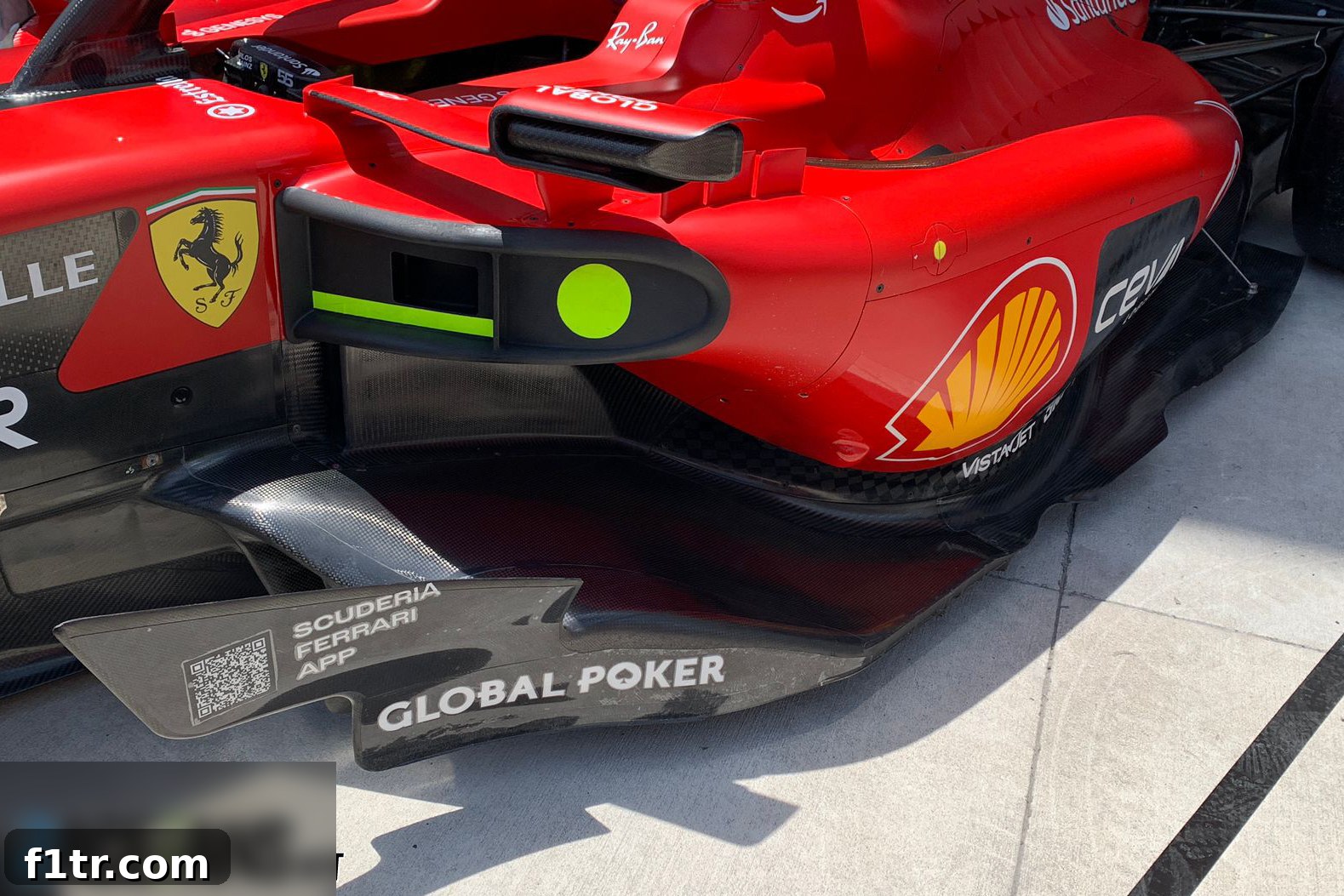
Among the front-runners, Ferrari made headlines by introducing a substantial upgrade package, centered around a redesigned floor for their SF-23 challenger. The Italian Scuderia described this as a key part of their “standard development cycle,” signaling their ongoing commitment to extracting maximum potential from their car throughout the season. The floor, often considered the most crucial aerodynamic component in modern ground-effect Formula 1 cars, plays a pivotal role in generating downforce. Even minor alterations can have profound effects on a car’s overall performance, stability, and efficiency.
Ferrari’s technical documentation submitted to the FIA detailed that “particular attention has been put on losses-reduction in all the updated areas,” with the explicit goal to “improve the overall aerodynamic performance and car efficiency.” In Formula 1 aerodynamics, ‘losses’ refer to any undesirable turbulence or energy dissipation in the airflow, which reduces the car’s ability to generate optimal downforce and minimize drag. By minimizing these losses, Ferrari aims to create a cleaner, more efficient aerodynamic package, which should translate into better cornering speeds and improved straight-line performance on the challenging Miami circuit. This continuous refinement is vital for Ferrari as they battle for supremacy at the top of the constructors’ standings.
Aston Martin Prioritizes Cooling, While AlphaTauri Focuses on Balance
Another team making strategic changes was Aston Martin, who brought an extra cooling option for their AMR23. The decision underscores the harsh environmental conditions often encountered at the Miami International Autodrome. Last year’s race was notably one of the hottest of the season, with ambient temperatures soaring to 30 degrees Celsius. Such extreme heat can severely impact engine reliability, power output, and even driver comfort and performance. By offering an additional cooling option, Aston Martin aims to ensure their power unit and other critical components operate within optimal temperature ranges, allowing the car to maintain peak performance throughout the demanding race distance, regardless of the conditions. This adaptability is key for a team looking to consistently challenge at the sharp end of the grid.
AlphaTauri, a team that had been diligently working to enhance its car’s low-speed balance, introduced a pair of revisions to its AT04. The first was a new front wing, a crucial component that dictates how airflow is managed over the entire car, especially influencing the performance of the all-important floor. A well-designed front wing can optimize the airflow to the underbody, thereby maximizing the ground effect and the downforce generated by the floor. Their second update involved a new winglet integrated into the rearview mirrors, meticulously designed to refine the airflow around these seemingly small but aerodynamically significant elements. Even minor disruptions caused by mirrors can create turbulence, negatively impacting the efficiency of other aerodynamic surfaces further downstream. By optimizing airflow around the mirrors, AlphaTauri seeks to ensure a cleaner, more stable flow field across the car, contributing to improved overall aerodynamic efficiency and stability, particularly in slower corners where balance is critical.
Haas and Alfa Romeo Seek Aerodynamic Gains and Setup Flexibility
Haas, leveraging its close technical partnership with Ferrari, also arrived in Miami with a new floor design for its VF-23. Like Ferrari’s update, Haas’s new floor is strategically intended to improve the car’s overall aerodynamic efficiency. For a team like Haas, operating with a smaller budget compared to the sport’s giants, every aerodynamic gain is immensely valuable. Enhancing the floor’s efficiency can unlock significant performance across various speed ranges, making the car more competitive in both high-speed sections and tighter turns. This continuous development effort is crucial for Haas to climb up the constructors’ standings and consistently challenge for points.
Alfa Romeo, meanwhile, adopted a different approach. They brought a previously-used beam wing, but with the intention of deploying it in a novel configuration for the Miami Grand Prix. The beam wing is a small, often overlooked, aerodynamic element located at the very rear of the car, underneath the main rear wing. It contributes to downforce generation and influences the airflow around the diffuser. By offering a different configuration option, Alfa Romeo gains greater flexibility in managing the drag-downforce trade-off, allowing them to fine-tune the car’s setup to better suit Miami’s unique track layout. This adaptability is vital for extracting optimal performance from the car across a circuit that demands both high straight-line speed and strong cornering grip.
Advert | Become a RaceFans supporter andgo ad-free
The Contrast: Teams Without Updates
While five teams introduced updates, several prominent competitors, including Red Bull, Mercedes, Alpine, McLaren, and Williams, did not declare any specific upgrades for the Miami weekend. In Red Bull’s case, their dominant performance in the early part of the season likely means they have less immediate pressure to introduce major updates, opting instead to optimize their already superior package or save major developments for later in the year. For other teams, the absence of upgrades could stem from various factors, including development timelines, budget constraints under the cost cap, or a strategic decision to focus on different races for their next wave of improvements.
The situation for Williams, currently last in the points standings, is particularly stark. The fact that the three teams directly ahead of them in the championship have all brought updates this weekend highlights the immense challenge they face in climbing up the competitive ladder. For teams at the back, a lack of regular updates can quickly lead to falling further behind, emphasizing the critical importance of a robust and continuous development program in modern Formula 1.
2023 Miami Grand Prix F1 Teams’ Updates: A Technical Deep Dive
The meticulous world of Formula 1 engineering demands precision and clear communication of changes. Here’s a detailed breakdown of the updates, drawing from the technical documentation provided by the teams to the FIA:
Ferrari
Floor Body
- Reason for change: Performance – flow conditioning
- Difference: “Updated front/mid floor and diffuser geometries”
- Description: “This new floor component is part of the standard development cycle. Particular attention has been put on losses reduction in all the updated areas, with the aim to improve the overall aerodynamic performance and car efficiency.”
Elaboration: Ferrari’s floor update goes beyond a simple change, involving revised geometries across the front, middle, and diffuser sections. The floor is the primary generator of downforce in current F1 regulations, utilizing ground effect. By “flow conditioning,” Ferrari aims to meticulously control the airflow underneath the car, ensuring it generates maximum suction and minimizes turbulence. Reducing losses in these critical areas directly translates to higher effective downforce and reduced aerodynamic drag, making the car faster through corners and more efficient on straights. This continuous refinement is essential for Ferrari to close the gap to their rivals and maintain their challenge for race victories.
Alfa Romeo
Beam Wing
- Reason for change: Circuit specific – drag range
- Difference: “Added option to run the beam wing without the flap.”
- Description: “This is an additional configuration of previously utilised parts; we have added this possible combination to give us an additional aerodynamic solution to respond to the characteristics of the Miami track.”
Elaboration: Alfa Romeo’s beam wing update provides crucial setup flexibility. The beam wing, located beneath the main rear wing, significantly influences the car’s overall downforce and drag levels. By introducing the option to run the beam wing without its flap, Alfa Romeo can fine-tune the car’s aerodynamic balance more precisely. This is particularly valuable for a circuit like Miami, which features a demanding mix of long, high-speed straights where drag reduction is paramount, and technical, medium-to-low-speed corners where maximum downforce is needed. This configurable element allows the team to optimize for specific track characteristics, potentially finding a sweet spot between outright speed and cornering grip that was previously unavailable.
Aston Martin
Cooling Louvres
- Reason for change: Circuit specific – cooling range
- Difference: “A new bodywork panel is available for R05 with an additional area of cooling exits in the side of the bodywork. Use will be dependent on the conditions.”
- Description: “The additional exit area allows more cooling flow to exit from the underbody cavity hence increasing cooling capacity allowing operating targets to be met in hotter conditions.”
Elaboration: Aston Martin’s new cooling louvres are a direct response to the anticipated high temperatures at the Miami Grand Prix. The additional exit area in the side bodywork allows a greater volume of hot air to escape from the car’s underbody cavity, significantly enhancing its cooling capacity. In Formula 1, effective cooling is vital for maintaining engine performance, preventing overheating of vital components, and ensuring driver comfort. By increasing the car’s ability to shed heat, Aston Martin can ensure their power unit operates at optimal temperatures throughout the race, preventing performance degradation and ensuring reliability, particularly if the Miami heat is as intense as predicted. This update demonstrates a pragmatic and circuit-specific engineering approach.
Advert | Become a RaceFans supporter andgo ad-free
Haas
Floor Body
- Reason for change: Performance – local load
- Difference: “Geometry of the surface that control the expansion of the floor has been modified.”
- Description: “With a better control of the pressure distribution and the management of the lateral flow, we have obtained improvement of the car aerodynamic efficiency at low, medium and high speed.”
Elaboration: Haas’s floor body update focuses on refining the geometries that control the expansion of the floor. This aspect is crucial for managing the intricate airflow underneath the car, which in turn dictates pressure distribution. By gaining better control over this pressure distribution and the lateral flow (airflow along the sides of the floor), Haas aims to optimize the ground effect generated by the floor. The benefit is a quantifiable improvement in aerodynamic efficiency across all speed ranges – low, medium, and high. This means the car should generate more effective downforce with less drag, leading to better grip in corners and higher straight-line speeds. For a team like Haas, such fundamental improvements are key to consistent performance gains.
AlphaTauri
Front Wing
- Reason for change: Performance – local load
- Difference: “Compared to launch, the outboard end of the front wing is modified to raise the tip elements and add small winglets to the inboard side of the endplate close to its trailing edge.”
- Description: “These modifications reduce the tip losses generated by the assembly that pass inboard of the front tyre. This increases the energy in the flow field downstream and allows the floor in particular to generate more load.”
Elaboration: AlphaTauri’s front wing modifications are a sophisticated exercise in managing intricate airflow dynamics. By raising the tip elements and adding small winglets to the inboard side of the endplate, the team aims to reduce “tip losses.” Tip losses occur when high-pressure air on the upper surface of a wing spills over to the lower-pressure underside at the wing tip, creating vortices and reducing efficiency. By mitigating these losses, AlphaTauri can preserve more energy in the airflow immediately downstream of the front wing. This ‘higher energy flow’ is then directed towards the car’s floor, allowing it to generate more downforce. Essentially, a cleaner and more energetic airflow from the front wing significantly enhances the efficiency and load-generating capability of the floor, which is the cornerstone of modern F1 aerodynamics.
Sidepod Inlet / Mirror Assembly
- Reason for change: Performance – local load
- Difference: “Relative to the launch mirror assembly that only has an aerofoil section above the mirror body, this update adds an aerofoil section below the mirror body as well. An extra winglet has also been added to the outboard mirror stay where it meets the sidepod upper surface.”
- Description: “The addition of the wing element below the mirror body reduces the size of the wake generated by the mirror glass by generating local up-wash behind it. The reduction in wake losses allows the rear of the car to receive higher energy flow, improving downforce generation as a result. The extra winglet provides some additional outwash to help keep front wheel wake losses further away from the bodywork.”
Elaboration: The AlphaTauri update to the sidepod inlet and mirror assembly showcases the minute details F1 engineers scrutinize. The new aerofoil section below the mirror body, coupled with an additional winglet, serves multiple critical functions. Mirrors, despite their small size, create turbulent “wake” behind them, which disrupts the smooth airflow crucial for downforce generation further back on the car. By introducing an aerofoil section, the team aims to generate “up-wash,” effectively cleaning up the airflow and reducing the size and impact of this wake. This ensures that the rear of the car receives a higher energy, less turbulent flow, thereby improving the efficiency of the rear wing and diffuser in generating downforce. Furthermore, the extra winglet on the mirror stay aims to create “outwash,” pushing the disruptive turbulent wake from the front wheels further away from the sidepod bodywork. This prevents the turbulent air from interfering with the sidepod’s aerodynamic performance, ultimately leading to a more stable and higher-performing aerodynamic platform for the entire car.
Advert | Become a RaceFans supporter andgo ad-free
The Relentless Pursuit of Performance
The 2023 Miami Grand Prix served as another powerful reminder of Formula 1’s relentless development cycle. Each update, no matter how small, represents an enormous investment of intellectual and financial capital, all directed towards the singular goal of competitive advantage. The engineering explanations provided by the teams underscore the incredibly complex and interconnected nature of modern F1 car design, where every surface, every angle, and every airflow interaction is meticulously optimized.
As the season progresses, these incremental gains will play a crucial role in shaping the championship battles. For teams like Ferrari, Aston Martin, and Haas, these updates are about consolidating their positions or climbing higher. For AlphaTauri and Alfa Romeo, they are about finding crucial performance to pull away from the back of the grid and challenge for points. The ongoing technical arms race is what makes Formula 1 such a captivating spectacle, with engineers and drivers constantly striving to push the limits of what’s possible on track. The Miami upgrades were not just changes to metal and carbon fiber; they were statements of intent, setting the stage for an even more intense battle for supremacy in the races to come.
2023 Miami Grand Prix
- Verstappen picks Miami Grand Prix as his best drive of 2023 so far
- Albon “maximised most races this year” despite single point scored to date
- A sign the upgrades worked? Ferrari see an upside to Leclerc’s Miami crashes
- Red Bull ‘surprised other teams under-delivered’ with their 2023 cars
- F1’s driver intros are right for US market but wouldn’t work at Silverstone – Horner
Browse all 2023 Miami Grand Prix articles