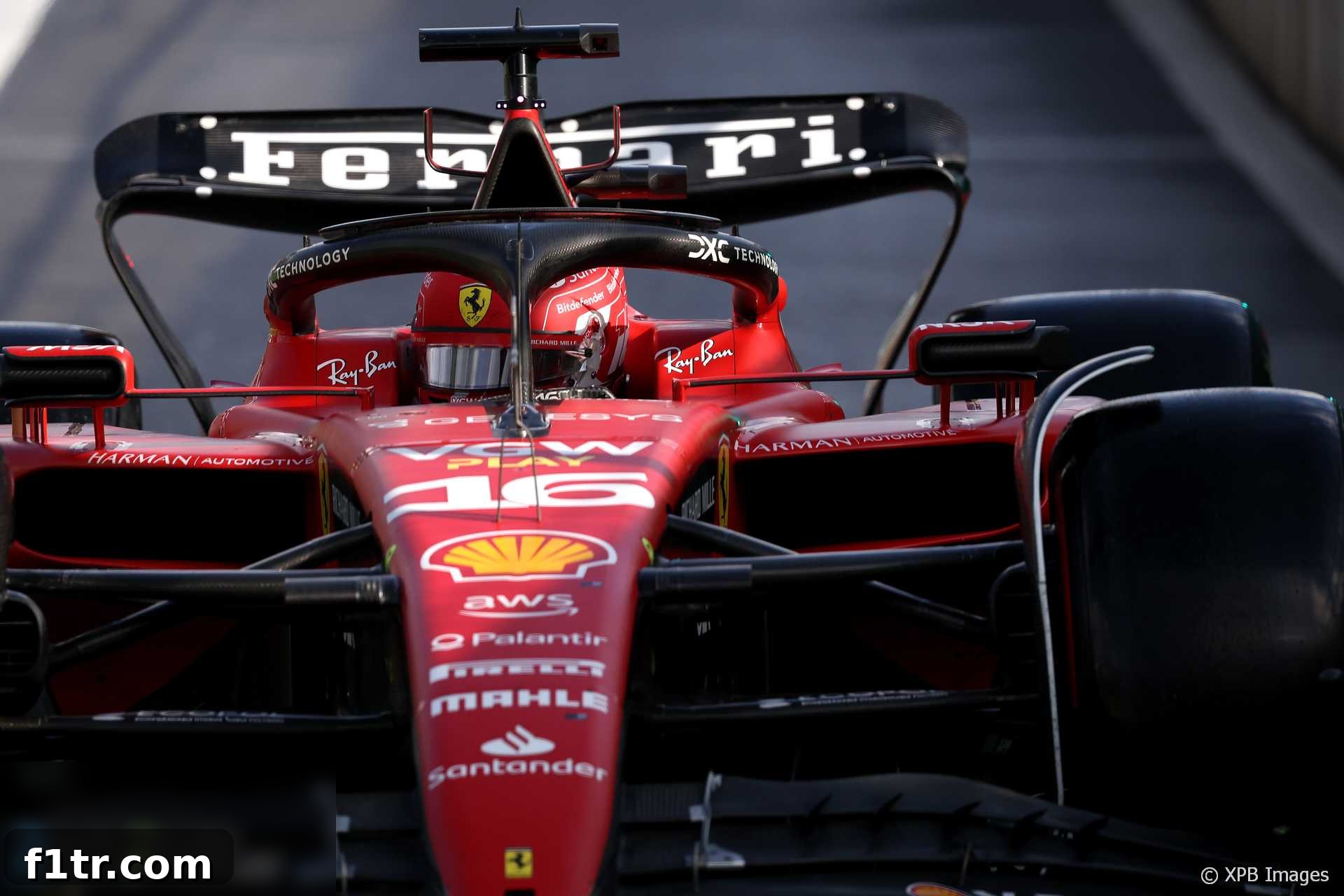
In a remarkable turnaround from recent struggles, Charles Leclerc has secured pole position for the Belgian Grand Prix, attributing his success to a nuanced adjustment in his driving style. This achievement marks a significant redemption for the Ferrari ace, who, just last month in Spain, faced an early Q1 elimination during a similarly damp qualifying session. The contrasting fortunes underscore Leclerc’s dedicated efforts to master the unpredictable challenges of mixed weather conditions, an area where he had openly admitted to grappling with consistency earlier in the season.
While Leclerc officially qualified second on the grid at the iconic Spa-Francorchamps circuit, he will commence Sunday’s race from the coveted P1 slot. This promotion comes courtesy of a five-place grid penalty incurred by the formidable Max Verstappen, who dominated qualifying but faces a sanction for an unscheduled gearbox change on his Red Bull machine. The Dutchman’s penalty, a consequence of regulations governing component usage, hands Leclerc a golden opportunity to convert his improved performance into valuable championship points.
The qualifying session itself unfolded under typically capricious Spa weather – a fluctuating dance between damp patches and a progressively drying track. These are precisely the conditions that have proven to be Leclerc’s Achilles’ heel in the recent past. At the Spanish Grand Prix, a similar meteorological scenario saw him mystified by his SF-23’s handling characteristics, leading to an unexpected failure to progress beyond the first qualifying segment. His frustration was palpable, highlighting a critical area for improvement that the Ferrari team and driver were keen to address.
Despite clocking in over eight tenths of a second slower than Verstappen’s blistering pace, Leclerc expressed immense satisfaction with his performance in Belgium. “I put quite a lot of work in those conditions, half-wet to half-dry,” he explained, detailing the intense analysis and practice dedicated to overcoming his previous difficulties. “I knew it was one of those conditions where I was still struggling with the car. I didn’t have the right feeling in Barcelona, I cannot remember the other races we had but we had two or three races in a row where we had those conditions, and today I felt much better in the car. So this was positive.” This candid assessment reveals a diligent approach to self-improvement, turning a weakness into a newfound strength.
One factor influencing the final Q3 timings was track evolution. Leclerc was among the first drivers to complete his final flying lap in the decisive segment. As the session progressed, the racing line continued to dry, offering marginally quicker conditions for those who ran later. This subtle but critical timing difference, Leclerc acknowledged, accounted for a portion of the significant gap to Verstappen. “I’m still very far from Max, in Q3 especially,” he conceded, maintaining a realistic perspective on raw pace. “But all in all, I think in Q3 we could have done things a bit slightly better. I don’t think pole was possible [without Verstappen’s penalty] – I mean, I’m sure pole was not possible today – but we probably could have been closer going a bit later in Q3.”
Leclerc elaborated on the essence of his transformation, emphasizing that it was less about radical overhaul and more about subtle refinement. He had previously been “making too many mistakes” in damp conditions, finding it “difficult to build from a solid base.” His solution? “So I changed a little bit the approach and it seems to be better.” He revealed that pinpointing the exact changes was challenging due to their minute nature: “It’s very difficult to give details because it’s very slight changes in terms of driving style. But that makes a big difference at the end.”
This microscopic attention to detail speaks volumes about the precision required at the pinnacle of motorsport. Leclerc, known for an inherently aggressive driving style that often yields dividends in both fully wet and completely dry scenarios, discovered that this approach was counterproductive in the delicate balance of a drying track on slick tires. “I have a very aggressive driving style, whether it’s in full wet or full dry, which pays off in those two conditions. But whenever I’m in between with slick tyres, then it doesn’t really pay off,” he explained. His adaptation involved not just personal technique but also manipulating car settings. “I tried different directions also with tools, so the way the car is set up and the way I can change it from one corner to the other, and this gave me much more confidence straight away and the lap time came better.” These “tools” likely refer to in-car adjustments available to drivers, such as brake balance, differential settings, or engine braking, which can profoundly impact how the car behaves under varying grip conditions. Mastering their use in real-time is a hallmark of elite drivers.
The inherent challenge of the Spa-Francorchamps circuit itself significantly magnified the difficulties of the mixed conditions. Known for its extensive length, dramatic elevation changes, and high-speed corners like Eau Rouge and Blanchimont, Spa demands absolute precision. In drying conditions, the variation in grip levels across its 7-kilometer layout becomes a formidable adversary. Max Verstappen, in his own assessment of the session, highlighted this unpredictability. “It was very difficult, especially [turn] eight-nine [Bruxelles] was horrible,” he recounted, offering a vivid picture of the treacherous conditions. “You would get into the corner and you never knew how much grip you will have. You just had to trust the car to grip again because in between eight and nine there was really low grip and then in the middle of nine you will get the grip again and you just had to trust the process.”
Verstappen’s description perfectly encapsulates the mental tightrope walk drivers undertake in such scenarios. The rapid shifts from minimal to moderate grip demand an extraordinary level of trust in both the car and one’s own instincts, pushing the boundaries of driver perception and control. The margin for error is razor-thin, as going “over the limit” often results in an unrecoverable slide or spin. “You can never really go over the limit in those conditions so you just need to go step by step and get as close as possible in the last lap of Q3,” Verstappen concluded, outlining the cautious yet determined approach necessary to extract maximum performance without crossing the threshold into disaster.
Leclerc’s pole position, though inherited, is a testament to his resilience and capacity for adaptation. It offers a crucial psychological boost for both him and the Ferrari team, demonstrating that they can effectively address and overcome specific performance deficits. While the race will undoubtedly present its own set of challenges, particularly with a hard-charging Verstappen starting further back, Leclerc’s improved confidence in mixed conditions could be a significant asset should the capricious Spa weather play a role on Sunday. This pole, therefore, is more than just a starting grid slot; it represents a hard-won victory in the ongoing battle for self-mastery and competitive edge in Formula 1.
2023 Belgian Grand Prix
- Haas drivers fear losing battle for seventh after “grim weekend” in Spa
- Mercedes optimistic they’re “in the right place for winter” with development plan
- Ferrari not convinced by call to equalise engines: ‘Renault is not so far away’
- Ferrari staying “calm” amid swings in performance from race to race
- Pirelli proposes new “super-intermediate” to address wet weather tyre problems
Browse all 2023 Belgian Grand Prix articles