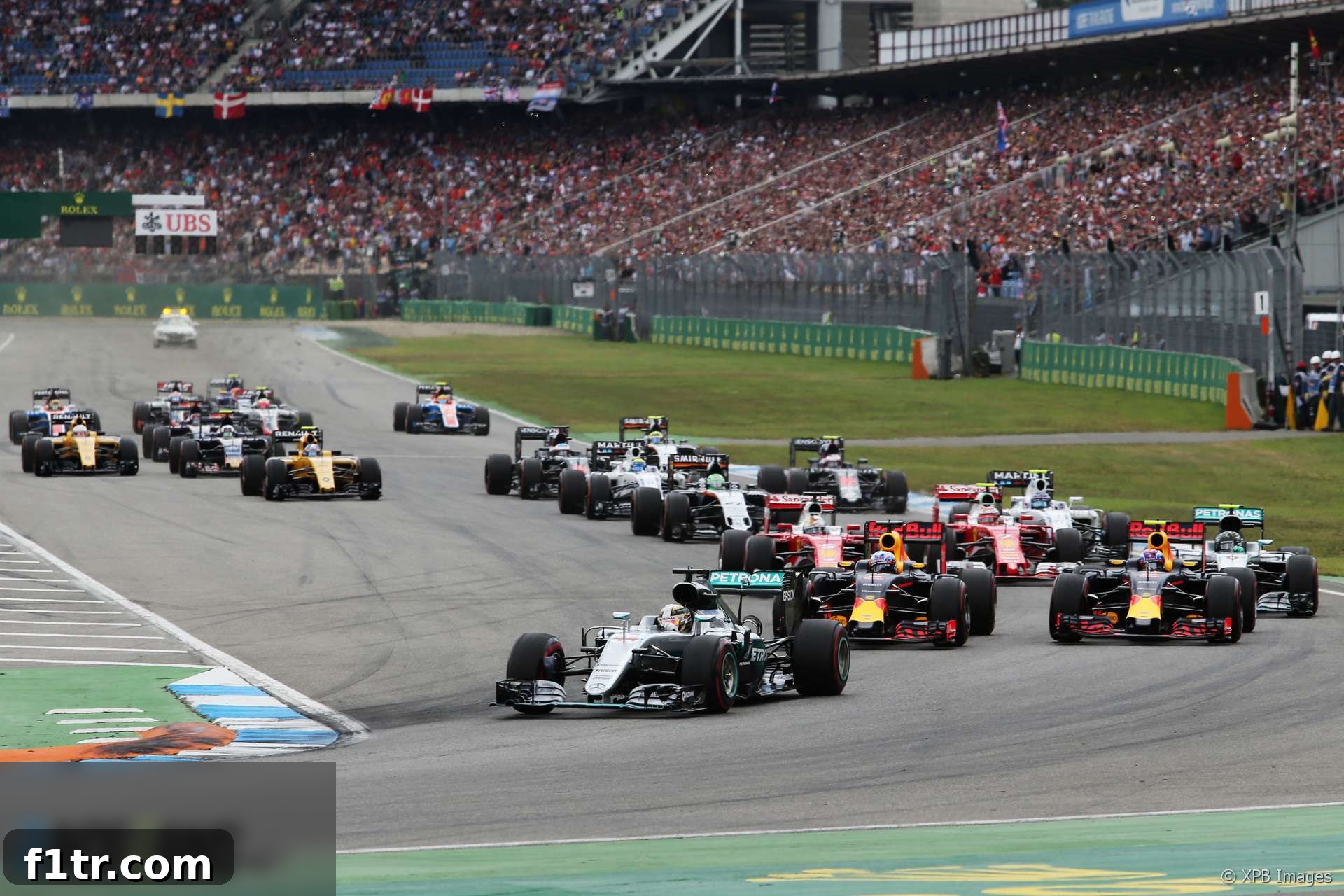
Strategic Tyre Choices Define 2018 German Grand Prix Battle: Hamilton and Vettel Align
As the Formula 1 world championship intensified in 2018, all eyes were on the upcoming German Grand Prix at the venerable Hockenheimring. The season had already delivered a gripping narrative, with Mercedes’ Lewis Hamilton and Ferrari’s Sebastian Vettel locked in a fierce and captivating battle for supremacy. In a sport where every fraction of a second and every strategic decision can sway the outcome, tyre selection stands as one of the most critical pre-race gambits. For this pivotal weekend in Germany, an intriguing strategic alignment emerged, with both championship protagonists opting for identical tyre compound allocations, setting the stage for a fascinating on-track duel.
Pirelli, Formula 1’s exclusive tyre supplier, nominated a specific trio of compounds for the Hockenheimring: the Ultra-soft, Soft, and Medium. These selections represent a careful balance of speed and durability, designed to challenge teams and drivers alike. The Ultra-soft, characterized by its superior grip, offers the quickest lap times but comes with the trade-off of higher degradation. The Soft compound provides a good blend of performance and longevity, often serving as a versatile race tyre. The Medium, the hardest of the three, is built for endurance, capable of extended stints but with reduced outright pace. Notably, the Super-soft compound, a common choice at many circuits, was not among Pirelli’s nominations for the German Grand Prix, simplifying the choices but also potentially pushing teams towards more aggressive Ultra-soft usage or more conservative Soft/Medium reliance.
Championship Rivals Adopt Identical Tyre Strategies
The mirroring of tyre choices between the two titans of the 2018 season, Lewis Hamilton and Sebastian Vettel, was undoubtedly one of the weekend’s most talked-about pre-race details. Both drivers committed to an allocation of seven sets of the Ultra-soft tyres, underscoring a shared belief in maximizing qualifying performance and exploiting the immediate pace advantage of the softest compound. This aggressive Ultra-soft allocation was paired with four sets of the more durable Soft compound and two sets of the robust Medium compound. This identical selection suggests a convergence in strategic thinking between Mercedes and Ferrari, implying that extensive data analysis and simulation had led both top teams to conclude this was the optimal path to victory at the Hockenheimring, signaling confidence in their ability to manage tyre degradation over race distances.
This strategic uniformity extended to their respective teammates. Valtteri Bottas for Mercedes and Kimi Räikkönen for Ferrari also made identical selections, albeit with a slight variation from their team leaders. Both Bottas and Räikkönen opted for an extra set of Soft tyres, totaling five, while reducing their Medium allocation by one, leaving them with just a single set. This subtle difference could indicate a strategic diversification within each team, perhaps allowing for different race profiles or catering to individual driving styles. An additional set of Soft tyres could offer more strategic flexibility during the crucial middle stints of the race or provide an extra opportunity to push hard in qualifying without compromising tyre availability for Sunday.
Red Bull’s Aggressive Stance and Midfield Innovations
While Mercedes and Ferrari demonstrated strategic cohesion, Red Bull Racing showcased a more audacious approach. Daniel Ricciardo notably distinguished himself among the top three teams by selecting eight sets of the Ultra-soft compound, one more than his immediate championship rivals. His teammate, Max Verstappen, followed suit with an identical eight Ultra-soft sets, signaling a clear team-wide preference for an aggressive, pace-focused strategy. Red Bull’s consistent willingness to push the boundaries of tyre strategy often aims to maximize qualifying performance and secure vital track position early in the race. Given the Hockenheimring’s layout, which features long straights ideal for overtaking but also demanding technical sections, a strong starting position provided by extra Ultra-softs could prove invaluable.
Further down the grid, the midfield teams generally adopted even more pronounced aggressive strategies. Most teams outside the traditional ‘big three’ — Mercedes, Ferrari, and Red Bull — elected for at least eight sets of Ultra-soft tyres. This trend highlights a common tactic among midfield contenders: leveraging the softest compounds to extract maximum performance, particularly during qualifying, in an attempt to close the gap to the front-runners or gain a crucial advantage over direct competitors. For teams fighting for valuable championship points, an aggressive tyre strategy, despite its inherent risks regarding degradation, often represents the best opportunity to make an impact.
Several teams pushed this aggressive strategy even further. Williams, for example, committed to nine sets of the Ultra-soft compound for both Lance Stroll and Sergey Sirotkin. This choice reflected a team focused on extracting every possible ounce of qualifying pace, potentially accepting reduced race-day flexibility in exchange for a stronger grid position. Renault demonstrated the most aggressive stance, with both Carlos Sainz Jnr and Nico Hulkenberg opting for an astonishing ten sets of Ultra-softs. Such an extreme allocation suggests a primary focus on maximizing single-lap speed, possibly planning for multiple short stints on the quickest compound or prioritizing a high starting position, even if it necessitated a more complex, multi-stop race strategy on Sunday.
The Hockenheimring’s Demands and Tyre Degradation
The Hockenheimring circuit, with its rich history and modern modifications, presents a formidable challenge for tyre management. Its layout is a compelling mix of contrasting characteristics: lengthy, high-speed straights, most notably the run down to Turn 2 and the back straight leading into the iconic stadium section, are juxtaposed with tighter, more technical corners and heavy braking zones. This diversity places varying and significant demands on the Pirelli compounds. Intense braking into corners such as the Spitzkehre hairpin (Turn 6) and the chicane before the stadium section generates high energy loads and considerable heat build-up within the tyres. Conversely, the fast, sweeping curves of the stadium section demand exceptional lateral grip and stability from the tyre structures.
Tyre degradation at Hockenheim can be a defining factor in race strategy, particularly for the softer compounds. Elevated ambient temperatures, characteristic of a German summer, exacerbate thermal degradation, making precise tyre management paramount. Teams must meticulously balance outright pace with the need for compounds to last for optimal stint lengths. The widespread choice of seven to ten sets of Ultra-softs indicates a strong belief in their ability to manage these tyres effectively, but it also underscores the potential for varied pit stop strategies and crucial real-time decision-making during the race.
Strategic Implications for Qualifying and Race Day
The varied tyre selections across the grid promised to ignite a captivating strategic battle throughout the German Grand Prix weekend, impacting both qualifying and the main race. In qualifying, the generous allocation of Ultra-softs for many teams meant drivers would have multiple opportunities to set their fastest lap times, allowing for more fine-tuning and recovery from minor errors. However, an overly liberal use of Ultra-softs in qualifying carries a significant drawback: it can compromise race strategy by depleting the supply of fresh, quicker compounds for Sunday.
On race day, the differences in tyre allocations were expected to catalyze diverse pit stop strategies. Drivers with fewer Ultra-softs might be compelled into a more conservative one-stop strategy, potentially starting on the Ultra-softs before transitioning to the Soft or Medium for a lengthy second stint. Conversely, those teams with a higher number of Ultra-softs could opt for a more aggressive two-stop race, maximizing their time on the quicker compound but needing to recover the time lost during additional pit stops. The absence of the Super-soft compound further accentuated the performance gap between the Ultra-soft and Soft, adding another layer of complexity to the strategy calculations.
External factors could further disrupt pre-planned strategies. Safety car periods, which are not uncommon at the Hockenheimring, often present an opportunity for a “free” pit stop, heavily favoring those who have prudently preserved a fresh set of a particular compound. Furthermore, the unpredictable nature of German summer weather means that even light showers could completely reshuffle the strategic deck, bringing intermediate and full wet tyres into play and potentially rendering pre-race dry compound choices less relevant for crucial segments of the race.
The Championship Context and Hockenheim’s Significance
Heading into the German Grand Prix, the 2018 Formula 1 season was delivering an enthralling spectacle, with Lewis Hamilton and Sebastian Vettel exchanging blows and leadership in the drivers’ championship at almost every turn. This particular Grand Prix held immense significance, not only as a mid-season marker but also as Sebastian Vettel’s home race, adding an extra layer of national pride and pressure. For Hamilton, Hockenheim had often been a strong circuit. The immense pressure on both drivers and their respective teams meant that every decision, including tyre strategy, carried disproportionate weight. A perfectly executed strategy could yield a critical advantage in their tightly contested championship battle, while any misstep could prove incredibly costly. The convergence in tyre choices for the leading contenders ultimately underscored the strategic confidence and perhaps a mutual understanding of the optimal approach to the unique challenges presented by the Hockenheimring.
2018 German Grand Prix Tyre Selections
| Driver | Team | Tyres (US / S / M) |
|---|---|---|
| Lewis Hamilton | Mercedes | 7 US / 4 S / 2 M |
| Valtteri Bottas | Mercedes | 7 US / 5 S / 1 M |
| Sebastian Vettel | Ferrari | 7 US / 4 S / 2 M |
| Kimi Raikkonen | Ferrari | 7 US / 5 S / 1 M |
| Daniel Ricciardo | Red Bull | 8 US / 3 S / 2 M |
| Max Verstappen | Red Bull | 8 US / 3 S / 2 M |
| Sergio Perez | Force India | 8 US / 3 S / 2 M |
| Esteban Ocon | Force India | 8 US / 3 S / 2 M |
| Lance Stroll | Williams | 9 US / 2 S / 2 M |
| Sergey Sirotkin | Williams | 9 US / 2 S / 2 M |
| Carlos Sainz Jnr | Renault | 10 US / 2 S / 1 M |
| Nico Hulkenberg | Renault | 10 US / 2 S / 1 M |
| Pierre Gasly | Toro Rosso | 8 US / 3 S / 2 M |
| Brendon Hartley | Toro Rosso | 8 US / 3 S / 2 M |
| Romain Grosjean | Haas | 9 US / 2 S / 2 M |
| Kevin Magnussen | Haas | 9 US / 2 S / 2 M |
| Fernando Alonso | McLaren | 8 US / 3 S / 2 M |
| Stoffel Vandoorne | McLaren | 8 US / 3 S / 2 M |
| Marcus Ericsson | Sauber | 8 US / 3 S / 2 M |
| Charles Leclerc | Sauber | 8 US / 3 S / 2 M |
Conclusion: The Tyre Battle at Hockenheim
The 2018 German Grand Prix was poised to be a thrilling and strategically rich encounter, largely due to the nuanced tyre strategies unfolding across the paddock. The identical choices made by championship rivals Lewis Hamilton and Sebastian Vettel underscored a fascinating strategic convergence at the very top, while subtle variations within their teams and the overtly aggressive selections from Red Bull and the midfield highlighted the diverse approaches to conquering the demands of the Hockenheimring. With the Ultra-soft, Soft, and Medium compounds nominated and the Super-soft notably absent, teams were compelled to make critical decisions, meticulously balancing qualifying pace with crucial race durability.
Ultimately, the true success of these pre-race tyre selections would only be revealed as the weekend progressed, heavily influenced by dynamic factors such as fluctuating track temperatures, individual driver performance, and unforeseen race incidents. However, one immutable truth remained: the strategic battle for the German Grand Prix commenced long before the starting lights extinguished, with every compound choice playing an indispensable role in the relentless pursuit of victory and the precious championship points that defined the enthralling 2018 Formula 1 season.
Browse all 2018 F1 season articles