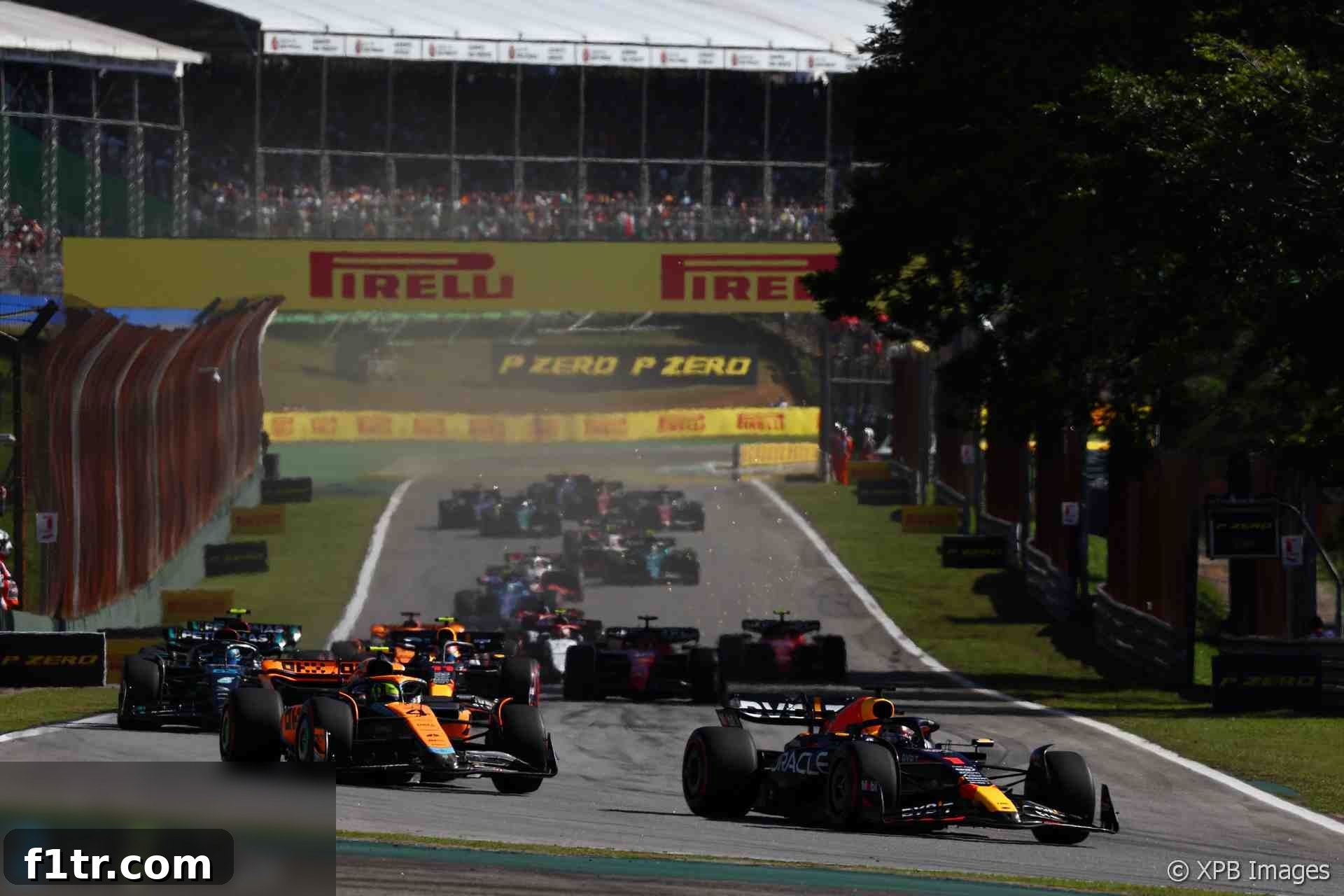
The roar of the engines and the electric atmosphere of the Brazilian Grand Prix at Interlagos always promise drama, but the 2023 sprint race offered a familiar narrative: Max Verstappen’s unparalleled dominance. Moments after securing a respectable fourth place in the sprint, Mercedes driver George Russell couldn’t hide his astonishment at the pace of his rivals, particularly the Dutchman. “What was the pace of Max and Lando at the end?” he queried his race engineer, Marcus Dudley. The reply, “Max at the end was doing 14.8, 14.7,” was met with Russell’s incredulous interruption: “FOURTEEN eight? Wowser. Okay…” This exchange perfectly encapsulated the prevailing sentiment of the 2023 Formula 1 season. Verstappen, and by extension Red Bull Racing, consistently operate in a league of their own, leaving competitors scrambling to bridge a seemingly insurmountable performance gap.
This weekend marks a significant milestone for the reigning world champion, as he will start from pole position for a Grand Prix for an astounding 11th time in 2023. While his career is replete with success, securing the top grid slot at the legendary Interlagos circuit has been a rarer feat for Verstappen, having only achieved it once before, back in 2019. Russell’s disbelief wasn’t just about Verstappen’s raw speed; it also highlighted the perceived strength of the Red Bull package at a track that has historically presented challenges for the team. Sao Paulo has not been Red Bull’s most fertile hunting ground, with only one victory in their last eight attempts. Notably, they famously struggled here last year, finding themselves locked into a sub-optimal setup that prevented them from extracting the full potential from their car. However, the conclusive evidence from Saturday’s sprint race suggests that Red Bull has masterfully circumvented those prior difficulties, arriving at Interlagos with a meticulously prepared and supremely confident machine.
While Max Verstappen appeared firmly in control during the 24-lap sprint, McLaren’s Lando Norris proved to be his most persistent challenger. Norris admirably kept Verstappen honest, particularly through the high-speed, uphill right-hand sweep of Ferradura. Throughout the race, the young Briton maintained sight of the Red Bull, even posting quicker lap times than the eventual winner through several middle laps. However, Verstappen’s superior ability to manage his Pirelli tyres and subsequently amplify his pace, even as his rivals experienced diminishing lap times, casts a shadow over Norris’s prospects of sustaining such a challenge over a full Grand Prix distance. His ultimate starting position of sixth for the main race further complicates his path to victory, making the task significantly harder despite McLaren’s strong underlying pace.
Adding another layer of intrigue to the starting grid, Verstappen will not have a Red Bull teammate alongside him. Instead, Charles Leclerc of Ferrari will occupy the front row, setting up a captivating battle into Turn 1. Ferrari’s race pace during the sprint may not have instilled fear into the hearts of the Red Bull camp, as Leclerc spent the majority of the race meticulously managing both his car’s temperatures and his tyres. Fortunately for the Scuderia, the forecast for the Grand Prix predicts cooler conditions compared to Saturday’s sprint, which should allow Leclerc and his teammate, Carlos Sainz Jnr, to push their SF-23s harder without the same thermal constraints. This shift in conditions could be a game-changer for Ferrari, who are renowned for their qualifying prowess but sometimes struggle with race-day consistency.
Ferrari also possesses a crucial strategic advantage that many of their rivals do not: a fresh set of soft tyres. By deliberately conserving their last new set of soft compound tyres during Saturday’s sprint sessions, both Leclerc and Sainz have an untouched, high-performance option available for the main event. This strategic foresight could provide them with a significant boost, either for an aggressive start or as a powerful weapon later in the race during an undercut attempt. The effectiveness of this strategy was subtly showcased on Saturday by Yuki Tsunoda, who demonstrated strong pace on a fresh set of softs, validating Ferrari’s decision. Leclerc himself confirmed this sentiment after the sprint, stating, “I think the pace of Yuki encourages me, seeing that he was on new softs. We expected them to not have the same pace as us, but with the new softs he was very similar to our pace. So I think it’s a good choice what we’ve done.” This tactical gamble could be the key to unlocking a podium finish or even challenging for the win against the mighty Red Bull.
Unlike the previous weekend where Leclerc had his teammate Sainz starting alongside him, the Ferrari driver will instead find the two Aston Martins of Lance Stroll and Fernando Alonso directly behind him on the grid. After a particularly challenging initial two legs of the triple-header, Aston Martin has remarkably positioned both their cars within the first two rows of the grid for the first time this entire season. Despite neither of the green cars finishing in the top half of the field during Saturday’s sprint, the experienced Fernando Alonso remains surprisingly optimistic about his team’s prospects for a podium finish in the main Grand Prix. “We had a lot of pace today, so a good sign for tomorrow,” Alonso commented, adding, “[A podium] could be possible if we execute a perfect race.” He acknowledged the formidable pace of competitors like Mercedes and Lando Norris, anticipating they will eventually catch up, but emphasized his team’s determination: “But we will try to execute a good race. No mistakes. If it’s a podium: fantastic. If it’s a top five: we’ll take it.” This demonstrates a cautious yet ambitious outlook for Aston Martin, who will be keen to capitalize on their strong qualifying performance.
While Alonso foresees the two Mercedes cars of fifth-placed Lewis Hamilton and eighth-placed George Russell making progress in the Grand Prix, their performance in the sprint race offered little encouragement. Russell, despite briefly passing Norris for second on the opening lap, ultimately finished precisely where he started in fourth. Hamilton, on the other hand, experienced significant tyre degradation in the latter stages of the sprint, causing him to fade to seventh. Team principal Toto Wolff openly admitted that his team might have inadvertently set themselves up for a challenging Grand Prix. He explained the car’s issues: “The car was not balanced optimally with the rear end not strong enough to live with the front. You’re having to drive the car on a knife’s edge but it’s almost impossible to do so.” Wolff stressed the urgency of addressing these problems: “We need to go away this evening and work through what we can do to improve it for tomorrow. There are no easy fixes, but we will do everything that we can.” Mercedes’ struggle with tyre management and balance will be a critical factor in their performance on Sunday, as the high-fuel, longer race distance will only amplify these issues.
Given Mercedes’ struggles, Lando Norris, starting from sixth, appears to be a stronger contender to climb up the order during the Grand Prix. His ability to largely match Verstappen’s pace through the majority of the sprint race certainly bodes well. The McLaren driver was visibly buoyed by significantly exceeding his own pre-weekend expectations on Saturday. “It’s sixth – but after today, it’s promising,” Norris remarked. “We’ve not done any long running until today, so it was our first good bit of knowledge of what we can expect for tomorrow, which is a good sign. It’s positive. I felt comfortable, but having to overtake quite a few cars makes it different for tomorrow. So hopefully we can do the same.” McLaren’s unexpected speed at Interlagos, a circuit they weren’t particularly optimistic about, could see Norris mount a formidable challenge, provided he can navigate the initial traffic and replicate his impressive tyre management.
As is often the case in Formula 1, the Grand Prix will place a strong emphasis on tyre management and strategic brilliance. The insights gained from the sprint race concerning tyre wear and degradation will be invaluable for teams fine-tuning their strategies. Unlike the previous weekend in Mexico, where a one-stop strategy was predominantly favored, Pirelli has indicated that a two-stop strategy will be the minimum requirement for the Brazilian Grand Prix, even with the available tyre compounds being a step harder. Interlagos is a circuit renowned for offering more viable overtaking opportunities compared to many other tracks on the calendar, and the “undercut” strategy – where a driver pits early for fresh tyres to gain track position – is notably more effective here. This dynamic incentivizes teams to be aggressive with their pit stops, sacrificing track position for the advantage of fresher, faster rubber, confident in their ability to regain ground on track. The choice between soft, medium, and hard compounds at various stages of the race will be crucial, with teams weighing the benefits of early aggression against the need for late-race endurance. The higher fuel loads at the start of the Grand Prix, combined with the cooler forecasted track temperatures, will undoubtedly introduce another layer of complexity to the already intricate art of tyre management.
Regardless of the specific strategy Red Bull opts for with their pole-sitting driver, Max Verstappen will head into Sunday’s Grand Prix in Sao Paulo with a significant boost in confidence and an undeniable comfort level with his car. This synergy between driver and machine, a hallmark of his dominant 2023 season, should undoubtedly alarm all of his rivals. Verstappen himself acknowledged the challenges while expressing his readiness: “With the higher fuel loads from the start, cooler track temp, I still think it’s going to be a lot of tyre management involved. But I think everyone will learn a lot from today and that will apply it to tomorrow. But very happy compared to last year. This is, of course, miles better for us and already looking forward to tomorrow.” His calm demeanor and the proven performance of the Red Bull RB19 make him the overwhelming favorite. The question isn’t whether Verstappen will be fast, but rather if anyone on the grid can truly challenge his relentless pace and strategic precision over 71 laps. The Brazilian Grand Prix at Interlagos always delivers excitement, and while Verstappen may be the man to beat, the unpredictable nature of Formula 1 promises a captivating race to the finish line.
Qualifying times in full
| P. | Driver | Team | Q1 | Q2 (v Q1) | Q3 (v Q2) |
|---|---|---|---|---|---|
| 1 | Max Verstappen | Red Bull | 1’10.436 | 1’10.162 (-0.274s) | 1’10.727 (+0.565s) |
| 2 | Charles Leclerc | Ferrari | 1’10.472 | 1’10.303 (-0.169s) | 1’11.021 (+0.718s) |
| 3 | Lance Stroll | Aston Martin | 1’10.551 | 1’10.375 (-0.176s) | 1’11.344 (+0.969s) |
| 4 | Fernando Alonso | Aston Martin | 1’10.557 | 1’10.237 (-0.320s) | 1’11.387 (+1.150s) |
| 5 | Lewis Hamilton | Mercedes | 1’10.604 | 1’10.266 (-0.338s) | 1’11.469 (+1.203s) |
| 6 | George Russell | Mercedes | 1’10.340 | 1’10.316 (-0.024s) | 1’11.590 (+1.274s) |
| 7 | Lando Norris | McLaren | 1’10.623 | 1’10.021 (-0.602s) | 1’11.987 (+1.966s) |
| 8 | Carlos Sainz Jnr | Ferrari | 1’10.624 | 1’10.254 (-0.370s) | 1’11.989 (+1.735s) |
| 9 | Sergio Perez | Red Bull | 1’10.668 | 1’10.219 (-0.449s) | 1’12.321 (+2.102s) |
| 10 | Oscar Piastri | McLaren | 1’10.519 | 1’10.330 (-0.189s) | |
| 11 | Nico Hulkenberg | Haas | 1’10.475 | 1’10.547 (+0.072s) | Missed by 0.172s |
| 12 | Esteban Ocon | Alpine | 1’10.763 | 1’10.562 (-0.201s) | Missed by 0.187s |
| 13 | Pierre Gasly | Alpine | 1’10.793 | 1’10.567 (-0.226s) | Missed by 0.192s |
| 14 | Kevin Magnussen | Haas | 1’10.602 | 1’10.723 (+0.121s) | Missed by 0.348s |
| 15 | Alexander Albon | Williams | 1’10.621 | 1’10.840 (+0.219s) | Missed by 0.465s |
| 16 | Yuki Tsunoda | AlphaTauri | 1’10.837 | Missed by 0.044s | |
| 17 | Daniel Ricciardo | AlphaTauri | 1’10.843 | Missed by 0.050s | |
| 18 | Valtteri Bottas | Alfa Romeo | 1’10.955 | Missed by 0.162s | |
| 19 | Logan Sargeant | Williams | 1’11.035 | Missed by 0.242s | |
| 20 | Zhou Guanyu | Alfa Romeo | 1’11.275 | Missed by 0.482s |
Sector times
The following table provides a detailed breakdown of the fastest sector times achieved by each driver during qualifying, offering insights into their strengths across different parts of the Interlagos circuit.
| P. | # | Driver | S1 | S2 | S3 | Ultimate lap (deficit) |
|---|---|---|---|---|---|---|
| 1 | 4 | Lando Norris | 18.31 (3) | 35.361 (3) | 16.226 (1) | 1’09.897 (+0.124) |
| 2 | 1 | Max Verstappen | 18.359 (6) | 35.296 (1) | 16.37 (10) | 1’10.025 (+0.137) |
| 3 | 63 | George Russell | 18.418 (12) | 35.309 (2) | 16.375 (11) | 1’10.102 (+0.214) |
| 4 | 11 | Sergio Perez | 18.272 (2) | 35.423 (5) | 16.422 (16) | 1’10.117 (+0.102) |
| 5 | 14 | Fernando Alonso | 18.415 (11) | 35.426 (6) | 16.31 (4) | 1’10.151 (+0.086) |
| 6 | 16 | Charles Leclerc | 18.369 (8) | 35.519 (9) | 16.307 (3) | 1’10.195 (+0.108) |
| 7 | 18 | Lance Stroll | 18.433 (14) | 35.488 (7) | 16.306 (2) | 1’10.227 (+0.148) |
| 8 | 81 | Oscar Piastri | 18.268 (1) | 35.612 (10) | 16.348 (7) | 1’10.228 (+0.102) |
| 9 | 44 | Lewis Hamilton | 18.386 (10) | 35.397 (4) | 16.451 (19) | 1’10.234 (+0.032) |
| 10 | 55 | Carlos Sainz Jnr | 18.337 (4) | 35.517 (8) | 16.4 (14) | 1’10.254 |
| 11 | 27 | Nico Hulkenberg | 18.364 (7) | 35.701 (11) | 16.313 (5) | 1’10.378 (+0.097) |
| 12 | 10 | Pierre Gasly | 18.348 (5) | 35.736 (13) | 16.356 (8) | 1’10.440 (+0.127) |
| 13 | 20 | Kevin Magnussen | 18.38 (9) | 35.787 (15) | 16.315 (6) | 1’10.482 (+0.120) |
| 14 | 31 | Esteban Ocon | 18.425 (13) | 35.771 (14) | 16.357 (9) | 1’10.553 (+0.009) |
| 15 | 23 | Alexander Albon | 18.473 (16) | 35.729 (12) | 16.392 (13) | 1’10.594 (+0.027) |
| 16 | 22 | Yuki Tsunoda | 18.483 (17) | 35.849 (16) | 16.382 (12) | 1’10.714 (+0.123) |
| 17 | 3 | Daniel Ricciardo | 18.537 (18) | 35.892 (17) | 16.414 (15) | 1’10.843 |
| 18 | 77 | Valtteri Bottas | 18.573 (19) | 35.938 (18) | 16.444 (17) | 1’10.955 |
| 19 | 2 | Logan Sargeant | 18.465 (15) | 36.126 (20) | 16.444 (17) | 1’11.035 |
| 20 | 24 | Zhou Guanyu | 18.719 (20) | 36.011 (19) | 16.545 (20) | 1’11.275 |
Speed trap
The speed trap data from qualifying reveals the top speeds achieved by each car, highlighting engine power and aerodynamic efficiency on the fastest sections of the Interlagos circuit.
| P. | # | Driver | Car | Engine | Model | Max kph (mph) |
|---|---|---|---|---|---|---|
| 1 | 10 | Pierre Gasly | Alpine | Renault | A523 | 339.1 (210.7) |
| 2 | 31 | Esteban Ocon | Alpine | Renault | A523 | 338.5 (210.3) |
| 3 | 1 | Max Verstappen | Red Bull | Honda RBPT | RB19 | 334.4 (207.8) |
| 4 | 11 | Sergio Perez | Red Bull | Honda RBPT | RB19 | 334.2 (207.7) |
| 5 | 22 | Yuki Tsunoda | AlphaTauri | Honda RBPT | AT04 | 333.9 (207.5) |
| 6 | 20 | Kevin Magnussen | Haas | Ferrari | VF-23 | 333.5 (207.2) |
| 7 | 3 | Daniel Ricciardo | AlphaTauri | Honda RBPT | AT04 | 333.5 (207.2) |
| 8 | 55 | Carlos Sainz Jnr | Ferrari | Ferrari | SF-23 | 332.7 (206.7) |
| 9 | 16 | Charles Leclerc | Ferrari | Ferrari | SF-23 | 332.3 (206.5) |
| 10 | 4 | Lando Norris | McLaren | Mercedes | MCL60 | 331.2 (205.8) |
| 11 | 18 | Lance Stroll | Aston Martin | Mercedes | AMR23 | 330.9 (205.6) |
| 12 | 81 | Oscar Piastri | McLaren | Mercedes | MCL60 | 330.8 (205.5) |
| 13 | 27 | Nico Hulkenberg | Haas | Ferrari | VF-23 | 330.7 (205.5) |
| 14 | 14 | Fernando Alonso | Aston Martin | Mercedes | AMR23 | 329.8 (204.9) |
| 15 | 2 | Logan Sargeant | Williams | Mercedes | FW45 | 329.0 (204.4) |
| 16 | 23 | Alexander Albon | Williams | Mercedes | FW45 | 328.3 (204.0) |
| 17 | 77 | Valtteri Bottas | Alfa Romeo | Ferrari | C43 | 327.5 (203.5) |
| 18 | 44 | Lewis Hamilton | Mercedes | Mercedes | W14 | 326.9 (203.1) |
| 19 | 24 | Zhou Guanyu | Alfa Romeo | Ferrari | C43 | 326.7 (203.0) |
| 20 | 63 | George Russell | Mercedes | Mercedes | W14 | 326.2 (202.7) |
Over to you
Will anyone be able to take the fight to Max Verstappen in the Grand Prix? Share your predictions and views on the Brazilian Grand Prix in the comments below.
2023 Brazilian Grand Prix
- Perez’s missed “open goal” in Miami was turning point in title fight – Horner
- F1 drivers insist new rules to prevent impeding in qualifying don’t work
- McLaren surprised by margin over rivals at track Norris thought would be “tough”
- “Follow Fernando’s line” – How Red Bull tried everything to get Perez past Alonso
- Mercedes’ Brazilian GP set-up was “conservative” after US GP disqualification
Browse all 2023 Brazilian Grand Prix articles