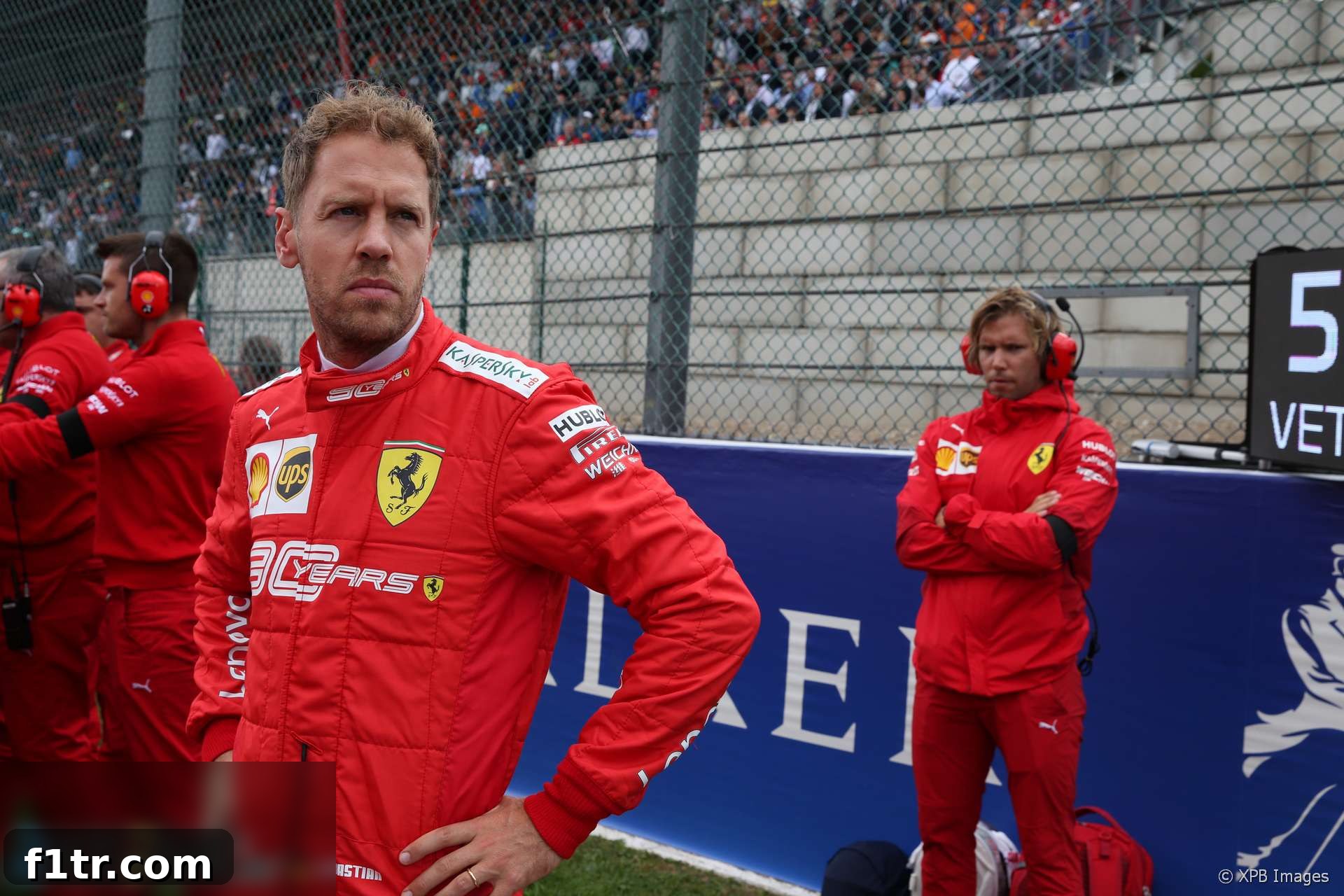
In a significant development within the highly regulated world of Formula 1, Sebastian Vettel has now garnered the unfortunate distinction of accumulating the most penalty points since the system’s inception in 2014. The four-time world champion has surpassed previous leaders Max Verstappen and Romain Grosjean, signalling a growing concern over his on-track conduct and raising critical questions about driver safety and adherence to racing rules.
Advert | Become a Supporter & go ad-free
The latest transgression occurred during the thrilling Italian Grand Prix at Monza, a pivotal race for Ferrari on home soil. Vettel received three penalty points on his Super Licence for an incident involving Lance Stroll. Following a spin at the Ascari chicane, Vettel rejoined the track in an unsafe manner, directly impeding Stroll’s Racing Point car and causing a collision. This error, which also resulted in a ten-second stop-go penalty during the race, proved costly both in terms of championship points and his cumulative penalty tally.
With this latest incident, Vettel’s total penalty points now stand at an alarming 24, amassed over 10 distinct offences throughout his career since 2014. This places him ahead of both Max Verstappen and Romain Grosjean, who currently each hold 21 penalty points. The Ferrari driver’s increasing number of infractions highlights a pattern that F1 stewards and fans alike are closely observing, particularly as the system is designed to deter unsafe or unsporting behaviour.
Romain Grosjean, like Vettel, has competed in every Formula 1 season since the penalty points system was introduced. His history of on-track incidents, particularly in the earlier stages of his F1 career, earned him a reputation for aggressive driving, though he has largely tempered this in recent years. Meanwhile, Max Verstappen, renowned for his tenacious and often aggressive racing style, has also accumulated a substantial number of points, reflecting his no-holds-barred approach to competition.
Compared to these top three, other prominent drivers show significantly lower totals. Lewis Hamilton, a five-time world champion, has a remarkably low six points, underscoring his precise and generally clean driving record. Daniel Ricciardo follows with seven points, Kimi Raikkonen with 10, Valtteri Bottas with 12, Nico Hulkenberg with 14, and Sergio Perez with 16. These figures illustrate the wide spectrum of driver behaviour and how different approaches to racing translate into penalty points.
Crucially, the Formula 1 penalty points system operates on a rolling 12-month period. Should a driver accumulate 12 penalty points within any 12-month timeframe, they face an automatic one-race ban. To date, no Formula 1 driver has reached this threshold, a testament to the system’s deterrent effect and the high level of professionalism expected from the sport’s elite. However, Sebastian Vettel is now precariously close, standing at nine points for the current 12-month period.
The looming threat of a race ban adds immense pressure on Vettel and Ferrari. His current nine points will not see any deductions until October 20th. This means that if Vettel incurs just three more penalty points over the next three Grand Prix weekends – Singapore, Russia, and Japan – he will trigger the automatic one-race suspension. These circuits are known for their demanding nature, tight corners, and high-speed sections, offering ample opportunities for racing incidents. For a driver already under scrutiny for his on-track decisions, the stakes for these upcoming races could not be higher.
The severity of such a ban was recently demonstrated in Formula 2. Earlier this year, Mahaveer Raghunathan was forced to miss an event after exceeding 12 penalty points in just nine races. Raghunathan’s situation serves as a stark reminder that the system is indeed enforced. Although he has since returned to racing, he now finds himself only four penalty points away from a second ban, highlighting the persistent challenges some drivers face in maintaining a clean record. This precedent underscores the very real consequences Sebastian Vettel could face if he fails to keep his penalty tally in check.
Sebastian Vettel’s Road to 24 Penalty Points: A Detailed Review
Sebastian Vettel’s journey to becoming the most penalized driver in terms of accumulated points began shortly after the system’s introduction. Each incident, ranging from minor infractions to significant collisions, has chipped away at his clean slate, contributing to his current precarious position. Below is a comprehensive look at the events that have shaped his penalty point history:
| Event | Session | Misdemeanour | Penalty | Points |
|---|---|---|---|---|
| 2015 Canadian Grand Prix | Third practice | Overtook Roberto Merhi under red flags | Five-place grid drop | 3 |
| 2016 British Grand Prix | Race | Forced Felipe Massa off the track | Five-second time penalty | 2 |
| 2016 Malaysian Grand Prix | Race | Caused a collision with Nico Rosberg | Three-place grid drop | 2 |
| 2016 Mexican Grand Prix | Race | Abnormal change of position while defending | Ten-second time penalty | 2 |
| 2017 Azerbaijan Grand Prix | Race | Caused a collision with Lewis Hamilton | Ten-second stop-go penalty | 3 |
| 2018 French Grand Prix | Race | Involved in an incident with Valtteri Bottas | Five-second time penalty | 2 |
| 2018 Austrian Grand Prix | Qualifying | Impeded Carlos Sainz Jnr | Three-place grid drop | 1 |
| 2018 United States Grand Prix | First practice | Failed to reduce speed significantly under red flag | Three-place grid drop | 2 |
| 2019 Canadian Grand Prix | Race | Rejoined the track when it was not safe to do so | Five-second time penalty | 2 |
| 2019 British Grand Prix | Race | Caused a collision with Max Verstappen | 10-second time penalty | 2 |
| 2019 Italian Grand Prix | Race | Rejoined the track when it was not safe to do so | Ten-second stop-go penalty | 3 |
Advert | Become a RaceFans supporter andgo ad-free
Understanding the F1 Penalty Points System: Impact and Evolution
The penalty points system was introduced in Formula 1 at the start of the 2014 season as a measure to encourage safer and fairer driving practices. Prior to its implementation, penalties often focused solely on the immediate race outcome, such as grid drops or time penalties, without a cumulative deterrent for persistent offenders. The FIA (Fédération Internationale de l’Automobile) recognized the need for a system that would track driver behavior over a longer period, applying a more stringent cumulative consequence for repeat infractions.
The core principle is simple: points are awarded for various infringements, from minor technical breaches to dangerous driving. These points remain on a driver’s Super Licence for exactly 12 months from the date of the incident. Once 12 points are accumulated within this rolling period, a mandatory one-race suspension is enforced, effectively removing the driver from a Grand Prix weekend. This ‘hard reset’ mechanism after 12 points, or the natural expiry of points after 12 months, ensures that the system remains dynamic and reflects recent driving conduct.
Over the years, the system has proven to be a generally effective deterrent. The threat of a ban forces drivers to reconsider overly aggressive maneuvers or risky decisions that might otherwise be taken without long-term consequence. While some critics argue about the consistency of stewarding decisions and the number of points awarded for specific incidents, the fundamental goal of promoting responsible driving has largely been achieved. The fact that no Formula 1 driver has yet reached the 12-point threshold for a ban speaks volumes about the level of discipline the system instills.
However, Sebastian Vettel’s current situation has reignited discussions about the system’s impact on high-profile drivers. His accumulation of 24 total points since 2014, while not leading to a ban due to the rolling nature of the system, highlights a concerning trend. It suggests that while individual points may expire, a pattern of infractions can persist, drawing scrutiny from the racing community and potentially impacting a driver’s reputation.
The system also serves as a crucial educational tool, reinforcing the importance of adhering to racing ethics and safety regulations. For young drivers ascending through the ranks, like those in Formula 2, the penalty points system offers an early introduction to the strict disciplinary framework that governs elite motorsport. Mahaveer Raghunathan’s case exemplifies how swiftly the consequences can arise when drivers fail to adapt their style to the rules.
The discussion around penalty points will undoubtedly continue, especially with top drivers like Vettel navigating such fine margins. It underscores the constant balance between aggressive, championship-winning driving and the imperative of safety and fair play that underpins Formula 1.
Drivers’ penalty points totals since 2014
*Season to date
Advert | Become a RaceFans supporter andgo ad-free
2019 F1 Season: Context and Consequences
The events of the 2019 Formula 1 season have been particularly intense, with numerous close battles and controversial decisions, many of which have involved Sebastian Vettel and his closest competitors. His performance and incidents throughout the year have been a significant talking point, especially as Ferrari aimed to challenge Mercedes for the championship. The increased pressure to perform, coupled with the fine margins in modern F1 racing, can often lead to drivers pushing the limits, sometimes resulting in infractions.
The season has provided a rich tapestry of narratives, from unexpected podiums to critical technical developments, all influencing how drivers approach their races and interact on track. The impact of penalty points, therefore, must be viewed within this broader context of intense competition and evolving regulations. As the season progresses, every point, both championship and penalty, carries amplified significance. For a deeper dive into the specific events and stories that have defined this electrifying year, explore the related articles below:
- Crying in the Melbourne car park at 2019 grand prix was my career low – Ocon
- McLaren Racing reports reduced £71 million loss in 2019
- Kvyat: Hockenheim podium last year was “my biggest achievement” so far
- How the FIA’s new encrypted fuel flow meter targets Ferrari’s suspected ‘aliasing’ trick
- “He smashed my office door”: 23 must-see moments from ‘Drive to Survive’ season two
Browse all 2019 F1 season articles