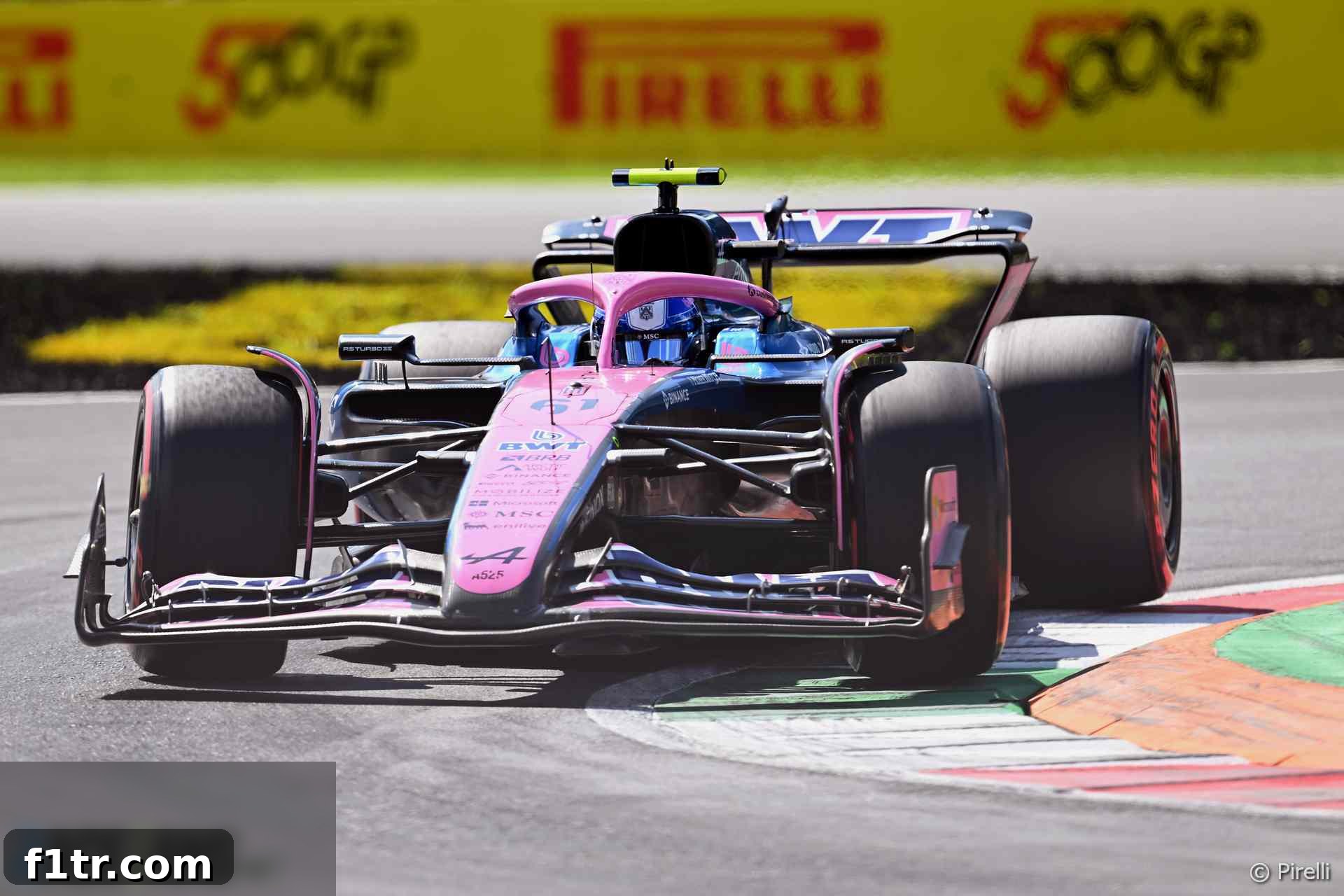
In a demanding display of dedication and the symbiotic relationship between real-world racing and advanced simulation, Paul Aron, Alpine Academy driver, embarked on an extraordinary journey from the high-speed tarmac of Monza to the high-tech confines of Alpine’s Enstone simulator. After an intense first practice session for the Italian Grand Prix, Aron flew back to the team’s base for an overnight simulator session, a critical endeavor designed to immediately translate track data into development insights. This unique undertaking underscores Alpine’s meticulous approach to driver development and car optimization, leveraging every possible opportunity to gain a competitive edge in the fiercely contested world of Formula 1.
Aron’s Friday at Monza was undoubtedly one of the busiest any rookie driver could experience. Piloting Franco Colapinto’s A524 in the first practice, he was tasked with not only familiarizing himself with a current-generation F1 car on one of the sport’s most iconic circuits but also gathering crucial data. Monza, with its long straights and challenging chicanes, demands a delicate balance of outright speed and precise handling, presenting a steep learning curve for any newcomer. For Aron, this was a vital opportunity to prove his capabilities under pressure, not just as a quick driver, but as a valuable technical asset.
The significance of Aron’s immediate transition from track to simulator cannot be overstated. Upon his return to Enstone, he was scheduled for an overnight session, a testament to the urgency and importance of the task at hand. The primary goal was to correlate the data collected during second practice at Monza with his fresh, real-world impressions of the car. This involves a meticulous comparison between what the car’s sensors record and what the driver actually feels – the subtle nuances in steering, braking, acceleration, and tire behavior that telemetry alone cannot fully capture. By having a driver who has just experienced the car in its natural environment provide immediate feedback in the simulator, teams can dramatically improve the accuracy and relevance of their virtual models.
This direct feedback loop is invaluable for Alpine’s engineering team. While simulator drivers are highly skilled, there’s no substitute for the raw, immediate experience of driving an F1 car at maximum attack. Aron’s ability to articulate the car’s behavior, identifying discrepancies between the simulator’s output and the real car’s dynamics, helps engineers fine-tune the simulator’s parameters. This ensures that future development work conducted in the virtual world is based on the most accurate and up-to-date representation of the physical car, accelerating setup improvements and understanding of vehicle performance limits. This process is a cornerstone of modern F1 development, where track testing is severely restricted.
Reflecting on his demanding schedule, Aron candidly admitted, “I think there will be no sleep, but hopefully by Sunday I’ll get to recover a little bit.” This statement highlights the incredible dedication and physical stamina required from aspiring Formula 1 drivers. The relentless schedule, from on-track performance to late-night technical work, showcases the multifaceted role these individuals play within a top-tier racing team. His commitment didn’t end with the simulator session; he was scheduled to return to Monza on Saturday to continue supporting the team trackside, demonstrating a holistic engagement in the race weekend operations.
The team’s rationale behind this intensive schedule is clear: to exploit a rare and precious opportunity. Aron himself articulated the strategic advantage: “You don’t get many opportunities to have a driver who’s driven the car during the weekend go back to the sim and have the actual feel of driving the real car. Normally you just watch the onboards and take the comments of the other drivers. So of course, it’s a good opportunity for the team and I’m pretty sure it’s do-able. I’m interested to see how it goes.” This unique scenario allows Alpine to bridge the gap between theoretical data and empirical driver sensation with unprecedented immediacy, a critical factor in understanding and enhancing the A524’s performance envelope.
During the first practice session at Monza, Aron finished at the bottom of the timesheets, approximately half a second slower than his seasoned teammate, Pierre Gasly. This outcome is not uncommon for rookie drivers in their first F1 practice outings, especially on a demanding circuit like Monza, where maximizing every fraction of a second requires extensive experience. Moreover, Aron experienced a spin at the Roggia chicane, a minor but noticeable incident during his session. However, his composure and professional response to the mistake were commendable.
“Obviously the mistake was made but I think it’s okay,” he stated, demonstrating maturity. “There was nothing wrong with the car and I recovered well and I got to do the whole session.” This self-assessment reflects a deep understanding of the high-stakes environment. In such limited track time, drivers are encouraged to push the boundaries, and minor errors can be part of the learning process, provided they don’t result in significant damage or lost track time. His ability to recover and complete the session ensured that Alpine still collected valuable data from his run.
Aron’s perspective on the spin further illuminated his ambitious approach: “These things can happen and for sure from my side I was trying a little bit in that session. You don’t get many opportunities and you need to take everything with both hands.” This quote encapsulates the mindset of a young driver striving to make an impression. With such scarce chances to drive an F1 car, every lap is an audition, a moment to push limits and demonstrate potential. His willingness to explore the car’s handling characteristics, even if it led to a momentary loss of control, speaks volumes about his determination to learn and perform at the highest level.
For Paul Aron, these opportunities are crucial stepping stones in his journey towards a potential full-time Formula 1 seat. Beyond raw speed, his ability to provide precise, actionable feedback to engineers demonstrates his comprehensive value to a team. Alpine’s investment in Aron, by providing him with FP1 track time and integrating him into immediate data correlation efforts, highlights their commitment to nurturing talent within their academy. It’s a strategic move to not only evaluate his driving prowess but also his technical acumen and dedication, qualities that are just as vital as pure pace in the ultra-competitive world of F1.
Ultimately, Paul Aron’s Monza experience and subsequent simulator sprint epitomize the relentless pursuit of excellence in Formula 1. It showcases the rigorous demands placed on young drivers, the sophisticated methodologies employed by teams to extract every ounce of performance, and the critical role of data correlation in bridging the gap between virtual and real-world racing. His tireless efforts over this intense Friday represent more than just a practice session; they are a vital component of Alpine’s ongoing development strategy and a significant chapter in Aron’s burgeoning motorsport career, underscoring his potential as a future star.
2025 Italian Grand Prix
- No change to McLaren’s team orders after Monza review – Stella
- Bearman did not deserve penalty for Sainz collision at Monza, says Vowles
- Transcript: Hamilton seeking final tenths as he closes gap to Leclerc
- McLaren can clinch F1’s earliest title win since 1988 with as little as fifth place
- How did Verstappen know about Norris’ slow stop in Italy? Red Bull told him
Browse all 2025 Italian Grand Prix articles