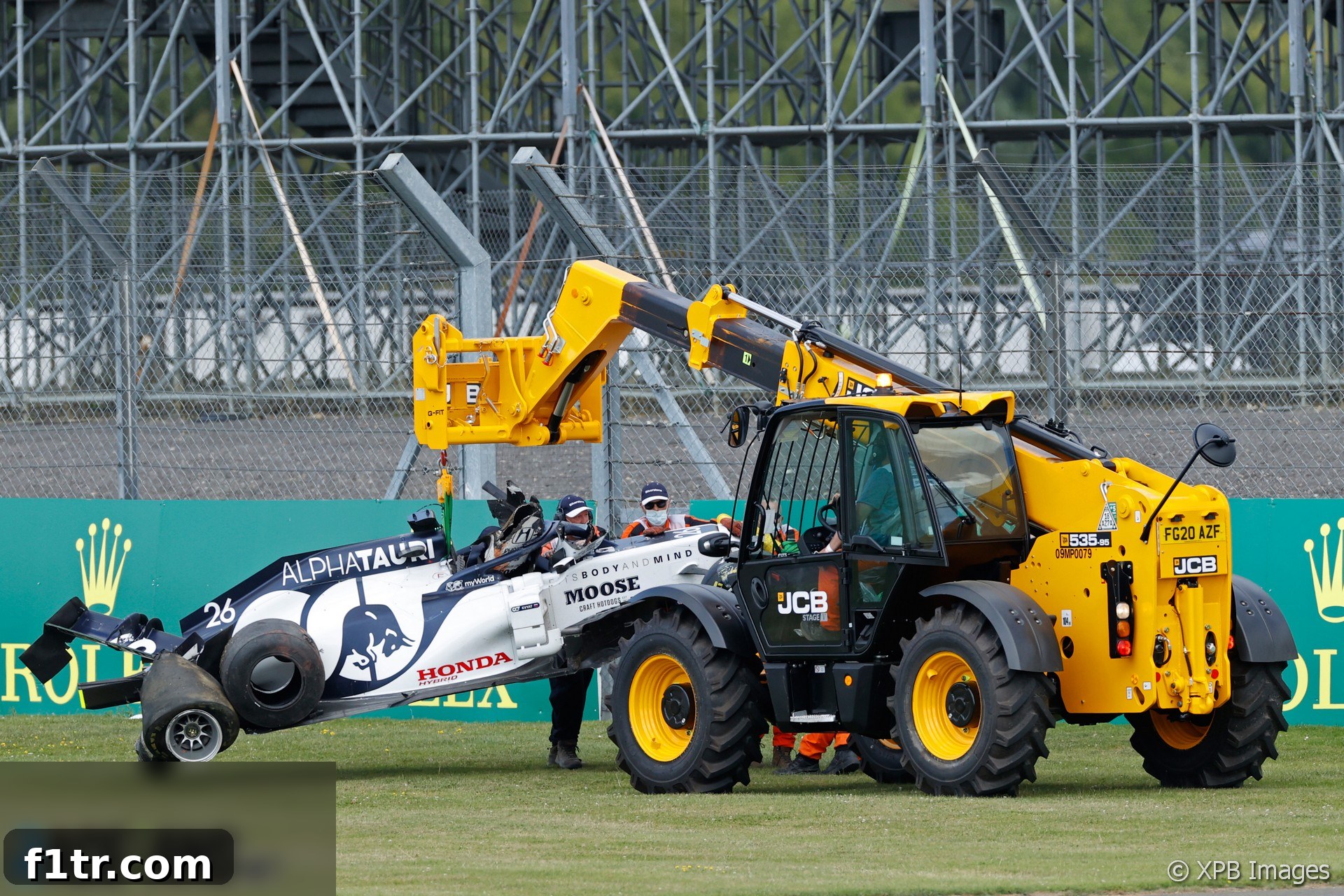
The thrilling and often unpredictable world of Formula 1 frequently delivers moments of high drama, none more critical than an unexpected mechanical failure at high speed. Such was the case during a recent British Grand Prix when AlphaTauri driver Daniil Kvyat experienced a catastrophic tyre failure, leading to a significant crash. For fans and technical observers alike, understanding the root cause of such incidents is paramount, not only for safety but also for the relentless pursuit of performance in motorsport.
In the aftermath of the incident, AlphaTauri’s technical director, Jody Egginton, shed light on the meticulous investigation that followed, revealing the precise technical malfunction behind Kvyat’s dramatic exit from the race. This thorough analysis, conducted in collaboration with tyre supplier Pirelli, underscores the complex interplay of engineering, materials science, and extreme operational conditions that define Formula 1 racing.
Unraveling Kvyat’s Tyre Failure: A Deep Dive into Technical Details
Daniil Kvyat’s right-rear tyre gave way without warning on lap 12 of the British Grand Prix, sending his AlphaTauri car into a high-speed collision. The immediate aftermath left many speculating about the cause, with initial thoughts often turning to tyre wear or debris. However, as Jody Egginton explained, the true culprit was far more specific and insidious, requiring a detailed post-mortem examination by both the team and Pirelli.
“The reason we weren’t quick to come forward and say exactly what we thought the issue was, was that Pirelli were doing their analysis in Milan and we were doing our analysis. We’ve come to our conclusion, Pirelli have come to their conclusion, and it fits.” Egginton stated, highlighting the collaborative and rigorous nature of the investigation.
He continued, “It was a rear brake duct we had a problem with. It was degrading and damaged, and we had heat migrating to the wrong parts of the brake duct, which then effectively heated the rim and that tyre. That got hot and then ultimately that’s what led to the tyre failure.”
The technical director further elaborated on the challenges of the investigation: “It took us a few days to arrive at that conclusion because, as you can imagine, there wasn’t much left to look at. Unfortunately, it is a component degradation which has led to a tyre failure.”
This explanation provides crucial insight into the extreme environment components face in Formula 1. Brake ducts, vital for cooling the brake assemblies, are meticulously designed structures that manage incredibly high temperatures generated under braking. When such a component degrades or sustains damage, its ability to channel heat away effectively is compromised. In Kvyat’s case, this led to an unintended transfer of heat directly to the wheel rim, which in turn superheated the tyre. Tyres are designed to operate within very specific temperature windows, and excessive heat significantly degrades their structural integrity and performance, making them susceptible to sudden failure, even if they appear to have ample tread remaining. The painstaking process of identifying this specific fault, particularly from extensively damaged wreckage, underscores the engineering expertise required at the pinnacle of motorsport.
Insights from the Paddock and Beyond
The Formula 1 paddock is a hive of activity, constantly buzzing with news, observations, and unique perspectives. Beyond the immediate on-track action, social media often offers a candid glimpse into the personalities and behind-the-scenes moments that define the sport. From team principals making rare trackside appearances to former drivers pursuing unexpected hobbies, these insights add layers to the F1 narrative.
During second practice @MercedesAMGF1 team principal Toto Wolff took advantage of the opportunity to watch his cars in action at one of the quickest circuits on the calendar.
Pic: @XPBImages, reproduced with permission#F1 #AnniversaryGP pic.twitter.com/taxQ3q4g2L
— RaceFans (@racefansdotnet) August 7, 2020
An interesting observation from the second practice session saw Mercedes-AMG F1 team principal Toto Wolff taking a rare moment to watch his cars directly from the trackside. This unusual sighting of a prominent team boss away from the pit wall highlights the intense focus and hands-on approach even at the highest levels of team management. It suggests a desire to gain a different perspective on the car’s behavior and performance at one of the calendar’s fastest circuits, emphasizing that even data-driven F1 benefits from the human eye and intuition.
Revelation from tonight’s dinner, courtesy of @AnnieBWansford: Former Jordan and Williams driver Heinz Harald Frentzen makes race track-shaped rugs/carpets. As you do. #F1
— Lawrence Barretto (@lawrobarretto) August 7, 2020
In a delightful revelation, former Formula 1 driver Heinz-Harald Frentzen, known for his stints with Jordan and Williams, has reportedly ventured into an incredibly unique post-racing career: crafting race track-shaped rugs and carpets. This anecdote offers a charming glimpse into the diverse passions and creative pursuits that sometimes emerge after a high-octane career in motorsport. It’s a reminder that beneath the helmets and fierce competition, drivers are individuals with varied interests, and some choose surprisingly artistic or entrepreneurial paths once their racing days conclude.
- For further connections within the F1 community, explore the extensive F1 Twitter Directory to find more official accounts and key figures to follow.
Motorsport News Roundup: Updates from Across the Racing World
Beyond the Formula 1 headlines, the broader motorsport landscape continually offers intriguing developments, strategic insights, and talent showcases. From team updates to junior series breakthroughs, these links provide a comprehensive look at the pulse of racing.
Friday recap (Haas)
Kevin Magnussen: “We’re lacking a little bit of straight-line speed compared to the other car. We lost a little bit of time, but we know it’s got to be there somewhere.”
Haas F1 Team’s struggles with straight-line speed were a notable point during the Friday practice sessions. This highlights the constant battle in Formula 1 to optimize aerodynamics for both downforce in corners and minimal drag on straights. For midfield teams, finding that elusive balance can be particularly challenging, often dictating their competitiveness on different circuit layouts. Magnussen’s comments suggest the team is actively investigating the discrepancy and aiming to unlock more pace.
Ilott beats out Lundgaard to become first repeat polesitter of 2020 (F2)
“Virtuosi’s Callum Ilott got his title challenge firmly back on track in the first points’ paying session of round five, becoming FIA Formula 2’s first repeat pole sitter of the season.”
In the highly competitive FIA Formula 2 Championship, Callum Ilott’s achievement of becoming the first repeat polesitter of the 2020 season is a significant milestone. This demonstrates not only his raw speed but also his consistency under pressure, crucial attributes for any aspiring Formula 1 driver. Pole positions in F2 often translate into strong race results, making this a pivotal moment for his championship aspirations and showcasing the talent within the feeder series.
Sargeant seals second successive pole, ahead of Lawson (F3)
“Logan Sargeant became the first double pole sitter of the season in FIA Formula 3, finishing 0.2s ahead of Hitech Grand Prix’s Liam Lawson in round five at Silverstone.”
Similarly, Logan Sargeant’s back-to-back pole positions in FIA Formula 3 underscore his dominance and emerging potential. Securing successive poles in F3, another fiercely contested junior category, indicates a driver who has found a strong rhythm and understanding of his car and the circuit. This consistent front-running performance is exactly what F1 teams look for when scouting future talent, highlighting the importance of every qualifying session in these critical development series.
Practice (Honda)
“The two Red Bull drivers took new power units this weekend to open up flexibility in terms of PU management, and we will now go through all the data from the 200 laps of running across the four cars to work out the best approach for Saturday and Sunday.”
Honda’s strategic decision to equip the two Red Bull drivers with new power units for the weekend is a significant move in engine management. Teams carefully plan their power unit allocations throughout the season to balance performance, reliability, and penalty avoidance. Introducing new components early can provide greater flexibility later in the season, allowing for more aggressive engine modes or mitigating potential wear. The extensive data analysis from over 200 laps across four cars (Red Bull and AlphaTauri) is vital for optimizing performance for the crucial qualifying and race sessions.
Friday (Renault)
Ciaron Pilbeam: “Everybody ran the same tyres in the morning session, but we have done something different with our tyres compared to most others in the afternoon, and it will be interesting to see how the consequences of that shake out through the rest of the weekend.”
Renault’s differentiated tyre strategy during Friday practice, where they opted for a different compound choice compared to many rivals in the afternoon session, is a testament to the strategic depth of Formula 1. Tyre choices are critical, impacting everything from grip levels and degradation to overall race strategy. Experimenting with different compounds in practice allows teams to gather invaluable data, even if it means sacrificing immediate lap time, to better understand their car’s performance across various tyre specifications and predict potential race scenarios.
70th Anniversary GP practice (Williams)
George Russell: “At least a third of the grid set their quickest time on the medium tyre and not on the soft. I think it will be an interesting and tricky qualifying session.”
George Russell’s observation from Williams regarding a significant portion of the grid setting their fastest practice times on medium tyres, rather than the theoretically quicker soft compounds, highlights a potential curveball for qualifying. This often occurs when soft tyres degrade too quickly or struggle to offer a sufficient performance delta over the mediums, especially on high-energy circuits like Silverstone. Such dynamics can lead to unpredictable qualifying sessions and force teams to reconsider conventional tyre strategies, adding another layer of intrigue to the race weekend.
TCR Asia to split in response to Covid-19 (Touring Car Times)
“The TCR Asia Series is to be split in two for the 2020 season with the creation of TCR Asia North and TCR Asia South.”
The decision to split the TCR Asia Series into two distinct championships, TCR Asia North and TCR Asia South, is a direct response to the logistical challenges and travel restrictions imposed by the global Covid-19 pandemic. This innovative solution allows regional motorsport to continue under difficult circumstances, adapting to local regulations and minimizing international travel for teams and drivers. It showcases the resilience and adaptability of motorsport organizers in finding practical ways to keep racing alive during unprecedented times.
We always endeavour to credit original sources. If you have a tip for a link to feature in the next RaceFans round-up please send it in via the contact form.
Comment of the Day: The Racing Point Penalty Debate
The saga surrounding Racing Point’s penalty for using illicit brake ducts sparked considerable debate within the F1 community, particularly concerning the allocation of points and penalties. The disparity between the constructor and driver points deductions became a focal point for discussion, raising questions about fairness and the nuanced application of sporting regulations.
If Racing Point have had a points deduction, their drivers should too, says @Robbie:
“I agree with Zak Brown on the conundrum that the team has been docked 15 points but the drivers not.”
“I get that the drivers aren’t the ones to be blamed for breaching the sporting regulation on the brake ducts, but still, the constructor points are identical to the combination of both the team’s drivers points, so it seems like it takes a bit of gymnastics to take from one but not the other.”
“And it would seem the drivers benefitted from brake ducts that should have been designed otherwise.”
@Robbie
As highlighted by the comment from @Robbie, mirroring Zak Brown’s sentiments, the discrepancy presents a genuine conundrum. While drivers are generally not held responsible for technical breaches made by their teams, the fact remains that they benefited directly from a component that was deemed illegal. The constructor’s championship points are a direct aggregation of driver performance, making it seem inconsistent to penalize one without affecting the other. This debate touches upon fundamental principles of sporting integrity and the complex challenge of imposing penalties that are both fair and effective in deterring rule infringements within the highly technical and competitive realm of Formula 1.
Milestones and Memories: Celebrating F1 History
Beyond the current news cycle, Formula 1 also thrives on its rich history, celebrating significant milestones and remembering the legends who shaped the sport. These periodic nods to the past serve as a reminder of the enduring legacy of Grand Prix racing.
Happy birthday!
Today, we extend our greetings to anyone celebrating their special day!
If you wish to receive a birthday shout-out on RaceFans, please let us know your birth date via the contact form or by adding it to our community list here.
On this day in F1
- Born today in 1953: Nigel Mansell
Today marks the birthday of one of Formula 1’s most iconic figures, Nigel Mansell. Born in 1953, the charismatic British driver, affectionately known as “Il Leone” (The Lion) by his Italian fans, captivated audiences with his aggressive driving style and never-say-die attitude. A World Champion in 1992 with Williams, Mansell’s career was defined by thrilling overtakes, dramatic victories, and a relentless pursuit of success, making him a true legend of the sport.