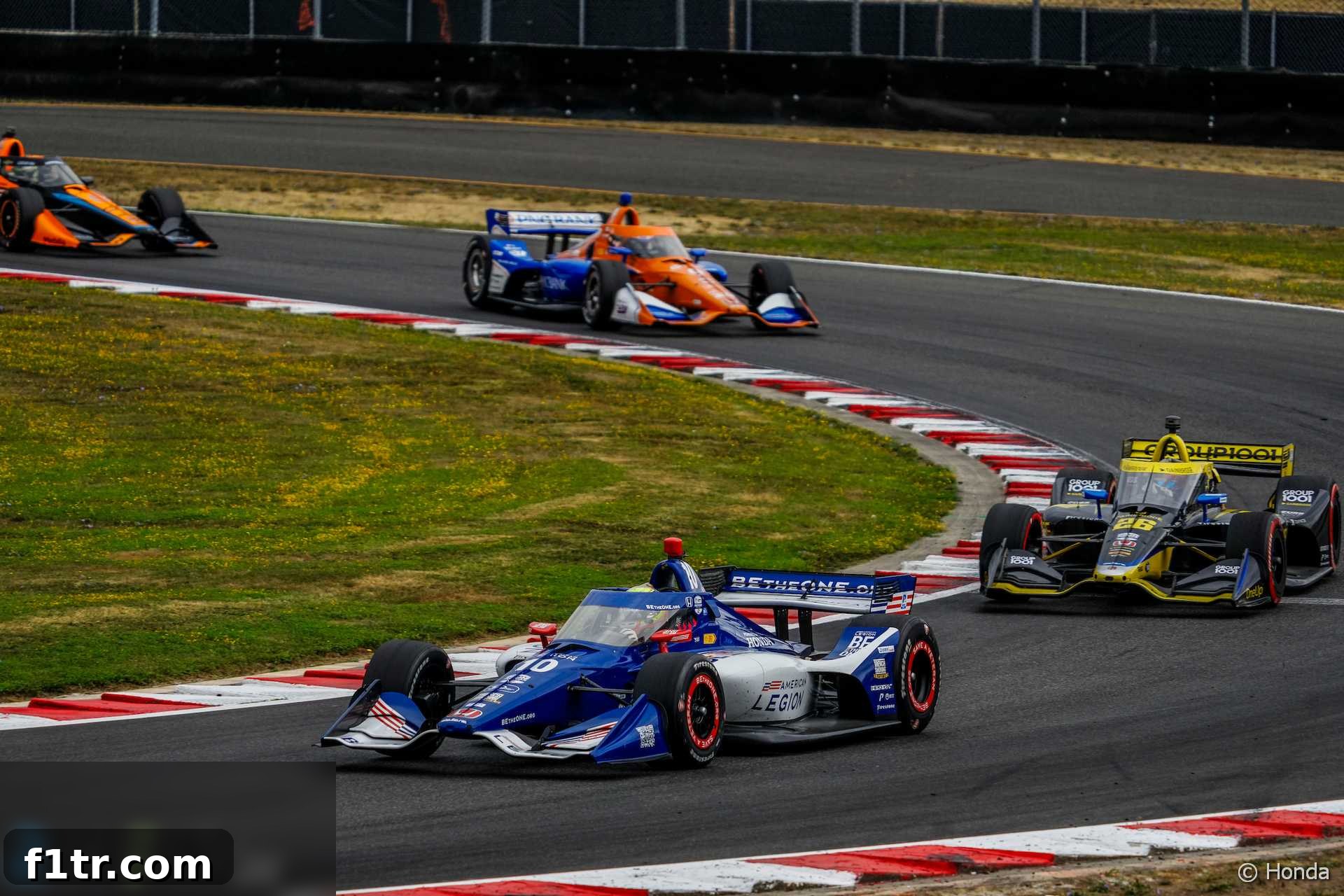
Alex Palou Secures Second IndyCar Championship with Dominant Portland Grand Prix Victory
In a masterful display of strategic brilliance and unmatched driving prowess, Alex Palou cemented his status as a modern IndyCar legend, clinching his second NTT IndyCar Series championship with a commanding victory at the Portland Grand Prix. The Chip Ganassi Racing star’s triumph was characteristic of his extraordinary season, marked by consistent excellence and an uncanny ability to convert strong positions into race wins. This victory not only handed Palou his second title since joining the venerable Chip Ganassi Racing team in 2021 but also etched his name into the history books as the first driver since the reunification of American open-wheel racing in 2008 to seal the championship before the final race of the season. His dominant performance at Portland International Raceway was the culmination of a near-perfect year, reinforcing his reputation as one of the sport’s most formidable talents.
The anticipation leading into the Portland Grand Prix was palpable. While Palou held a substantial points lead, the championship mathematically remained open, with veteran teammate Scott Dixon being his sole remaining challenger. The atmosphere was charged with the possibility of history being made, as fans and pundits eagerly watched to see if Palou could close out the season in style. The weekend began with Graham Rahal securing a surprise pole position, setting the stage for what promised to be an exciting race. Rahal’s performance in qualifying demonstrated the competitiveness of the field, but all eyes were firmly fixed on Palou and Dixon, and their respective strategies for the championship decider.
As the green flag dropped, the race unfolded with immediate drama. Pole-sitter Graham Rahal made a strong start, maintaining his lead in the early stages. However, Alex Palou, starting from fifth on the grid, executed a brilliant opening lap. Despite commencing the race on a used set of the harder, primary tires—a strategic choice that might have seemed conservative to some—Palou demonstrated exceptional car control and race craft, quickly advancing two positions to settle into third place. This early move was indicative of Palou’s confidence and his team’s well-thought-out plan, laying the groundwork for his eventual dominance.
The conditions at Portland International Raceway strongly favored the primary tire compound for the majority of the race distance. This crucial insight would dictate much of the strategic play throughout the 110-lap event. Rahal continued to lead, but Palou remained within striking distance, meticulously managing his tires and observing the race leader’s pace. The first round of pit stops commenced around lap 22, with Rahal being among the first to dive into the pits. This provided Palou with a golden opportunity. As Rahal pitted, Palou inherited the lead, and rather than following suit immediately, he stretched his first stint for an additional ten laps. This extended run proved to be a pivotal moment, allowing him to build up a significant advantage of over six seconds before he eventually made his first stop. During this period, Rahal and Scott McLaughlin found themselves locked in a fierce battle for track position, a skirmish that further played into Palou’s hands as he extended his buffer at the front.
Upon completing his first pit stop, the Ganassi driver re-emerged onto the track and, critically, reclaimed the lead of the race on pure merit. His extended first stint had paid dividends, giving him a comfortable margin. Meanwhile, Scott Dixon, Palou’s only remaining championship rival, settled into second position, running on a similar strategy that kept him in contention but never truly threatening Palou’s lead. As the race progressed into the second round of pit stops, Palou’s command over the field became even more pronounced. His lead continued to grow, stretching to over ten seconds, a testament to his consistent pace, efficient tire management, and the flawless execution by his Chip Ganassi Racing crew. It was a clinic in how to control an IndyCar race from the front, minimizing risks while maximizing performance.
Just as Palou seemed to be cruising towards an unchallenged victory, a full-course caution period interrupted the proceedings on lap 84. Agustin Canapino spun, suffering a terminal mechanical failure that necessitated the deployment of the Safety Car. This was the second caution of what had otherwise been a remarkably clean race, the first having occurred much earlier on lap three due to a spin by Will Power. The Safety Car effectively neutralized Palou’s hard-earned advantage, bunching up the field and setting the stage for a dramatic sprint to the finish. All of Palou’s careful management and strategic gains were suddenly erased, leaving him vulnerable at the restart.
The restart presented Palou with a significant challenge. Felix Rosenqvist, running second, was on the alternate tire compound, known for its superior grip and faster initial pace over a short run. This tire choice theoretically gave Rosenqvist an edge in the crucial opening laps after the Safety Car. However, Palou, demonstrating the composure and skill that have defined his season, was more than up to the task. Not only did he effectively hold off the challenging McLaren driver, but he also pulled clear in the final 20 laps of the race. With precision and unwavering focus, Palou extended his lead once more, ultimately crossing the finish line a comfortable 5.4 seconds ahead of Rosenqvist. In total, Palou led a remarkable 69 out of the 110 laps, an indisputable measure of his dominance on the day.
This second championship for Alex Palou marks a significant milestone not just for the driver, but also for Chip Ganassi Racing. It represents the 15th major American open-wheel championship for the legendary team, further cementing their legacy as one of the most successful outfits in motorsport history. Ganassi’s ability to consistently produce championship-winning cars and drivers speaks volumes about their operational excellence, strategic prowess, and commitment to winning. Palou’s achievement is a proud chapter in their illustrious history, demonstrating the continued strength and competitive spirit of the team.
Behind Palou, the race for other significant positions and championship implications unfolded. Felix Rosenqvist’s second-place finish was his best of the season, a strong performance that could potentially be his penultimate appearance for the McLaren IndyCar team. His efforts showcased his talent and resilience, even as rumors swirled about his future. Scott Dixon’s bid for a record-tying seventh national title ultimately came up short, as he finished third. While a solid points haul, it wasn’t enough to prevent his teammate from clinching the title, but it underscored Dixon’s incredible consistency and enduring competitiveness at the highest level of the sport. Pato O’Ward finished fourth, leaving McLaren with just one more race left to avoid a win-less 2023 season. The team’s inability to secure a victory throughout the year despite strong qualifying performances and flashes of speed remained a significant talking point. Josef Newgarden, who had a challenging qualifying session culminating in a crash, demonstrated impressive recovery to round out the top five, showcasing his determination and skill. Rinus VeeKay’s sixth-place run was his best of 2023, a much-needed boost for the young driver and his Carpenter Racing team.
Further down the order, Marcus Ericsson secured a respectable seventh place, contributing to Ganassi’s strong showing. He finished ahead of David Malukas, who delivered a standout performance by charging from 23rd on the grid to finish eighth. Malukas’s drive was one of the most exciting of the day, highlighting his ability to navigate traffic and make up significant ground. Scott McLaughlin finished just behind Malukas in ninth, while Kyle Kirkwood rounded out the top ten. Graham Rahal, who had started on pole, ultimately finished 12th after gradually slumping down the order following the final restart, unable to maintain his early pace and position. Colton Herta was on track for a top-ten finish but suffered a late spin with just three laps remaining, causing him to drop to 13th, a frustrating end to what could have been a stronger result for the Andretti Autosport driver.
The Portland Grand Prix also saw the debut of Juri Vips, who, by default, emerged as the top rookie, finishing 18th. While not a performance that set the world alight, it provided valuable experience for the young driver in a new discipline. Marcus Armstrong, another promising rookie, had a disastrous pit stop where his rear-right wheel detached after service, costing him significant time and positions. Despite this setback, Armstrong finished 19th and remains comfortably positioned to clinch the Rookie of the Year award next week at the season finale at Laguna Seca Raceway, a testament to his consistent performances throughout the year.
Beyond Canapino’s spin due to mechanical failure, the only other retirement of the race was Romain Grosjean. The Frenchman suffered damage in a lap one collision with Callum Ilott, forcing him to retire after just 32 laps. These incidents, while unfortunate, were relatively isolated, allowing the majority of the race to unfold under green flag conditions, emphasizing the pure racing talent on display. The Portland Grand Prix thus provided a fitting stage for Palou’s coronation, showcasing both the strategic depth and the fierce competition that define the NTT IndyCar Series.
Portland Grand Prix Results
| Position | Car | Driver | Team | Engine |
|---|---|---|---|---|
| 1 | 10 | Alex Palou | Ganassi | Honda |
| 2 | 6 | Felix Rosenqvist | McLaren | Chevrolet |
| 3 | 9 | Scott Dixon | Ganassi | Honda |
| 4 | 5 | Pato O’Ward | McLaren | Chevrolet |
| 5 | 2 | Josef Newgarden | Penske | Chevrolet |
| 6 | 21 | Rinus VeeKay | Carpenter | Chevrolet |
| 7 | 8 | Marcus Ericsson | Ganassi | Honda |
| 8 | 18 | David Malukas | Coyne/HMD | Honda |
| 9 | 3 | Scott McLaughlin | Penske | Chevrolet |
| 10 | 27 | Kyle Kirkwood | Andretti | Honda |
| 11 | 45 | Christian Lundgaard | RLL | Honda |
| 12 | 15 | Graham Rahal | RLL | Honda |
| 13 | 26 | Colton Herta | Andretti | Honda |
| 14 | 6 | Felix Rosenqvist | McLaren | Chevrolet |
| 15 | 77 | Callum Ilott | Juncos Hollinger | Chevrolet |
| 16 | 14 | Santino Ferrucci | Foyt | Chevrolet |
| 17 | 29 | Devlin DeFrancesco | Andretti | Honda |
| 18 | 30 | Juri Vips | RLL | Honda |
| 19 | 11 | Marcus Armstrong | Ganassi | Honda |
| 20 | 7 | Alexander Rossi | McLaren | Chevrolet |
| 21 | 20 | Ryan Hunter-Reay | Carpenter | Chevrolet |
| 22 | 55 | Benjamin Pedersen | Foyt | Chevrolet |
| 23 | 51 | Sting Ray Robb | Coyne/RWR | Honda |
| 24 | 60 | Tom Blomqvist | Meyer Shank | Honda |
| 25 | 12 | Will Power | Penske | Chevrolet |
| 26 | 78 | Agustin Canapino | Juncos Hollinger | Chevrolet |
| 27 | 28 | Romain Grosjean | Andretti | Honda |
IndyCar Series News and Updates
- IndyCar driver McLaughlin cleared of injury after crashing through barrier at Barber
- Schumacher says his IndyCar feels like ‘an F2 car, just with better tyres’
- IndyCar “way faster than Formula 1” in some corners, says Grosjean
- FIA to award more F1 superlicence points to IndyCar drivers from 2026
- Schumacher to race full-time in IndyCar with RLL in 2026
Browse all IndyCar articles