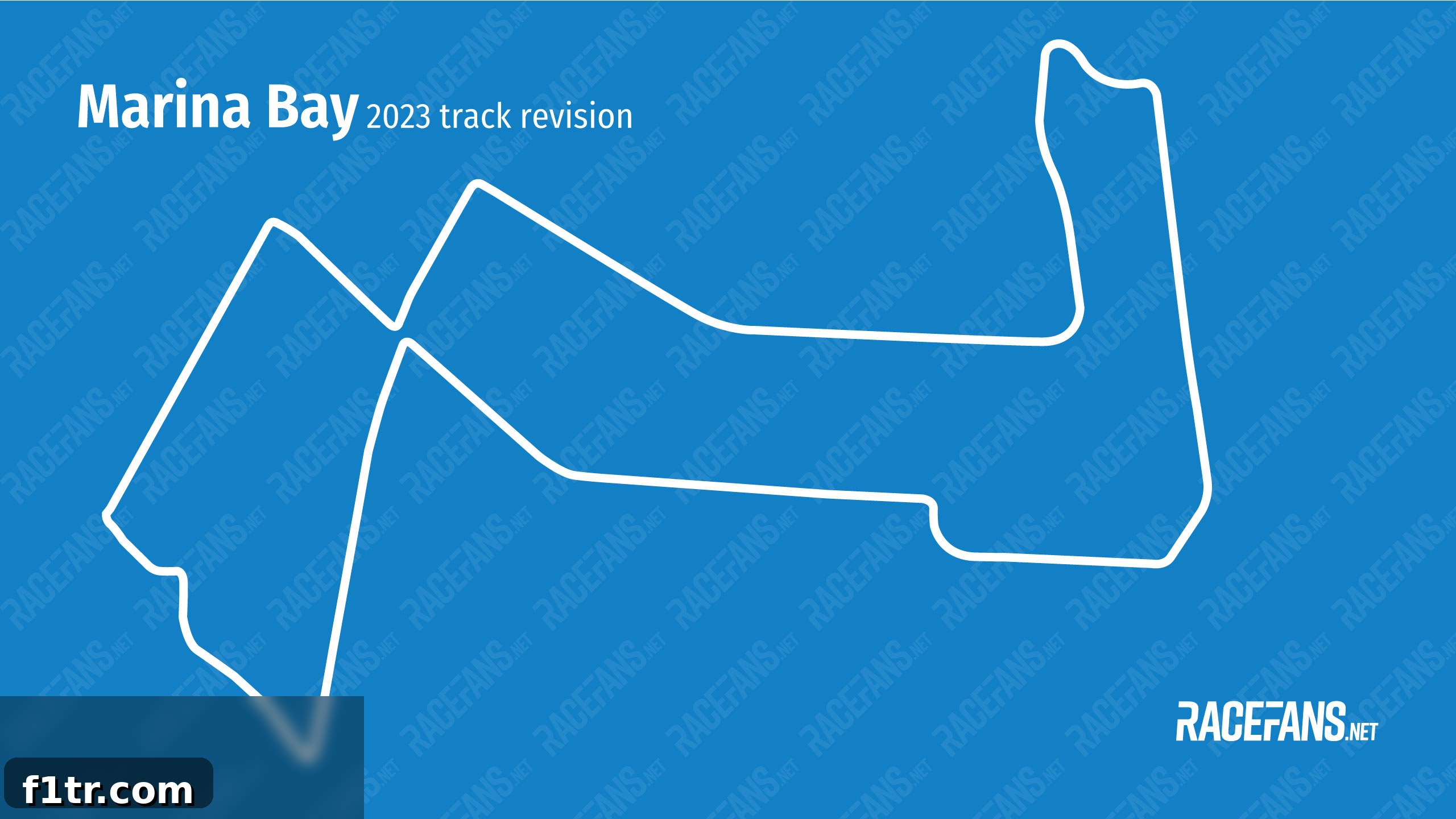
The Singapore Grand Prix has officially confirmed a significant alteration to its iconic Marina Bay Street Circuit layout for the upcoming 2023 Formula 1 season. This temporary change will see a shorter track configuration implemented, primarily due to extensive development work taking place in the final sector of the city circuit. Fans and teams can anticipate a fresh challenge and potentially even more thrilling action as Formula 1 cars once again light up the Singapore night sky.
Revolutionary Changes to Marina Bay Street Circuit for 2023
In a move that will redefine the challenge of one of Formula 1’s most demanding circuits, turns 16 to 19 will be effectively bypassed. A newly introduced straight will now guide cars directly to what is currently known as Turn 20, streamlining a complex sequence of corners. This modification is directly linked to the extensive urban redevelopment project of the country’s new National Service Square, located to the south of this reconfigured section.
The construction and renovation efforts for the National Service Square are scheduled to commence in March of next year, with an anticipated completion date towards the end of 2026. While this ambitious project unfolds, Formula 1 enthusiasts can rest assured that the Singapore Grand Prix remains a fixture on the calendar, as the city-state’s current F1 contract extends for two years beyond the completion of the square, ensuring the future of this spectacular night race.
The restructuring of the track will naturally lead to several immediate consequences. Most notably, the Bay Grandstand, a popular viewing spot for fans, will be temporarily removed to accommodate the construction. This critical change means the total number of corners on the demanding Marina Bay street circuit will decrease from 22 to 19. Furthermore, the overall track length will be reduced by 137 metres, resulting in a revised lap distance of 4.928 kilometres.
To ensure that the Grand Prix maintains its full race distance and integrity, the lap count for the 2023 event will be increased from 61 laps to 63. This adjustment guarantees that the total distance covered by the cars during the race remains consistent with Formula 1 regulations, despite the shorter individual lap length.
Anticipated Faster Lap Times and Evolving Race Dynamics
The modified layout is expected to dramatically impact lap times and, consequently, the racing spectacle itself. Simulations conducted using digital models of 2020 F1 cars – which, interestingly, never had the opportunity to race on the original Singapore circuit – suggest a substantial increase in speed. Projected lap times indicate figures around 1 minute 27.7 seconds in qualifying trim and approximately 1 minute 30.3 seconds during race conditions.
To put this into perspective, pole position laps in both the 2018 and 2019 Singapore Grand Prix, utilizing cars with comparable performance characteristics, were consistently around the 1 minute 36 second mark. This data suggests that the new, shorter configuration could result in lap times that are approximately eight seconds faster. Such a significant reduction will undoubtedly alter race strategies, potentially leading to fewer pit stops or different tyre management approaches, as drivers spend less time navigating the technical final sector.
It is important to note, however, that a direct comparison to recent performance data is complicated. The introduction of new technical regulations for the 2022 season resulted in inherently slower Formula 1 cars compared to previous generations. Moreover, the 2022 Singapore Grand Prix weekend was heavily impacted by adverse weather conditions, including significant rainfall, making any direct year-on-year lap time gain comparison particularly challenging and potentially misleading.
Driver and Team Implications
The removal of turns 16-19 and their replacement with a high-speed straight will require drivers to adapt quickly. The previous sequence was highly technical, demanding precision and a nuanced understanding of tyre grip and car balance. The new straight could become a prime overtaking zone, especially with DRS, which could lead to more thrilling wheel-to-wheel action into the new Turn 20. Teams will need to re-evaluate their car setups, potentially opting for lower downforce configurations to maximise speed on the straights, while still ensuring stability through the circuit’s remaining challenging sections. This delicate balance between straight-line speed and cornering grip will be crucial for success on the revised Marina Bay circuit.
Long-Term Vision and the Circuit’s Evolving Legacy
While the immediate focus is on the 2023 race, the architects involved in the development of the new NS Square have provided intriguing glimpses into the future. Images released by their firms suggest a long-term intention to integrate the Formula 1 circuit with the completed grandstand, allowing cars to race past the new structure once it is fully built. This vision hints at a future iteration of the Marina Bay Street Circuit that seamlessly blends with the revitalized urban landscape.
However, the timeline for this ambitious integration remains somewhat fluid. The completion date for the NS Square project has already faced delays, being pushed back by a year largely due to the global pandemic’s impact on construction and logistics. Consequently, the race promoters have yet to provide a definitive indication of when they anticipate this future track configuration, incorporating the new grandstand, might come to fruition.
This upcoming modification marks the sixth significant change to the Singapore Grand Prix circuit since its inaugural race in 2008. The circuit has a rich history of adaptation, demonstrating its commitment to continuous improvement and addressing logistical or sporting requirements. For instance, the track underwent a slight shortening with a corner alteration for its second running in 2009. A more substantial modification followed in 2013 with the permanent removal of the infamous Singapore Sling chicane, a corner that had proven controversial among drivers.
Further enhancements to the circuit continued in 2015, when the bridge area that follows the now-removed Singapore Sling was modified to improve racing lines and safety. More recently, in 2018, turns 16 and 17 were reprofiled, once again with the dual aim of enhancing both the racing challenge and driver safety. Each of these modifications has contributed to the unique character and enduring appeal of the Marina Bay Street Circuit, ensuring it remains a favourite among drivers and fans alike.
Anticipating the 2023 Singapore Grand Prix
The upcoming 2023 Singapore Grand Prix promises to be an extraordinary event, not only for the high-octane racing under the floodlights but also for the unveiling of this significantly reconfigured track. The changes present a new puzzle for teams to solve and an altered spectacle for fans to enjoy. Will the faster lap times lead to more dramatic overtakes, or will the new straight provide a momentary respite before the next complex section? Only time will tell, but the anticipation is palpable.
The commitment of Singapore to hosting a world-class Formula 1 event, even amidst major urban development, underscores its dedication to the sport. While the Bay Grandstand will be missed by some, the prospect of an even quicker and potentially more action-packed race, coupled with the long-term vision for integrating the circuit with the future National Service Square, paints an exciting picture for the evolution of the Singapore Grand Prix. This temporary layout is more than just a logistical workaround; it’s a testament to the dynamic nature of Formula 1 and its ability to adapt and innovate.
Advert | Become a RaceFans supporter andgo ad-free
2023 F1 Season Insights
Stay informed with the latest developments and analyses from the thrilling 2023 Formula 1 season:
- FIA president cleared of alleged interference in two 2023 races
- First week viewing figures for new Drive to Survive season fall again
- Max who? Drive to Survive season six prefers its favourite faces
- RaceFans’ complete 2023 season review
- The F1 drivers who pulled off the 10 biggest charges through the field in 2023
Browse all 2023 F1 season articles