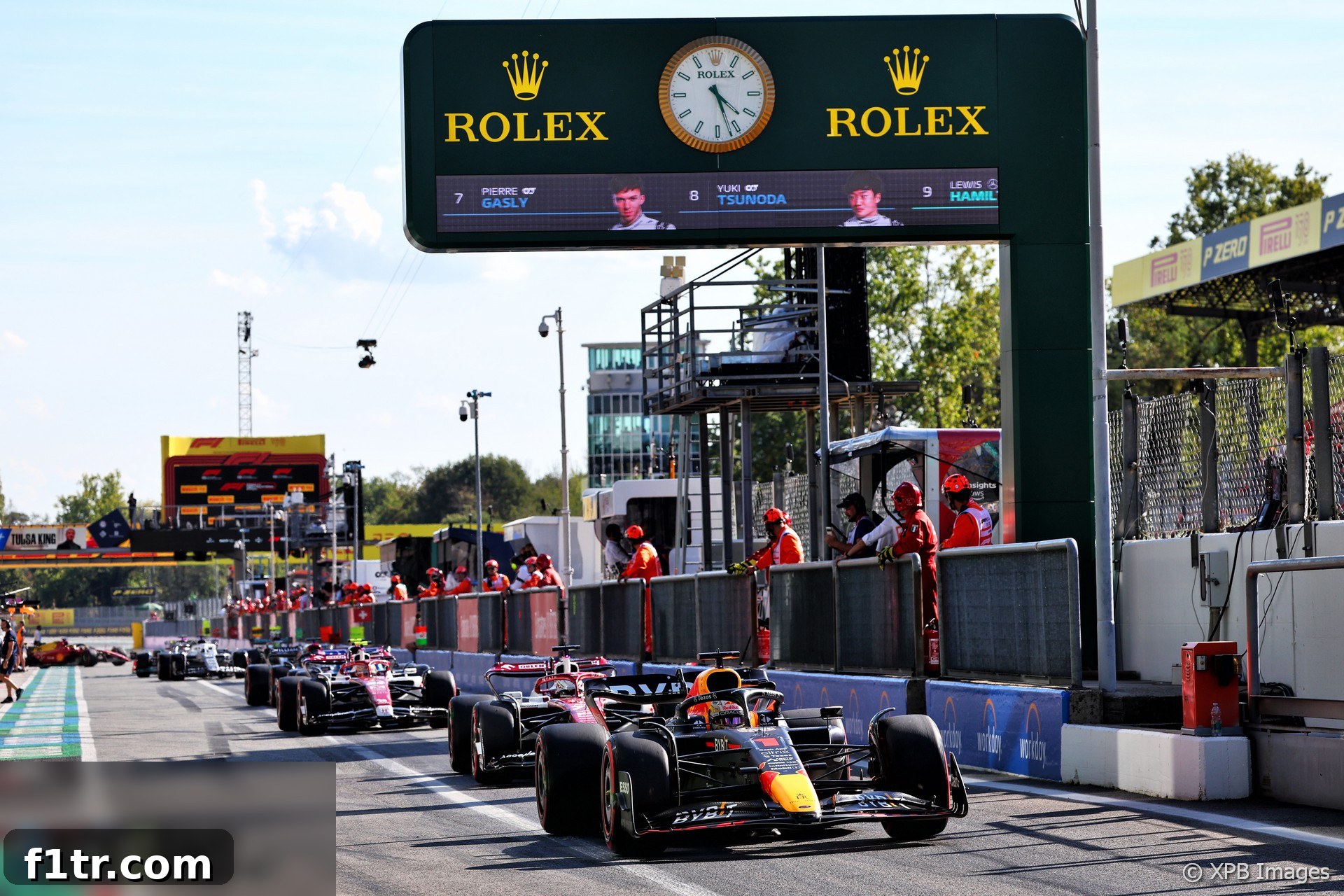
Decoding the Monza Maze: Unraveling F1’s Italian Grand Prix Grid Penalties
The 2022 Formula 1 Italian Grand Prix presented a grid scenario unlike any other, plunging drivers, teams, and fans alike into a state of profound confusion. With an astonishing nine drivers receiving various grid penalties, piecing together the starting order for the race at Monza became a complex puzzle, defying easy comprehension even for those directly involved in the sport. The unique nature of the high-speed Monza circuit, often a strategic location for power unit changes, combined with a myriad of regulatory infringements, culminated in a grid that was anything but straightforward to predict.
The sheer intricacy of the situation was palpable throughout the paddock. Max Verstappen, a usually composed and rule-savvy driver, found himself in an FIA press conference, confidently asserting his expected P7 starting position. Yet, just moments away, Fernando Alonso was sharing with journalists his anticipation of starting “P7” as well – a clear indication of the widespread uncertainty. Meanwhile, Esteban Ocon and Pierre Gasly took to social media, candidly asking their followers for clarification on their starting positions, with Ocon admitting, “I have no idea.” This widespread confusion underscored the urgent need for a clearer, more accessible understanding of Formula 1’s intricate penalty system.
A Symphony of Sanctions: The Roots of the Grid Chaos
The deluge of penalties at Monza was not a random occurrence but rather a confluence of Formula 1’s technical regulations and strategic team decisions. At the heart of the matter lies the sport’s stringent rules regarding power unit component usage. Drivers are typically allocated a limited number of key power unit components – such as internal combustion engines, turbochargers, MGU-H, and MGU-K units – for the entire season. Exceeding these allowances inevitably triggers grid penalties, a measure designed to control costs and promote reliability. Monza, with its long straights and emphasis on engine power, often becomes a strategic venue for teams to introduce new power unit components, knowing that the potential for overtaking on this particular circuit might mitigate the impact of a grid drop.
Beyond power unit changes, other infractions also contributed to the grid chaos. Gearbox component changes, exceeding reprimand limits, and even minor on-track infringements like failing to slow for yellow flags, all carry their own specific penalties. The accumulation of these diverse sanctions across nearly half the grid created a unprecedented challenge for the FIA stewards and ultimately for the race itself.
Who Got What? A Detailed Look at Driver Penalties
To fully grasp the complexity of the 2022 Italian Grand Prix grid, it’s essential to examine each driver’s specific transgressions and the resulting penalties. The list of sanctioned drivers was extensive, encompassing a range of grid drops and the more severe ‘start at the back of the grid’ penalties:
- Max Verstappen (Red Bull): A five-place grid penalty was imposed due to a power unit component change, specifically exceeding the allowed number of internal combustion engines.
- Esteban Ocon (Alpine): Also received a five-place grid penalty for a power unit component change, mirroring Verstappen’s infringement.
- Sergio Perez (Red Bull): Incurred a 10-place grid penalty for a power unit component change, indicating a larger overhaul of his engine components.
- Valtteri Bottas (Alfa Romeo): Faced a significant 15-place grid penalty due to multiple power unit component changes, signaling a comprehensive replacement of various engine elements.
- Kevin Magnussen (Haas): Like Bottas, he was handed a 15-place grid penalty for multiple power unit component changes, affecting his starting position considerably.
- Mick Schumacher (Haas): Received a 15-place grid penalty, a combination of power unit and gearbox component changes, highlighting issues across different critical vehicle systems.
- Lewis Hamilton (Mercedes): Was ordered to ‘start at the back of the grid’ for extensive multiple power unit component changes, effectively committing him to the very last rows regardless of his qualifying performance.
- Carlos Sainz Jnr (Ferrari): Also received a ‘start at the back of the grid’ penalty due to multiple power unit component changes (incurred twice, though the duplication had no further impact beyond the initial ‘start at back’ rule). He also had an additional 10-place grid penalty for gearbox component changes.
- Yuki Tsunoda (AlphaTauri): Faced a ‘start at the back of the grid’ penalty for multiple power unit component changes. On top of this, he accumulated a 10-place grid penalty for collecting five reprimands over the season and a further three-place grid penalty for ignoring yellow flags during a session.
The FIA Rulebook: Navigating the Penalty Application Process
The application of F1 grid penalties is governed by a series of precise, albeit sometimes bewildering, sporting regulations. Over the years, the process has evolved significantly, often in an effort to simplify the system or to ensure penalties are fully served. The 2022 Italian Grand Prix highlighted the current iteration of these rules, particularly the hierarchy and sequencing of different penalty types.
The Primacy of “Start at the Back” Penalties
The fundamental principle dictating the sorting of drivers with penalties is the precedence given to the ‘start at the back of the grid’ penalty. This rule is absolute: any driver who receives this penalty will line up behind all drivers who have received only traditional ‘grid drop’ penalties. Even if a driver theoretically accumulated a 100-place grid drop, they would still start ahead of a driver assigned a ‘start at the back’ penalty. Furthermore, once a ‘start at the back’ penalty is incurred, any additional grid drops or component change penalties a driver might have accrued effectively become moot. For example, Carlos Sainz incurring the ‘start at the back’ penalty twice, or Yuki Tsunoda having multiple additional grid drops, made no difference to their ultimate starting position once the primary ‘start at the back’ rule was applied.
Applying Grid Drops: Initial Calculations
According to the F1 sporting regulations, traditional grid drops are applied to drivers based on their qualifying positions before the ‘start at the back of the grid’ penalties are fully integrated into the final sequence. This initial calculation helps establish a theoretical pecking order among those with finite grid drops. For the six drivers who received only grid drops, their initial theoretical relegation was calculated as follows:
- Verstappen: Qualified second, theoretically relegated to seventh position.
- Perez: Qualified fourth, theoretically relegated to 14th position.
- Ocon: Qualified 11th, theoretically relegated to 16th position.
- Bottas: Qualified 12th, theoretically relegated to 27th position.
- Magnussen: Qualified 19th, theoretically relegated to 34th position.
- Schumacher: Qualified 20th, theoretically relegated to 35th position.
Naturally, some of these calculated positions, such as 27th, 34th, and 35th, are impossible on a typical 20-car Formula 1 grid. This clearly indicated that further adjustments would be necessary once the ‘start at the back’ penalties were factored into the final grid composition.
Assembling the Puzzle: How the Grid Takes Shape
The true complexity arose when integrating the ‘start at the back of the grid’ penalties with the traditional grid drops. The process involves a careful re-ordering that significantly impacts the final positions of many drivers, often lessening the effective impact of their initial penalties.
Securing the Back Row: Sainz, Hamilton, and Tsunoda
As per the rules, the three drivers with ‘start at the back of the grid’ penalties – Carlos Sainz Jnr, Lewis Hamilton, and Yuki Tsunoda – were always destined to occupy the very last three places on the grid. Their specific order within these final positions is determined by their qualifying performance relative to each other. Therefore, based on their qualifying times, their positions were:
| Position | Driver |
|---|---|
| 18 | Carlos Sainz Jnr |
| 19 | Lewis Hamilton |
| 20 | Yuki Tsunoda |
The Cascade Effect: Other Drivers Move Up
With Sainz, Hamilton, and Tsunoda firmly placed at the very back, a significant cascade effect rippled through the rest of the grid. Drivers who had received traditional grid drops, especially those whose initial theoretical relegations placed them beyond the 20-car limit, benefited greatly. The presence of so many drivers starting from the back effectively “cancelled out” much of the severity of their own penalties. The next five places on the grid were then occupied by these drivers, now in revised positions:
| Position | Driver |
|---|---|
| 13 | Sergio Perez |
| 14 | Esteban Ocon |
| 15 | Valtteri Bottas |
| 16 | Kevin Magnussen |
| 17 | Mick Schumacher |
Consequently, the actual grid drops served by these drivers were considerably less punitive than their original penalties. Sergio Perez, for instance, dropped only nine places instead of 10. Esteban Ocon lost three places instead of five. The Haas pair, Kevin Magnussen and Mick Schumacher, who were each theoretically relegated by 15 places, effectively gained three positions compared to their maximum possible drop, highlighting the significant mitigating effect of the multiple ‘start at the back’ penalties.
Verstappen’s Unique Case: A Full Penalty Served
Amidst this complex recalibration, Max Verstappen found himself in a unique position. Despite the extensive penalties affecting many drivers behind him, he was the only one who served his full grid drop without any mitigation. Having qualified second and receiving a five-place penalty, he started exactly P7. This is in line with a specific F1 regulation: if there are sufficient un-penalized drivers to move ahead of a driver with a grid drop, that driver does not benefit from others being moved further back on the grid due to ‘start at the back’ penalties. In Verstappen’s case, there were enough drivers without severe penalties to slot in front of him, ensuring he served his full five-place relegation. Meanwhile, other drivers like Pierre Gasly and Fernando Alonso (who ended up starting P6, confounding his own P7 expectation) benefited from the shuffling of the grid, moving up the order.
The Final Starting Grid for the Italian Grand Prix
After all the calculations, permutations, and appeals, the final starting grid for the 2022 Italian Grand Prix solidified as follows, a testament to the intricate dance of penalties and regulations:
| Position | Driver |
|---|---|
| 1 | Charles Leclerc |
| 2 | George Russell |
| 3 | Lando Norris |
| 4 | Daniel Ricciardo |
| 5 | Pierre Gasly |
| 6 | Fernando Alonso |
| 7 | Max Verstappen |
| 8 | Nyck de Vries |
| 9 | Zhou Guanyu |
| 10 | Nicholas Latifi |
| 11 | Sebastian Vettel |
| 12 | Lance Stroll |
| 13 | Sergio Perez |
| 14 | Esteban Ocon |
| 15 | Valtteri Bottas |
| 16 | Kevin Magnussen |
| 17 | Mick Schumacher |
| 18 | Carlos Sainz Jnr |
| 19 | Lewis Hamilton |
| 20 | Yuki Tsunoda |
Historical Precedent and Driver Insight
The way Formula 1 applies penalties has not been static. Several years prior, the FIA implemented these sanctions differently, often by applying each penalty sequentially and re-ordering the grid after each application. This older methodology frequently resulted in situations where multiple penalties could partially or fully “cancel each other out,” leading to less severe overall consequences for drivers. However, the current practice, as exemplified at Monza, is a deliberate shift towards ensuring drivers serve the entirety of their penalties where operationally possible, aiming for greater sporting integrity and consistency.
Verstappen’s Confidence and the Qatar Grand Prix Parallel
Max Verstappen’s remarkable confidence in stating his exact starting position of P7, even amidst the widespread confusion, was rooted in a clear understanding of these updated regulations and recent precedents. He famously quipped, “It’s P7, unless I’m stupid, I think it’s P7. You need to read the rules.” His assertion was well-founded, backed by a clear precedent from the previous year’s Qatar Grand Prix. In that instance, Verstappen’s situation was almost identical: he qualified second, received a five-place grid penalty, and subsequently started seventh. Crucially, a penalty dropped another driver from third to sixth, but neither sanction affected the other’s application. This demonstrated that the system is designed to ensure penalties are served independently where possible, reinforcing Verstappen’s correct prediction for Monza.
Beyond the Grid: Implications for Race Day
The scrambled grid at the 2022 Italian Grand Prix had significant implications for the race itself. Drivers starting out of position, particularly those like Carlos Sainz and Lewis Hamilton who began from the back, faced an uphill battle to recover positions. However, Monza’s high-speed nature and ample overtaking opportunities meant that strong recovery drives were entirely plausible, adding an extra layer of excitement and unpredictability to the race. For drivers like Max Verstappen, starting seventh meant a slight disadvantage but one he was well-equipped to overcome with the dominant Red Bull machinery. The unique grid undoubtedly shaped team strategies, from tire choices to early race aggression, making the Italian Grand Prix a fascinating tactical encounter.
The Ongoing Debate: Simplicity vs. Sporting Integrity
The chaotic grid at Monza reignited the perennial debate surrounding Formula 1’s penalty system. While the FIA’s intention to ensure penalties are fully served and to maintain sporting integrity is commendable, the complexity and opaqueness of the rules continue to frustrate drivers, teams, and fans alike. The confusion expressed by even seasoned F1 professionals underscores the challenge of balancing robust regulations with a system that is transparent and easy to understand. As Formula 1 continues to evolve, finding a simpler, yet equally fair, method for applying grid penalties remains a key area for potential reform, ensuring that the spectacle on track is not overshadowed by the intricacies off it.
2022 Italian Grand Prix Related Articles
- Helmet rows, hot mics and more forgotten motorsport stories from 2022
- McLaren ‘surprised two teams found more performance than everyone else’ in 2022
- Alpine confident for Singapore and Suzuka races after “massive” floor upgrade
- Red Bull’s RB18 suits Verstappen more than Perez now – but that’s not by design
- “We’ll have four racing laps’: How F1’s Safety Car confusion unfolded at Monza
Browse all 2022 Italian Grand Prix articles