The 2024 Saudi Arabian Grand Prix at the lightning-fast Jeddah Corniche Circuit once again showcased Red Bull Racing’s formidable dominance, with the team securing another emphatic one-two finish. While Max Verstappen and Sergio Perez cruised to victory, Ferrari’s Charles Leclerc emerged with a renewed sense of optimism, despite not having the outright pace to challenge the reigning champions. Leclerc’s post-race comments highlighted a crucial silver lining for the Scuderia: their car demonstrated encouraging long-run pace, especially towards the latter stages of each stint.
Leclerc’s weekend was a mixed bag, defined by initial struggles with tire activation but marked by a commendable resurgence in performance as his tires came up to temperature. This characteristic – a slow start followed by strong sustained pace – has been a recurring theme for Ferrari. The Monegasque driver explained, “We were struggling all the time at the beginning of the stints, whether it was at the beginning of the medium or beginning on the hards, we struggled to switch the tyres on. Then towards the end of the stint we were pretty good.” This suggests that while outright single-lap qualifying pace might still be a challenge, Ferrari is making strides in tire degradation and overall race management over longer distances, a critical factor for championship contention.
However, the burning question that lingers for every team chasing Red Bull is the true extent of the front-running Bulls’ pace. Were Verstappen and Perez truly pushing to their limits, or were they managing their cars and tires with a comfortable buffer, ready to unleash more speed if challenged? This unknown makes Leclerc’s late-stint pace difficult to benchmark definitively, yet it provides a psychological boost for the Maranello squad.
Early Race Dynamics and the Safety Car Incident
The race start for Leclerc was immediately challenging. He found himself engaged in a fierce rear-guard action to defend his second position from a charging Sergio Perez. The Mexican driver, capitalizing on Red Bull’s superior straight-line speed, wasted no time and swiftly deployed his Drag Reduction System (DRS) to bypass Leclerc into second place by the fourth lap. This early move underscored the performance gap, as Leclerc was losing up to half a second per lap to the leading RB20s on his initial set of medium tires.
A pivotal moment arrived on lap seven with the deployment of the Safety Car. Lance Stroll’s crash brought the entire field into the pits for their mandatory tire change. This incident, while disruptive, played a critical role in homogenizing tire strategies across the grid, allowing most front-runners to switch from medium to hard compound tires, which they would run until the checkered flag. Leclerc, Verstappen, and Perez were among the first to pit, setting up a direct comparison of their car’s capabilities on the durable hard compounds.
Immediately following the Safety Car restart, Leclerc lost significant ground to Verstappen and even had to work hard to get past Lando Norris in the McLaren. This phase of the race again highlighted Ferrari’s initial struggle to get the hard tires into their optimal operating window. However, as the stint progressed and the tires began to bite, Leclerc’s pace dramatically improved. By the closing stages of the Grand Prix, he was consistently lapping quicker than both Red Bulls, a testament to Ferrari’s improved long-run performance. This sustained speed culminated in a remarkable achievement: Leclerc snatched the fastest lap of the race on the final tour, outpacing even Max Verstappen.
Significantly, Leclerc’s fastest lap time of 1’31.632 was not only quicker than Verstappen’s best on the final lap but also beat Lewis Hamilton’s impressive time set on soft tires a dozen laps earlier. This underscores the genuine pace Ferrari unlocked towards the end of the race. Leclerc himself took significant encouragement from this, stating, “All in all, it’s been a positive race. I think we are doing small steps in the right direction. If I look back the last six, seven months, we are the team that have improved the most and we are slowly closing the gap. So the gap is still quite big. But if we keep working like that, I’m sure it’s a matter of time before we put the Red Bull under a bit more pressure.” This declaration reflects a growing confidence within the Ferrari camp, signaling their intent to challenge for wins as the season progresses.
Verstappen’s Challenge and Haas’s Controversial Strategy
While Leclerc celebrated his fastest lap, it’s essential to consider the circumstances that might have influenced Verstappen’s pace in the final laps. The reigning world champion’s performance was notably compromised by heavy traffic. He encountered a cluster of backmarkers that had been deliberately held up by Kevin Magnussen earlier in the race. Navigating these slower cars made it difficult for Verstappen to maintain optimal tire temperature, impacting his ultimate lap times. “With the back markers at the end the tyres were getting a bit cold and it was a bit slippery getting close to them,” Verstappen commented. “And of course then also you don’t want to take too much risk. We had a good gap behind. So that was probably a little bit of a difficult moment to pace yourself.” This perspective adds context to Leclerc’s fastest lap, suggesting that while Ferrari’s pace was genuinely strong, Verstappen wasn’t necessarily pushing flat out in clear air.
The strategic actions of the Haas F1 Team became one of the most talked-about aspects of the 2024 Saudi Arabian Grand Prix. Their decision to strategically slow down Kevin Magnussen in the latter half of the race was driven by the unfortunate reality that Magnussen had incurred two separate 10-second time penalties, effectively eliminating his chances of scoring points. From lap 22 onwards, Magnussen dramatically reduced his pace, deliberately backing up the cars behind him. This controversial tactic was executed to benefit his teammate, Nico Hulkenberg, who was then running in a points-scoring position. By creating a significant delay for the cars chasing Hulkenberg, Magnussen allowed his teammate to build a sufficient gap to serve a penalty of his own (for an unsafe release during his pit stop) and still retain a position within the top ten. Hulkenberg gained five places as a direct result of this ingenious, albeit contentious, team play, securing a crucial final point for Haas.
Conversely, this strategy severely hampered Yuki Tsunoda of RB, who qualified an impressive ninth but ultimately fell back six positions to 15th, precisely where Hulkenberg had started. RB expressed strong discontent with Haas’s tactics, viewing them as an unfair impediment to Tsunoda’s race. Between laps 21 and 34, Magnussen’s reduced pace cost the cars behind him approximately 12 seconds, fundamentally altering the race outcome for several drivers. This episode sparked widespread debate about the legality and spirit of such team strategies in Formula 1.
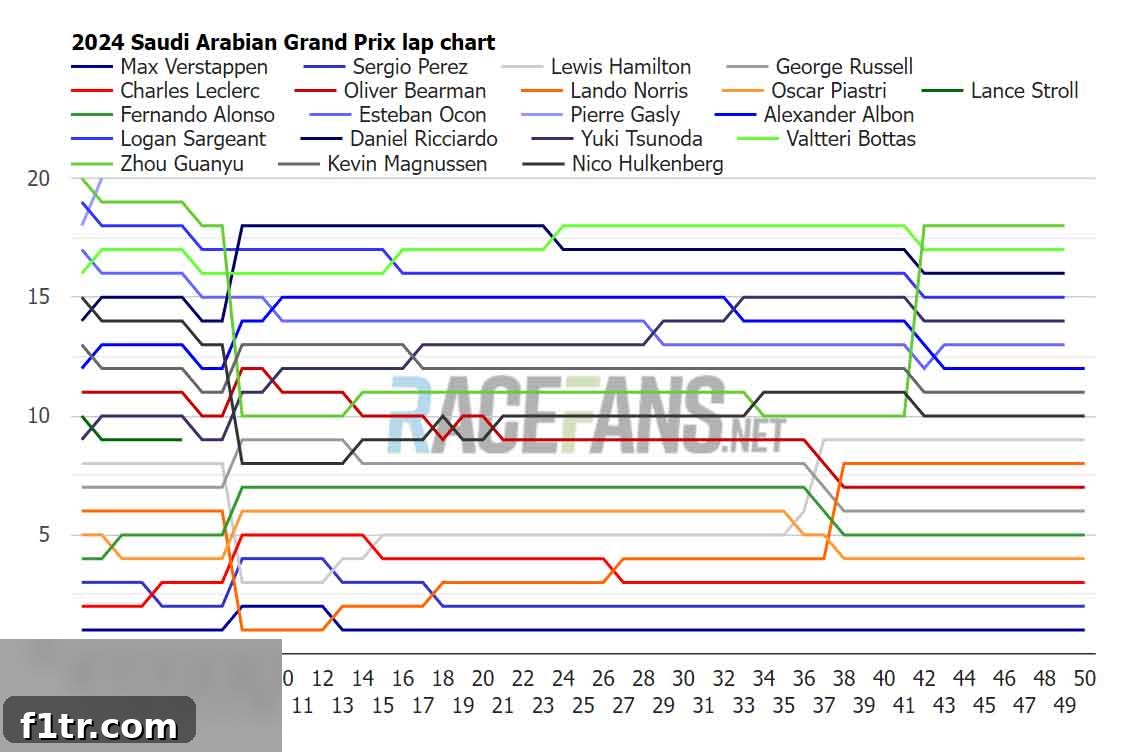
2024 Saudi Arabian Grand Prix Lap Chart Analysis
The lap chart provides a visual representation of each driver’s position on every lap, offering crucial insights into overtakes, defensive drives, and strategic plays. It vividly shows Hulkenberg’s climb through the field, contrasted with Tsunoda’s unfortunate regression. Examining the lap-by-lap data often reveals the immediate impact of events like the Safety Car and the effectiveness of various strategies. For instance, the chart would illustrate how Leclerc initially dropped behind Norris post-SC before meticulously working his way back up.
(Interactive lap position chart data would typically be displayed here, showing driver positions over each lap.)
2024 Saudi Arabian Grand Prix Race Chart Analysis
The race chart visualizes the gaps between drivers relative to the leader’s average lap time, highlighting how these gaps evolve throughout the race. This chart particularly emphasizes Magnussen’s dramatic slowdown from lap 22 onwards, illustrating the growing distances he created between himself and his pursuers, thereby protecting Hulkenberg. Very large gaps are often omitted for clarity, focusing on the competitive clusters.
(Interactive race gap chart data would typically be displayed here, showing time gaps between drivers relative to the leader.)
2024 Saudi Arabian Grand Prix Lap Times Analysis
A detailed breakdown of individual lap times (excluding very slow laps) offers granular insights into each driver’s performance peaks and troughs. This data clearly reveals how Leclerc’s lap times improved significantly towards the end of his stints, demonstrating Ferrari’s better long-run potential on older tires. It also confirms Magnussen’s reduced pace between laps 21 and 34, increasing his lap times by approximately one second per lap, directly impacting those behind him. Such analysis helps in understanding tire management strategies and car performance under different conditions.
(Interactive lap times chart data would typically be displayed here, showing individual lap times for all drivers.)
2024 Saudi Arabian Grand Prix Fastest Laps
The fastest lap table is a key indicator of raw pace at different stages of the race. Charles Leclerc’s achievement of the fastest lap on the final tour was a significant highlight for Ferrari. His time of 1’31.632 was a definitive statement of intent, narrowly beating Lewis Hamilton’s impressive effort on older soft tires and Max Verstappen’s best. The data reveals a tight battle for ultimate pace, with several drivers demonstrating strong performance at various points in the Grand Prix.
| Rank | # | Driver | Car | Lap time | Gap | Avg. speed (kph) | Lap no. |
|---|---|---|---|---|---|---|---|
| 1 | 16 | Charles Leclerc | Ferrari | 1’31.632 | 242.6 | 50 | |
| 2 | 44 | Lewis Hamilton | Mercedes | 1’31.746 | 0.114 | 242.3 | 38 |
| 3 | 1 | Max Verstappen | Red Bull-Honda RBPT | 1’31.773 | 0.141 | 242.23 | 50 |
| 4 | 4 | Lando Norris | McLaren-Mercedes | 1’31.944 | 0.312 | 241.78 | 40 |
| 5 | 38 | Oliver Bearman | Ferrari | 1’32.186 | 0.554 | 241.14 | 50 |
| 6 | 24 | Zhou Guanyu | Sauber-Ferrari | 1’32.208 | 0.576 | 241.09 | 49 |
| 7 | 63 | George Russell | Mercedes | 1’32.254 | 0.622 | 240.97 | 42 |
| 8 | 11 | Sergio Perez | Red Bull-Honda RBPT | 1’32.273 | 0.641 | 240.92 | 37 |
| 9 | 23 | Alexander Albon | Williams-Mercedes | 1’32.307 | 0.675 | 240.83 | 50 |
| 10 | 81 | Oscar Piastri | McLaren-Mercedes | 1’32.310 | 0.678 | 240.82 | 45 |
| 11 | 20 | Kevin Magnussen | Haas-Ferrari | 1’32.338 | 0.706 | 240.75 | 47 |
| 12 | 27 | Nico Hulkenberg | Haas-Ferrari | 1’32.366 | 0.734 | 240.67 | 49 |
| 13 | 14 | Fernando Alonso | Aston Martin-Mercedes | 1’32.387 | 0.755 | 240.62 | 43 |
| 14 | 77 | Valtteri Bottas | Sauber-Ferrari | 1’32.706 | 1.074 | 239.79 | 49 |
| 15 | 2 | Logan Sargeant | Williams-Mercedes | 1’33.026 | 1.394 | 238.97 | 49 |
| 16 | 3 | Daniel Ricciardo | RB-Honda RBPT | 1’33.323 | 1.691 | 238.2 | 47 |
| 17 | 31 | Esteban Ocon | Alpine-Renault | 1’33.481 | 1.849 | 237.8 | 48 |
| 18 | 22 | Yuki Tsunoda | RB-Honda RBPT | 1’33.523 | 1.891 | 237.7 | 44 |
| 19 | 18 | Lance Stroll | Aston Martin-Mercedes | 1’35.560 | 3.928 | 232.63 | 5 |
| 20 | 10 | Pierre Gasly | Alpine-Renault | 2’01.453 | 29.821 | 183.03 | 1 |
2024 Saudi Arabian Grand Prix Tyre Strategies
The Safety Car period on lap seven proved to be a critical juncture for tire strategy. Almost every driver seized the opportunity to pit under the safety car, opting for the durable hard compound tires to see them through to the end of the race. This mass pit stop effectively neutralized initial tire advantages and placed all competitors on a similar strategic footing for the majority of the Grand Prix. The few exceptions were those who chose to complete the race on a set of soft tires, a less favored option for the long run but sometimes dictated by pit stop timing or tire availability. Nico Hulkenberg stood out as a unique case, his tire strategy uniquely aided by his teammate Kevin Magnussen’s deliberate pace manipulation, allowing him to manage his soft tires effectively and secure a point.
(Interactive driver tire strategy chart data would typically be displayed here, detailing each driver’s tire compounds and pit stop laps.)
2024 Saudi Arabian Grand Prix Pit Stop Times
Efficient pit stops are paramount in Formula 1, and the Saudi Arabian Grand Prix provided its share of rapid turnarounds and a few prolonged stops. Mercedes excelled with Lewis Hamilton’s lightning-fast 20.17-second stop, setting the benchmark. Red Bull also demonstrated strong execution with Max Verstappen’s stop. These timings can be crucial in tight battles, highlighting the relentless pursuit of perfection in the pit lane. Longer stops, like Zhou Guanyu’s, can significantly impact a driver’s race, often due to unforeseen issues or tire changes at suboptimal moments.
| Rank | # | Driver | Team | Complete stop time (s) | Gap to best (s) | Stop no. | Lap no. |
|---|---|---|---|---|---|---|---|
| 1 | 44 | Lewis Hamilton | Mercedes | 20.17 | 1 | 36 | |
| 2 | 1 | Max Verstappen | Red Bull | 20.607 | 0.437 | 1 | 7 |
| 3 | 63 | George Russell | Mercedes | 21.013 | 0.843 | 1 | 7 |
| 4 | 27 | Nico Hulkenberg | Haas | 21.035 | 0.865 | 1 | 33 |
| 5 | 81 | Oscar Piastri | McLaren | 21.427 | 1.257 | 1 | 7 |
| 6 | 20 | Kevin Magnussen | Haas | 21.46 | 1.29 | 1 | 7 |
| 7 | 22 | Yuki Tsunoda | RB | 21.694 | 1.524 | 1 | 7 |
| 8 | 23 | Alexander Albon | Williams | 21.723 | 1.553 | 1 | 7 |
| 9 | 14 | Fernando Alonso | Aston Martin | 22.129 | 1.959 | 1 | 7 |
| 10 | 11 | Sergio Perez | Red Bull | 22.196 | 2.026 | 1 | 7 |
| 11 | 4 | Lando Norris | McLaren | 22.211 | 2.041 | 1 | 37 |
| 12 | 38 | Oliver Bearman | Ferrari | 22.457 | 2.287 | 1 | 7 |
| 13 | 31 | Esteban Ocon | Alpine | 22.502 | 2.332 | 1 | 7 |
| 14 | 77 | Valtteri Bottas | Sauber | 22.795 | 2.625 | 1 | 7 |
| 15 | 77 | Valtteri Bottas | Sauber | 23.281 | 3.111 | 2 | 35 |
| 16 | 16 | Charles Leclerc | Ferrari | 23.419 | 3.249 | 1 | 7 |
| 17 | 2 | Logan Sargeant | Williams | 23.645 | 3.475 | 1 | 7 |
| 18 | 24 | Zhou Guanyu | Sauber | 46.381 | 26.211 | 1 | 41 |
Further Insights from the 2024 Saudi Arabian Grand Prix
- Oliver Bearman’s impressive F1 debut in Jeddah, stepping in for Carlos Sainz, earned him plaudits despite his self-critical assessment.
- Williams team principal James Vowles discussed the patient approach with Logan Sargeant, emphasizing the need for demonstrable progress throughout the season.
- Delve into the most intriguing and unheard team radio transmissions from Jeddah, offering a candid look into driver and team communications during the high-pressure race.
- Alpine’s Bruno Famin reflected on the team’s surprisingly poor start to the season, acknowledging that it highlighted an urgent need for significant organizational and performance changes.
- Lance Stroll’s brief but intense struggle with tire degradation was abruptly ended by a crash into the wall, underscoring the demanding nature of the Jeddah circuit.
Browse all 2024 Saudi Arabian Grand Prix articles