In a crucial moment for their 2023 Formula 1 campaign, Mercedes-AMG Petronas Formula 1 Team has officially unveiled a significant package of aerodynamic upgrades for their W14 challenger at the iconic Spa-Francorchamps circuit, home of the Belgian Grand Prix. These comprehensive revisions, particularly focusing on the sidepods and floor, signal a determined effort by the Silver Arrows to extract more performance and bridge the gap to their front-running rivals.
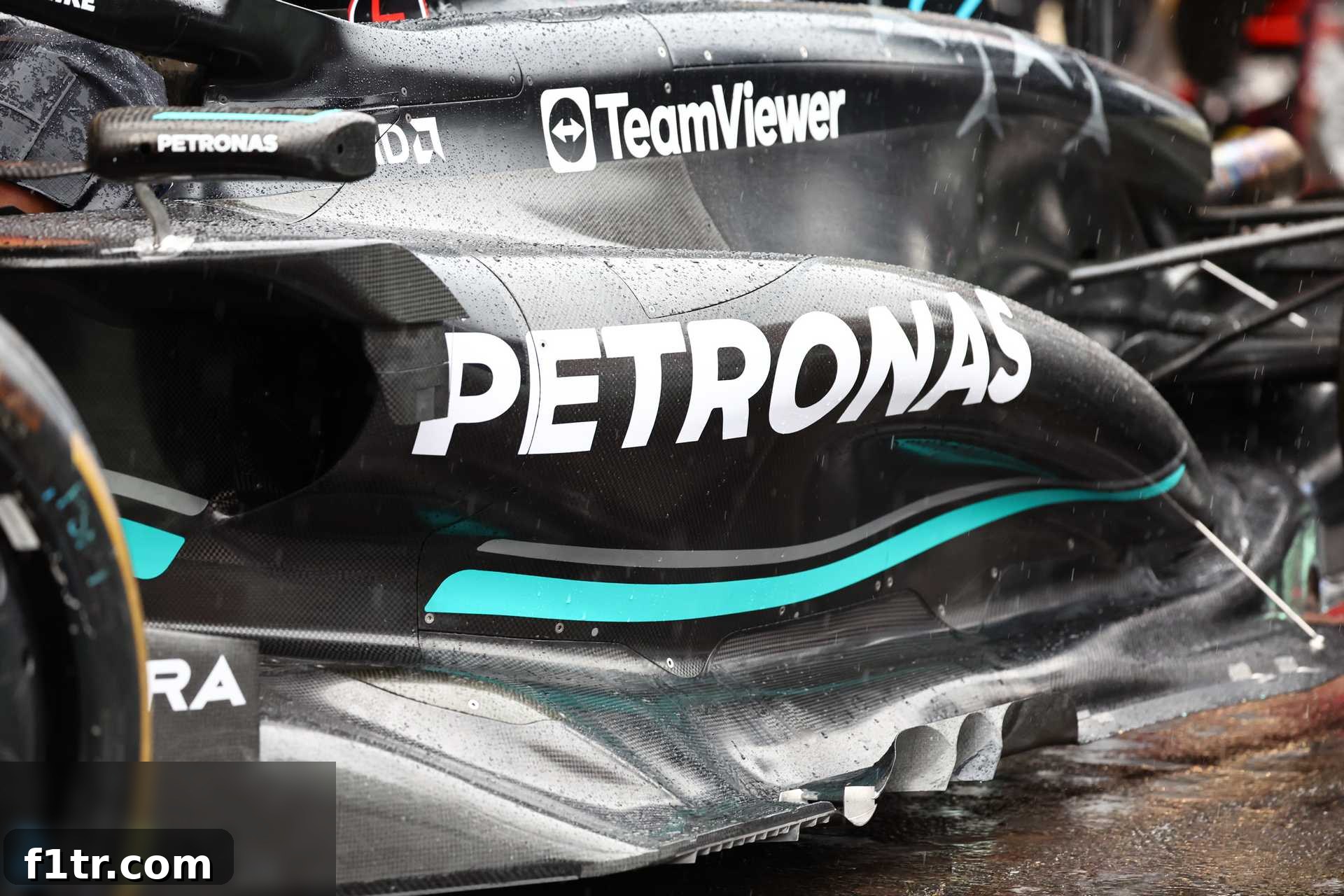
W14 Evolution: A Deep Dive into Mercedes’ Latest Sidepod Design
Since the initial struggles with their innovative ‘zero sidepod’ concept, which was famously abandoned after the Miami Grand Prix, Mercedes has been on a continuous journey of aerodynamic re-evaluation and development. The latest iteration of their sidepod design, introduced at Spa, marks another pivotal step in this evolution. Mercedes has confirmed to the FIA that these changes are designed to optimize airflow around the car, a critical factor for overall performance.
A key modification lies in the rear section of the sidepods, which now features a notably steeper ramp. This design adjustment is specifically engineered to “improve onset flow to the rear of the car, notably the rear wing,” as detailed in Mercedes’ technical submission. By directing air more efficiently to the rear, the team aims to enhance the performance of the entire rear aerodynamic package. While this revised camber is expected to generate increased downforce, Mercedes acknowledges a corresponding increase in drag, necessitating a careful balancing act to maintain straight-line speed.
This sidepod development is a testament to Mercedes’ ongoing commitment to understanding and manipulating complex airflow structures. The previous ‘zero pod’ philosophy aimed to minimize the sidepod’s frontal area, but ultimately proved too restrictive for generating the necessary downforce and consistent airflow. The current strategy, embracing a more conventional sidepod profile, allows for greater flexibility in shaping the car’s bodywork to guide air effectively towards critical areas like the rear wing and diffuser. The steeper ramp suggests a focus on creating a stronger pressure differential and improving the flow attachment over the rear surfaces, crucial for high-speed stability and traction out of corners.
Strategic Rear Wing Modifications for Spa-Francorchamps
Recognizing the unique demands of the Spa-Francorchamps circuit, with its legendary long straights such as Kemmel Straight and the Blanchimont section, Mercedes has also introduced a specific rear wing design for this weekend. This new wing features a smaller upper chord compared to their standard specification. The objective is clear: to reduce both downforce and drag, thereby maximizing straight-line speed, which is paramount for competitive lap times at this high-speed venue.
The decision to run a lower-downforce rear wing is a calculated compromise. While it reduces the aerodynamic grip available in the corners, the gains on the straights are often more significant at tracks like Spa. This strategic tuning highlights Mercedes’ ambition to not only improve their overall aerodynamic package but also to optimize their car for specific circuit characteristics. The balance between cornering performance and straight-line efficiency is a perpetual challenge in Formula 1, and this bespoke rear wing for Spa demonstrates a targeted approach to extract maximum potential from the W14.
This approach to rear wing design also mirrors the philosophy seen in rival teams, particularly Red Bull Racing. Red Bull has consistently achieved notable success by generating immense downforce from their car’s underbody and floor, which in turn allows them to run significantly thinner rear wings. This aerodynamic efficiency translates directly into superior straight-line speed without sacrificing too much cornering performance. Mercedes is clearly aiming to replicate this trait on their W14, shifting the emphasis of downforce generation to the car’s underside and allowing for drag reduction at the rear. It represents a fundamental shift in their aerodynamic philosophy, moving away from relying heavily on the upper bodywork for downforce towards exploiting ground effect aerodynamics more fully.
Enhanced Cooling and Aerodynamic Efficiency: More Than Just Sidepods
Beyond the revised sidepod shape, Mercedes has also implemented other strategic changes to improve both cooling and aerodynamic efficiency. The height of the sidepod inlets has been increased. This modification allows for a greater volume of air to be directed towards the power unit, enhancing cooling capabilities. While seemingly a minor detail, improved cooling is crucial, especially in the demanding conditions of a Formula 1 race.
The aerodynamic benefit of this change is significant: by providing more efficient cooling through larger inlets, Mercedes will be able to run fewer cooling vents elsewhere on the car’s bodywork. Each cooling vent is a source of aerodynamic drag, disrupting the smooth flow of air. By reducing the number or size of these vents, the overall drag of the car is decreased, contributing to better straight-line speed. While the cool temperatures typically encountered at Spa-Francorchamps might not immediately highlight the cooling benefits, this change is a forward-looking upgrade. It promises significant dividends at future races in hotter climates, such as Singapore and Qatar, where managing engine temperatures without compromising aerodynamic performance is a severe challenge.
This integrated approach demonstrates Mercedes’ holistic view of car design. Aerodynamics, cooling, and power unit performance are not isolated elements but interconnected systems that must work in harmony. Optimizing one aspect, such as cooling, to gain an advantage in another, like drag reduction, is a hallmark of sophisticated F1 engineering. These seemingly subtle changes collectively contribute to a more efficient and competitive package, giving the W14 greater operational flexibility across different climatic conditions and circuit types.
Subtle Yet Significant: The Underbody Revisions
While the sidepods and rear wing are visually the most striking upgrades, Mercedes has also made critical, albeit less visible, revisions to the W14’s floor. The team reports a “small” but impactful adjustment to the bodywork beneath the car, specifically designed to redirect airflow. This area, often referred to as the ‘black box’ of Formula 1 aerodynamics, is where a significant portion of a modern F1 car’s downforce is generated through ground effect.
Mercedes states that the “volume distribution [was] adjusted to extract more local load from forward floor vortex system, which in turn improves flow to the diffuser.” To unpack this, the floor of an F1 car works by creating vortices and managing air pressure differentials. The “forward floor vortex system” refers to the complex structures at the leading edge of the floor, which generate specific airflow patterns and vortices. By adjusting the “volume distribution”—essentially the shape and contours of the underbody in this area—Mercedes aims to enhance the strength and stability of these vortices.
The creation of more “local load” means generating greater downforce in that specific area. Crucially, improving the flow from this forward system then has a beneficial cascading effect on the diffuser, located at the rear of the car’s underbody. The diffuser is responsible for expanding the airflow that has passed beneath the car, creating a low-pressure area that “sucks” the car to the track. A cleaner, more energetic flow to the diffuser significantly enhances its effectiveness, leading to a substantial increase in overall downforce. These floor revisions, though hidden from plain sight, are often the most potent performance differentiators in modern F1, offering significant gains in cornering speed and stability without incurring drag penalties associated with upper bodywork elements.
The Sprint Weekend Challenge: A Race Against Time
Implementing such a comprehensive upgrade package during a sprint race weekend presents unique challenges for Mercedes. The sprint format significantly reduces practice time, allowing only a single one-hour free practice session before qualifying. This limited track time severely constrains the team’s ability to test, validate, and fine-tune the new components.
Adding to the complexity, the unpredictable weather at Spa-Francorchamps is also expected to play a role. While dry conditions are anticipated for Sunday’s main race, practice and qualifying sessions are likely to be disrupted by rain. Wet track conditions further complicate data gathering and car setup, making it incredibly difficult for engineers and drivers to accurately assess the impact of the new upgrades. The pressure will be immense for the team to quickly understand how the W14 responds to these changes and to optimize its performance in a very compressed timeframe. Every lap, every data point will be crucial in their quest to unlock the full potential of this updated package.
The success of these upgrades hinges not just on their inherent design but on the team’s ability to efficiently integrate them and extract performance under immense pressure. This sprint weekend scenario at Spa will be a true test of Mercedes’ operational efficiency, engineering acumen, and the drivers’ adaptability to a car that feels different. The data gathered, even if limited, will be vital for future development, providing insights into the direction of the W14’s performance trajectory for the remainder of the season.
Implications for Mercedes’ 2023 Season and Beyond
This latest upgrade package for the W14 at Spa-Francorchamps represents more than just a performance boost for a single race; it’s a statement of intent from Mercedes. After a challenging start to the season and acknowledging the inherent design flaws of their initial concept, these progressive aerodynamic changes demonstrate a clear and focused development path. The objective is not just to close the gap to Red Bull but also to solidify their position against fierce competitors like Ferrari and Aston Martin, who are also pushing hard for second place in the Constructors’ Championship.
The integration of lessons learned from rivals, particularly Red Bull’s mastery of ground effect aerodynamics, suggests a pragmatic and data-driven approach. By focusing on fundamental areas like sidepod flow, rear wing efficiency, and crucially, floor performance, Mercedes is laying the groundwork for a stronger finish to the 2023 season and, more importantly, establishing a robust development direction for their 2024 challenger. The success of these upgrades at Spa will be closely monitored, as they offer the first real glimpse into the potential of the revised W14 and Mercedes’ aspirations for recapturing their championship-winning form.
Mercedes’ old and new sidepods
Pictures: Mercedes’ new sidepods at Spa
2023 Belgian Grand Prix Related Articles
- Haas drivers fear losing battle for seventh after “grim weekend” in Spa
- Mercedes optimistic they’re “in the right place for winter” with development plan
- Ferrari not convinced by call to equalise engines: ‘Renault is not so far away’
- Ferrari staying “calm” amid swings in performance from race to race
- Pirelli proposes new “super-intermediate” to address wet weather tyre problems
Browse all 2023 Belgian Grand Prix articles