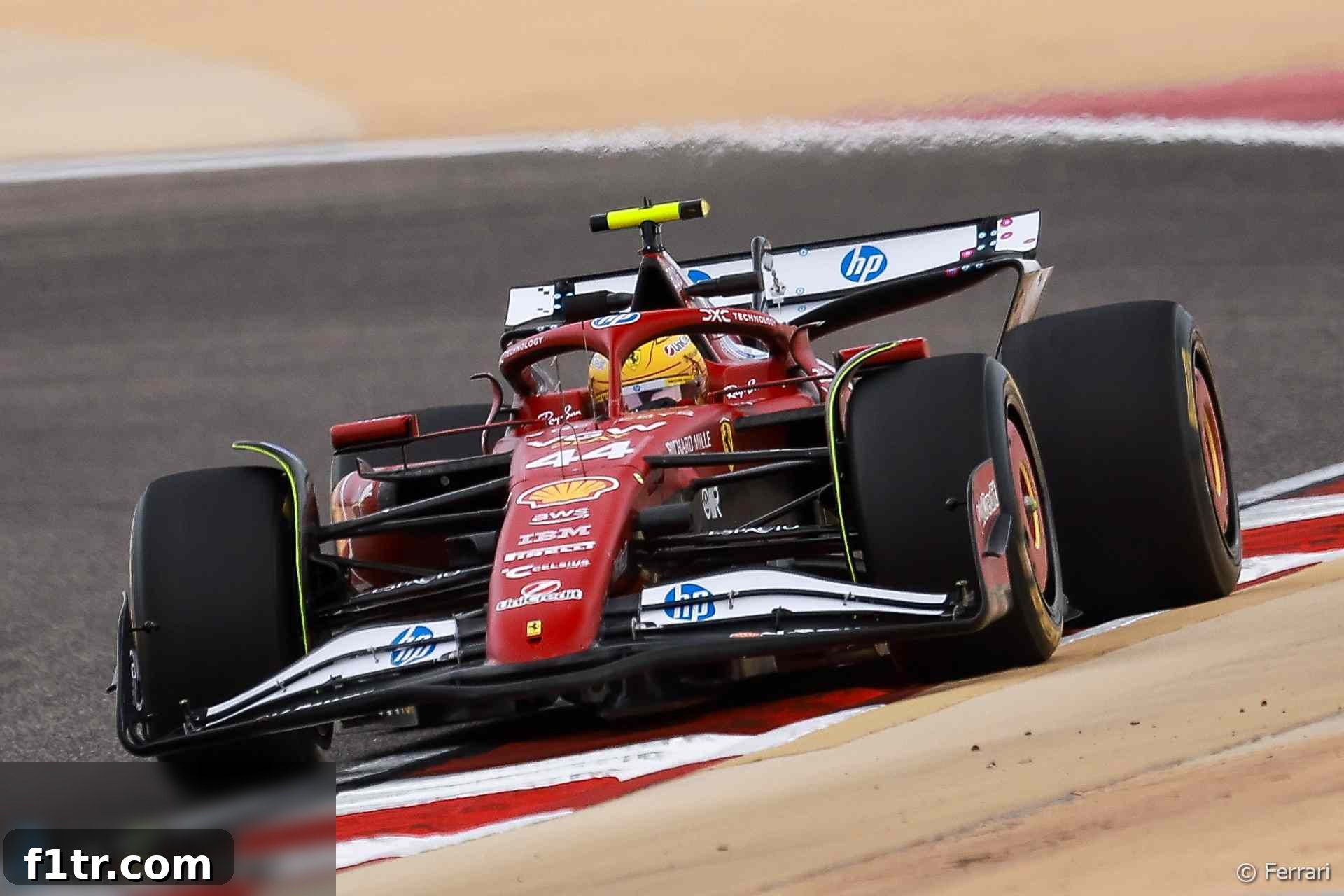
The highly anticipated Formula 1 2025 pre-season testing at the Bahrain International Circuit reached its crucial halfway point, delivering a mix of thrilling speed and unexpected drama. Leading the charge, seven-time world champion Lewis Hamilton, now behind the wheel for Ferrari, spectacularly set the quickest time recorded so far, hinting at an electrifying season ahead for the Scuderia. His performance sent a clear signal of intent, immediately putting the spotlight on Ferrari’s potential for the upcoming championship. However, the desert testing ground, usually basking in perpetual sunshine, threw a curveball with a rare downpour, causing a significant and unusual interruption to the day’s proceedings.
Pre-season testing is not merely about raw pace; it’s a meticulously planned marathon of data collection, reliability checks, and strategic adjustments. Teams strive to understand every nuance of their new machines, pushing the limits while ensuring the cars can endure race distances. The two-day mark signifies a pivotal moment, with engineers poring over telemetry and drivers adapting their feedback, all working towards optimizing performance before the lights go out for the first Grand Prix. Hamilton’s stunning lap time serves as a significant benchmark, providing both encouragement for Ferrari and a challenge to their rivals.
Advert | Become a Supporter & go ad-free
The morning session in Bahrain had been progressing smoothly until the skies opened up, showering the circuit with rain – an almost unheard-of event for the desert locale. This meteorological anomaly brought the on-track action to a virtual standstill for nearly an hour, profoundly affecting testing schedules and disrupting carefully laid plans. The track, designed for relentless dry running, quickly became unsuitable for slicks, leaving most garages firmly shut. While many drivers and teams waited out the unexpected deluge, one intrepid competitor dared to brave the conditions.
During this period of inactivity, Esteban Ocon of Haas provided a brief moment of excitement. His team was one of the only two to have proactively prepared for such a scenario, fitting a set of intermediate tyres to his car. Ocon ventured out for a short, exploratory run on the damp track, gathering invaluable data on the intermediate compound’s performance in low-grip conditions. This strategic decision by Haas could prove beneficial in unpredictable race scenarios throughout the season, offering them a unique advantage in understanding tyre degradation and car balance on a wet-to-drying surface. It highlighted the meticulous preparation and foresight often unseen by casual observers but crucial for success in Formula 1.
As the rain subsided and the desert sun began its work, gradually drying the track, the cars eagerly returned to the circuit, making up for lost time. The intensity of testing quickly resumed, leading to a minor but notable incident at Turn Eight involving Oscar Piastri in the McLaren and Nico Hulkenberg driving the Sauber. Piastri, pushing hard and looking for an overtaking opportunity typical of a race simulation, made contact with the Sauber’s right-rear tyre. The McLaren driver, visibly frustrated after the tap, gestured towards Hulkenberg, indicating his displeasure. Both cars returned to the pits immediately after the brief altercation. Fortunately, initial assessments revealed no lasting or significant damage to either vehicle, allowing both teams to resume their testing programmes shortly thereafter. Such incidents, while undesired, are not uncommon in pre-season testing as drivers explore the limits of their new machinery and gauge their rivals’ on-track behaviour.
Hamilton’s Pace and Ferrari’s Ambitions
The undoubted highlight of the morning session belonged to Lewis Hamilton. The British driver meticulously chipped away at the best lap time, progressively refining his approach and pushing the Ferrari SF-25 to its limits. His ultimate benchmark, a blistering 1’29.379, stood as the fastest time of the test so far, a testament to both his skill and Ferrari’s engineering prowess. This impressive lap was over half a second quicker than the quickest time set at the corresponding test last year, which was also achieved by Ferrari in the hands of his predecessor, Carlos Sainz Jnr. Hamilton’s seamless integration into the Ferrari team and his immediate pace suggest a potent combination for the 2025 season.
After cementing his position at the top of the leaderboard, Hamilton concluded his morning duties, handing over the reins of the SF-25 to his teammate, Charles Leclerc, for the remainder of the day’s running. This driver handover strategy is typical in pre-season testing, allowing both drivers ample time to acclimatize to the car, provide feedback, and validate different setup configurations. The strong performance from Hamilton provides a solid foundation for Leclerc to build upon, setting a positive tone for Ferrari’s 2025 campaign.
Driver Workloads and Technical Setbacks
Unlike the split duties seen at many teams, two drivers were uniquely scheduled to spend the entire day in their cars, aiming for maximum mileage and data collection. These were Carlos Sainz Jnr at Williams and Liam Lawson at Red Bull. For Sainz, a full day offered a crucial opportunity to put significant laps on the Williams FW47, gathering vital information on its reliability and performance across various fuel loads and tyre compounds. This extended track time is especially critical for a team like Williams, looking to make strides up the grid.
However, the day proved more challenging for Liam Lawson. His ambitious full-day programme was unfortunately cut short after just 28 laps due to an apparent power unit problem within his Red Bull RB21. A power unit failure, especially in pre-season testing, is a significant setback. It not only robs the team and driver of precious track time but also raises concerns about reliability – a paramount factor in the demanding Formula 1 season. Engineers will now face the arduous task of diagnosing the issue and ensuring it doesn’t manifest again, emphasizing the fine line between pushing performance and maintaining robust engineering.
Despite the rain-induced interruption, the morning session still saw impressive mileage accumulation from several drivers. George Russell, piloting the Mercedes W16, logged the most laps, completing a commendable 71 tours of the Bahrain circuit. Achieving more than a race distance in a single session is a critical reliability milestone for any team, demonstrating the car’s durability and providing a wealth of data for engineers to analyze. Russell’s extensive running underscores Mercedes’ commitment to thorough testing and optimizing their package.
Towards the end of the morning session, Russell, Ocon, and Piastri also participated in a scheduled test of important race procedures. This included practicing the Virtual Safety Car (VSC), suspended start, and race start protocols. These drills are vital for ensuring drivers and teams are fully prepared for every eventuality on a Grand Prix weekend. Practicing VSC procedures helps ensure safe speed reduction and adherence to delta times, while perfecting race starts is crucial for gaining track position and avoiding penalties. Such detailed testing ensures operational efficiency and safety once the competitive season begins.
Advert | Become a RaceFans supporter andgo ad-free
2025 Bahrain Pre-Season Test Day Two Morning Results: A Snapshot of Pace and Potential
The provisional results from the morning session of Day Two offer an intriguing glimpse into the competitive landscape as teams push their new cars to the limit. Lewis Hamilton’s chart-topping performance for Ferrari clearly signals their strong intentions, but impressive showings from other teams indicate a closely contested season ahead. Mercedes, with George Russell, showcased strong reliability and competitive speed, consistently placing high on the lap count and time sheets. The mid-pack battle also appears fierce, with several teams demonstrating promising pace.
Detailed Morning Session Results
Below is the official breakdown of the morning session from Day Two of the 2025 F1 pre-season test, highlighting driver performance, team standings, best lap times, and total laps completed by each competitor.
| Pos. | Car number | Driver | Team | Model | Best time | Gap | Laps |
|---|---|---|---|---|---|---|---|
| 1 | 44 | Lewis Hamilton | Ferrari | SF-25 | 1’29.379 | 45 | |
| 2 | 63 | George Russell | Mercedes | W16 | 1’29.778 | 0.399 | 71 |
| 3 | 55 | Carlos Sainz Jnr | Williams | FW47 | 1’30.090 | 0.711 | 44 |
| 4 | 10 | Pierre Gasly | Alpine | A525 | 1’30.430 | 1.051 | 40 |
| 5 | 14 | Fernando Alonso | Aston Martin | AMR25 | 1’30.700 | 1.321 | 45 |
| 6 | 22 | Yuki Tsunoda | Racing Bulls | 02 | 1’30.793 | 1.414 | 46 |
| 7 | 81 | Oscar Piastri | McLaren | MCL39 | 1’30.821 | 1.442 | 44 |
| 8 | 30 | Liam Lawson | Red Bull | RB21 | 1’31.233 | 1.854 | 28 |
| 9 | 27 | Nico Hulkenberg | Sauber”>Sauber | C45 | 1’31.457 | 2.078 | 56 |
| 10 | 31 | Esteban Ocon | Haas | VF-25 | 1’33.071 | 3.692 | 69 |
The timesheet paints a vivid picture, with the top three showcasing strong pace. Hamilton’s commanding lead sets a high bar, while Russell’s consistent running and competitive time underscore Mercedes’ strong form. Carlos Sainz Jnr’s position in the top three for Williams is also noteworthy, demonstrating potential for the Grove-based team. Further down, the gaps between the midfield teams are relatively tight, promising an intense battle for points during the season.
Advert | Become a RaceFans supporter andgo ad-free
Looking Ahead: The Road to the 2025 F1 Season
As the pre-season testing progresses, every lap, every data point, and every incident contributes to the intricate puzzle that teams are trying to solve. The morning session of Day Two in Bahrain provided a thrilling mix of speed and unforeseen challenges. Lewis Hamilton’s blistering pace for Ferrari undeniably captured headlines, signaling a potentially formidable partnership for 2025. Yet, the unexpected rain and the subsequent incidents served as stark reminders of the unpredictable nature of Formula 1, even during controlled test environments.
The afternoon session and the remaining days of testing will be crucial for all teams to further refine their setups, address any reliability concerns, and validate their performance targets. With just days left before the official start of the 2025 Formula 1 season, the stakes remain incredibly high. Fans around the world will be eagerly watching, anticipating what promises to be another exhilarating year of top-tier motorsport, fueled by innovation, fierce competition, and the relentless pursuit of speed. The journey from the drawing board to the podium is long and arduous, and pre-season testing is the critical first step.
Formula 1 Insights and Related Articles
For more in-depth analysis, news, and opinions on the world of Formula 1, explore our curated selection of articles:
- Controversies, Norris, Newey and more: Five new motorsport books reviewed
- One of F1’s greatest races happened 15 years ago today. Or did it?
- “Overtaking is overtaking”: Domenicali denies F1’s yo-yo racing is “artificial”
- The crashes F1 is trying to prevent may be rare – but the danger is obvious
- F1 returning to India soon after 2027 sounds like wishful thinking
Browse all Formula 1 articles