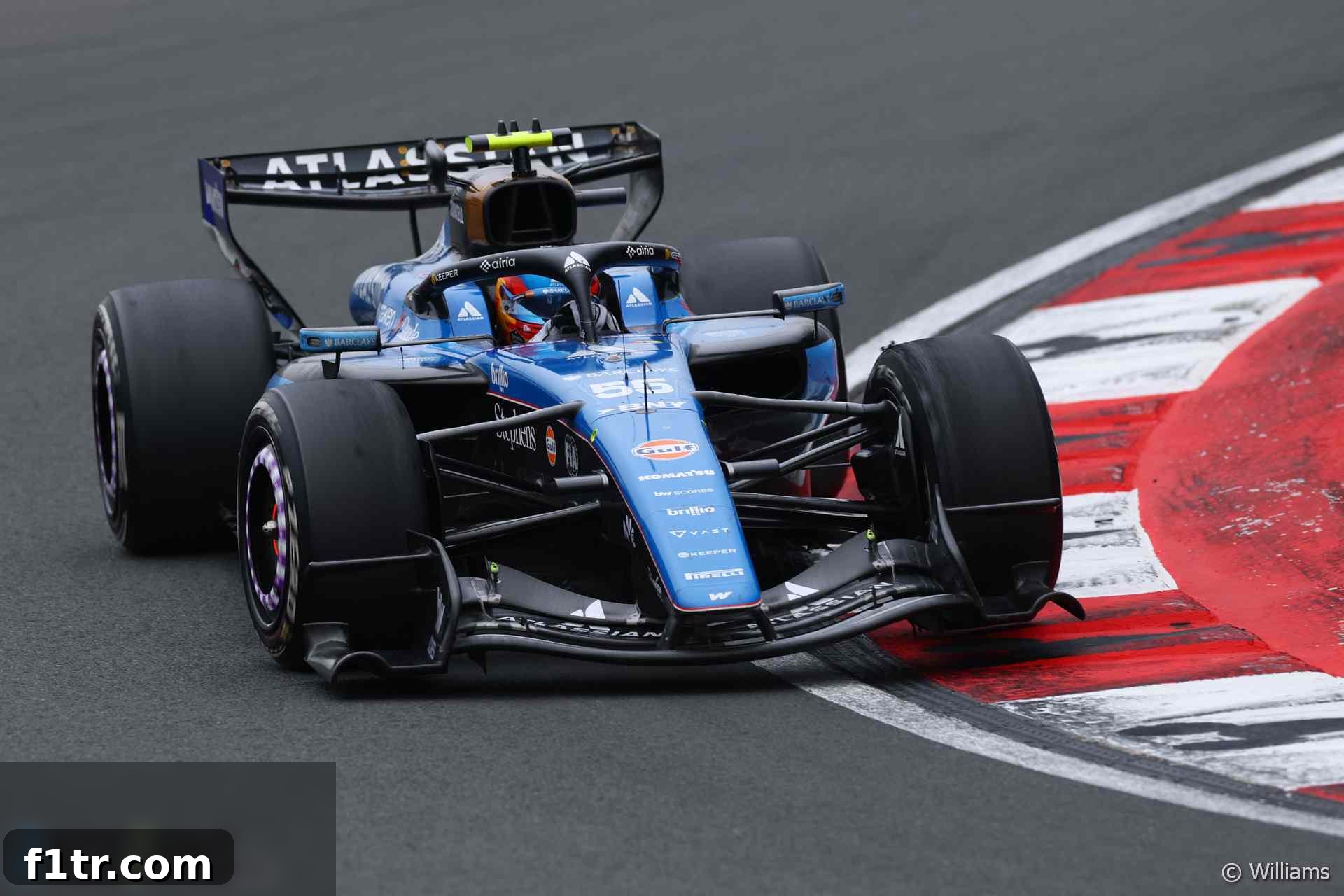
Carlos Sainz Jnr Masterfully Exploits F1’s New Overtake Mode to Secure Crucial Points for Williams
In a display of astute tactical brilliance and unwavering determination, Carlos Sainz Jnr recently demonstrated the strategic depth now possible in Formula 1 by expertly leveraging the sport’s innovative Overtake mode. During the intense closing stages of a recent Grand Prix, the Williams driver faced a relentless assault from Franco Colapinto in the Alpine. Instead of succumbing to the pressure, Sainz orchestrated a cunning defense, not only holding his position but also securing a vital ninth-place finish, delivering Williams their first championship points of the season.
Understanding Formula 1’s New Overtake Mode
The introduction of the Overtake mode marks a significant evolution in Formula 1’s regulatory landscape, designed to enhance racing spectacle and provide drivers with new strategic tools. This power boost system operates in a manner conceptually similar to the now-discontinued Drag Reduction System (DRS), yet with distinct characteristics that open up fresh avenues for tactical play. Under the new regulations, drivers gain an additional surge of speed – a temporary power increment – when they are within a one-second window of a car ahead. This mechanism is intended to facilitate closer racing and offer more opportunities for attacking, but as Sainz spectacularly proved, it can also be a formidable defensive weapon when wielded strategically.
Unlike DRS, which primarily reduced drag on straights, the Overtake mode provides a direct engine power increase, making its application potentially more versatile across various sections of the track. Its purpose is to create dynamic shifts in pace, allowing drivers to manage their energy deployment and react to the ebb and flow of a race. The art of its use lies not just in activating it, but in understanding *when* and *how* to deploy it, anticipating opponents’ moves, and even manipulating track conditions, as Sainz so brilliantly demonstrated against Colapinto.
The Tactical Chess Match: Sainz vs. Colapinto
The Battle Unfolds in the Closing Laps
The incident unfolded during the climactic moments of the Grand Prix, with Sainz clinging to ninth position. Colapinto, driving the Alpine, had been rapidly closing the gap, having pitted for fresh medium tyres. With superior grip and pace, the Alpine appeared destined to sweep past the Williams, jeopardizing Sainz’s hard-earned points. The tension was palpable as the distance between the two cars dwindled, setting the stage for a dramatic head-to-head battle where raw speed would be pitted against cunning strategy.
Blue Flags and Strategic Gains: The “Overtake Mode Train”
What transpired next was a masterclass in defensive racing, highlighting Sainz’s exceptional race craft and strategic foresight. As faster cars approached to lap the battling duo, blue flags began to wave – a signal for backmarkers to yield. It was at this critical juncture that Sainz saw an opportunity, not just to hold his ground, but to gain an advantage. He realized that drivers could effectively “recharge” or gain access to the Overtake mode by allowing lapping cars to pass them. Sainz meticulously timed his maneuvers, ensuring that he positioned himself to capitalize on these moments. By skillfully creating dirty air for Colapinto while simultaneously gaining his own Overtake mode charge, he initiated what he ingeniously dubbed an “Overtake mode train.”
This tactic involved a calculated cycle: allow a faster car through, activate Overtake mode, put Colapinto in dirty air to hamper his pursuit, then repeat the process with the next lapping car. This nuanced approach effectively neutralized Colapinto’s pace advantage, turning what seemed like an inevitable overtake into a frustrated chase. Sainz’s ability to multitask – managing his car, monitoring his mirrors, reacting to blue flags, and deploying Overtake mode – underscored his exceptional mental capacity under pressure.
Sainz’s Perspective: A Calculated Defense
Reflecting on the intense battle, Sainz articulated his thought process, revealing a measured yet aggressive mindset. “Because it [was for ninth place] I knew if he attacked me, I wouldn’t have played it too stupid, given the fact that I could still get a top 10,” Sainz explained. “For the team, one point is still a good result, so I was not going to play too aggressive.” This pragmatic approach allowed him to assess the situation calmly. However, when the blue flags appeared, his strategic gears began to turn rapidly. “But then I saw the blue flags coming and I said if I play this well I can give him dirty air, then get my Overtake mode, give him dirty air, Overtake [and so on].” The clarity with which he envisioned and executed this complex strategy speaks volumes about his racing intelligence. “So rather than a DRS train, an Overtake mode train,” he concisely summarized, encapsulating the novelty and effectiveness of his tactic.
A Lifeline for Williams: Securing First Points of the Season
Ultimately, Sainz’s audacious tactics paid off handsomely, securing Williams Racing their inaugural points of the season. While a ninth-place finish might not always be the primary target for a driver of Sainz’s calibre, its significance for the struggling Williams team cannot be overstated. “In the end it’s still a P9 for me, it’s not what I want,” Sainz admitted, always striving for more. “Even though it’s good points for me and for the team, I really hope it serves as motivation, as boost for everyone back at home to dig deep now.”
These points are more than just numbers on a scoreboard; they represent a crucial injection of morale and a tangible reward for the relentless effort exerted by every member of the team. For a constructor like Williams, battling against significantly larger budgets and resources, every single point is a hard-fought victory that can inspire confidence and drive further development. It signifies progress, validates countless hours of work in the factory, and provides critical data for refining future car designs and race strategies. The emotional lift this result provides could be the catalyst needed to ignite a stronger performance trajectory for the remainder of the championship.
Sainz’s Standout Performance: Driver Against Car
The ‘Mario Kart’ Start: From P17 to P11
Long before his defensive masterclass, Sainz laid the foundation for his points finish with an astonishing start to the race. Launching from a challenging 17th position on the grid, he surged through the field, rocketing up to 11th place by the end of the very first lap. This meteoric rise was partly aided by misfortune striking other drivers, but predominantly a testament to Sainz’s raw skill and lightning-fast reactions. “The start is something definitely I’m proud of because it’s where the driver can also make a bit of a difference,” Sainz asserted, highlighting his personal contribution. He proudly noted a consistent string of “mega start[s]” across recent events, underscoring his prowess off the line.
His description of the start as “just a bit like Mario Kart” perfectly encapsulated the chaotic yet exhilarating experience of navigating through the initial melee of an F1 race. To gain so many positions in such a short space of time requires not just perfect clutch control and throttle application, but also an acute awareness of the cars around him, predicting their moves, and identifying gaps that might only exist for a fleeting moment. It’s a high-stakes gamble where precision and aggression must be perfectly balanced. “Then suddenly you ask on the radio which position you are and you’re at P10 and you are like ‘okay, let’s see how I defend this now’.” This immediate shift from attack to defense exemplifies the dynamic nature of F1 racing and Sainz’s ability to adapt on the fly.
Driver vs. Car: A Frustrating Reality
Despite the elation of scoring points, Sainz remained candid about the inherent frustrations of his current situation. The Williams car, while showing flashes of potential, is still a work in progress, often lacking the consistent pace to challenge the established midfield contenders. “It’s not the start of the season we wanted, it is not what were our intentions with this car, so we need this result I think to push hard back in the factory to start bringing performance,” he emphasized. His honesty painted a clear picture of the ongoing struggle: “Because the reality is that today even fighting with midfield cars, I felt like I had no chance. So it’s frustrating, but at the same time, a good result that we take home, and we hope it helps everyone.” This sentiment underscores the perpetual battle between driver talent and machinery in Formula 1, where even the most exceptional performances can be limited by the car’s capabilities.
His final assessment of the race, bringing it full circle back to the Colapinto defense, further highlighted the extraordinary effort required. “So I was definitely enjoying that one and then towards the end again with Franco he pitted for new mediums, he was coming back very quick on us and we managed to keep him behind playing a bit with blue flags, with the Overtake mode and just doing everything in my head to try and sneak my way into P9.” This was not a victory born of superior pace, but of superior strategy and relentless personal drive.
Beyond the Finish Line: Implications for the Season
Carlos Sainz Jnr’s P9 finish at the recent Grand Prix serves as a powerful testament to the impact a single driver can have, even when their equipment isn’t at the pinnacle of performance. His tactical use of the Overtake mode has not only put Williams on the scoreboard but has also provided valuable insights into the strategic depth that the new regulations bring to Formula 1. This race will undoubtedly be remembered as a crucial turning point for Williams, offering a much-needed morale boost that could fuel further advancements throughout the season. For Sainz, it reinforces his reputation as a shrewd and tenacious competitor, capable of extracting every ounce of performance and opportunity from any given situation. As the season progresses, all eyes will be on Williams to see if this hard-won success can be converted into consistent improvements and a more competitive standing on the grid.
Further Reading: Recent F1 Grand Prix Insights
Explore more in-depth analyses and reports from recent Formula 1 events and behind-the-scenes stories:
- What led Stroll to call his Aston Martin “the worst piece of s*** I’ve ever driven”
- Stats: Antonelli is 12th Formula 1 driver to score a ‘hat trick’ with his first win
- “Leclerc just backed Lewis up”: How Russell saw the fight between the Ferraris
- Verstappen reduced his pace unnecessarily due to communications error
- ‘Just an easy pass with Overtake’: Every radio message from Antonelli’s first F1 win
Browse all 2026 Chinese Grand Prix articles