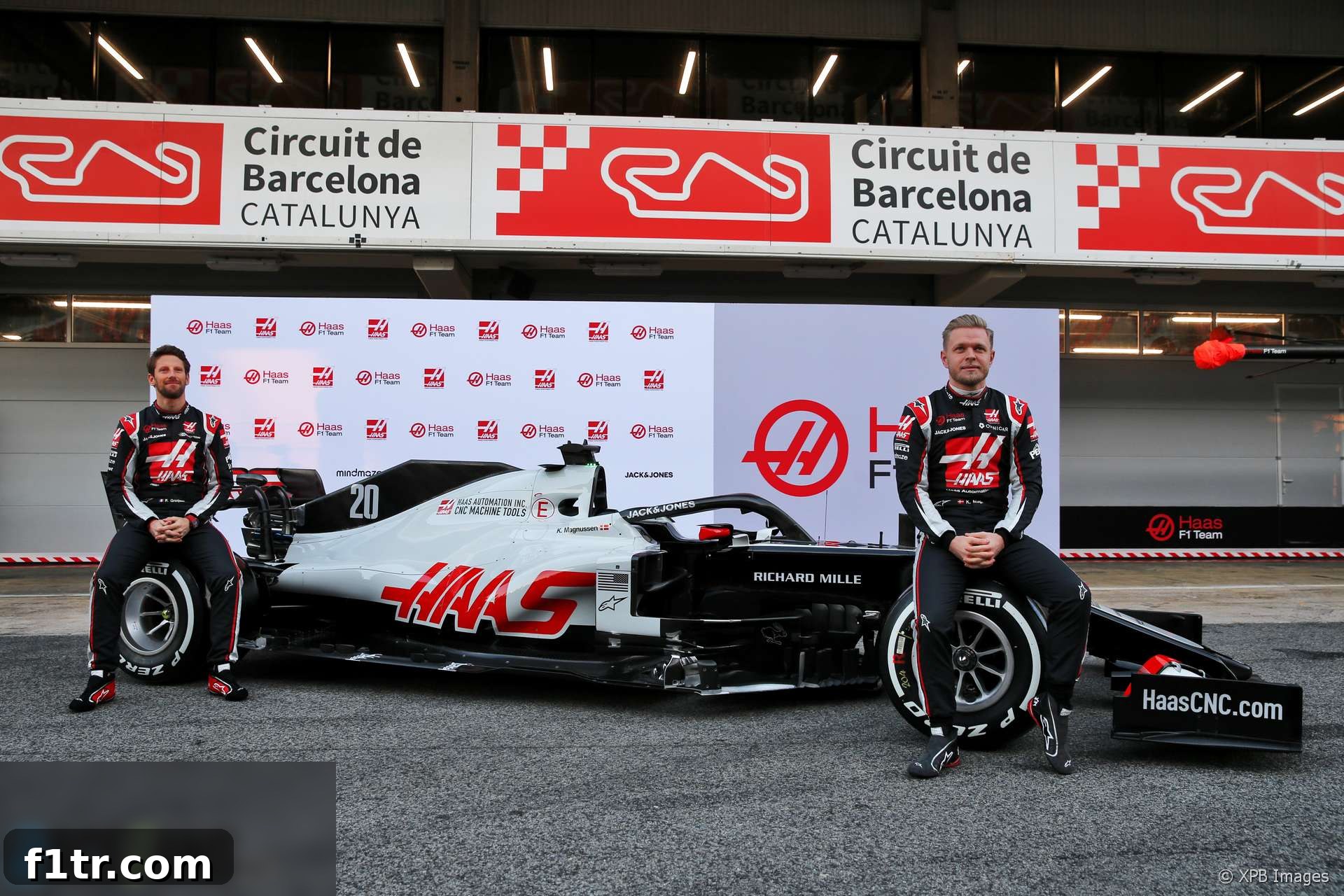
The highly anticipated 2020 F1 season officially kicked off its preliminary activities with the unveiling of the Haas F1 Team’s new challenger, the VF-20. The grand presentation took place at the renowned Circuit de Catalunya in Barcelona, setting the stage for what promises to be a pivotal year for the American racing squad. This launch event was more than just a reveal of new machinery; it symbolized a fresh start and a determined push for improvement following a demanding previous season.
Haas VF-20 Debut: A United Front in Barcelona
The atmosphere at the Circuit de Catalunya was charged with optimism as the Haas F1 Team presented its latest creation. The launch was graced by the presence of key figures instrumental to the team’s operations and ambition. Team owner Gene Haas himself attended, underscoring his deep-seated commitment to the Formula 1 project. Beside him stood the pragmatic and outspoken Team Principal, Guenther Steiner, whose leadership is often seen as the backbone of the independent team. Completing the lineup were the experienced driving duo: Romain Grosjean, known for his speed and analytical feedback, and the fiercely competitive Kevin Magnussen. Their collective presence radiated a sense of unity and purpose, signaling a team ready to confront the arduous challenges of a new Formula 1 campaign.
Days before its official unveiling, the VF-20 had already completed its inaugural shakedown run on the very tarmac of the Spanish circuit. These initial laps are crucial for performing vital system checks, ensuring all mechanical and electronic components function as intended, and gathering foundational data. The brief shakedown serves as a preliminary health check for the car before it embarks on the more rigorous schedule of pre-season testing. Indeed, the serious work began almost immediately after the launch ceremony, with the first day of pre-season testing commencing later on the same day. This intensive period provides teams with their most significant opportunity to understand their new cars, fine-tune their setups, and begin the iterative process of development before the racing season officially begins.
Ambitious Rebound: Overcoming the 2019 Season’s Setbacks
The Haas F1 Team approaches the 2020 F1 season with a resolute mission: to emphatically bounce back from a profoundly challenging 2019. The previous year saw a significant downturn in their fortunes, with the team sliding four positions to finish a disappointing ninth in the Constructors’ Championship. This fall from grace was particularly frustrating for a team that had shown flashes of strong performance in earlier seasons. The primary culprit for their struggles was an elusive understanding of their car’s performance, particularly regarding tire utilization and aerodynamic correlation. Issues that surfaced early in the season, such as the car’s inconsistent behavior with Pirelli tires and discrepancies between simulation data and real-world track performance, continued to plague their efforts throughout the year, hindering their ability to extract consistent pace and develop effectively.
Guenther Steiner, ever forthright in his assessment, articulated the team’s collective desire for a fresh start. “Obviously, after a season like 2019, it’s good to get going again with a fresh start,” he conveyed, capturing the renewed spirit within the garage. Steiner further elaborated on the proactive measures taken to address their weaknesses: “We realised last year, in the middle of the season, that we needed to do something different for 2020, and we did. We’ve just tried to apply into the new car some of the things we learned at the end of the season when we had development parts on the car.” This statement highlights the intricate and continuous nature of Formula 1 car development. Even as the 2019 season unfolded, Haas was already analyzing its shortcomings and integrating valuable insights gleaned from late-season experimental components directly into the design philosophy of the VF-20, aiming for a car that is fundamentally better understood and more predictable.
Strategic Evolution: Enhanced Data Analysis and Driver Feedback
The strategic shift within the Haas F1 Team extends beyond mere technical adjustments; it encompasses a fundamental re-evaluation of their operational processes. The stark contrast between their promising start to 2019 pre-season testing and the dramatic decline in performance throughout the year served as a powerful, albeit painful, lesson. This “going south” experience, as Steiner colorfully described it, underscored the critical need for a more robust and reliable methodology in data interpretation and car development. “Last year we had a good test, and the early races were good – then it went south,” Steiner reflected, emphasizing the determination to avoid such a recurrence.
According to Steiner, the core of their revised strategy hinges on two crucial pillars: superior data analysis and a more profound engagement with their drivers. “What we’ve learned is how to look at things better, and how to analyse our data better to see if we’re on the right track or if we’re headed in the wrong direction. We learned as well to listen to our drivers, that sometimes helps a lot.” In the high-stakes, data-driven environment of Formula 1, the nuanced feedback from experienced drivers like Romain Grosjean and Kevin Magnussen is an invaluable asset. Their ability to articulate the car’s behavior and identify subtle handling characteristics can often bridge the gap between theoretical models and real-world performance. By fostering a closer synergy between engineers and drivers, and by refining their data correlation tools, Haas aims to establish a clearer, more effective development pathway for the VF-20, minimizing the risk of pursuing counterproductive upgrades and ensuring a more consistent competitive edge.
Circuit de Catalunya: The Crucial Proving Ground for the VF-20
The choice of Circuit de Catalunya for both the launch and pre-season testing is no coincidence. This Spanish track is celebrated for its demanding layout, featuring a diverse range of corners from slow hairpins to high-speed sweeps, along with challenging elevation changes. This makes it an ideal venue for comprehensively evaluating a Formula 1 car’s aerodynamic efficiency, mechanical grip, tire management, and overall balance. For the Haas F1 Team, the testing sessions are more critical than ever, serving as the ultimate proving ground for their renewed philosophy and the VF-20’s design integrity.
During these intensive days, the team’s objective extends beyond merely setting fast lap times. The primary focus is on meticulously logging hundreds of laps to ensure reliability, understanding how the car interacts with different Pirelli tire compounds across varying fuel loads, and verifying the efficacy of new components. The goal is to avoid the misleading optimism of 2019, when strong test performances failed to translate into race-day consistency. Both Romain Grosjean and Kevin Magnussen will be working hand-in-hand with their engineering teams, providing vital real-time feedback on every aspect of the VF-20’s behavior. Their detailed insights on handling, braking, power delivery, and aerodynamic stability will be crucial in fine-tuning the car’s setup and guiding its development trajectory throughout the season. A clear, unified direction established during these testing days at Circuit de Catalunya will be paramount to Haas’s ambition of a more successful and consistent 2020 F1 season.
Pictures: 2020 Haas VF-20 F1 Car Debut
The Road Ahead: Ambition and Consistency for Haas in 2020
As the 2020 F1 season rapidly approaches, the Haas F1 Team stands at a critical juncture. The VF-20 represents more than just a new car; it embodies the team’s relentless pursuit of redemption and its unwavering commitment to learning and evolving. The ambitions are clear: to significantly improve upon their 2019 performance, establish greater consistency in their results, and challenge for points on a more regular basis. With a revitalized approach to data analysis, a deeper emphasis on incorporating driver feedback, and the invaluable experience gained from past seasons, Haas aims to demonstrate that its strategic adjustments will yield tangible, positive results on track.
The journey for Haas in 2020 will undoubtedly be challenging, competing against well-established and significantly more resourced rivals. However, the confidence exuded by Gene Haas, Guenther Steiner, Romain Grosjean, and Kevin Magnussen during the VF-20 launch signals a determined collective. The successful integration of their learned lessons from 2019 and a focused, diligent effort during pre-season testing could very well set the stage for a much stronger, more competitive season for the American F1 team, re-establishing their presence in the highly contested midfield and proving their enduring commitment to Formula 1 success.
Related Articles: 2020 F1 Season & Haas F1 Team
- Grosjean to make F1 test return tomorrow for first time since Bahrain horror crash
- Pictures: Wrecked chassis from Grosjean’s Bahrain fireball crash to go on display
- Bottas vs Rosberg: Hamilton’s Mercedes team mates compared after 78 races each
- F1 revenues fell by $877 million in Covid-struck 2020 season
- Hamilton and Mercedes finally announce new deal for 2021 season
Browse all 2020 F1 season articles